Experimental production of stone tools

Category: Thoughts (Page 3 of 3)

The process is the thing

Thanks to Alice la Porta we now have the best part of a tonne of flint nodules in the Teaching Lab. Thank you Alice! Earlier this afternoon I went to a talk by Julian Thomas about excavations at the early Neolithic site of Dorstone Hill in Herefordshire. Of particular interest was the pattern of rock crystal deposition. Whilst flint was found across the site, rock crystal was almost exclusively associated with cremated remains.

And whilst present in the form of very small pieces of debitage, no rock crystal tools were recovered, and the small size of the debitage suggests none were produced. The process of reduction seems to have been the thing. This is in stark contrast to the typological focus of modern archaeology discussed in Grace’s previous post.

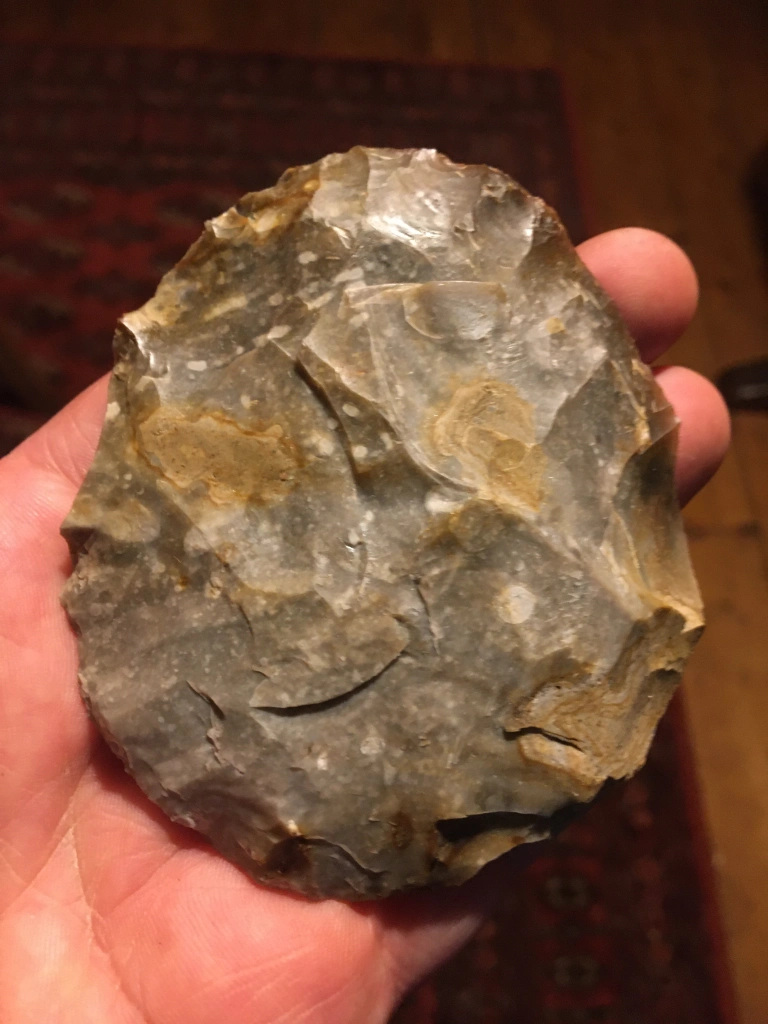
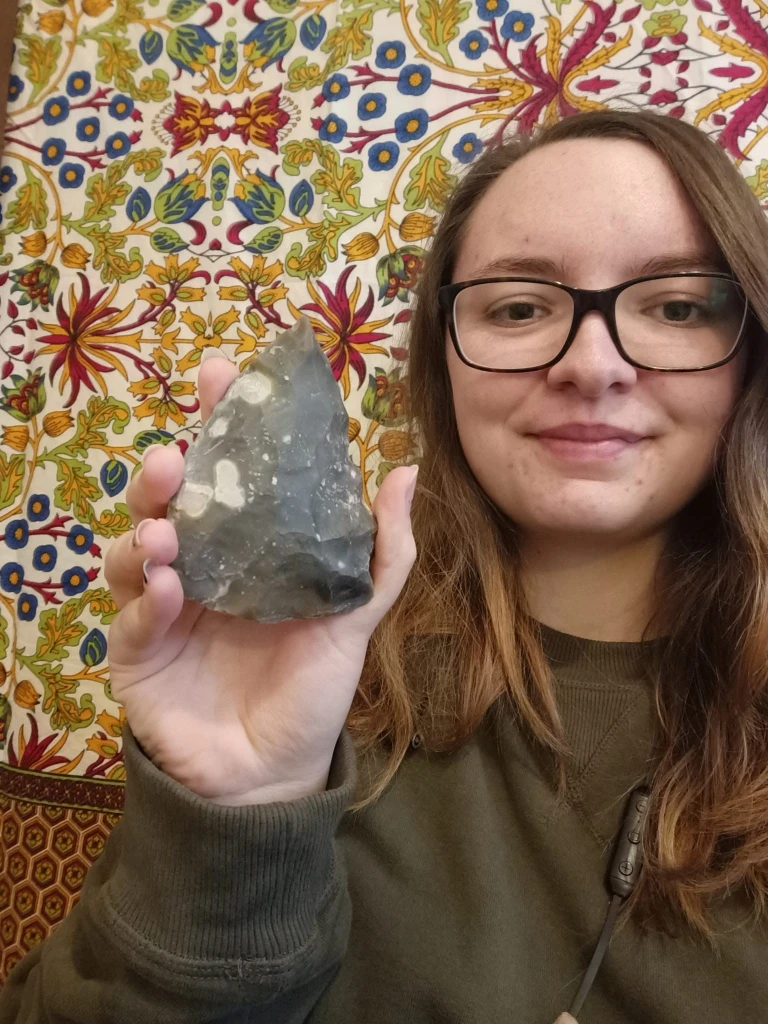
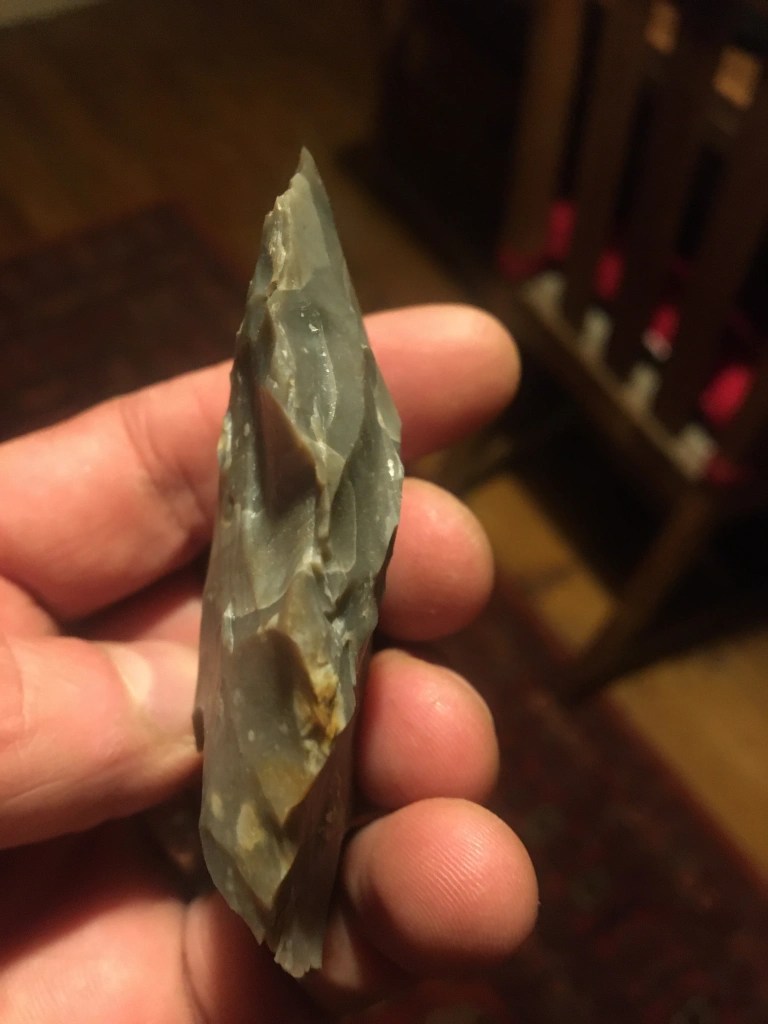
Anyway, at about 5.30pm I found myself in the lab with a large hammer stone reducing a large nodule into manageable flakes. I have posted some pics of one of the handaxes made, but to reiterate, the process is the thing. I like the handaxe but I stole the 50 minutes or so of the day when I could be alone in the lab making something. Why is this process so precious?

Laura’s handaxe workshop report

Handaxe, Workshop

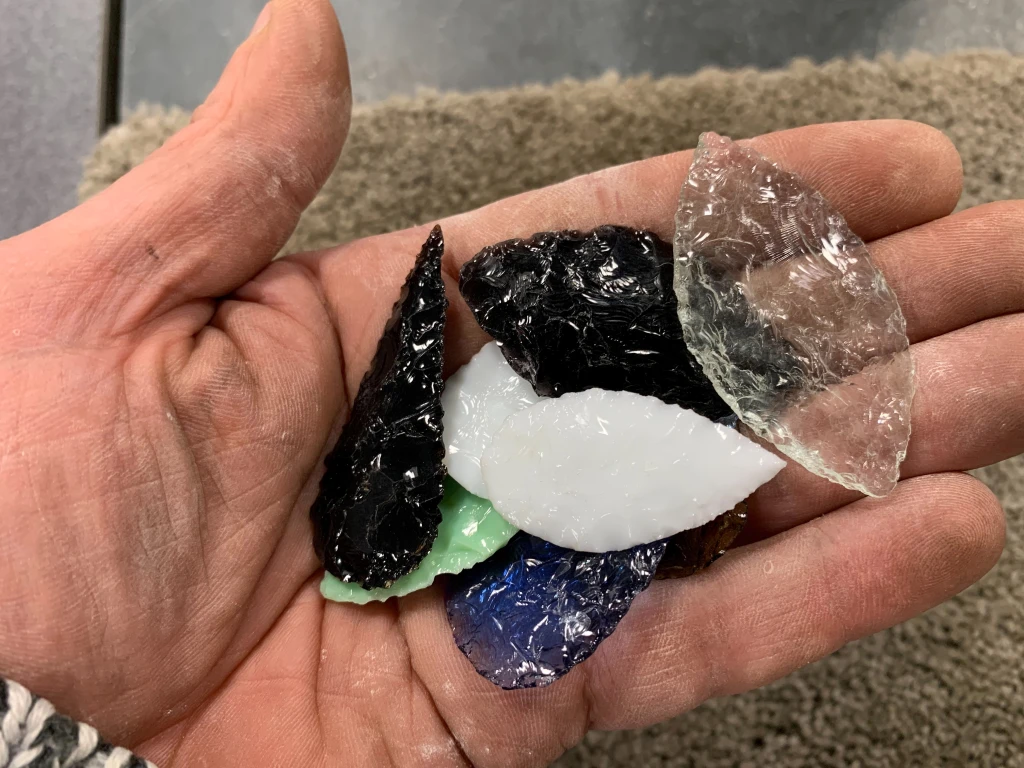
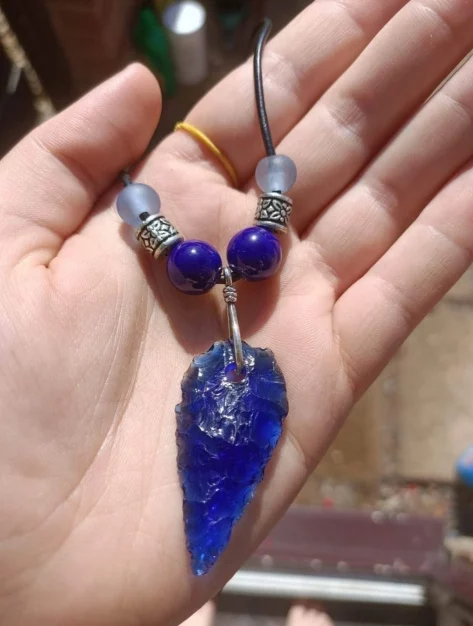
Flint working was an entirely new experience for me but getting to approach the material in a group environment made it a far less daunting task. I have knapped before, but only with glass bottles – easy to acquire as a student and much cheaper than flint! Glass behaves itself generally and you can predict where and when it will facture (mostly) making it a great starting material for knappers. I have no right to claim any decent knowledge of knapping or the skills that come with it, but I have managed, after many (many!) breakages, to form a neat little collection of glass arrowheads for myself.

I felt somewhat confident going into the flint knapping workshop John was hosting. I had seen the flint before, but I had never worked with it. We were given a detailed run through of how the flint reacts and how we should react to the flint, thinking of it as working together rather than just working on a material. Alice la Porta showd a video of a professional American knapper who created a beautiful flint axehead in just 25 strikes – a rather impressive and somewhat intimidating display of skill.

We started trying to make our own scrappers after a demonstration from John, and it’s fair to say mine did not turn out so well. I began with a decent palm-sized piece of flint which ended up about the size of my thumb with no real clear edge that could be used as a scraper. I tried again and again with flint flakes I found on the floor (I didn’t want to waste any good bits with my terrible practice blows) but didn’t have much luck. Flint was far harder to work with than I had anticipated and certainly much harder to knap than glass. I spent a good hour or so working on scraps trying to make a scraper before we moved onto looking at handaxes. Oddly, working towards a handaxe with the flint was much easier for me – I could visualise what I wanted a lot better and working with a larger piece of flint made me much more confident in my hits with the soft and hard hammers. Perhaps it was because I was used to working towards a similar goal that I set myself when making glass arrowheads, getting full surface removal of cortex and shaping the material, that I found making the flint handaxe easier to understand. This does not mean, however, that I had any clue what I was truly doing and was solely relying on the flint to help me and suggest areas to work on next. I did, in the end, leave with a beautiful handaxe I am very proud of (after some help from John).

What I took away from this experience was that knapping does not have to be a lone effort. Beginner knappers, such as myself, need help and guidance from the more experienced, and even other beginners who might be catching on to some of the tricks faster. Though it is a personal creation does not mean a community effort cannot go into its manufacturing. I personally believe the experience would not have been as enjoyable had I been left alone in a room with an instructional video to watch and learn from. People help people when it comes to these kinds of workshops, whether that’s the teacher or other learners, community is an important part of the learning and creation process.

It took a long time for me to get used to working with the characteristics of flint as I was so used to glass. I had to relearn a lot of what I knew about knapping, but it was an eye-opening experience as it just goes to show how skills can always be developed and adapted to new (and more difficult) materials. This workshop was an excellent chance for me to make something I could be proud of, but also learn through others: there was such a variety of people at the workshop, professors, other students, commercial archaeologists, and we all had different ways of approaching the task. Getting to watch others learn and practice is, for me, one of the best ways to develop new skills and enjoying doing so.

The performance of control

We had an excellent handaxe making workshop in the labs yesterday, and I will do a separate post about it when I get some feedback from participants. This post is about one small part of the session. Before the handaxe making started in earnest we watched a ten minute video of an American knapper produce a large handaxe from a flat tablet of Texas chert.

The American knapper was highly skilled and produced a long symmetrical handaxe within something like 25 removals. Impressive. However, I lost interest early on. We had looked at the handaxes in the teaching collection and these real examples were much less refined. In our session we were also using knobbly flint nodules from Norfolk with fossils, holes and differential texture throughout.

The video was a performance of control by a highly skilled knapper using high quality material of an optimum shape and size. The factors being controlled, size, shape, material quality, were exactly those we were negotiating. To me the video was a sales pitch to archaeologists looking for machine like knappers to take part in ‘scientific’ experiments.

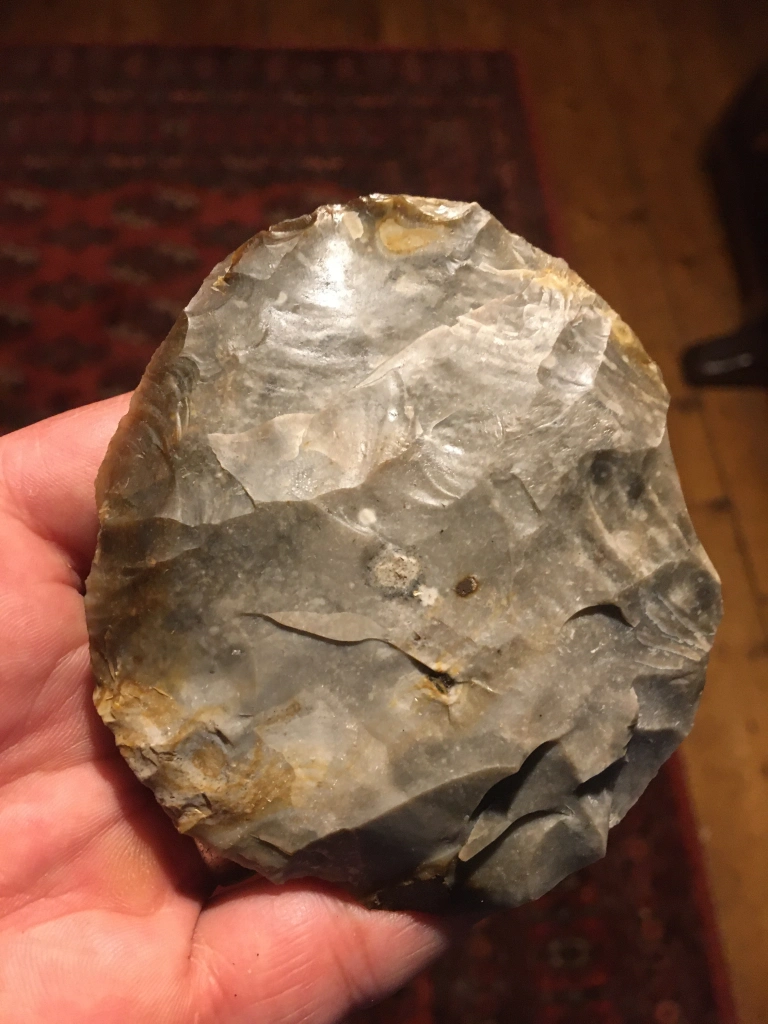
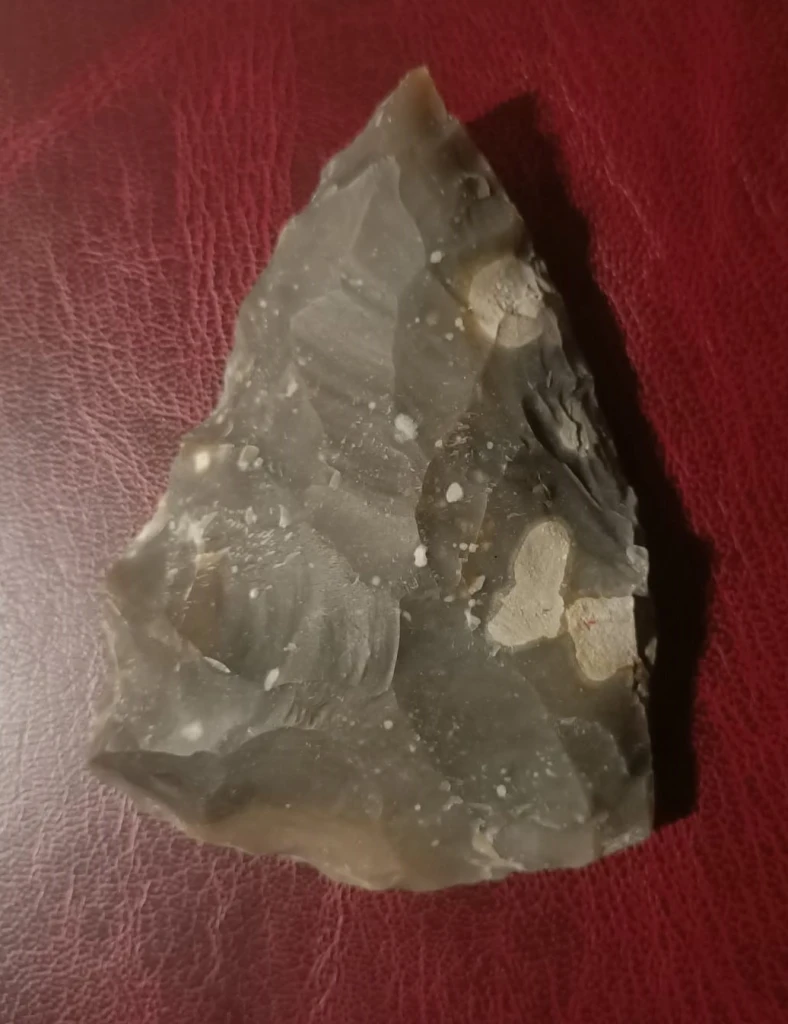
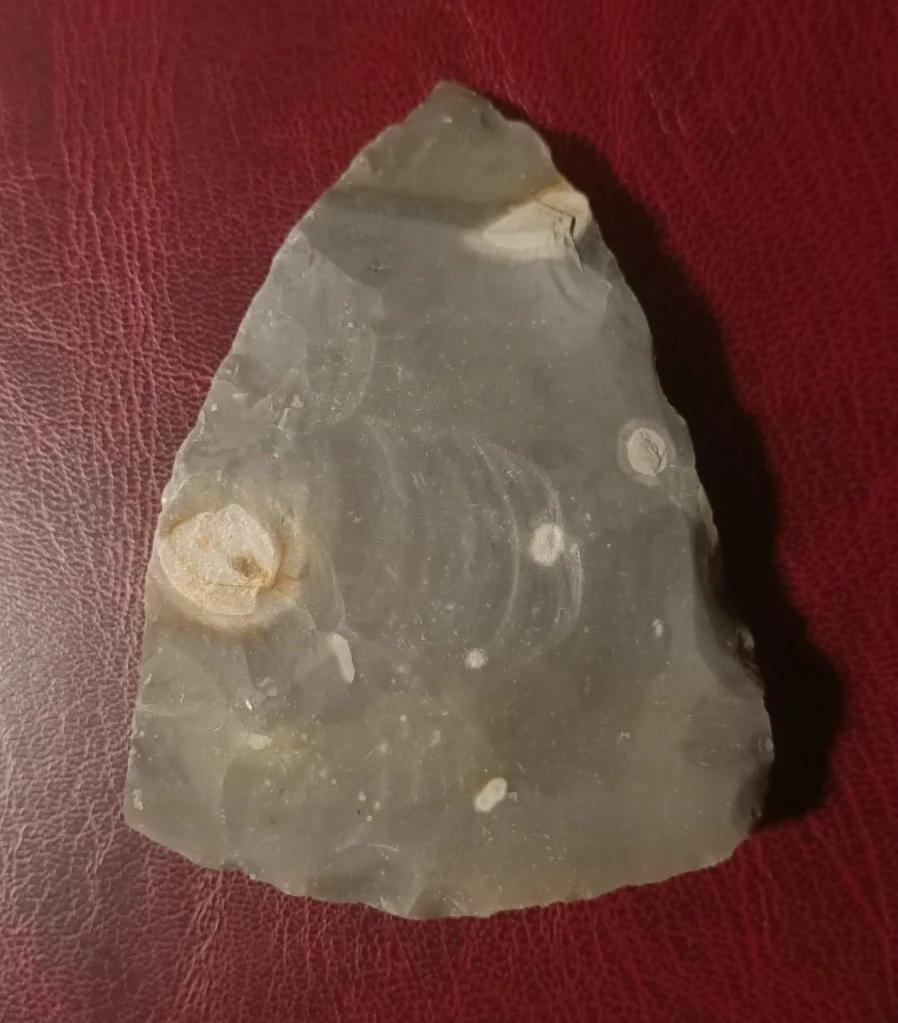
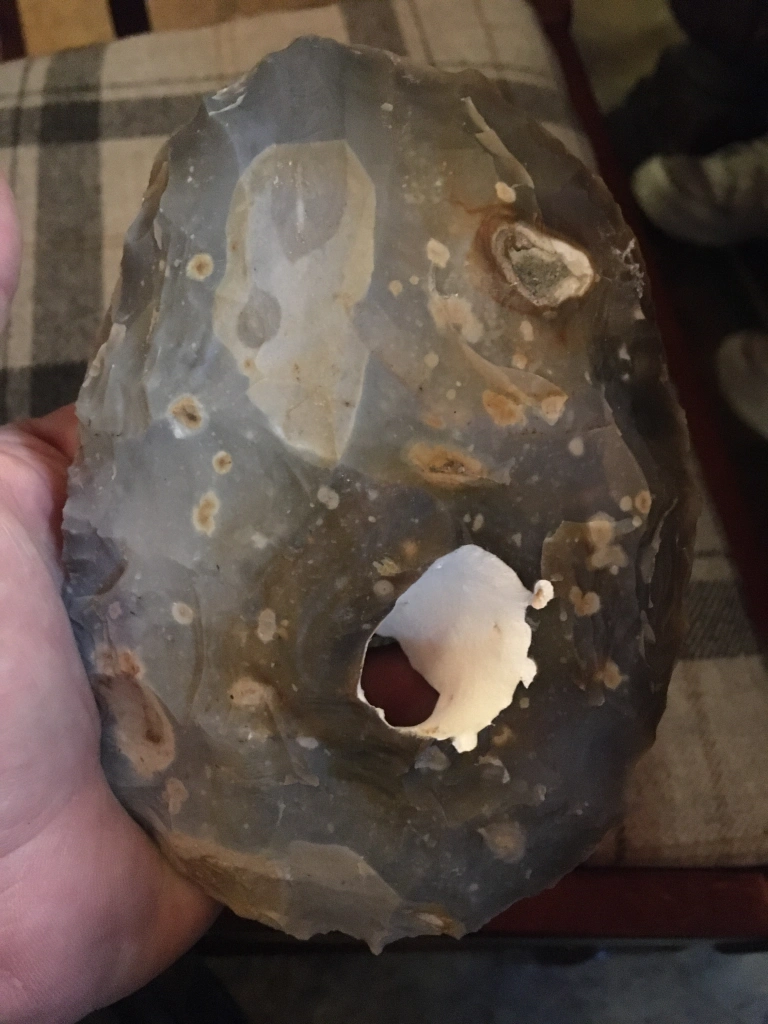
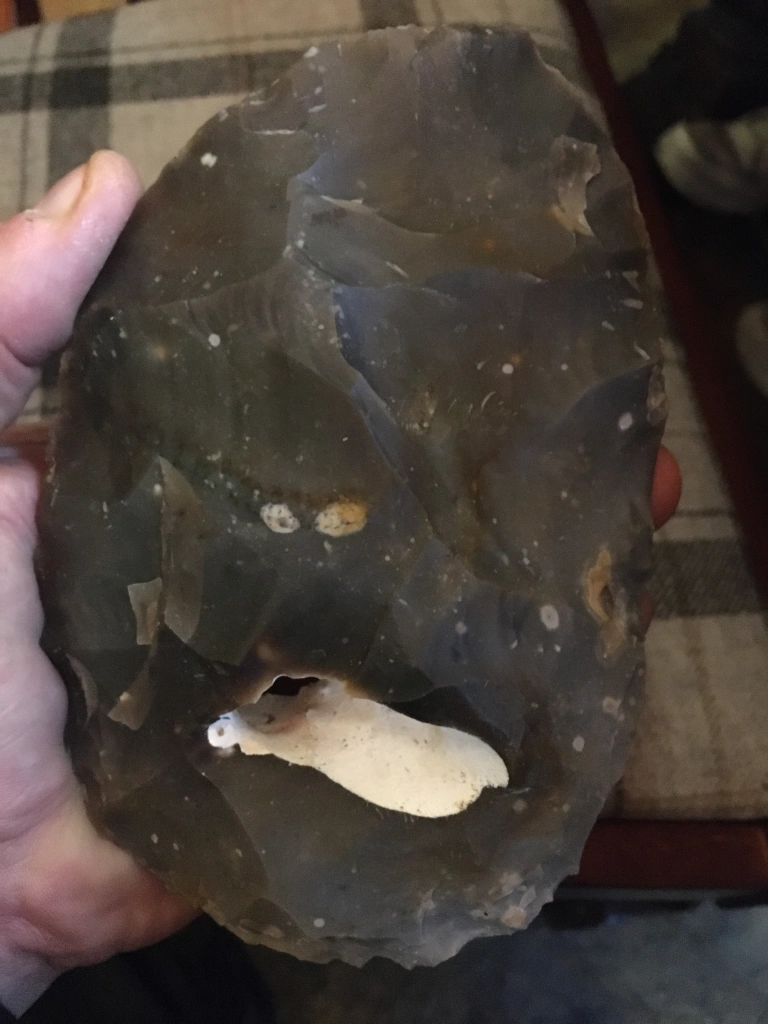
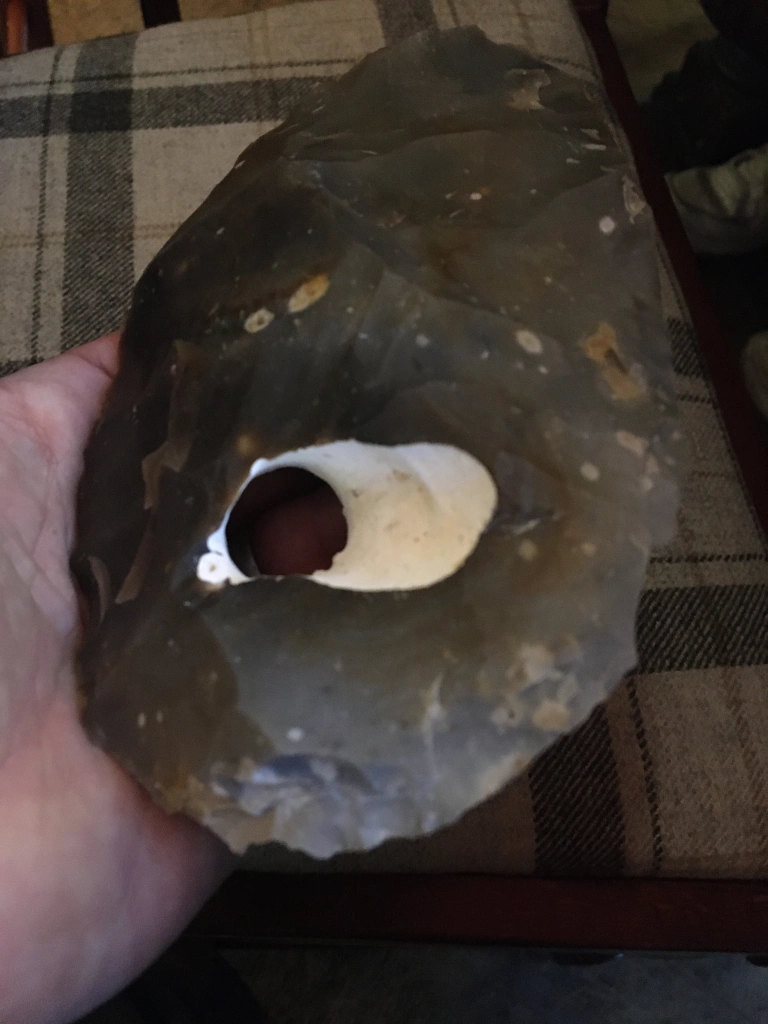
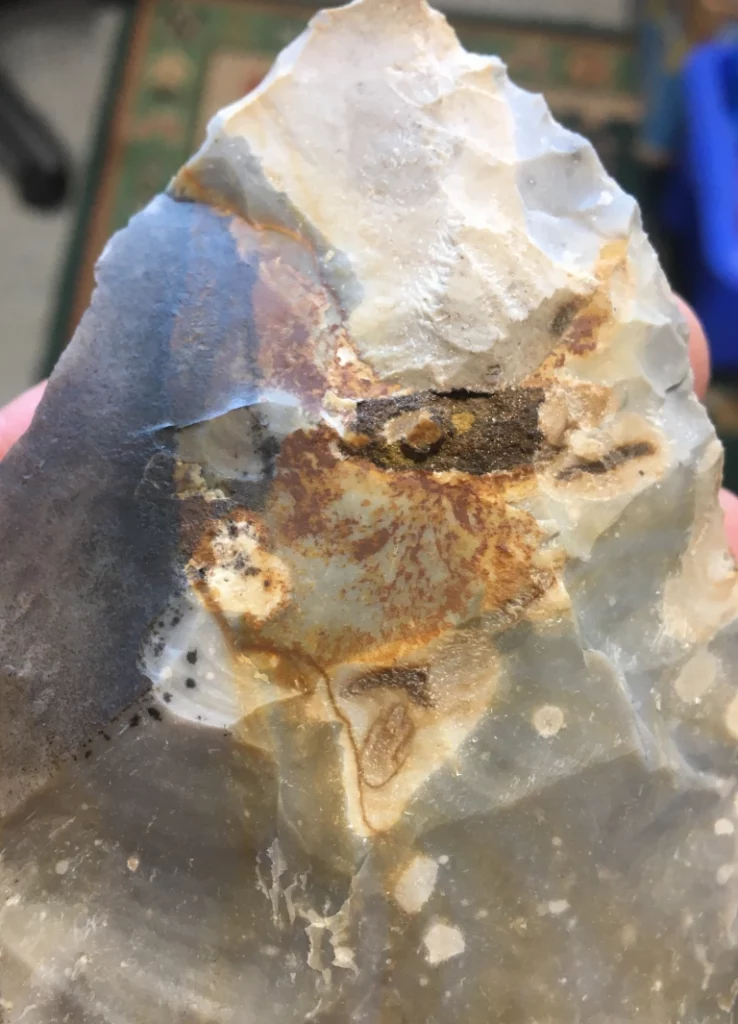
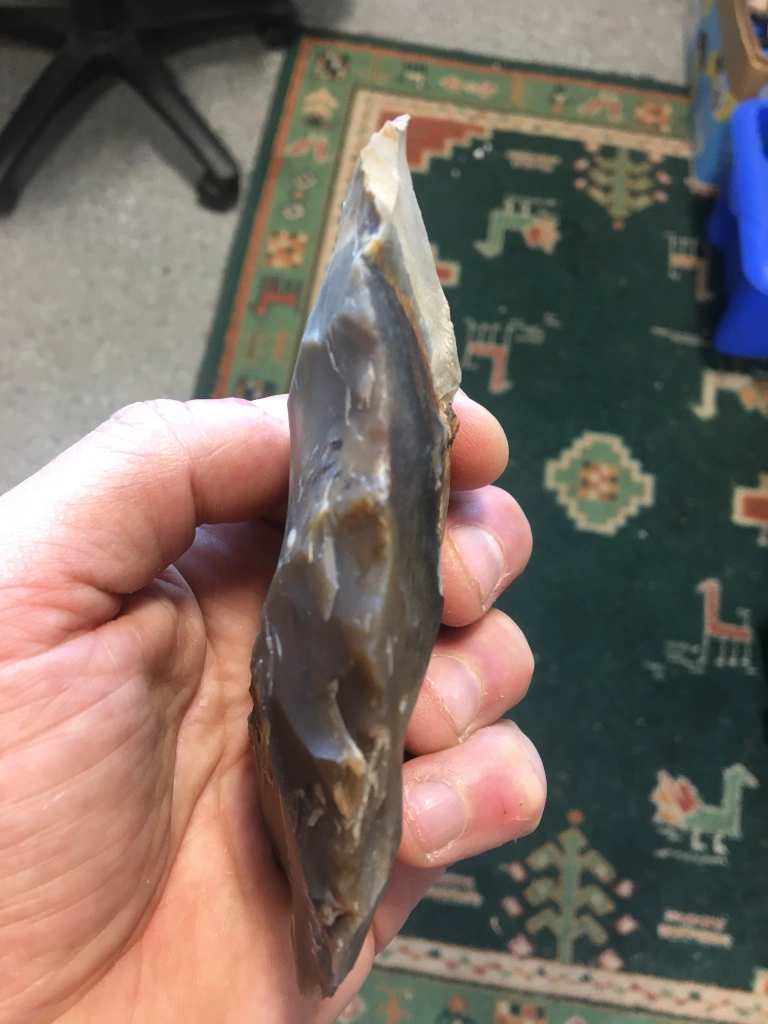
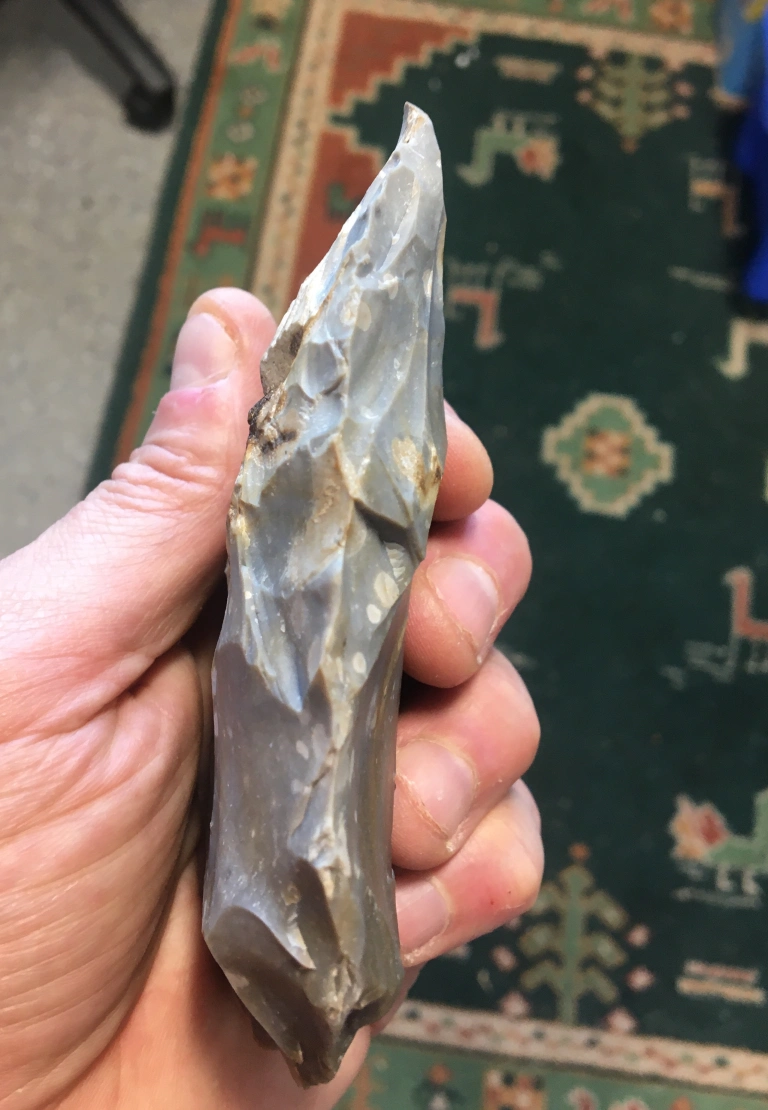
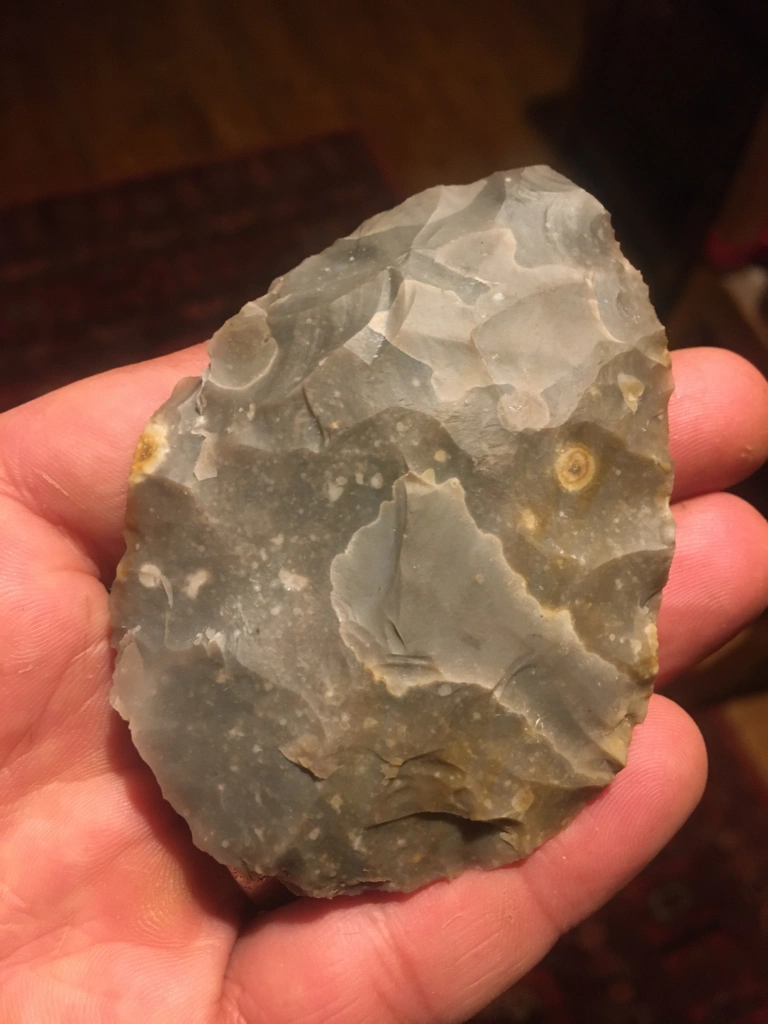
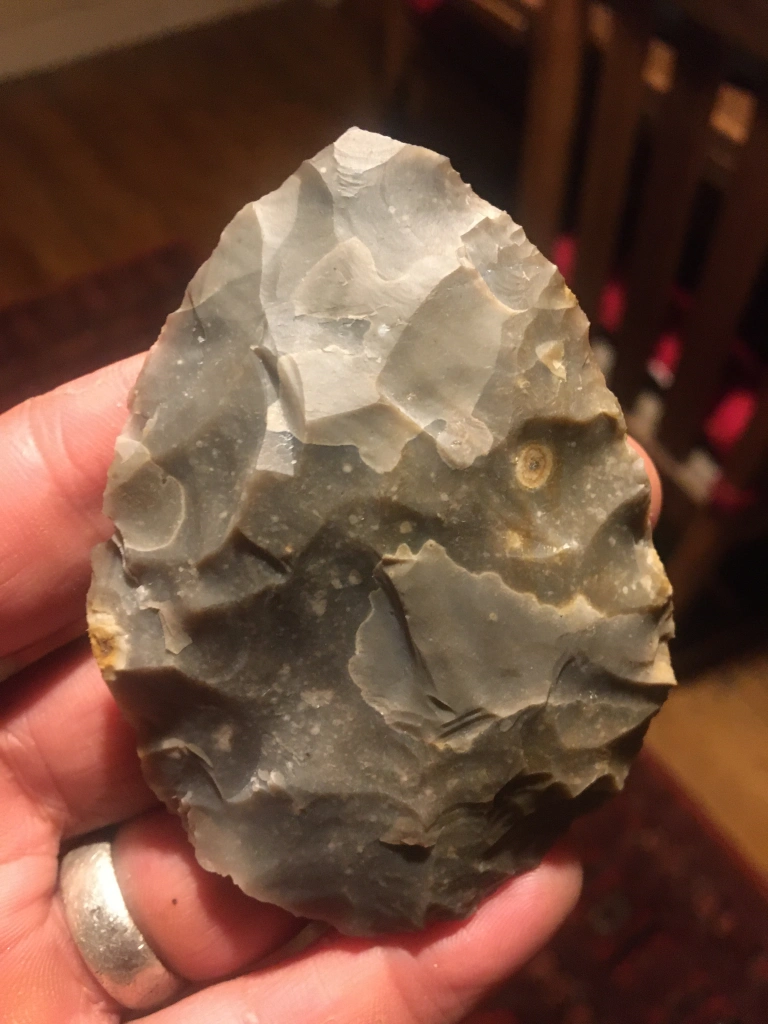
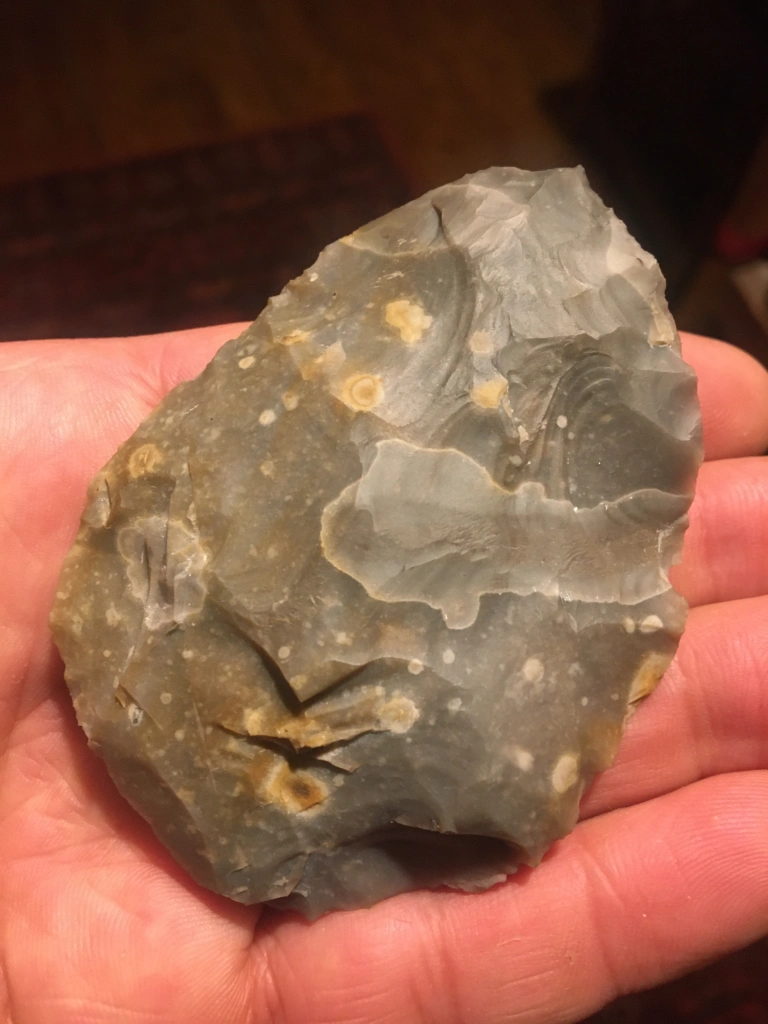
However, our exploratory negotiations with less than ideal materials resulted in artefacts much closer to the examples in the teaching collection. The handaxe in the photos was made before the workshop from a large flake with a big hole, small fossil, and course grained sections. My perspective is perhaps related to a current obsession with this brilliant track by the band James, describing the messiness of life and how we engage, make mistakes, change tack, and that we are ultimately, just getting away with it.

Whilst I felt the American knapper’s video was a performance of control, our knapping session was more like the performance of being human, and I loved it.

Work to do? Make a handaxe

I have a number of projects on the go, all of which need people and dates to coincide. I find this kind of scheduling activity stressful at the best of times, and I have three immediate ones to deal with and a lecture to produce.

So after doing a significant chunk of lecture producing I treated myself to some time in the lab. This was a big flake and I reduced it down systematically. I need some new hammer stones and antler hammers as all of mine are worn.

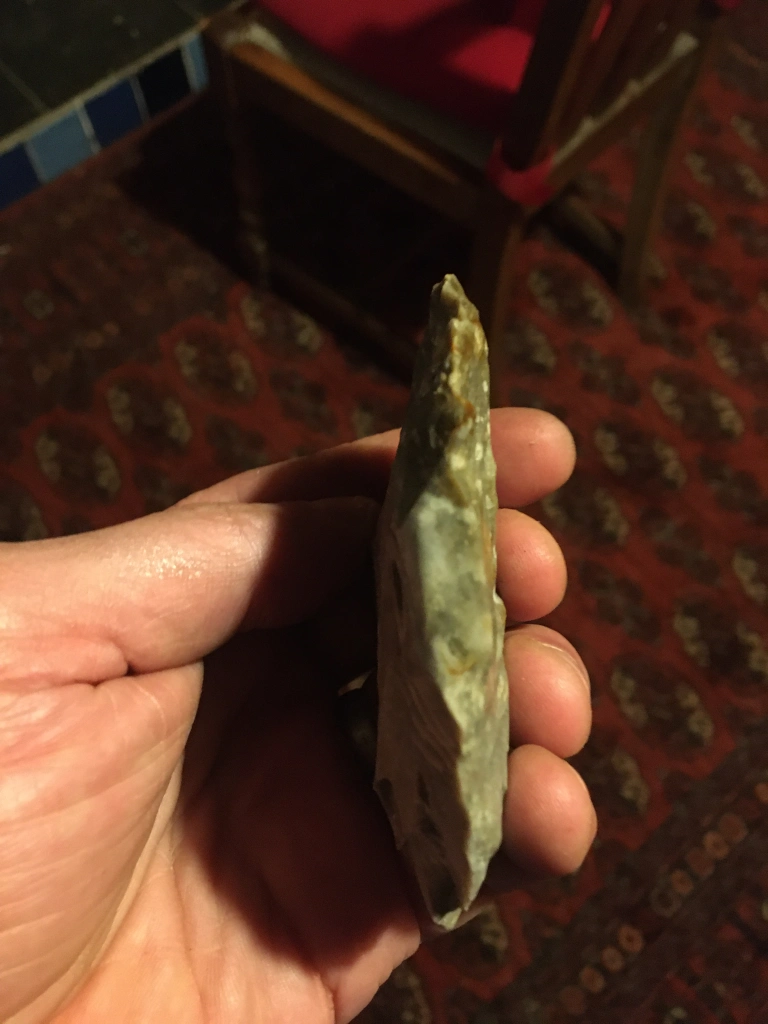
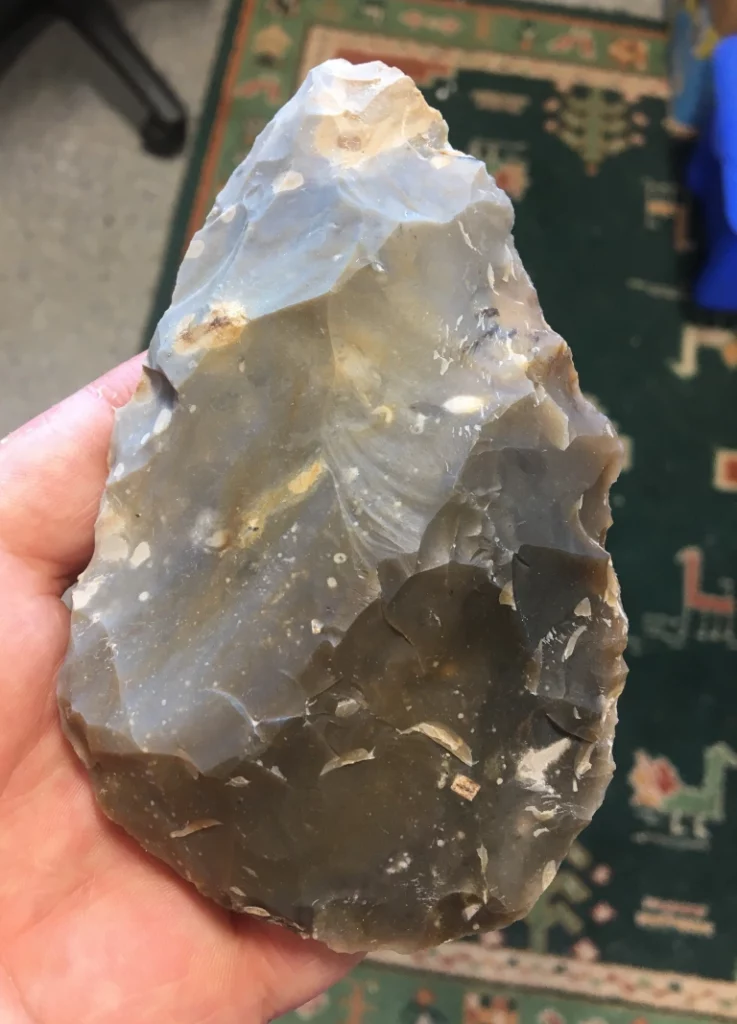
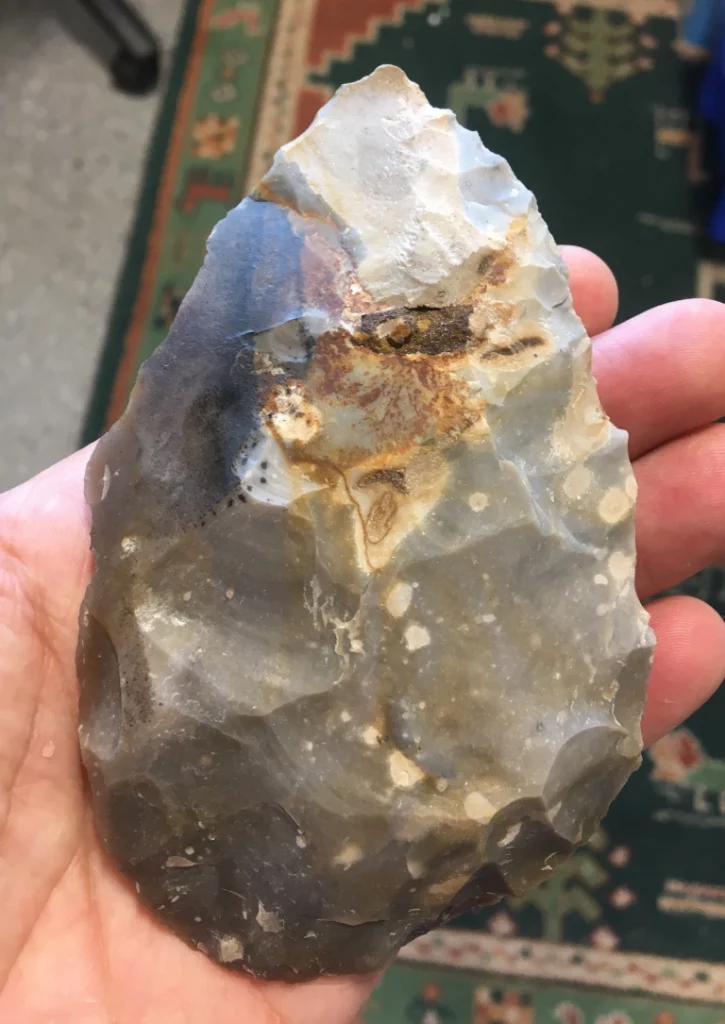
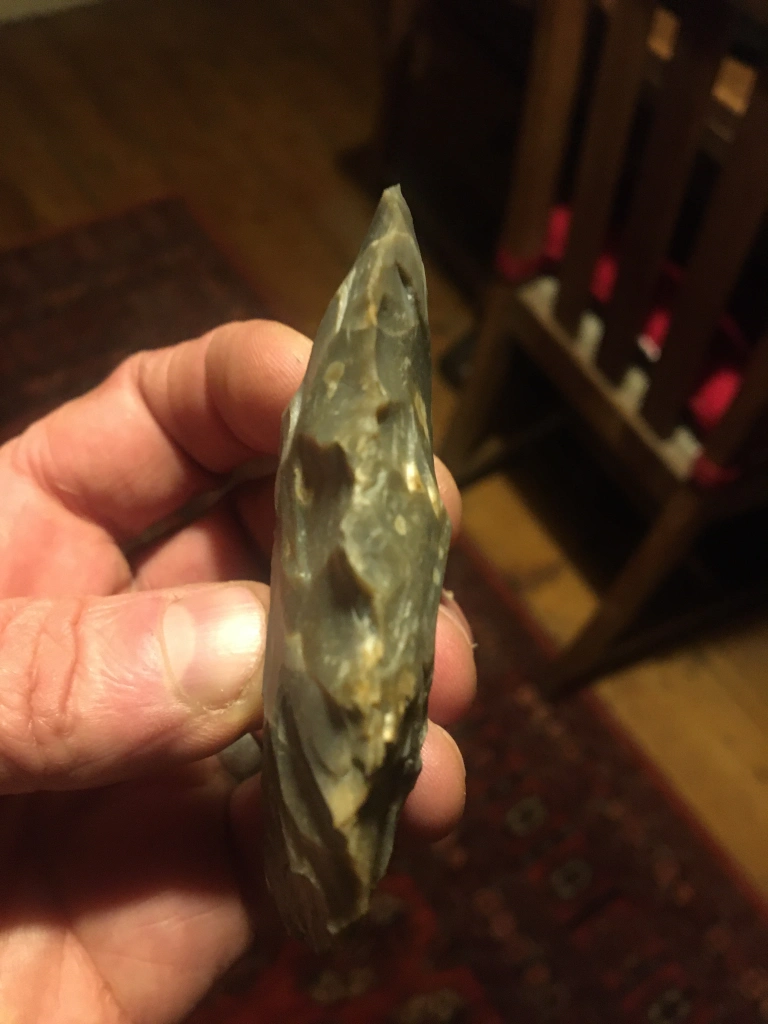
The handaxe is asymmetrical, but in a way I can live with. The edges are all sharp, but best of all, it is a double A side. Both faces are equally interesting. The first picture shows two good thinning flakes meeting in the middle, and coincidently delineating a colour and flint consistency change.

The other face has this interesting fossil in it. I didn’t plan it like that but the texture of the flint around the fossil made me work around it and so it was a negotiated settlement. The rust colour is usually where water has penetrated the flint through flaws in the nodule.

Hammer stone and worn antler problems made me realise how I normally unconsciously choose the right tool for the job at hand. I struggled a bit trying to use a stone that was too large but unworn. This made me think about handaxe reduction.

This handaxe is…hand size! perhaps a lot of the handaxe reduction process was to transform an already useful flake into a good fit with the hand. None of the above handaxe characteristics were planned above and beyond thinking about bifacial reduction. And on that note, back to scheduling 😐

Stone cold boiler

This story has two main characters. The above small handaxe is one, made in the lab last week from an unpromising large flake. I actually really like it although it is asymmetrical, and the cutting edges on each side are both sharp but of different character. It is almost as if each side was made by a different artisan.

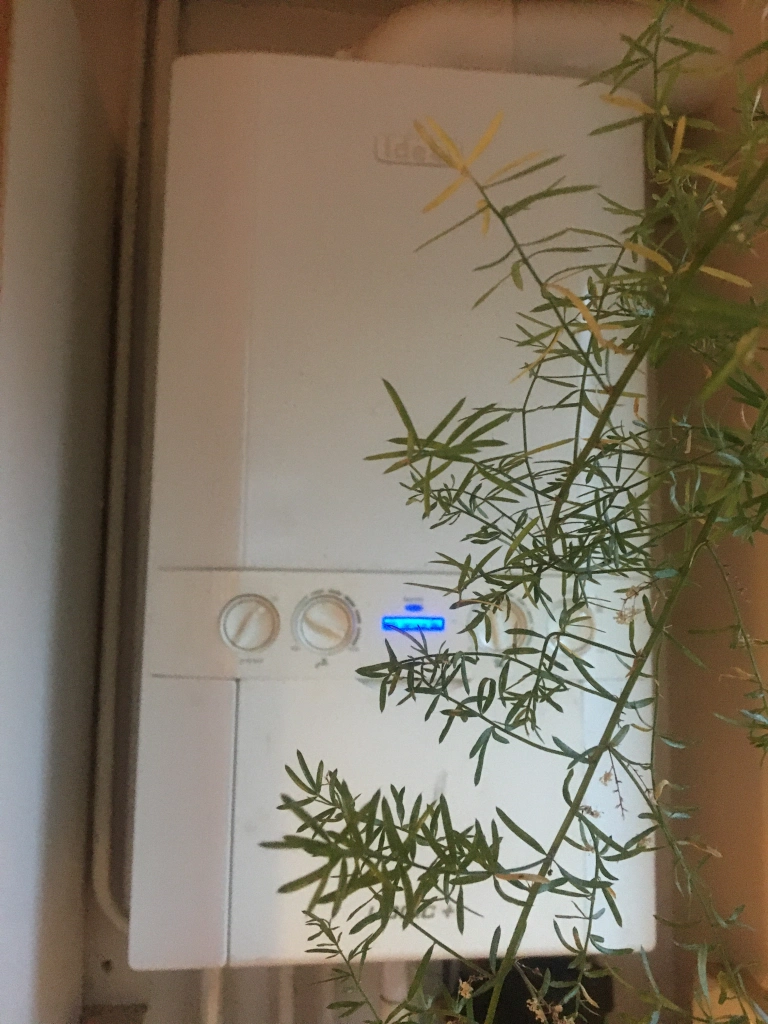
The second character in this story is our kaput combi-boiler. It stopped working last week and we have not been able to get an engineer out who could solve the problem yet. In Manchester currently it is below zero degrees most nights, so apart from the wood burner room the house is pretty cold all the time. The secret of good comedy is timing 😐.

Anyway, back to the handaxe. As usual I handle these things a lot after I have made them. In getting to know the artefact haptically it occurs to me what I may want to change, and ways in to making those changes.

Picking up the handaxe first thing yesterday morning I was struck by how cold it was to the touch. It seemed to have absorbed the coldness that had pervaded the house overnight, and through the past week. It was in fact ‘stone cold’, and that was my overriding and surprising response to the object.

I was experiencing a different and unrealised capacity of the object, however, as I continued to hold and handle it I could feel its ‘body temperature’ changing, blending with that of my hand which enclosed it, and harmonising with my body temperature in general.

It made me think about how the human hand creates a haptic relationship with the object, finding a way of holding that seems to fit. However, it also alerted me to the fact that the object also responds to the human touch by warming to the person.

Whilst I grasp the science behind an inert piece of stone absorbing heat from my body and changing temperature, I was surprised by the process and think in pre-Enlightenment periods this experience may have been understood and explained in different ways, perhaps in terms of an object becoming part of the human body.

It is also interesting to think about in terms of the occult skills necessary to use the handaxe in for example a butchery process. Would the tool and the process be separated as a noun and a verb?

This is the start of an idea, however, it is Saturday, Shakeel has possibly fixed the boiler and the house is warm. A story with a happy ending!

Newer posts >

© 2026 Learning Through Making. All Rights Reserved.

Up ▴