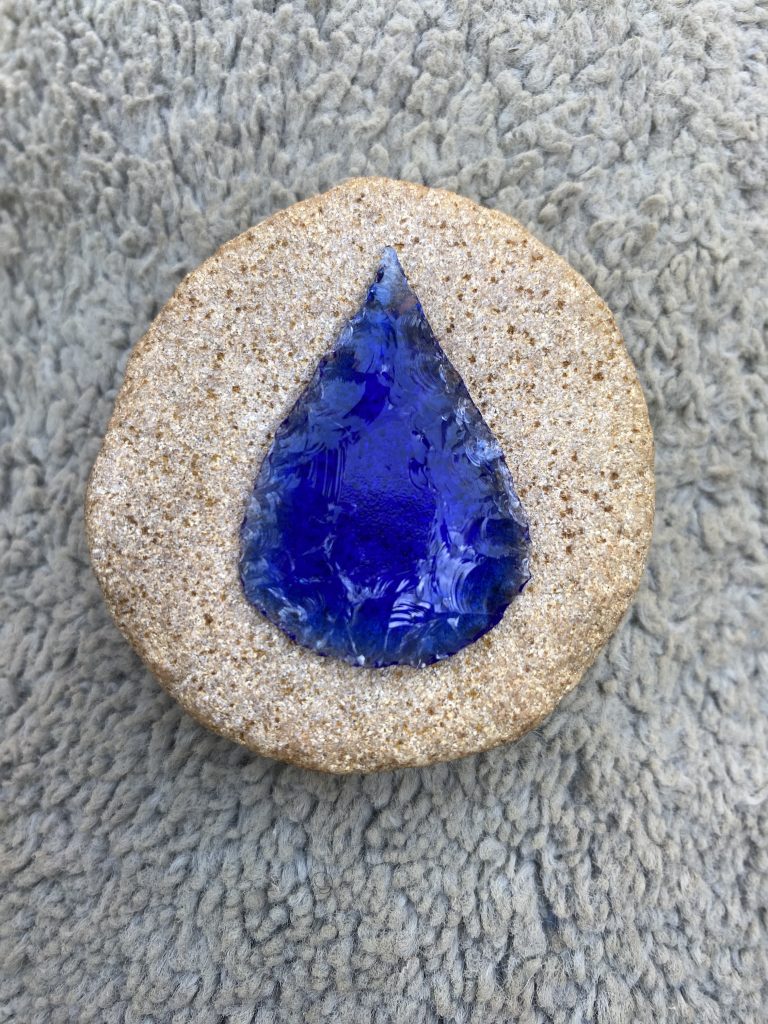
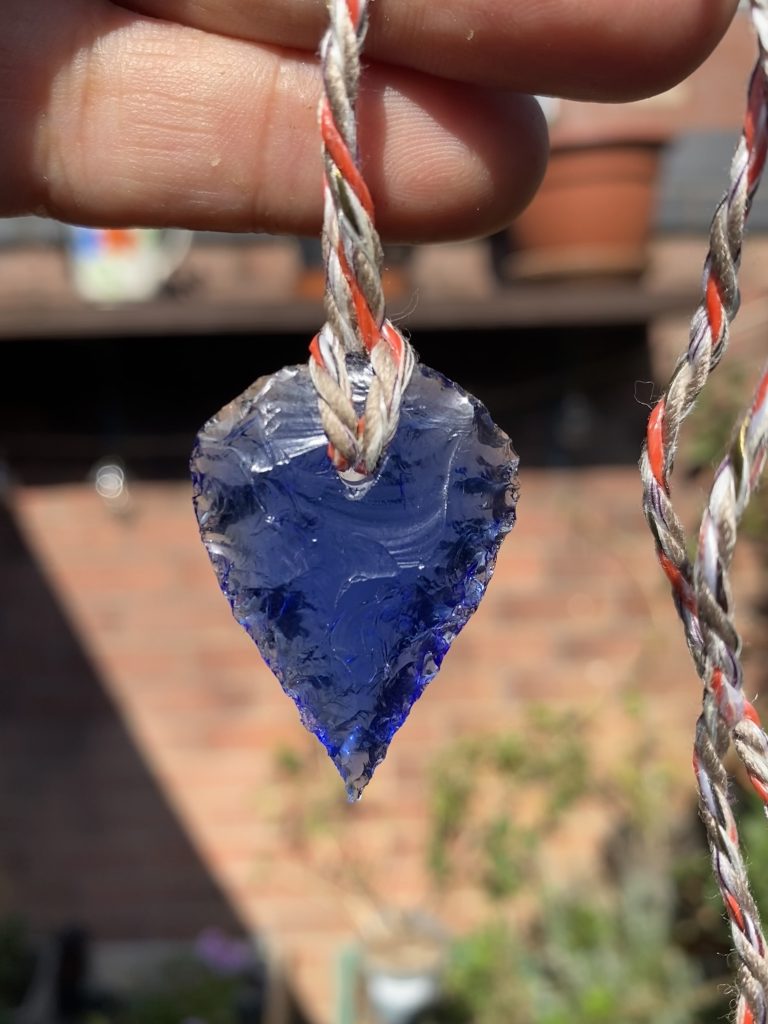
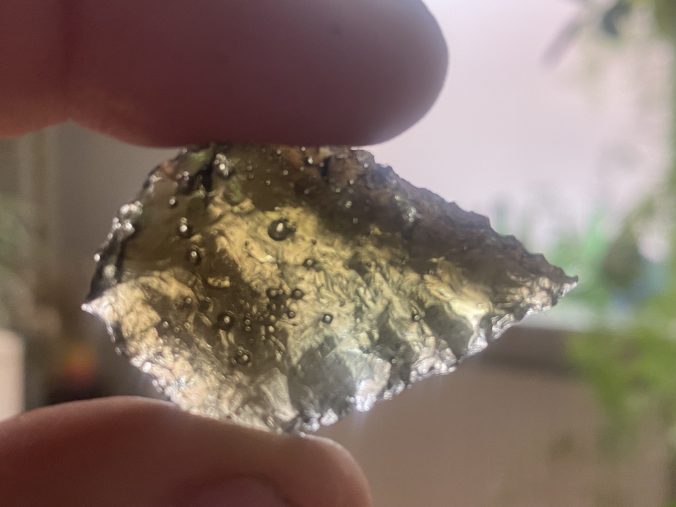
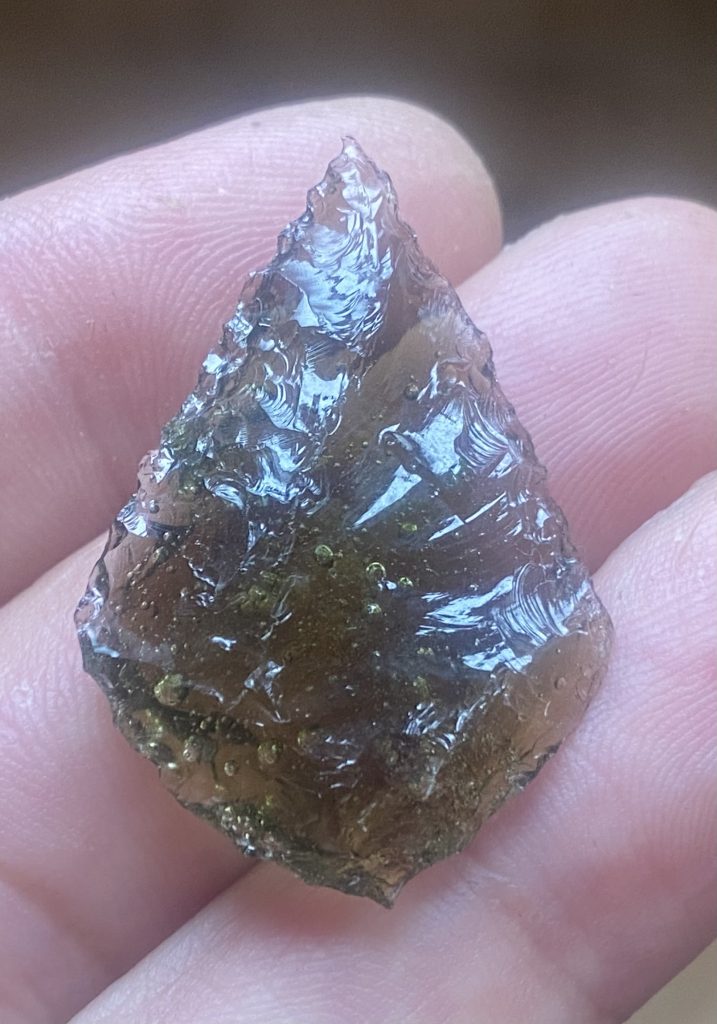
Experimental production of stone tools

Category: Materials (Page 1 of 4)

Size and Symmetry: I’ve made something I like (again)

I have been off work for two weeks over Easter, and although I have had some work stuff to do, I also have lots of Barmston Beach flint tablets to play with!

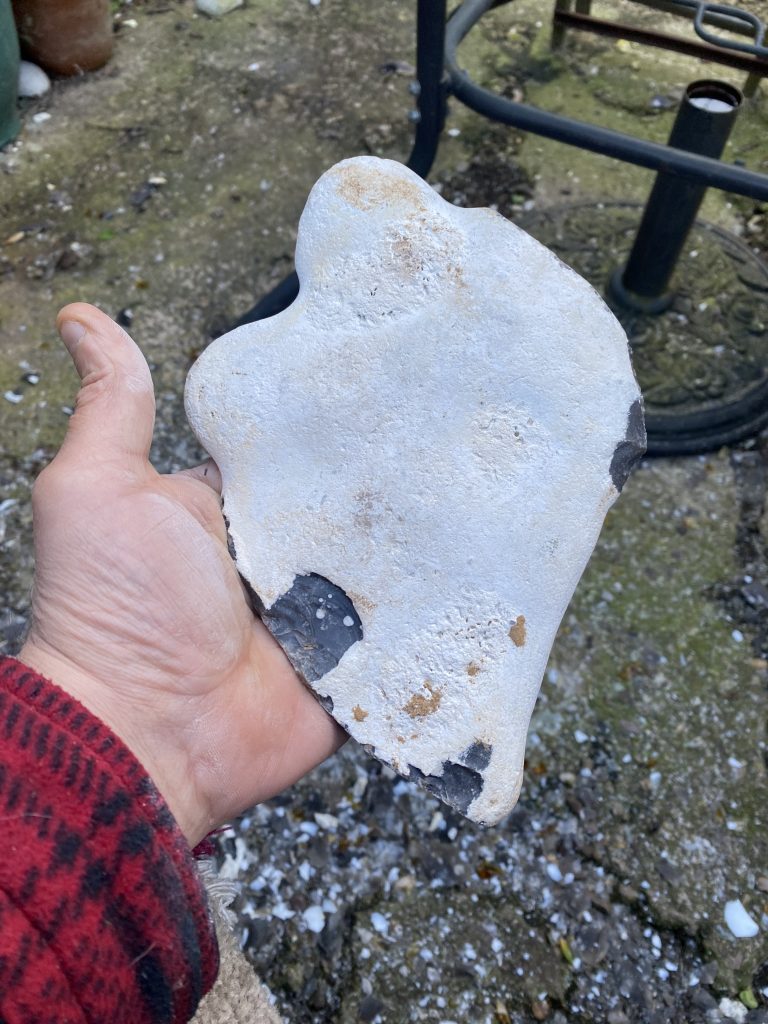
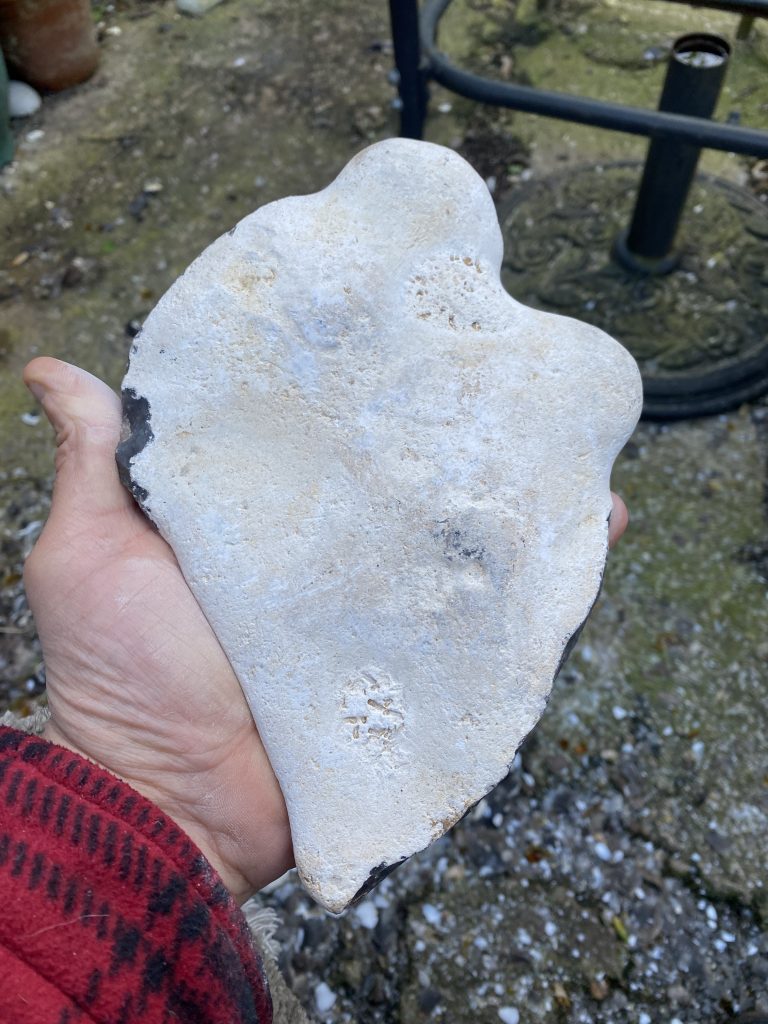
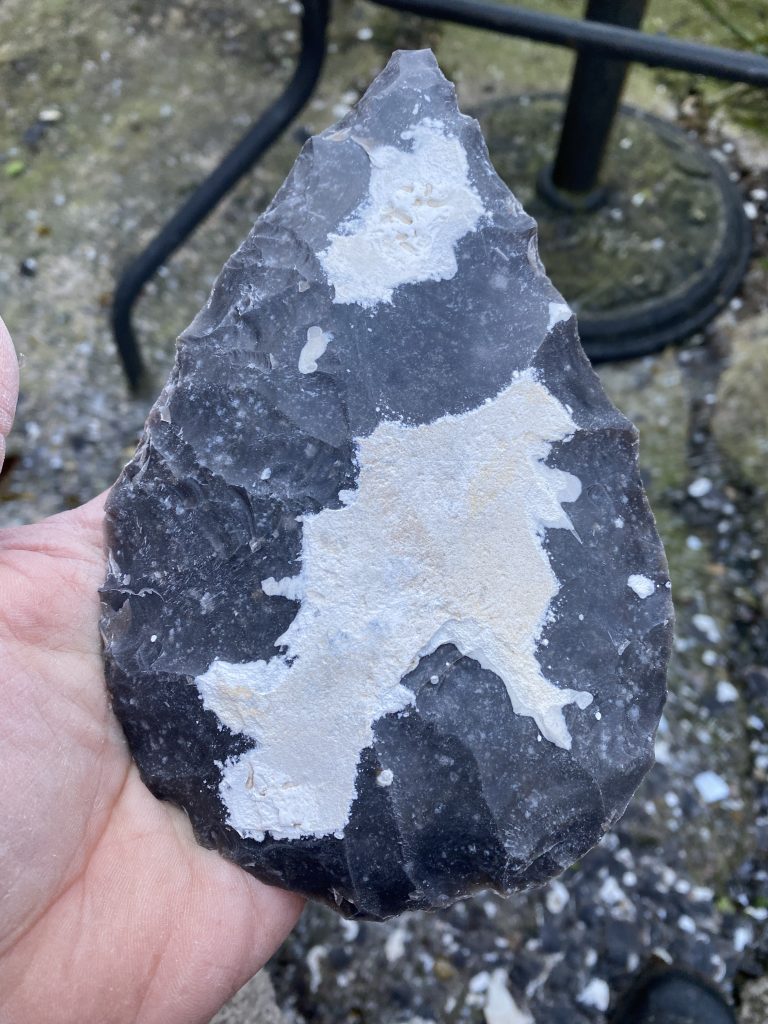
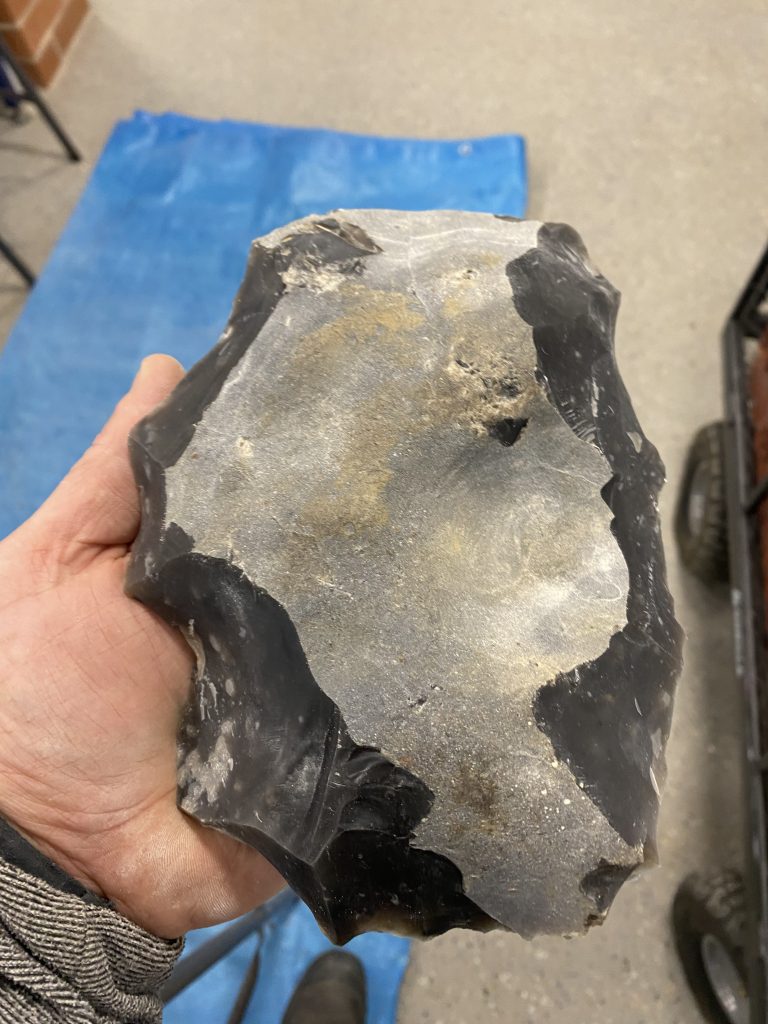
From Barmston there does seem to be two different types of flint collected. One type, like the above thin tablet with chalky outer surface seems to be pretty undamaged and works well. This leads me to think the materials on the beach are from two different glacial events or perhaps accumulated from different geographical locations.

Anyway, this was a particularly thin tablet of flint and as such liable to break. As a strategy to avoid breakage I pressed the flint to my thigh. The idea being that this helps by adding my body mass to that of the flint.

Using this strategy the next step was to use a hard hammerstone to ‘turn’ the edge. This involved taking a flake off one face, then turning the tablet over and using the fresh flake scar as a way in to take a flake off the the opposite face.

The sound is really interesting as you can hear when the tablet is resisting the hard hammer blows. Rather than persist and risk endshock and breakage, I would simply go back a stage and made bigger the platform. This approach allowed me to work my way around the nodule turning the edge without any major issues.

I then shifted over to a heavy antler hammer and used the worked edge as a ‘way in’ to take off longer flakes. Because I was pressing the tablet of flint into my thigh I was effectively hitting my leg with the antler hammer, but on the way catching the edge of the tablet and pulling off a flake.

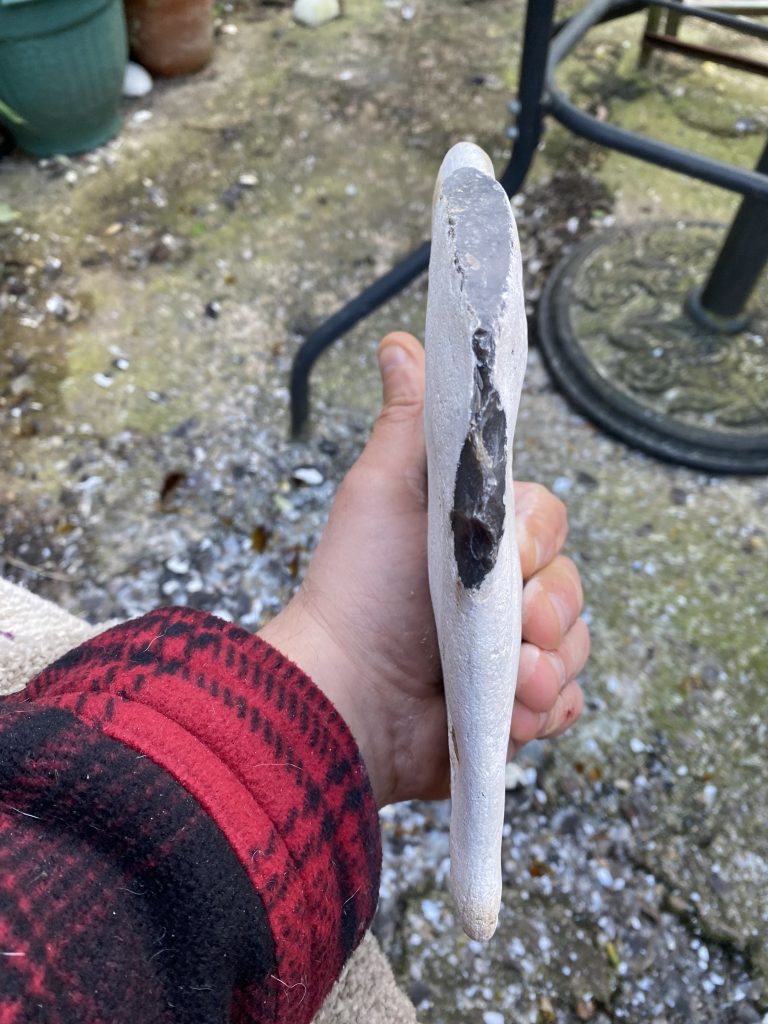
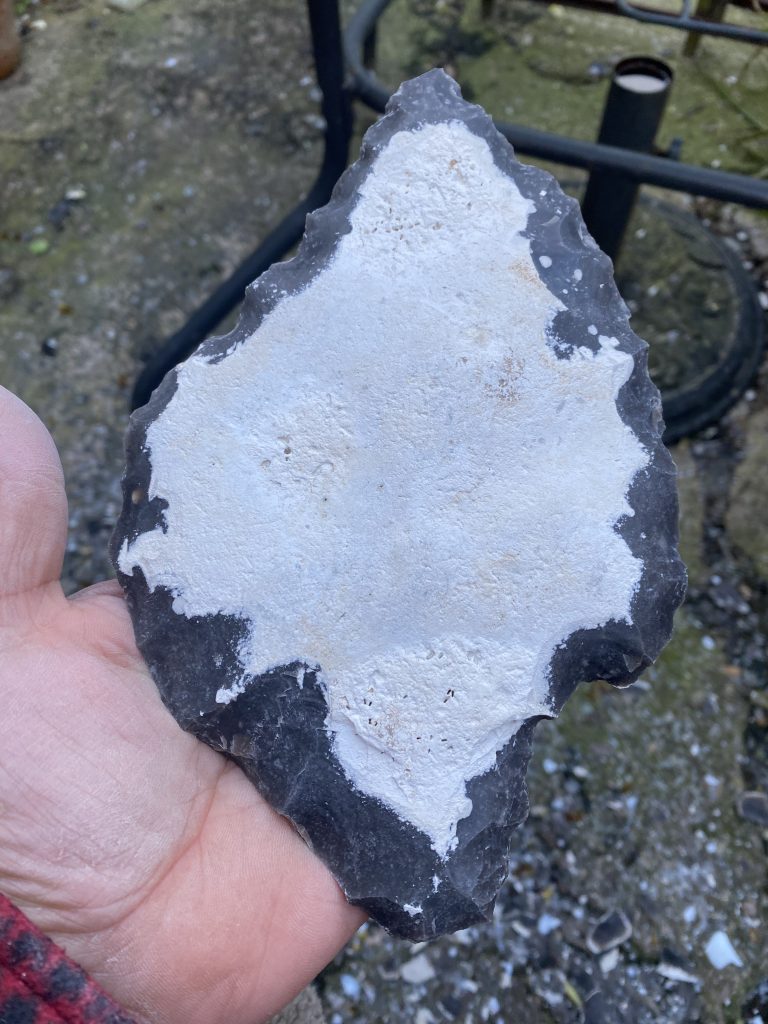
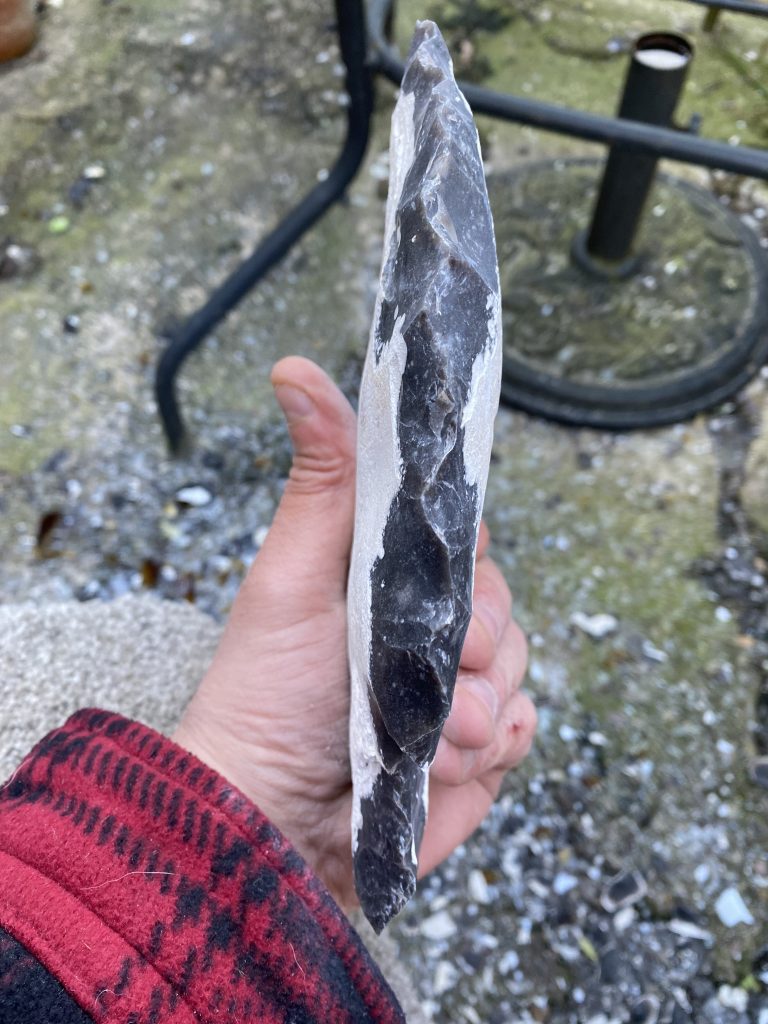
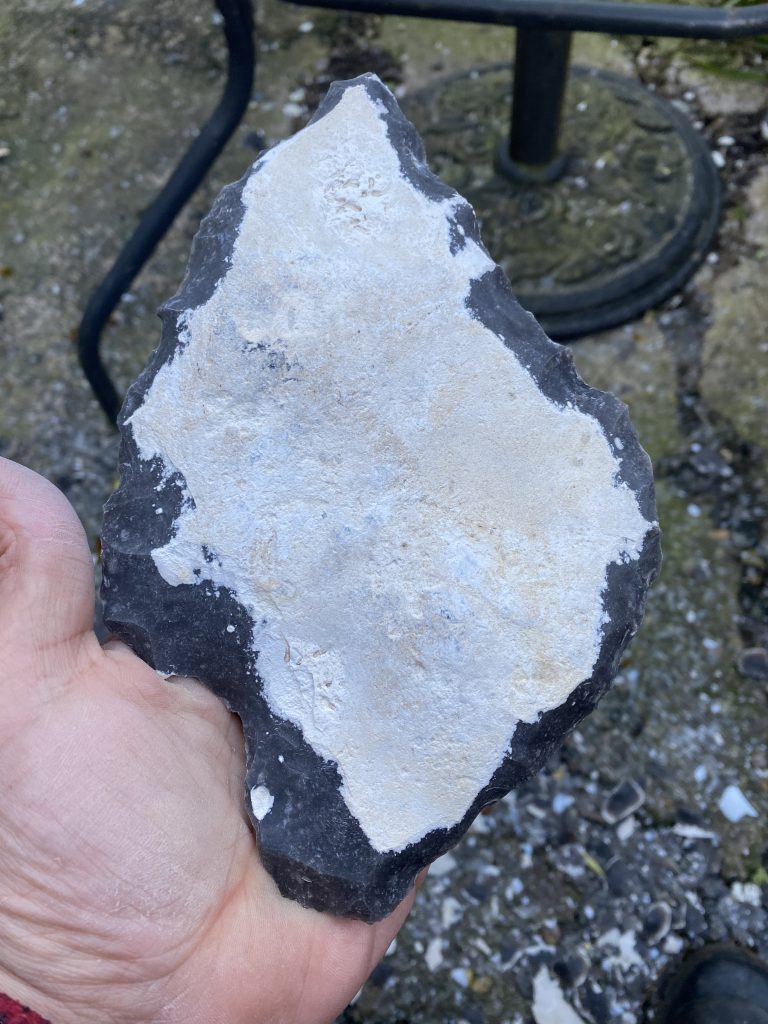
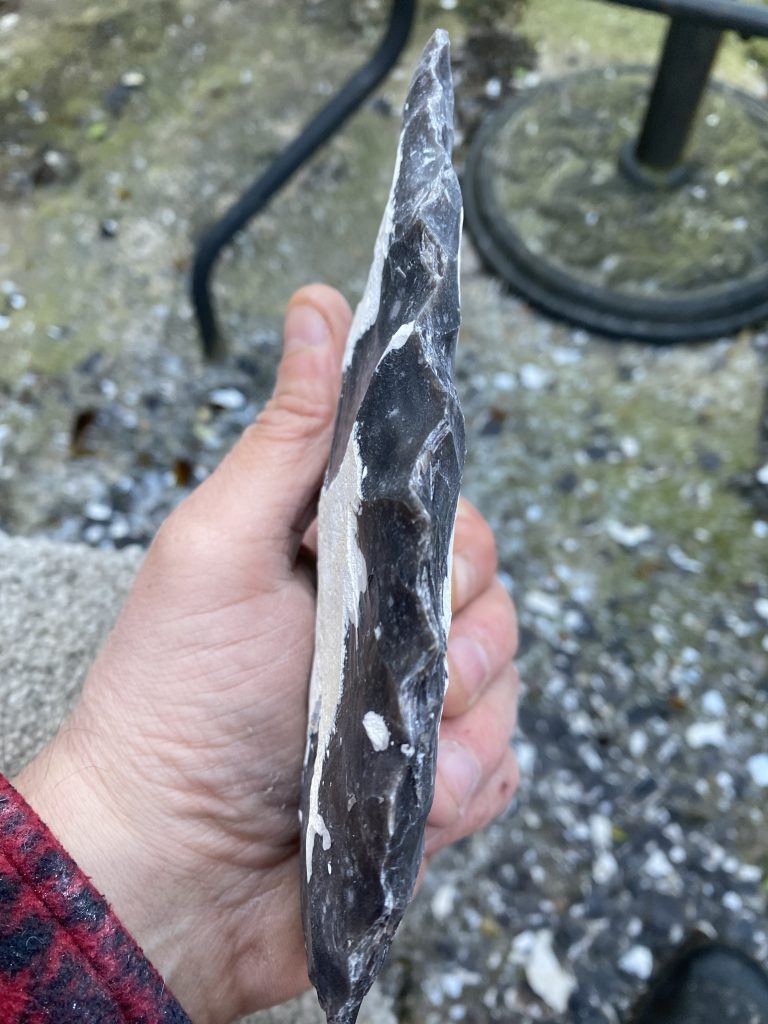
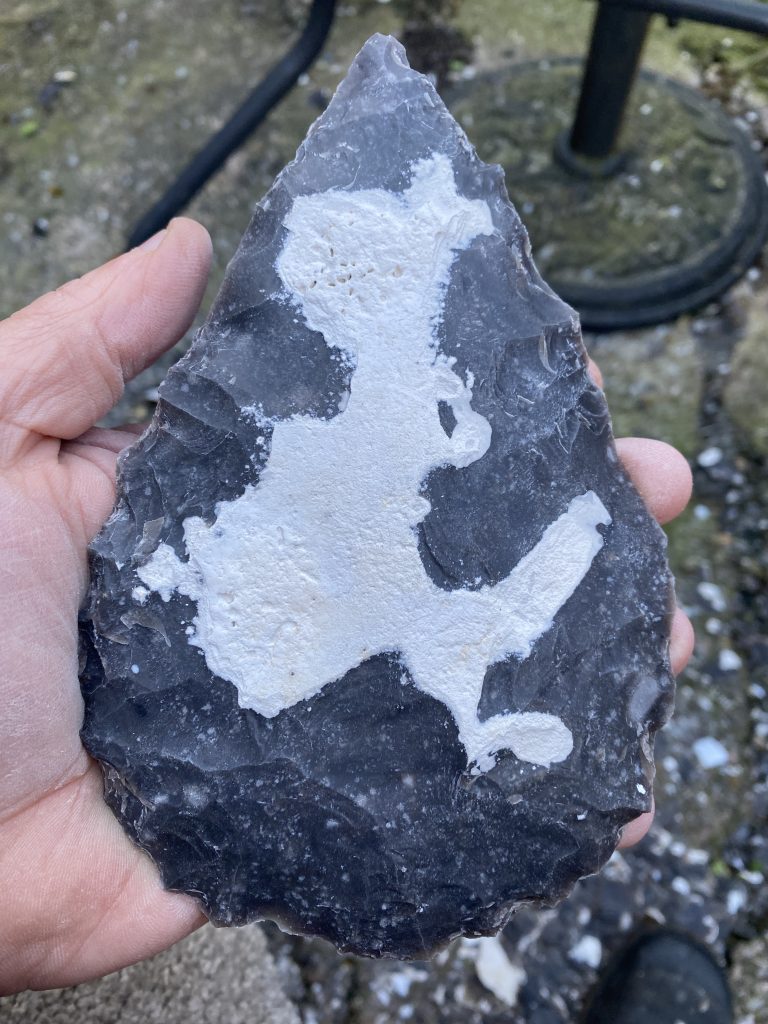
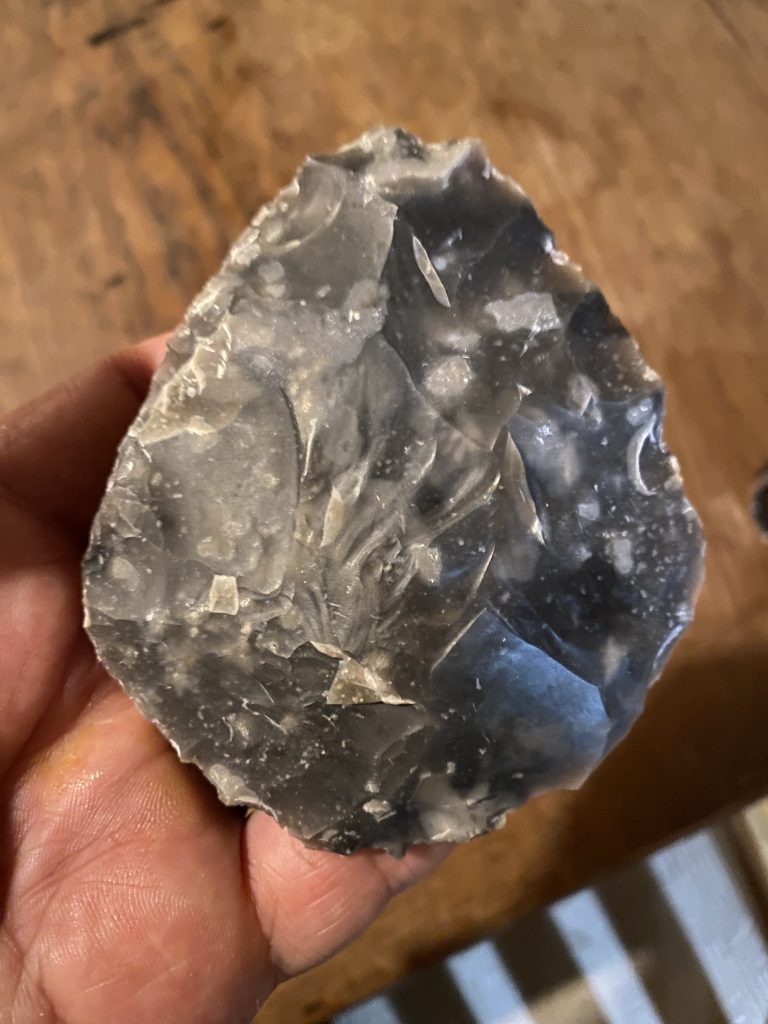
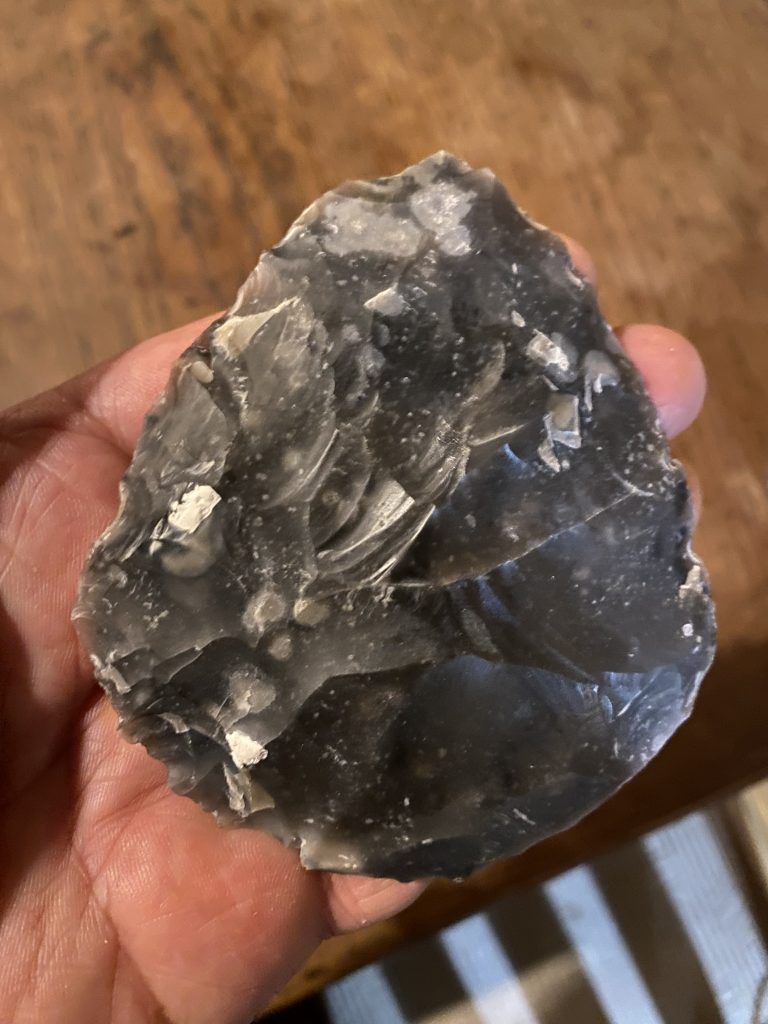
As you can see from each worked face, the longest flake removals are a pretty descent 5 cms or so, but because the tablet of flint was already relatively flat I was mainly creating a cutting edge.

The two aspects I really like about this handaxe is the size (it is pretty big) and the symmetry. As I know how tricky it is to achieve these aspects I believe that this would have also held aesthetic value to a Palaeolithic handaxe maker.

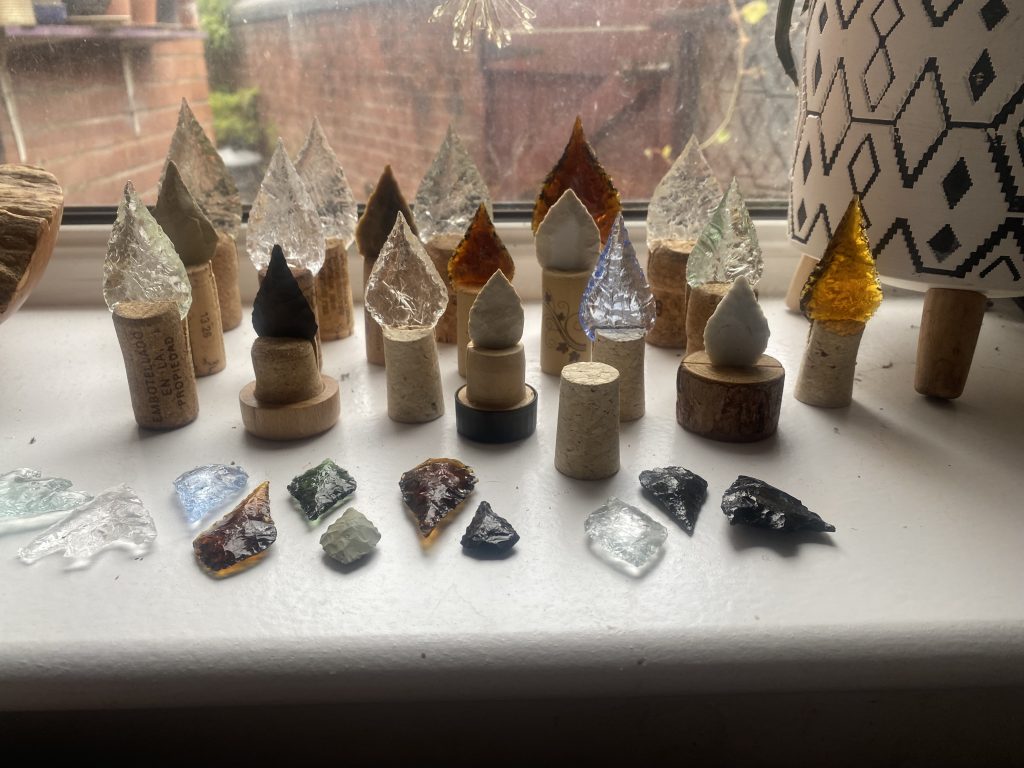
So, the end result is one big, sharp and also aesthetic handaxe. Yesterday I destroyed one flat nodule and made two glass arrowheads as well as making this rascal. In relation to my performance here I think the correct term is that ‘I was cooking on gas!’

Happy days!

My Barmston Beach wonky handaxe

This tabular piece of Scandinavian beach flint must have had a few adventures in its life, as it contained many more internal fractures than I expected.

Consequently, the handaxe is much smaller than I was aiming for at the start, and I realised after taking the photos that it is also wonky.

However, it does have something about it, in that it is sharp and hand size, and a product of persistence on my part. So happy days!

Our Runswick Bay, Whitby and Barmston Beach World Tour

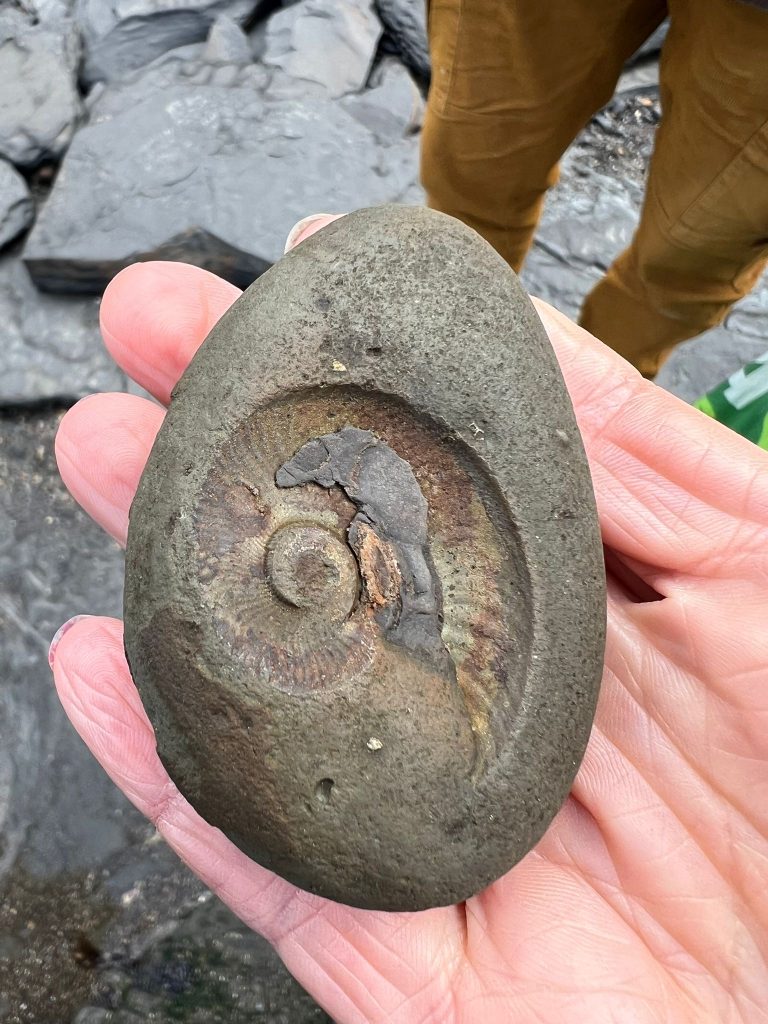
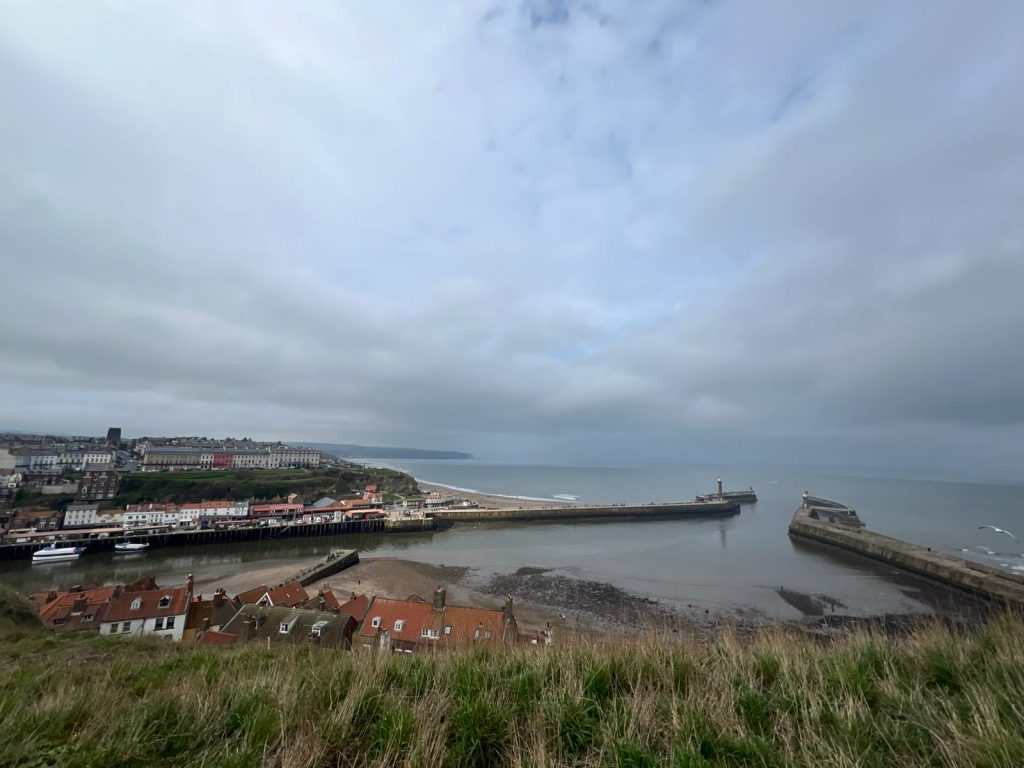
Last weekend we were rock hunting on the north east coast of England, starting out at Runswick Bay on the Saturday, looking for fossils, and small flat shale pebbles for our upcoming Star Carr type pendant workshops.

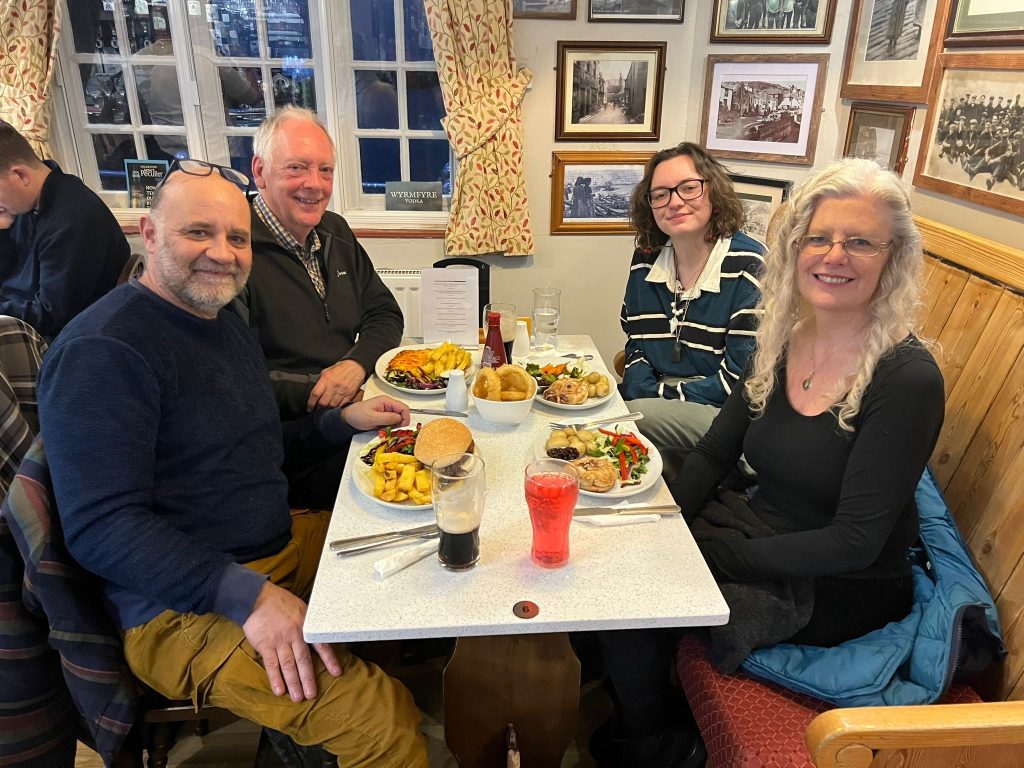
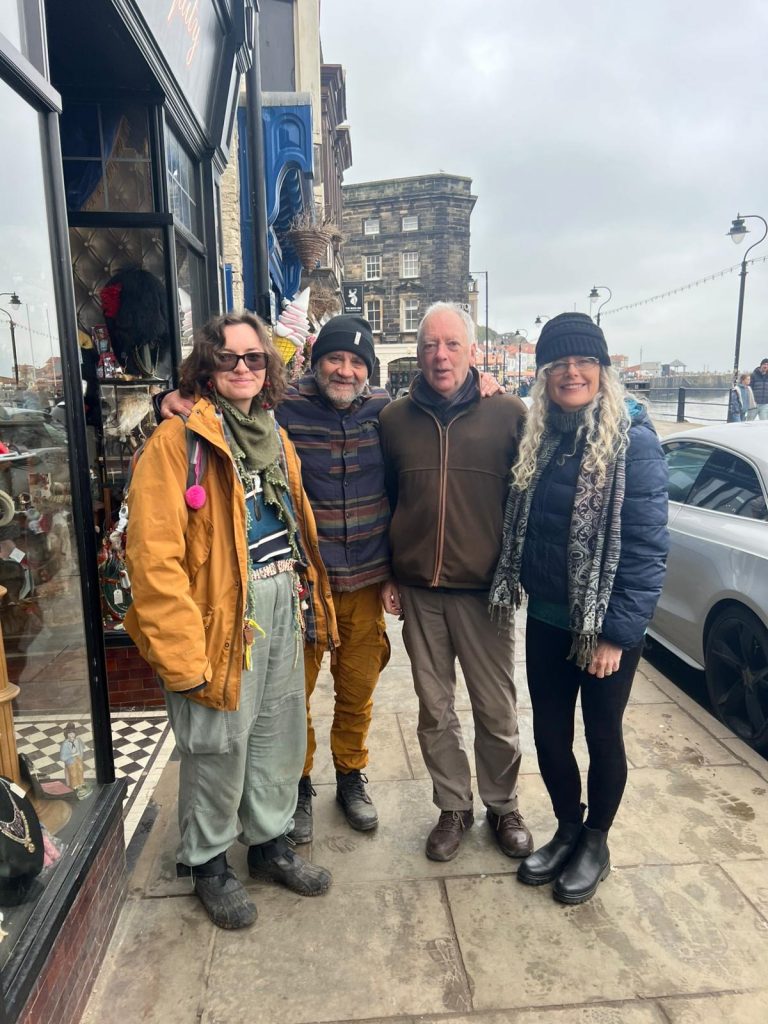
We stayed near to Runswick Bay and that evening we headed to the Cod and Lobster for out tea. The following morning we set off to have a quick look around Whitby.

I suppose we are actually a ‘rock band’ as the thing that brought us together for this weekend was…rocks. From left to right, Laura, me, Stephen and Karen.

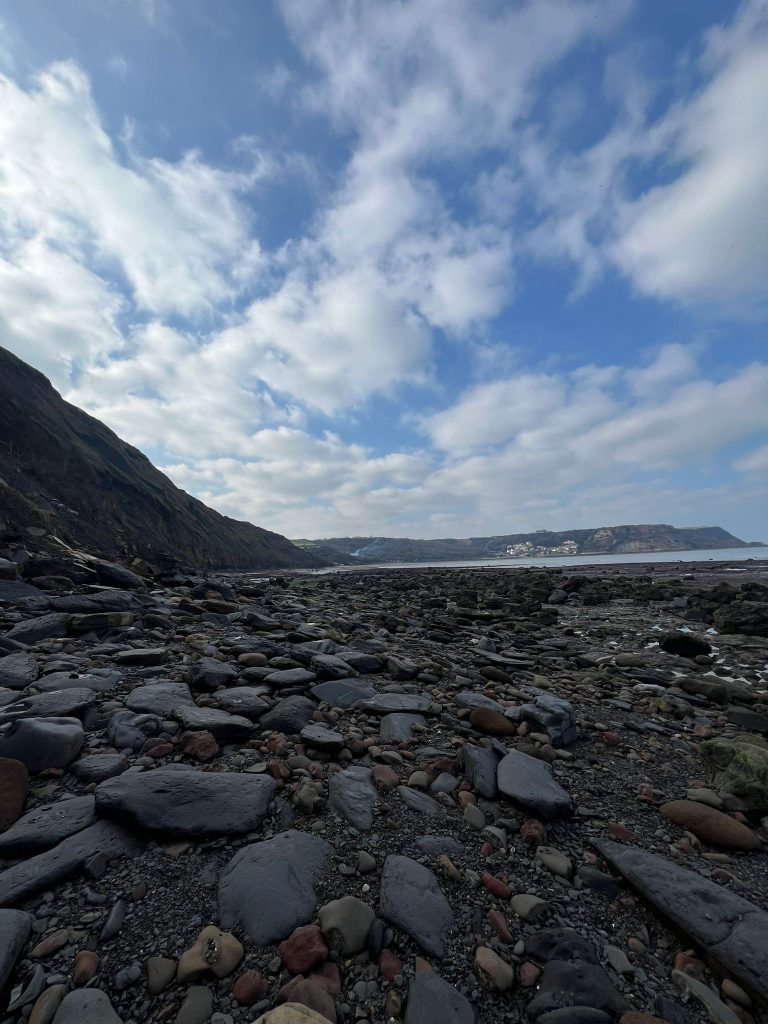
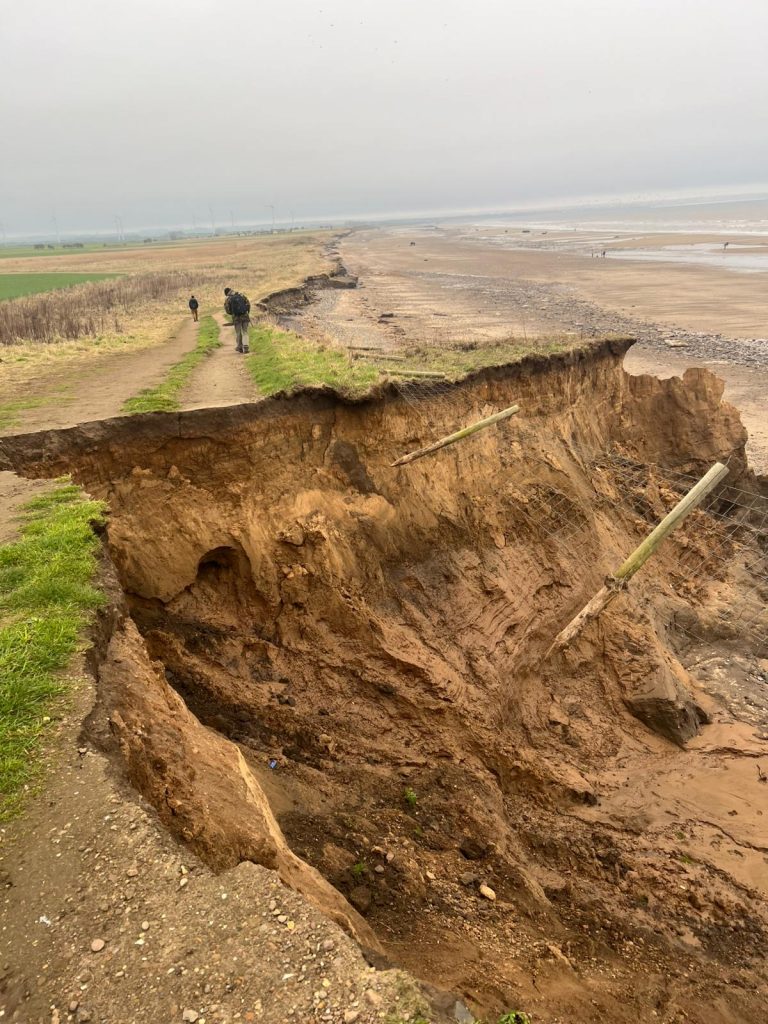
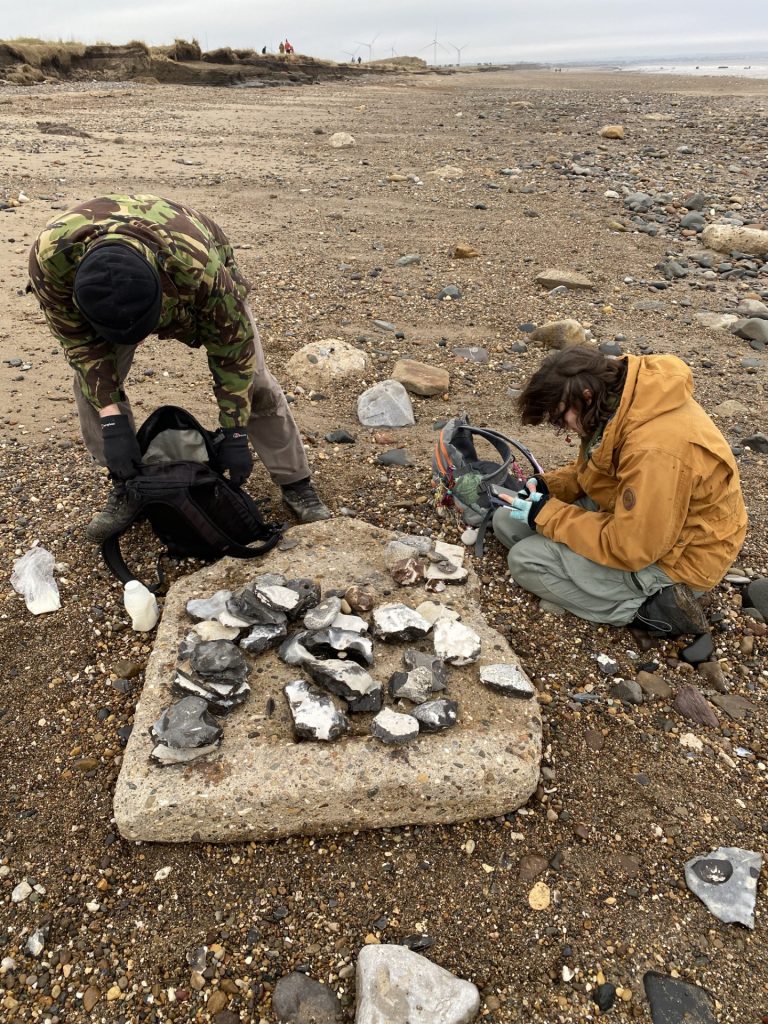
From Whitby it is approximately one hours drive to Barmston Beach, home of really nice tabular beach flint. According to my geology source (Stephen), this flint was carried over on glaciers from Scandinavia during the Pleistocene and deposited at Barmston when the glaciers melted. The flint was subsequently buried and is now being washed out by the encroaching sea.

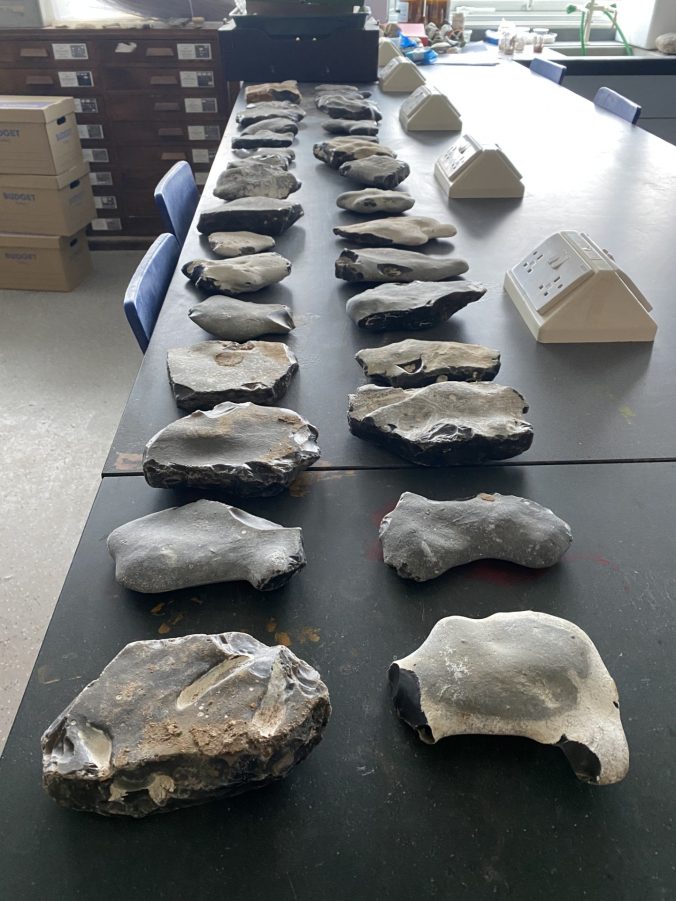
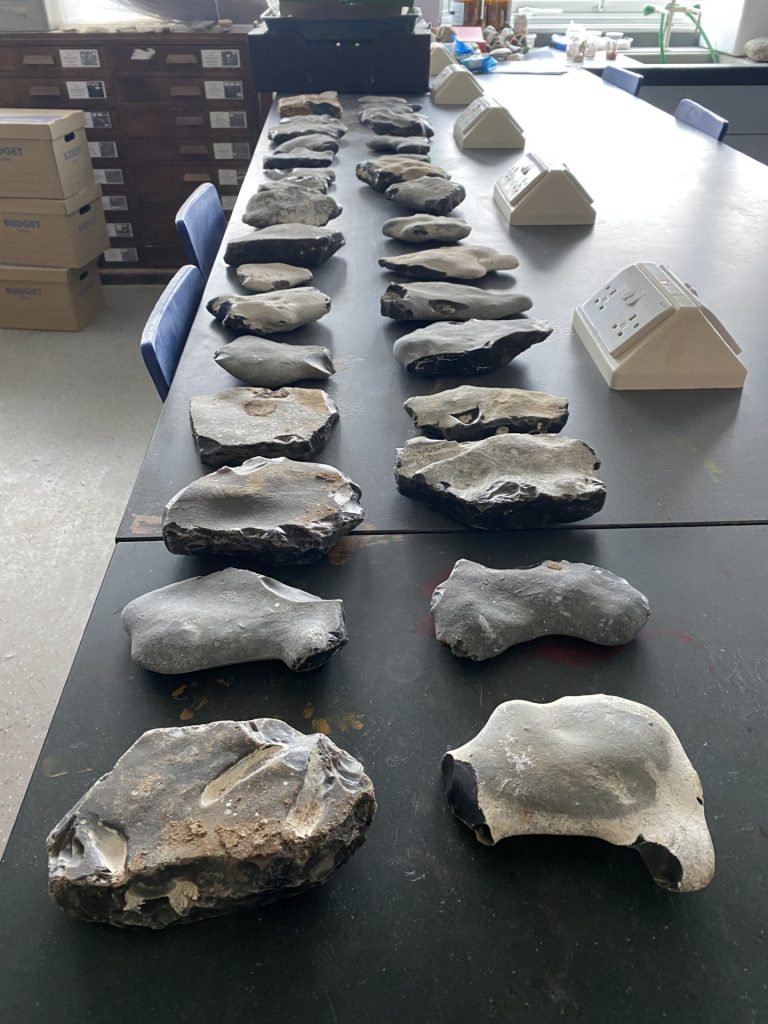
Today, I am in Chester and I have brought about a dozen nodules with me for my teaching session this afternoon. I find these tabular pieces usually of good quality, unless they have been rolled a lot on the beach. They are also an ideal size for handaxe making, which coincidentally is this afternoon’s goal.

My latest dual heritage handaxe

I realised a good while ago that I am interested in categories and boundaries. This is because of my own experience, being ‘half-caste’ in the 60s, 70s and 80s, ‘mixed race’ in the 90s and by the early 2000s I had become ‘dual heritage’. These are all what are termed ‘etic’ or outside categories, how society has characterised me. An ’emic” or internal category would be how I characterise myself, and that would be as ‘Mancunian’. More than just abstract concepts, these labels have implications for the differing ways I have understood myself and been treated in the real world, hence my interest.

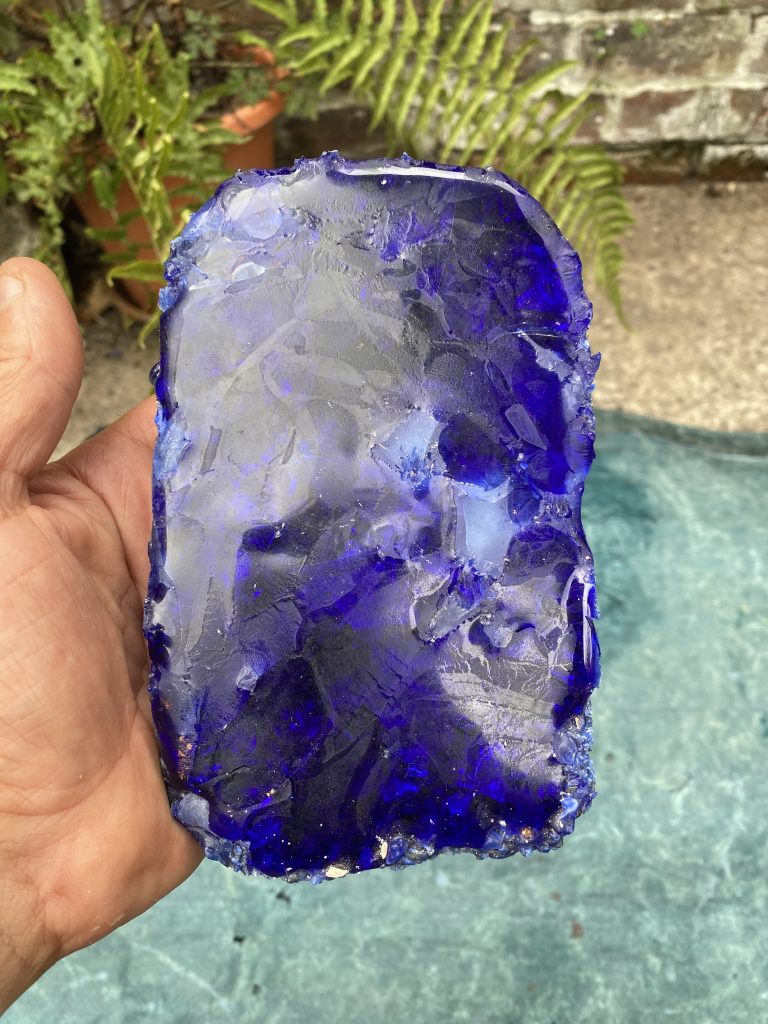
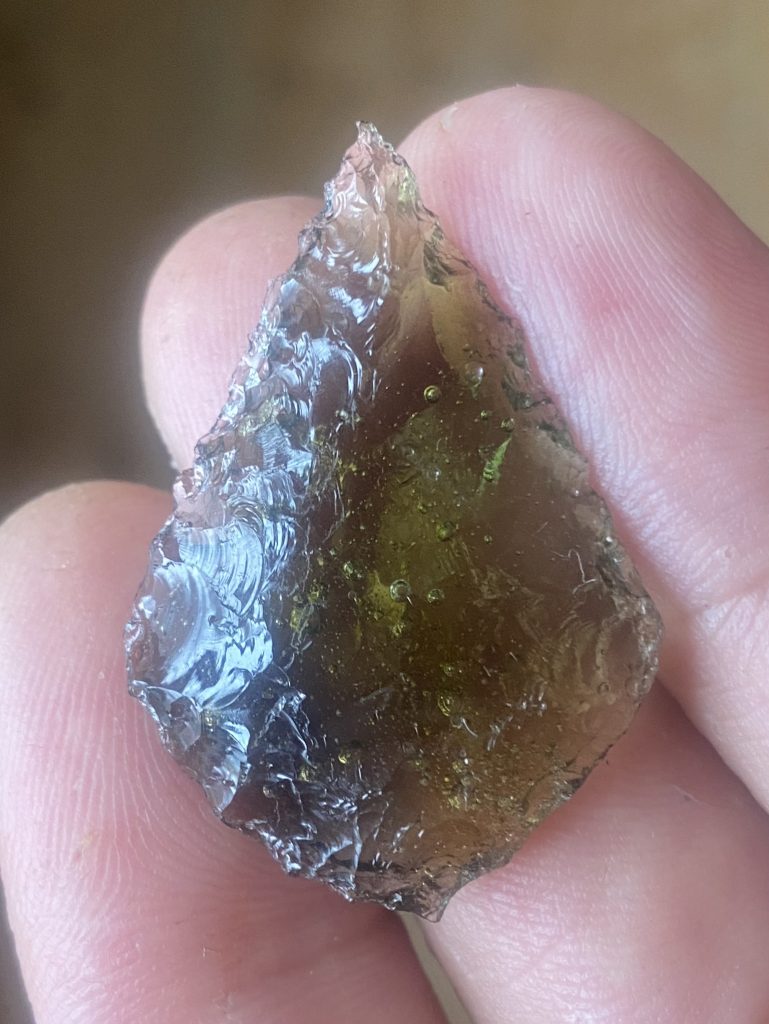
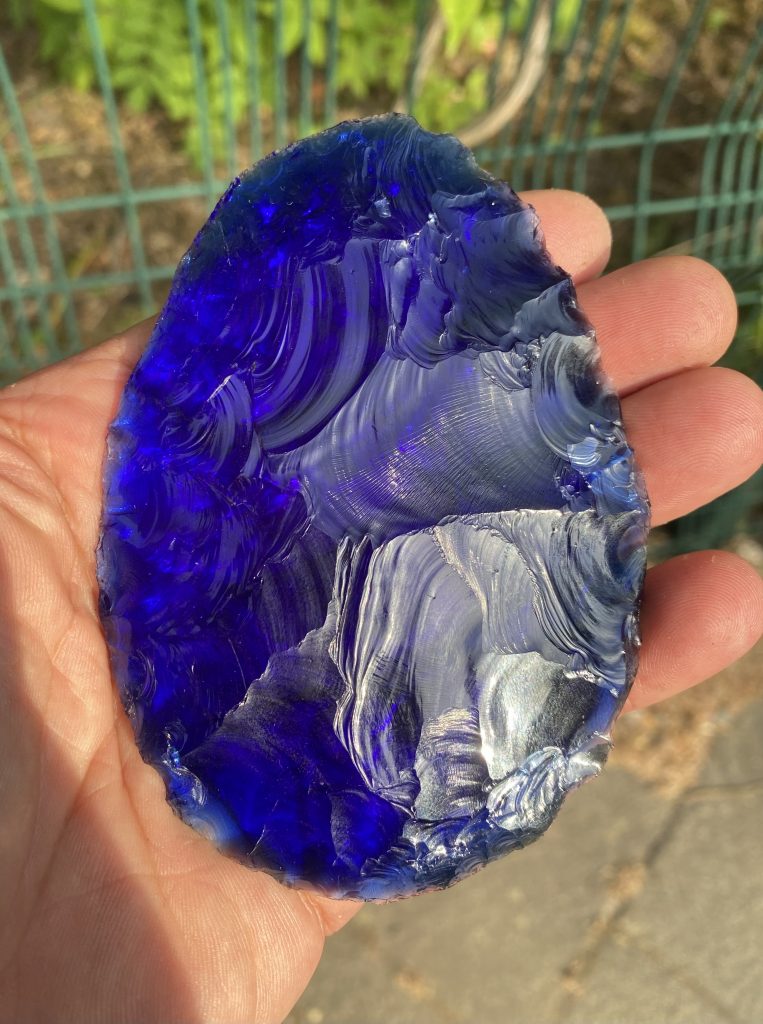
Onto handaxes. I am really liking this most recent offering. It is made from the largest piece of slag glass kindly provided by the folks at Salford Archaeology. I have left the base as is, referencing where it has come from, and in relation to the worked section, I like the thinned serrated edge on both sides. It would make a great cutting tool, and I am super pleased with this one.

So form and potential function if you like, mirror a Palaeolithic handaxe. However, the material it is made from, a slag glass block excavated from a factory in Manchester, anchors it very much in the modern industrial period. It has two, temporally contradictory etic heritages, or narratives captured within one beautiful object.

So what about its emic identity? I don’t think the handaxe itself can tell us, but through my visual and haptic engagement with it I would say it is pretty special. It works for me on every level, and it feels like I have expressed something of myself within the production of this object. It was satisfying to make and I am happy that I have this ability to create things of beauty such as this. And I think that its dual heritage adds to its aesthetic and doubles its narrative value. Happy days!

I’ve made something I like. Again!

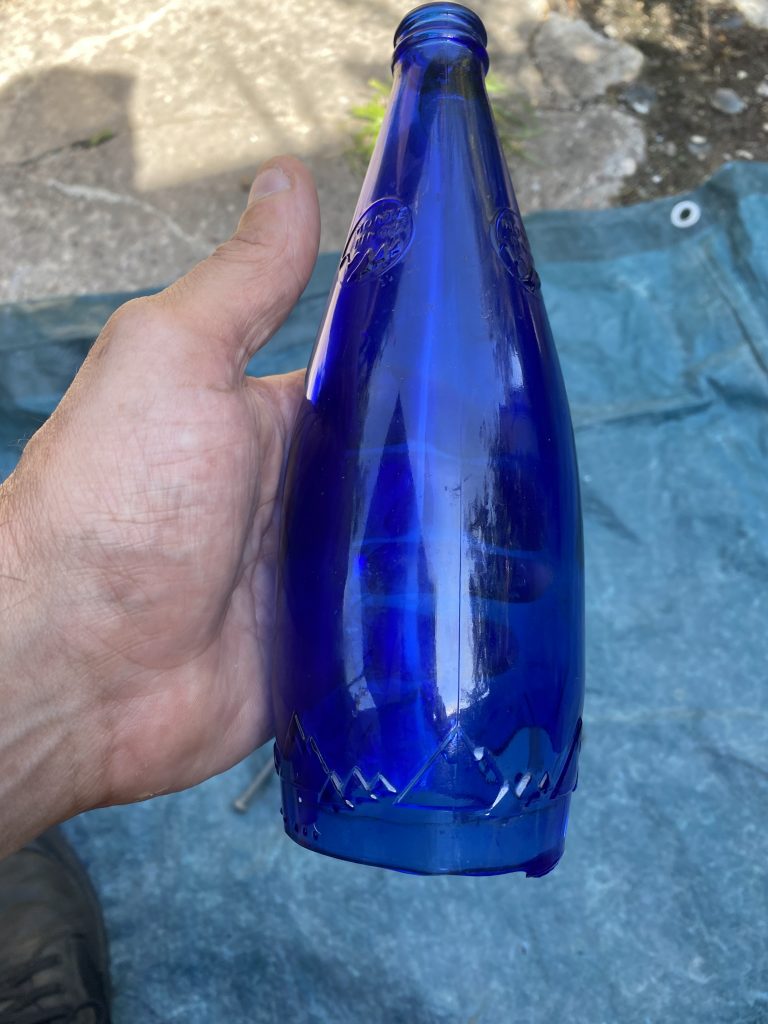
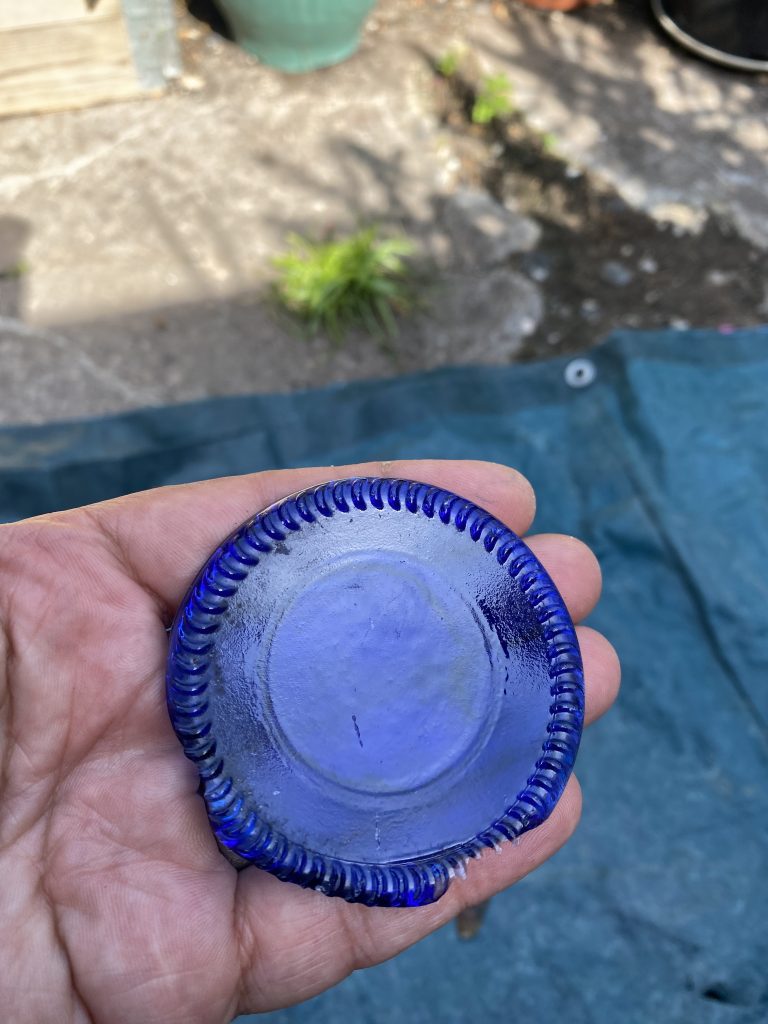
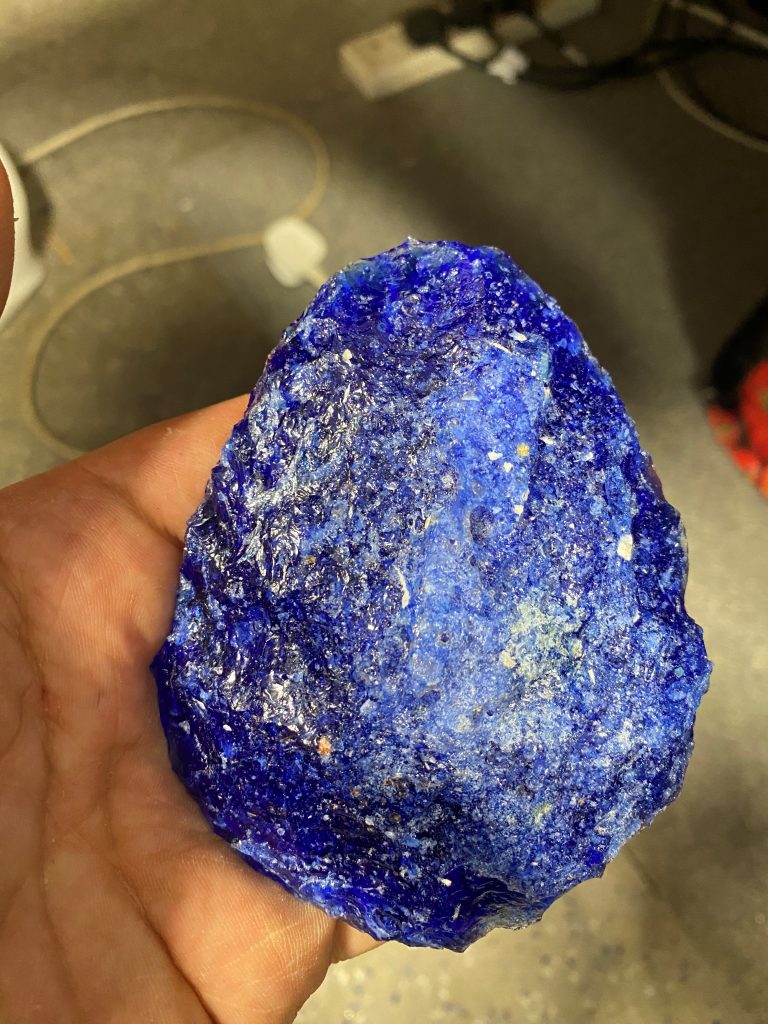
We have just come back from a week in Athens, and the main thing I brought home was a large disc of blue glass, bought at the flea market for five Euros.

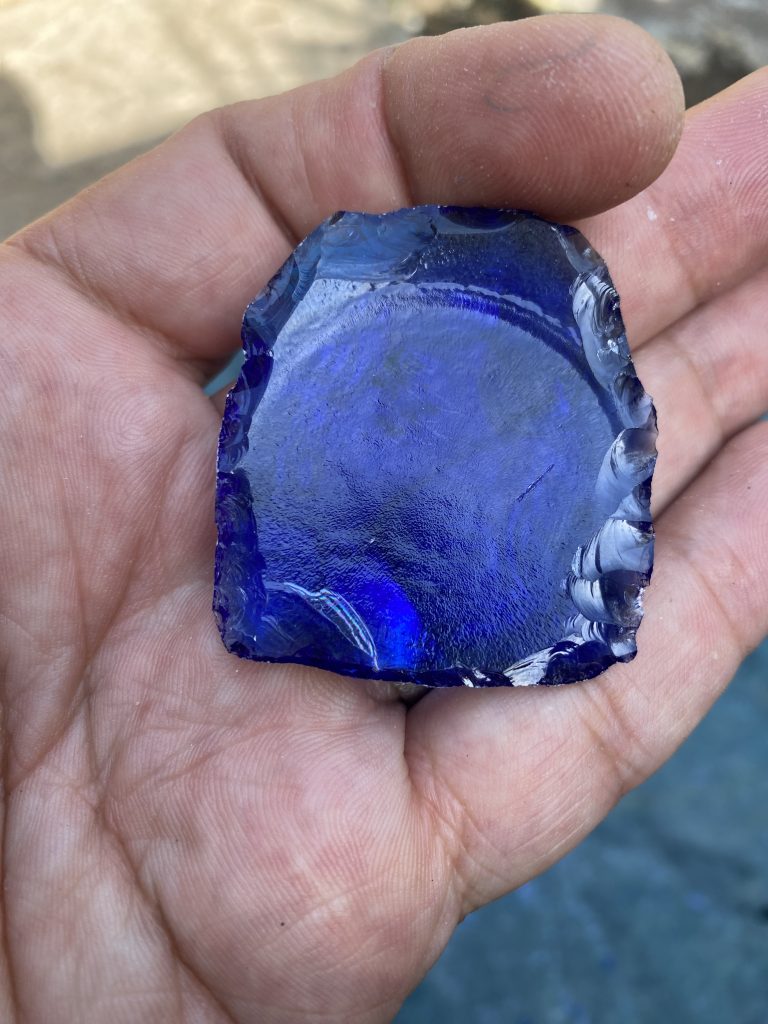
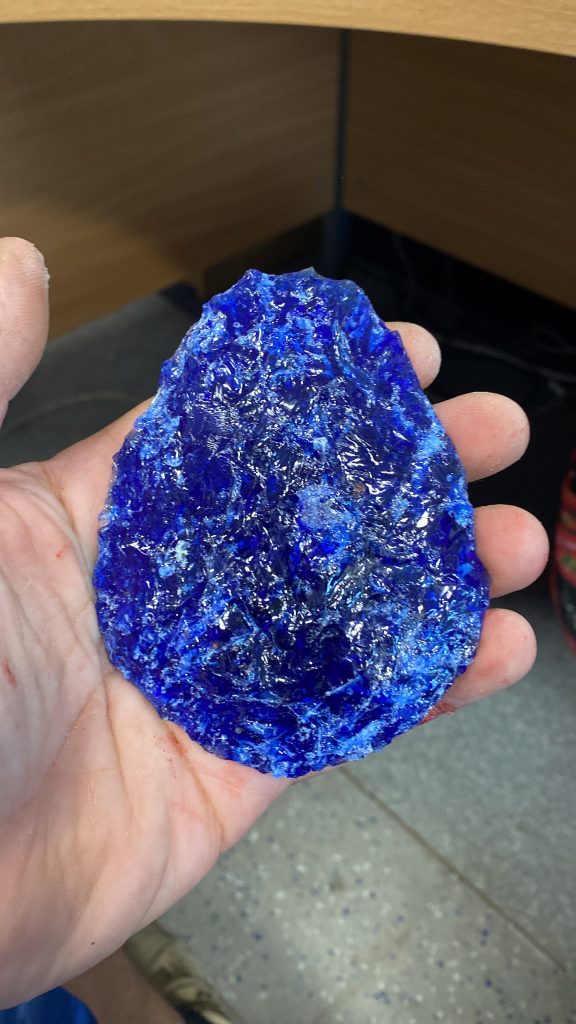
Anyway, I found time to hide in the lab for an hour or so and came away with this very nice blue ovate handaxe.

Everything worked well. Turning the edges with a hard hammer, and then thinning using an antler hammer. This is the second iteration, initially it was larger but wonky.

I brought the wonky version home, lived with it for 24 hours and then the following day finished it off so that it is a shape I can live with. I am currently thinking about the difference in experience between my work with emails, spreadsheets and budgets, and escaping into the lab and the satisfaction of making something beautiful. I suspect it is something to do with what that famous stone tool specialist, Karl Marx, termed ‘Alienation’. To be continued!
Endshock, or something or other?

This is a strange time of year for me. Relatively quiet diary wise and along the corridor, but work wise I have a lot to do within the couple of weeks before term starts.

This flexibility inevitably means I end up in the lab and doing what I am obsessed with at the moment, making handaxes. However, over the past two days things have not gone so well.

I have been trying to work the big chunks I have had lying round for a long time, but seem to be just destroying stuff, rather than being able to make anything. I think it is because I have so much going on in my head it is difficult for me to slow down and focus.

Anyway, I was pretty pleased with this handaxe preform. It was a large clean flake removal from the bottom right nodule in the cage. So far so good. The hard hammer shaping went well and I moved onto the soft hammer. The thing to note on the above photo is the dark brown inclusion at the bottom near my little finger. This material was a lot harder than the flint it was sat within.

This is a better view of the hard section. Soft hammer wise I do not have so much choice, they are all a pretty similar size, and I could have done with something heavier to take longer flakes from this particular flint, but I did not have that option, so I just had to hit it faster with the aim of increasing the kinetic energy and therefore impact. Above is an example of what I would class as a good platform, both low and isolated, or sticking out a bit. All the ingredients to produce a good clean removal.

However, I hit the platform of hard material, again and again with no result, until this happened. Increasing the impact at one end has split the handaxe preform in the middle. I know this as endshock, although I do not fully understand the phenomena, I just avoid hard hits at one end of a handaxe. With this example I was working with it on my leg, held down at the distal end and hitting hard the proximal. I wonder if my leg acted as a fulcrum and it gave way in the middle? Is this the same as endshock? I don’t know, but I am keeping this as a really interesting example of something or other.

The use of glass as a material: my learning journey in four parts

The image above is from a postcard I picked up in 2011 (I think) whilst at an archaeology conference at the University of Southampton. It has been framed and sat on my wall since then and I only recently found out the the glass replica of a Boxgrove handaxe featuring on the postcard was made by a knapper called Tim Ace. Tim’s handaxe inspired me then and has been instrumental in my enthusiasm for glass as a material to work with now.

Fast forward to 2016 and I had finished my stone tool based PhD and found I had time to learn how to flintknap. This was something I had failed to do up to then, in spite of working closely with both John Lord and Karl Lee. The main issue was lack of practice due to a lack of access to flint in the north west of England where I live. The above video was really useful in reminding me of the value of using glass to practice, and it was this video that got me going with arrowheads.

The above image was taken in the Liverpool World History Museum in 2017 (I think) and is of their collection of glass and stone Kimberley Points. When I realised Australian Aboriginals also used glass I became really excited about researching their points and methods. A number of people helped me on this learning journey as discussed here, but as well as helping me develop my pressure flaking skills, this journey provided me with a real insight into the social aspects of stone tools and their production.

And now it is 2024, and after many years spent hunched over in my back yard, I sort of know what I am doing. The above was a big flat slab of good quality glass from the Didsbury Oxfam shop (£3) and it is now a large pointy handaxe. We are in the lovely Spanish city of Valencia at the moment, and today I came across a woman in her studio making glass to produce her own glass jewellery. That would be like a dream for me. Having my own small studio space in a lovely city like Valencia, and being able to knap beautiful glass handaxes all day, interrupted only by the occasional cafe con leche.

Barmston Beach, near Bridlington

We had a weekend in Scarborough recently, and on my list was to collect some tabular flint from the beach at Barmston, near Bridlington. Timing wise we arrived late on the Sunday just before the tide started coming in, so I hurriedly filled three carrier bags with likely looking candidates and then we were off back to Manchester.

I really like the flint from this beach and in the past have found it ideal for making ovate handaxes. This time was no exception and up to now I have made one nice large ovate and a couple of smaller cordates, and it is one of these cordates I want to talk about.

The making of the smaller cordate on the left coincided with a visit by Mark Beckett from Europac 3D to show us how to use the Artec Spider 3D scanner. The broad aim was to take scans of both faces, then use the software to stich the two scans together to make a 3D model. So far so good.

Mark set up the handaxe and completed three scans in less than ten minutes. We recognised the value of using 3D models for teaching purposes during lockdown and the Artec Spider seems like a really useful tool for the process. The fact that the software is intuitive to use means we can use it with our students to give them some digital skills and experience as well.

However, what has really got me excited about the scanner is the post processing opportunities. As you can see from all the images on the left, the flint is difficult to read, as the colour and inclusions disguise the scar pattern, and a fundamental part of lithic analysis is reading the scar pattern to understand the process of production. What you see with the images on the right is the ability to manipulate the colour and lighting in order to highlight the scar pattern. This kind of colour manipulation has real potential for helping to ‘translate’ the scar patterns on tricky to read materials. Are we going to get an Artec Spider? I certainly hope so. Many thanks to Mark for coming over to Manchester and running us through the processes. For more information about the Artec Spider checkout the Europac 3D website.

Having a sort out

Since coming back from fieldwork I have slowly been sorting out stuff at home and in the labs. In doing so I came across this box given to me by Pete Yankowski at the Chorlton Arts Festival knapping session (see previous post).

As you can see it is full of treasure, however the thing that caught my immediate attention was the modern broken vase base, languishing at the bottom of the pile.

As you can see, it is both thick and has a way in, and so I spent a little time with this yesterday. A day earlier I had worked on another glass base, but hadn’t prepared the edges as well as necessary. Consequently I ended up with an artefact with a ‘step fracture island’ on one face, and some original surface left on the other. Most unsatisfactory! Consequently, I spent quite a lot of time on this one, turning the edges as well as possible.
This particular flake has a story. The reflective bit is a section of original surface that was sitting at the centre of one face, and it needed to go. Because I had spent time creating well prepared edges and platforms I was able to remove it with one accurate and hard blow of the antler hammer. This meant both faces were fully bifacially worked. Most satisfactory!

Anyway, the result is a small and wonky cordate handaxe. There are a couple of small step fractures that I could get rid of, but that would mean losing width, so I am going to live with them. Or should I say, Pete is going to live with them, as the handaxe and flake are now winging their way to him, as a thank you for the original box of treasure.

The Blue Handaxe part two: an unsuccessful melting experiment

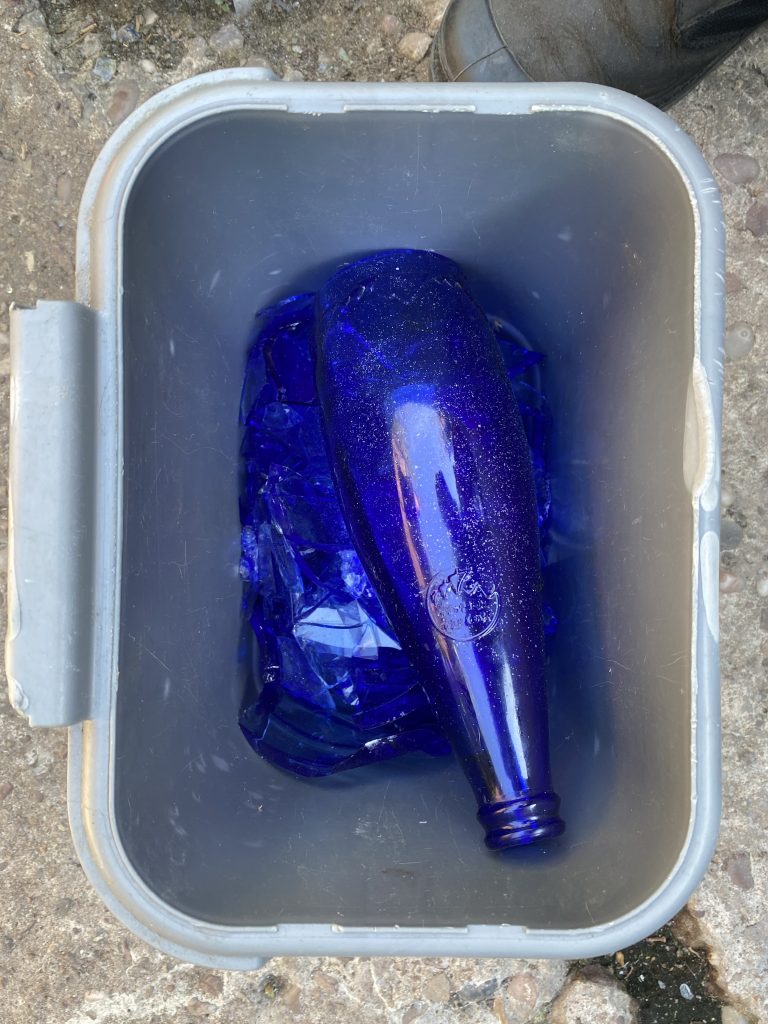
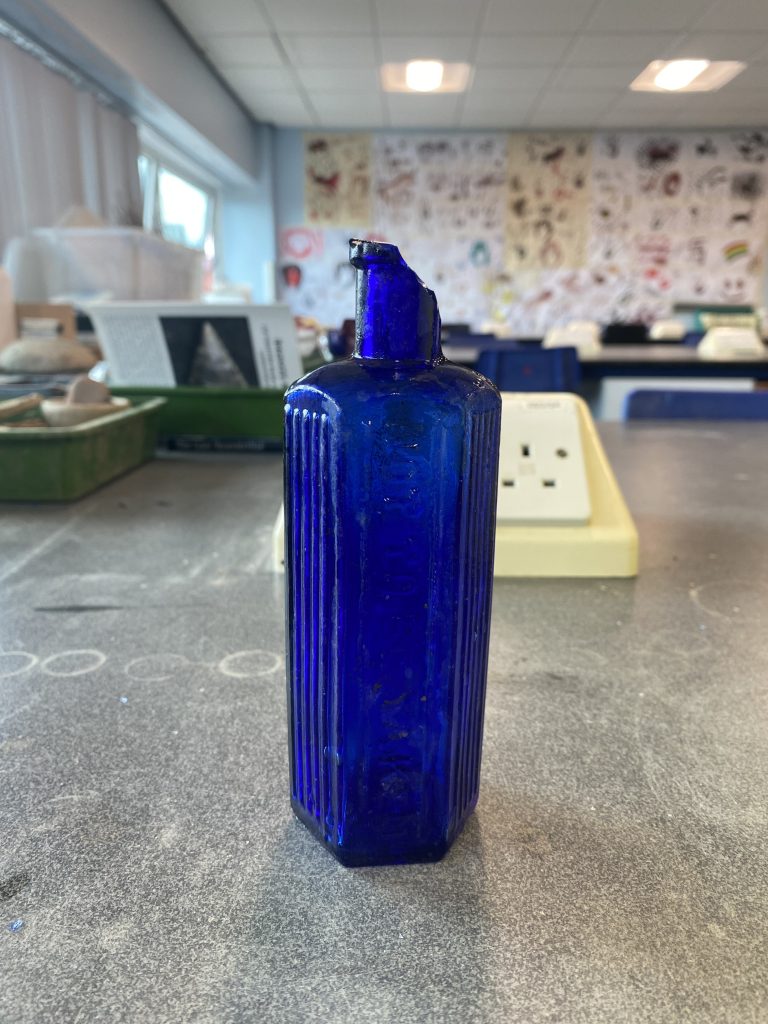
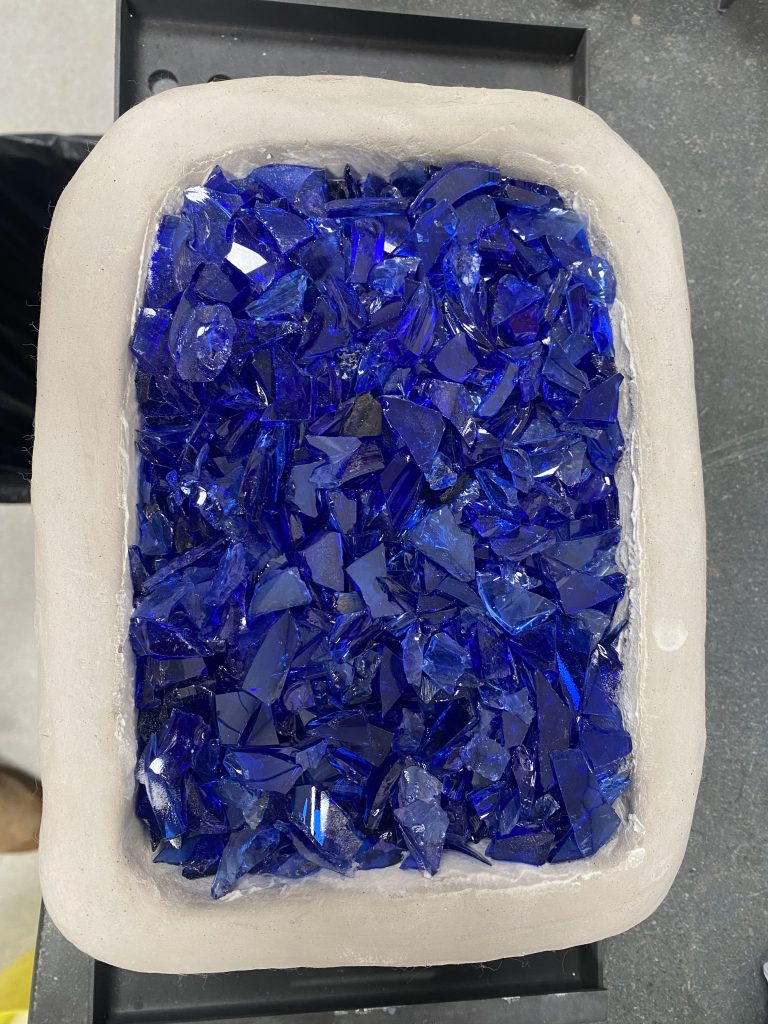
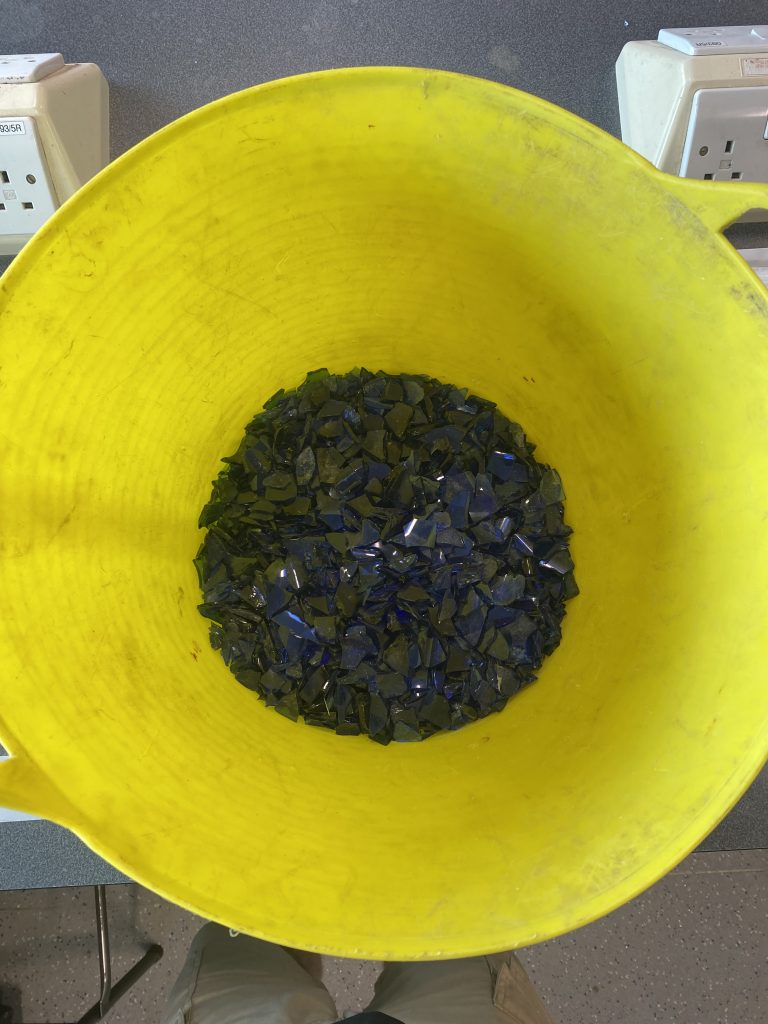
Last week Nacho, Howard and Jex made some time to record the smashing and melting processes for the glass collected from the bottle tip. Above you can see a birds eye view of Nacho’s home made kiln that we were using for the experiment.

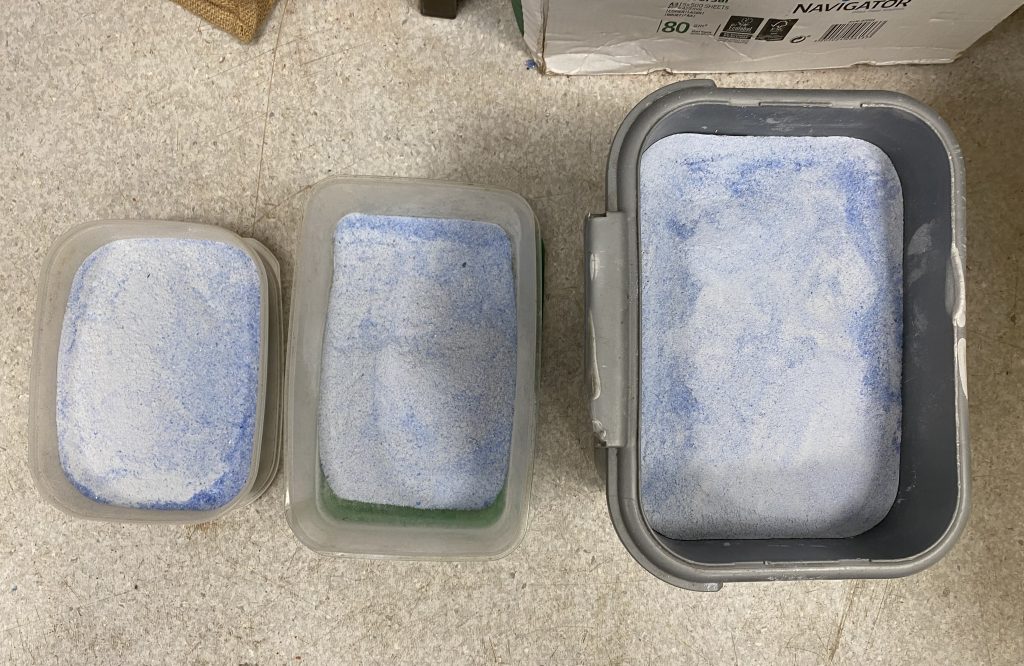
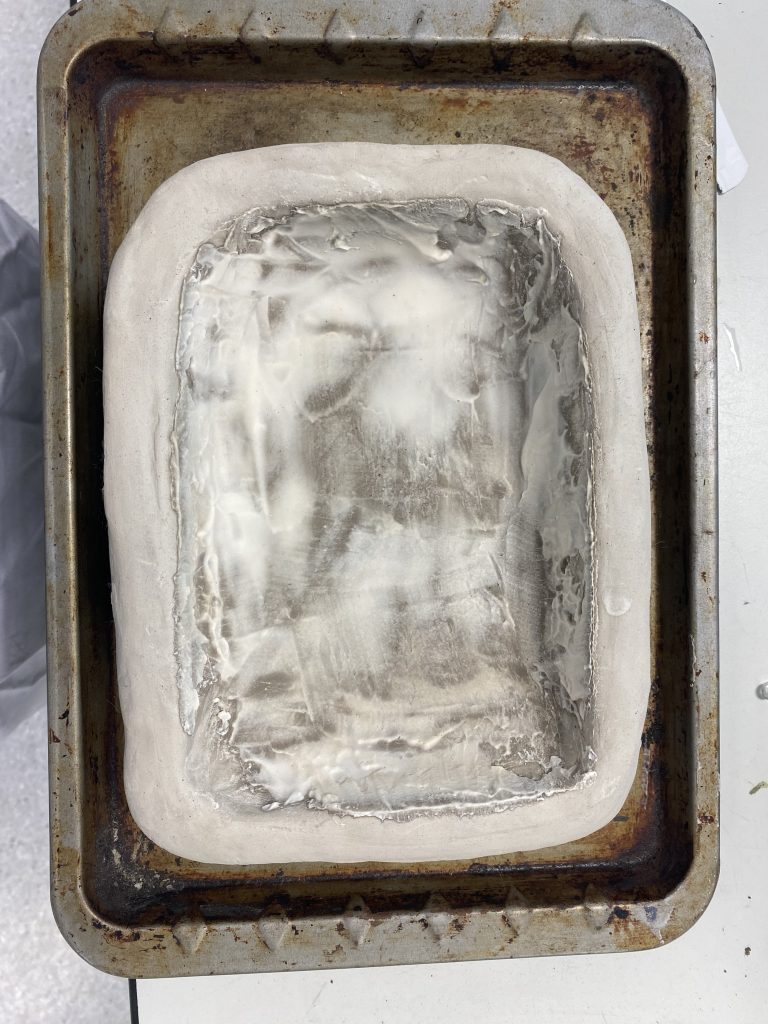
In total we had six clay moulds lined with aluminium takeaway containers. The take away containers function was to stop the melting glass adhering to the clay mould. In relation to the kiln we had an upper and lower section, and were interested to know if location within the kiln was going to be a factor. As you can see, we also had glass of different colours and Nacho thought the milk glass, based upon its density, would be the most difficult to melt.

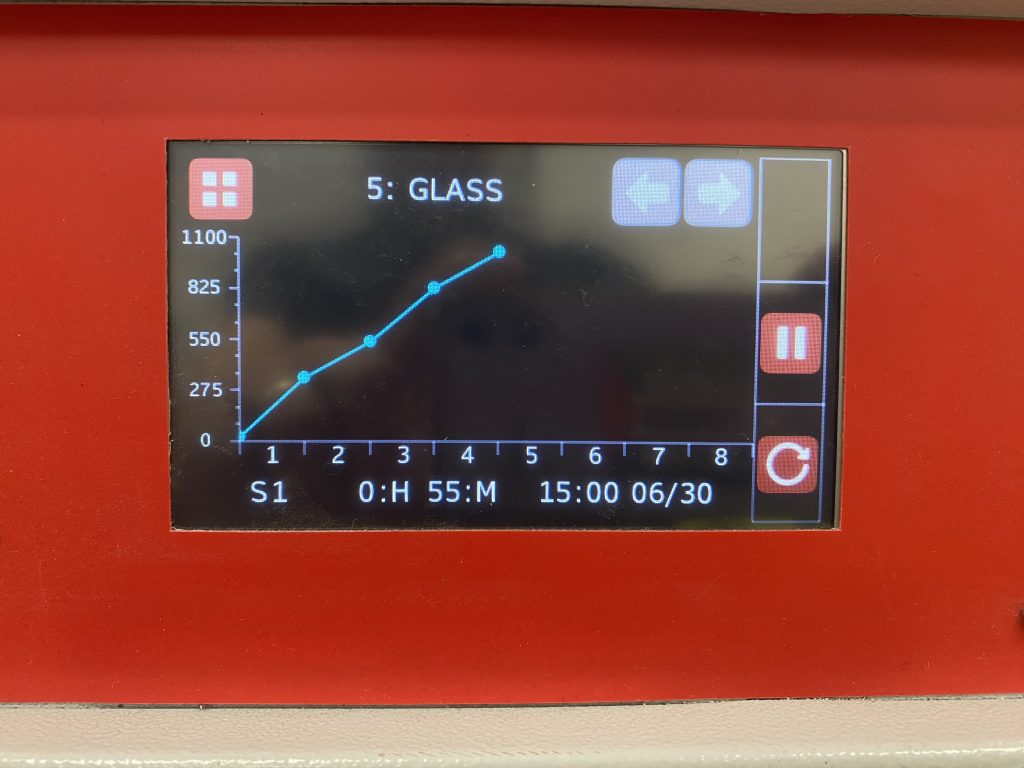
The above photograph shows the kiln just as it reached 1000 degrees. I was told in Spain that glass melts at around 850 degrees, and so in theory 1000 degrees would be more than enough. However, it was possible to see into the kiln, and although the glass had adopted a sheen, it clearly had not yet liquified. So we carried on upping the temperature.

Above is the sample Nacho had made so that we could pull it out and see how things were progressing. When he pulled this out the glass was red hot, however, as it cooled it became apparent that the clear glass fragments had liquified whilst those of milk glass were still recognisable as fragments. The differing colours were indeed behaving differently.

I had to be in university by 5pm and so at 4pm Nacho switched off the heat source and allowed the kiln to start the cooling process naturally. We could see that some of the glass had indeed melted, whilst other glass hadn’t. The mix above of clear and milk glass had the texture of a rice cake, rather than the smooth and solid block we were looking for. On the plus side, it did release from the clay mould easily, in spite of the fact that the aluminium tray had melted.

This blue example was perhaps exactly the opposite. It seemed to have melted well, although upon close inspection a crack could be see running diagonally across the block.

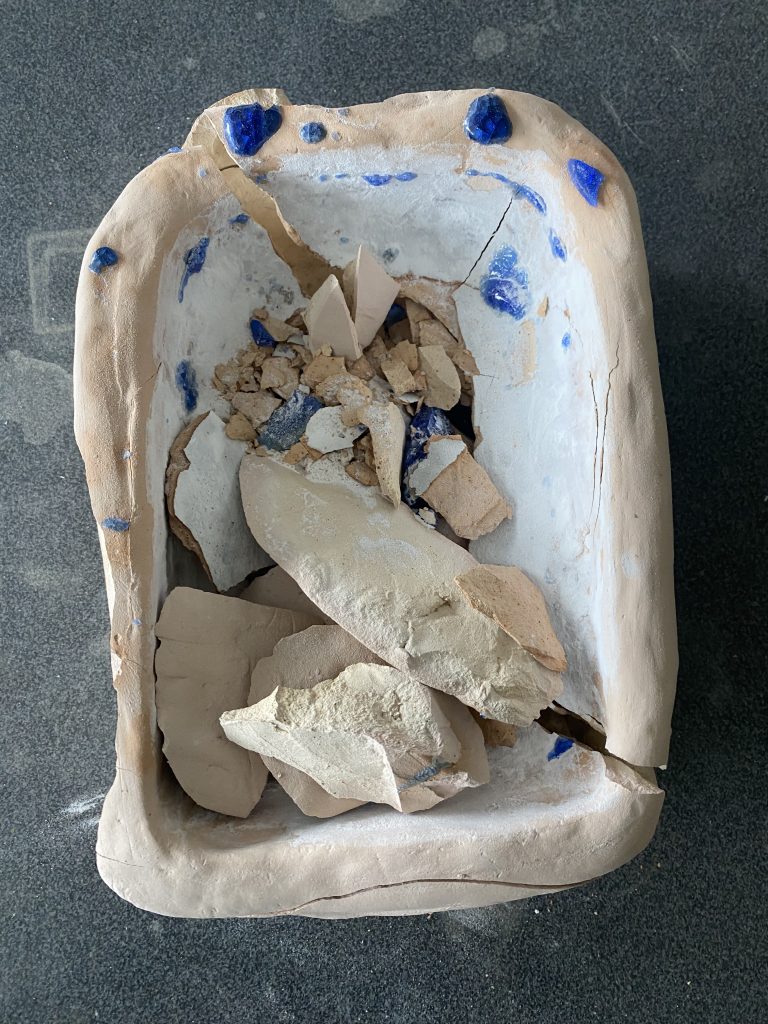
Because this looked like a promising candidate we tried to release it from the clay mould, but this one had attached itself to the clay, and you can see the results of our attempts.

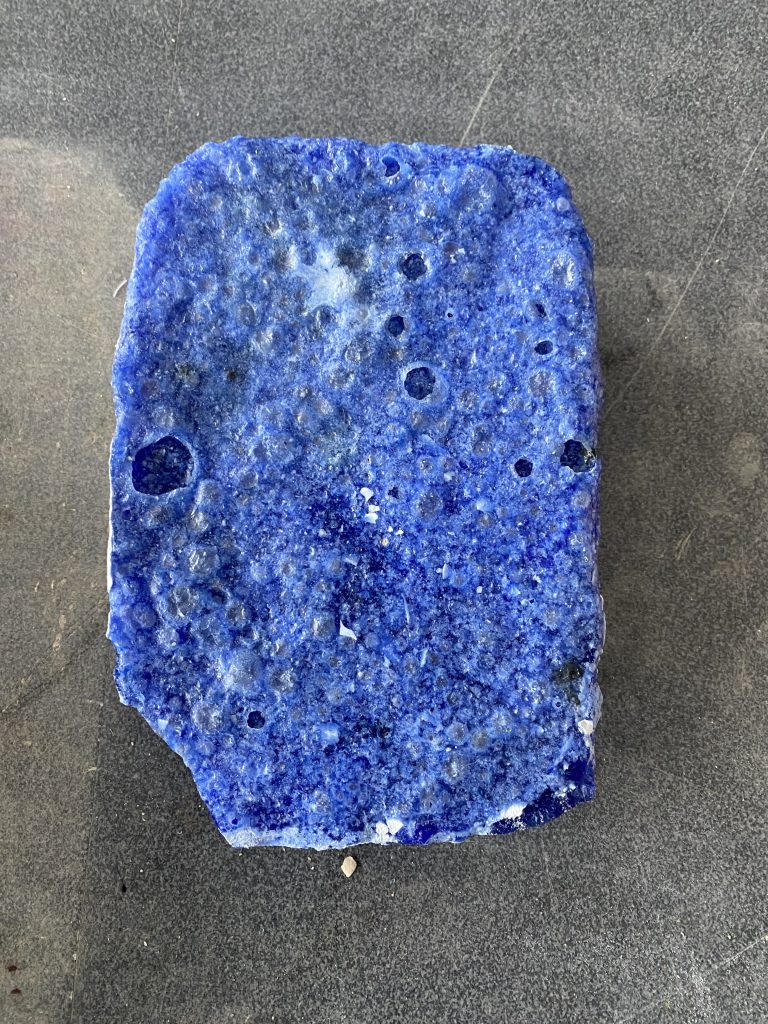
This blackcurrant glass also looked promising, but the thing to note here is the bubbles. This must have cooled very (too) rapidly to capture the bubbles like this. Perhaps, if we don’t want bubbles then the heat should be turned down rather than turned off in order to make the cooling process more gradual.

This second blue one looked similar to the blackcurrant glass on the surface, however, when I tried to release it from the mould the internal structure was revealed, and that also contained bubbles. None of the six slabs were suitable for Knapping, so what did we do wrong?

I think we should have kept increasing the temperature to above the maximum of 1018 degrees that we got to on the day, in order to identify when the most difficult milk glass will melt. A second thing is to slow the cooling process so that bubbles have the chance to settle before the glass starts to solidify. We also need to consider alternative mould methods, as the aluminium takeaways, whilst not the main issue, didn’t help by melting.

We didn’t get what we wanted, but we did get plenty to think about!

< Older posts

© 2026 Learning Through Making. All Rights Reserved.

Up ▴