Experimental production of stone tools

Category: Thoughts (Page 1 of 3)

What’s going on? Part two…

I have had some time to sleep on it (not literally), and some more ideas emerged.

I think actually two competing and contradictory ideas are being played out here. As concluded in the last post: perhaps this is a piece of art; inspired by Palaeolithic crafts people; and using the making process to highlight a different attitude and set of values to modern ‘waste’ materials. Perhaps that is what I am doing, and that is what this handaxe is doing.

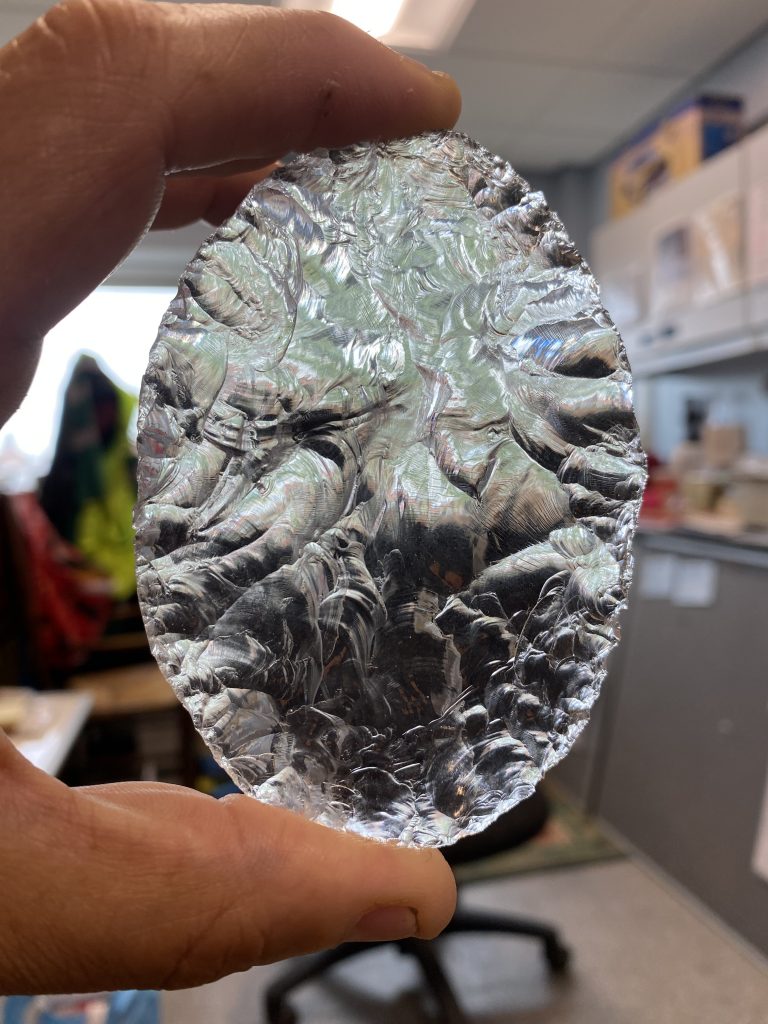
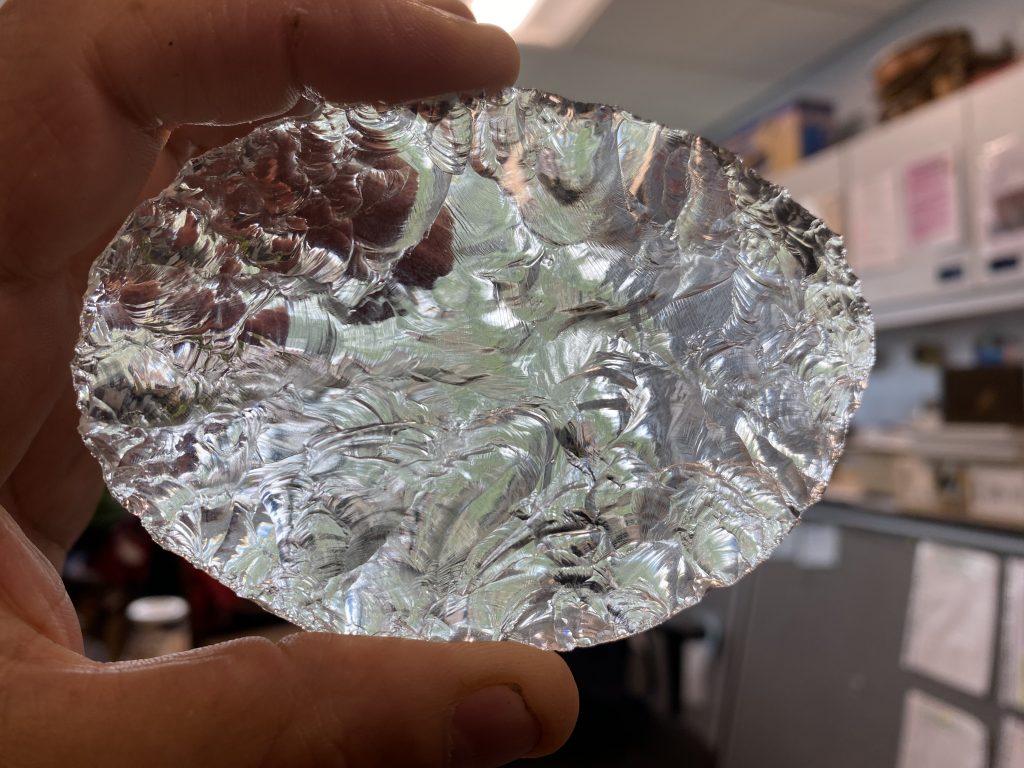
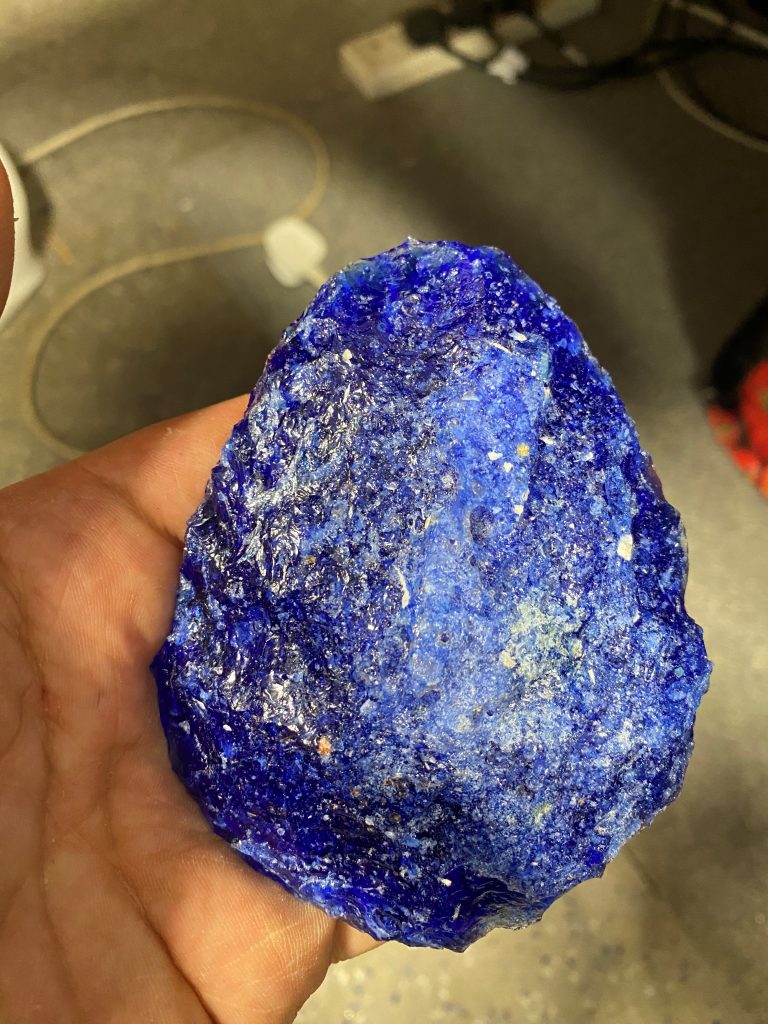
Idea number one: since the last post I have spoken to two of my friends who work with ceramics, Nacho Jimenez and Lee Page Hanson, and both have agreed to help me by producing some slightly narrower, slightly taller ceramic moulds. As discussed here, Holly has ideas about how the next furnace firing should unfold. There is also the invisible contribution of the people who originally made the blue glass, and then those who abandoned them in the1930s to 1950s for them to end up as a waste material, and then again in the recent past, the bottle diggers who have left the fragmented glass bottles on the surface for me to collect. Then there is my contribution to the narrative as a flint knapper. So, as an object this blue handaxe embodies a number of narratives as well as a number of skilled practices. Perhaps that is part of why I love it?

Idea number two: however, as previously discussed, I also love the recycling of the glass that goes into this, to highlight a different approach to valuing materials. It has occurred to me that this ‘eco narrative’ actually embodies a series of energy intensive processes, such as the the kiln use for the production of the moulds, and then the furnace use to melt the glass to form the block. In that respect this handaxe also has an industrial narrative, using probably non-renewable resources in order to make a statement about the value of recycling materials. In that respect this blue handaxe embodies an inherent contradiction, something I am not so enamoured by.

That’s where I am up to, and today is a day off!

What’s going on?

What is going on? I am an archaeologist, so why am I getting super excited about creating Palaeolithic tools from materials unavailable to people in the Palaeolithic past? Furthermore, this seems more to be an exploration of my own particular aesthetics, albeit with a link to crafts people in the Palaeolithic past. Perhaps they are my inspiration here? Essentially, this process is telling us nothing about Palaeolithic people, so is it a vanity project?

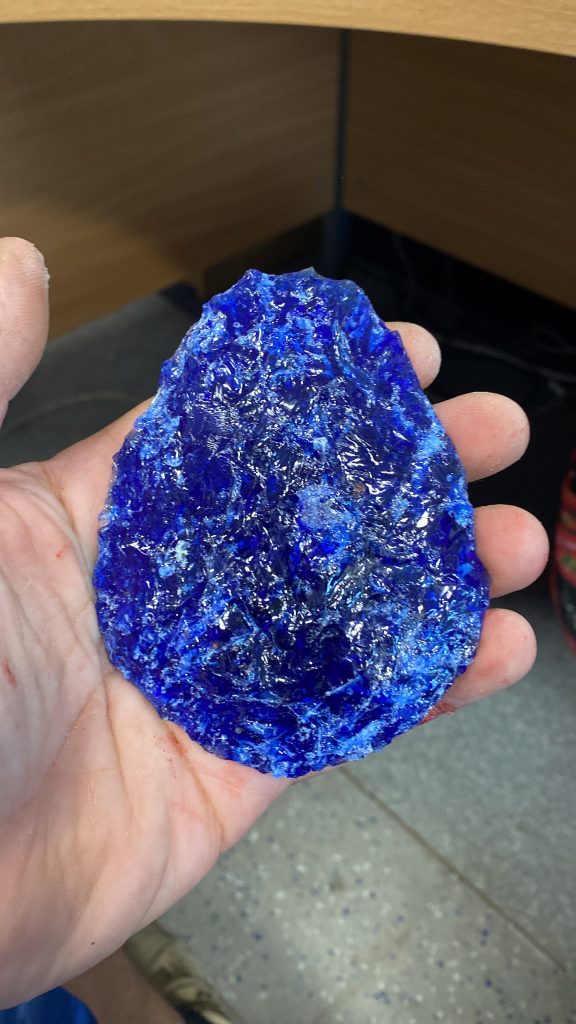
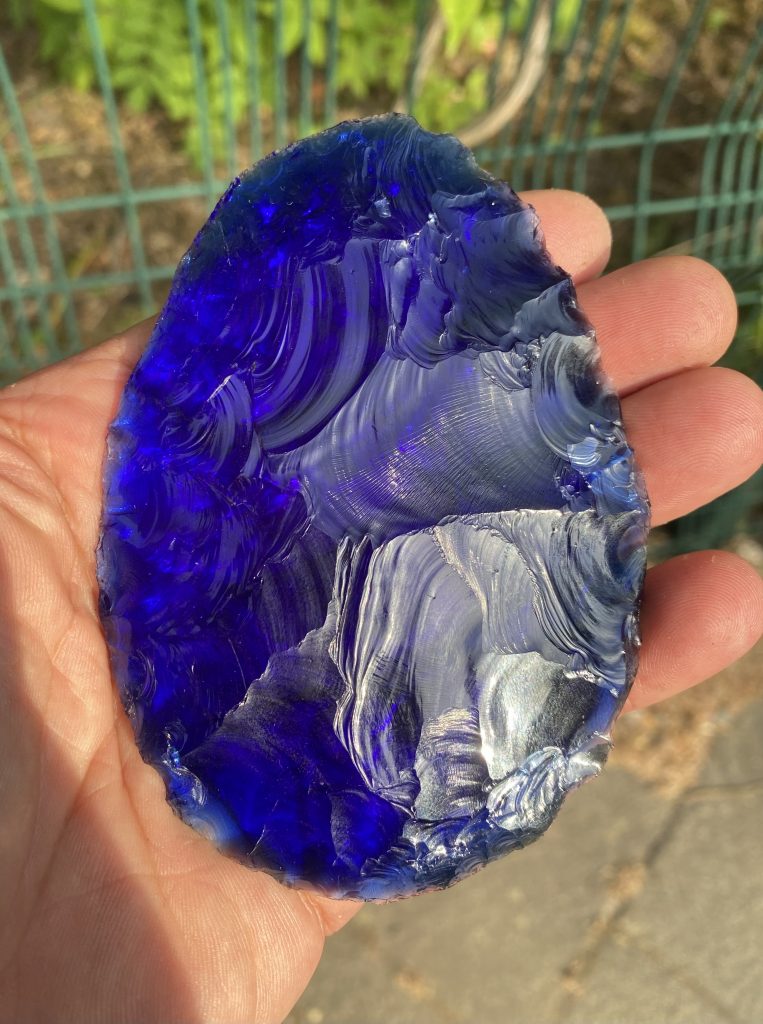
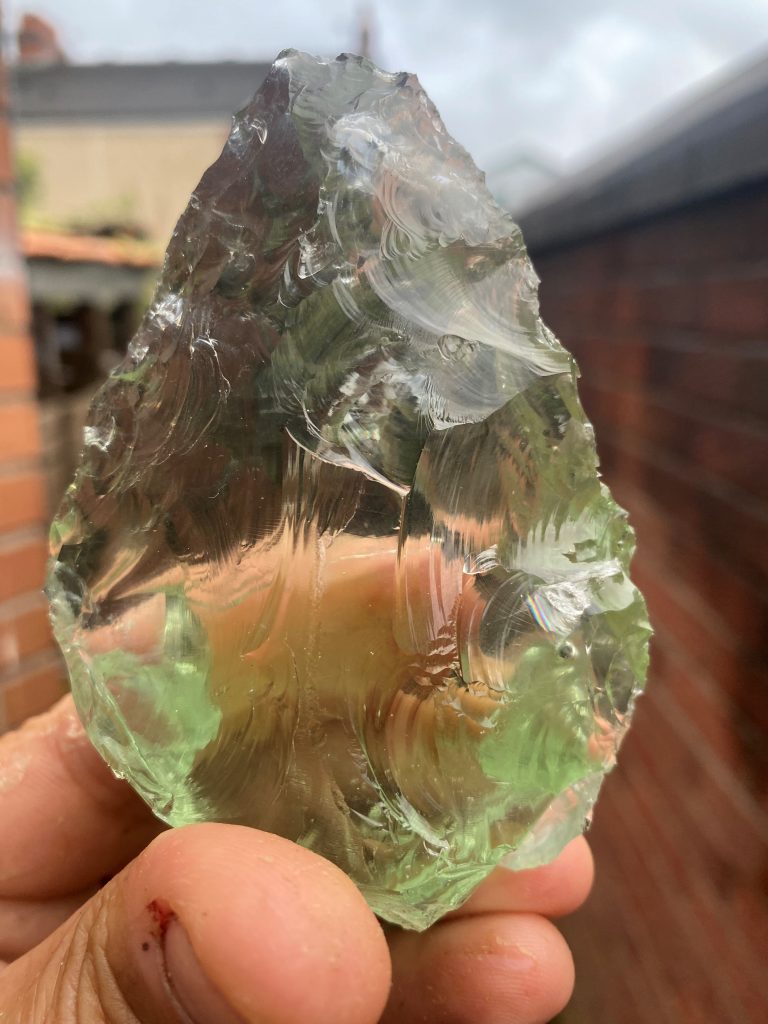
This particular handaxe is not perfect, but I love it. I actually love its idiosyncrasies’, the lumpy central line I couldn’t remove. It fits together perfectly for what it is, in spite of not being something else? By something else I am thinking of my last blue handaxe, classically aesthetic, with smooth, long and clean removals.

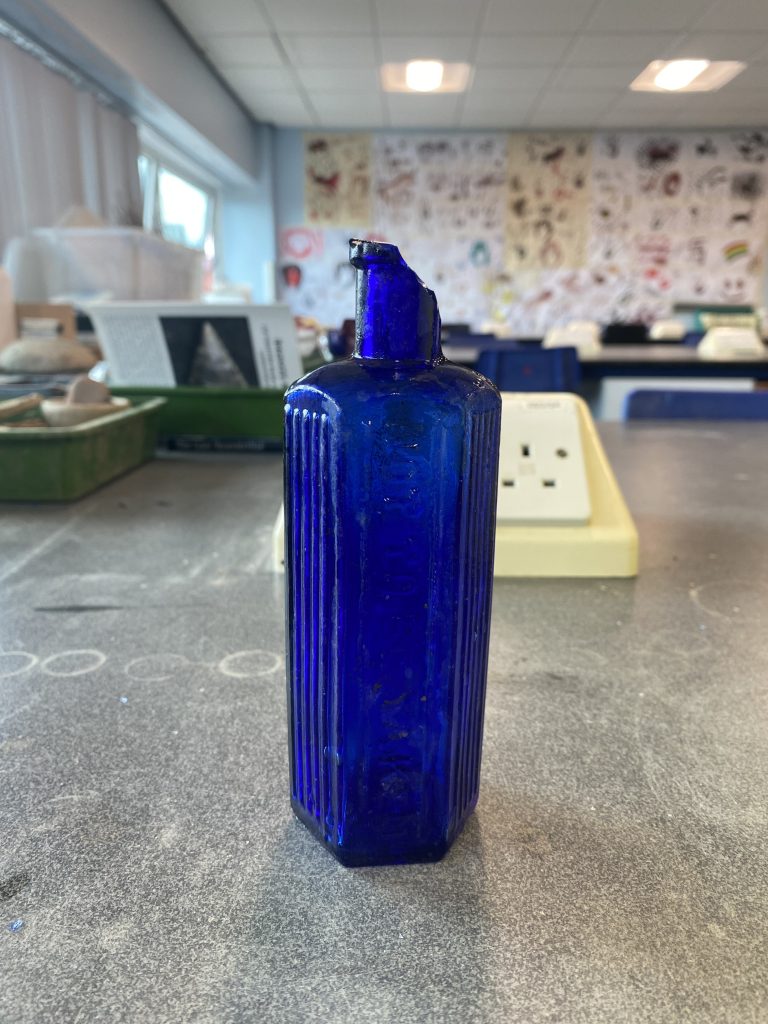
I immediately thought, well I collected the glass for this most recent handaxe, and so that must be it. However, I bought the glass disc for the earlier handaxe, from a flea market so although not the same, I was still responsible for acquiring the materials. It may be to do with the extended process, involving mould makers and furnace drivers? It may also be that I am using a waste material, originally abandoned in the 1930s to 1950s, and then again in the recent past, by the bottle diggers who have left the fragmented glass bottles on the surface for me to collect.

I don’t know. As an archaeologist I feel this object should be adding some kind of intellectual value to our understanding of the Palaeolithic past, but it doesn’t. So, is it a vanity project? If so then all art could be classed as vanity projects. Perhaps this is a piece of art rather than a piece of archaeology? I also love the recycling of materials that goes into this, to highlight a different approach to valuing materials.

So perhaps what I am saying here is; this is a piece of art; inspired by Palaeolithic crafts people; and using the making process to highlight a different attitude and set of values to modern ‘waste’ materials. Perhaps that is what I am doing, and that is what this handaxe is doing.

Well now!

Well now. Lots of thanks to Holly Flannaghan, my technician comrade in Geography who has access to a furnace, and also does her research!

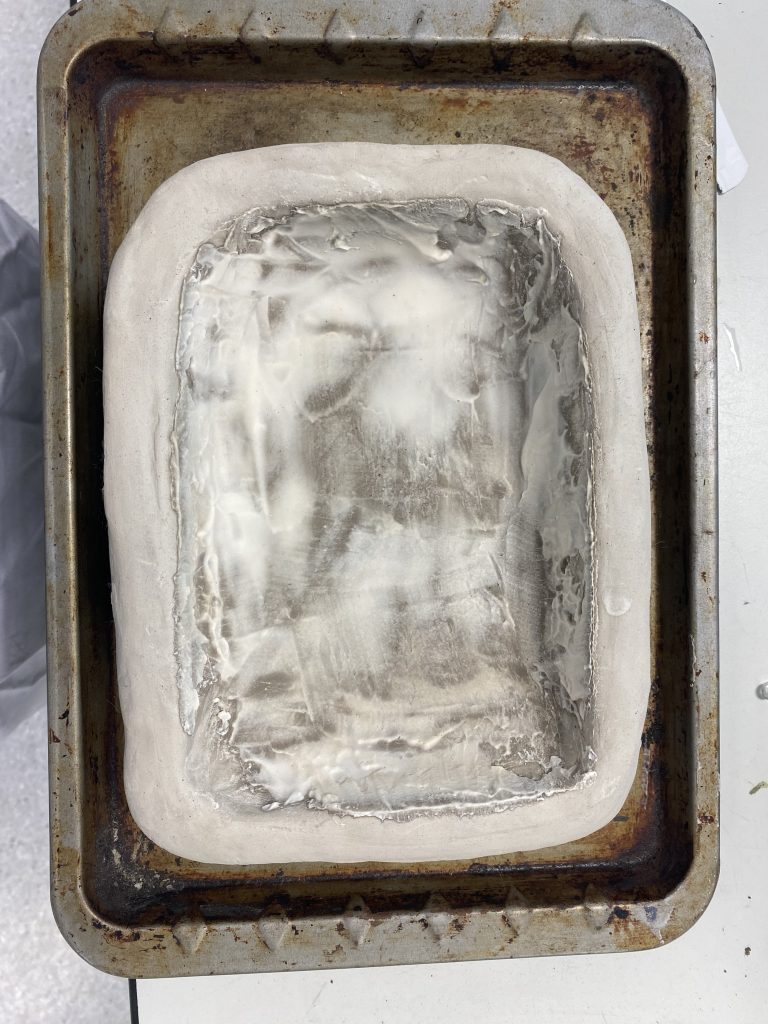
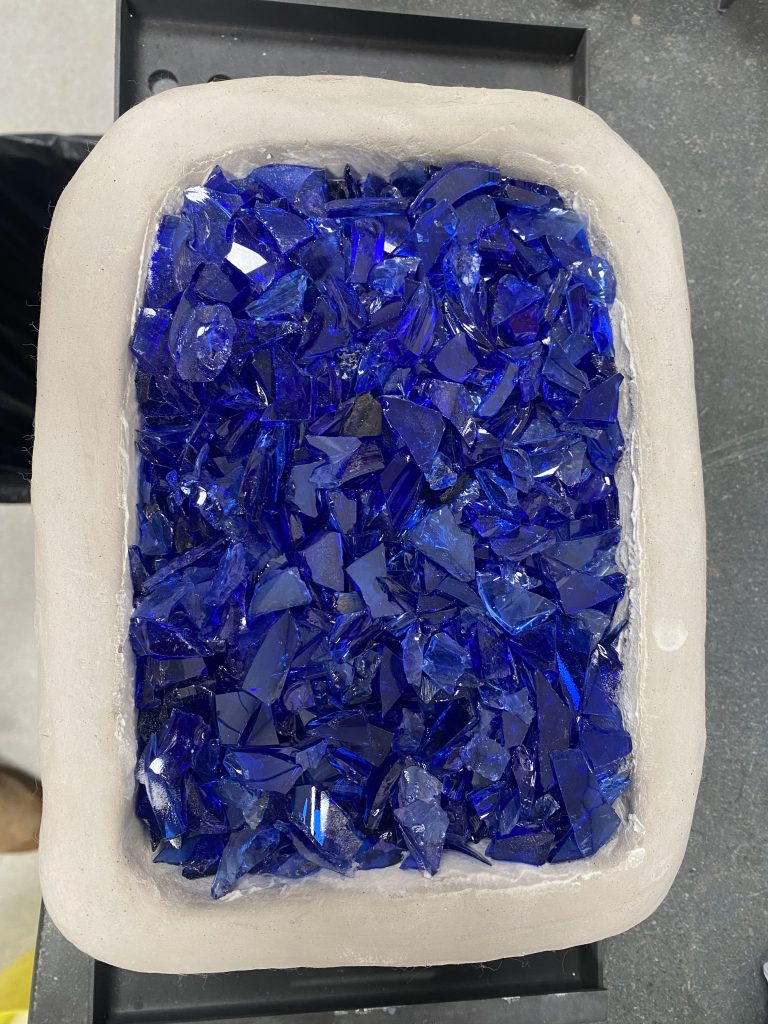
This is Alice la Porta’s mould painted with the Aluminium Kiln Wash to stop the glass adhering to the mould. It did more or less work. The mould was unfired and next time we may use an already fired ceramic mould.

I had three grades of glass cullet. Sand, sub-1cm, and above 1cm. We used the sand and sub-1cm cullet on the top to fill up the mould.

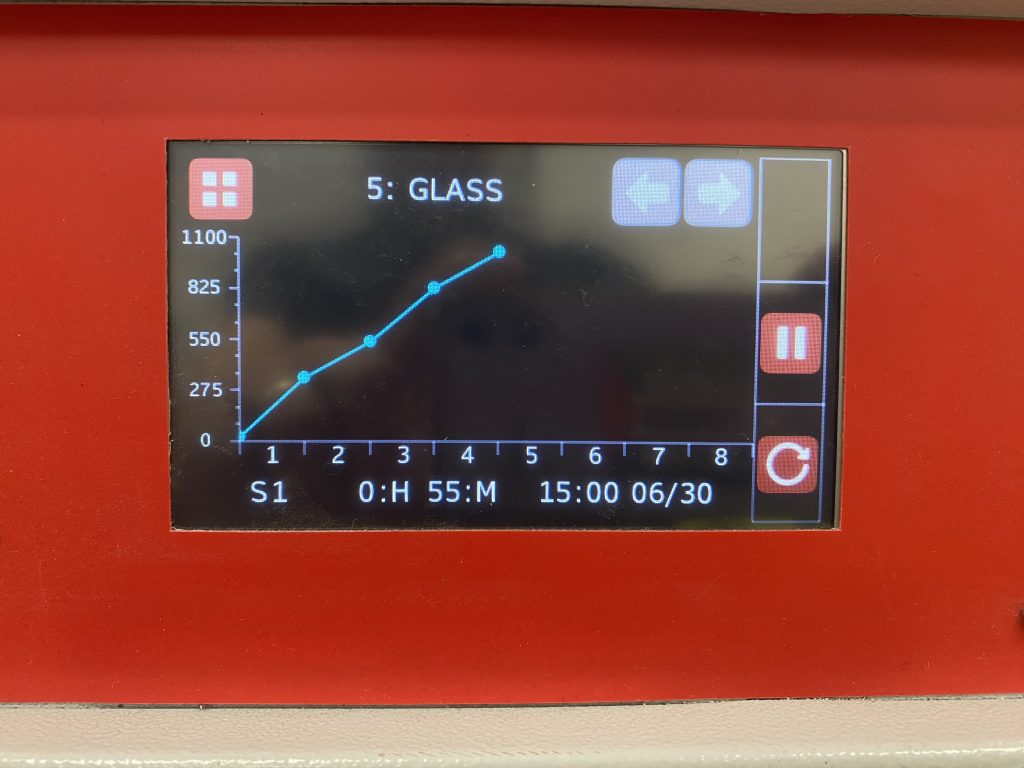
Then Holly performed her magic. Over four hours the temperature was gradually raised to around 1000 degrees Centigrade, and then kept there for two hours or so before starting the slow cooling process.

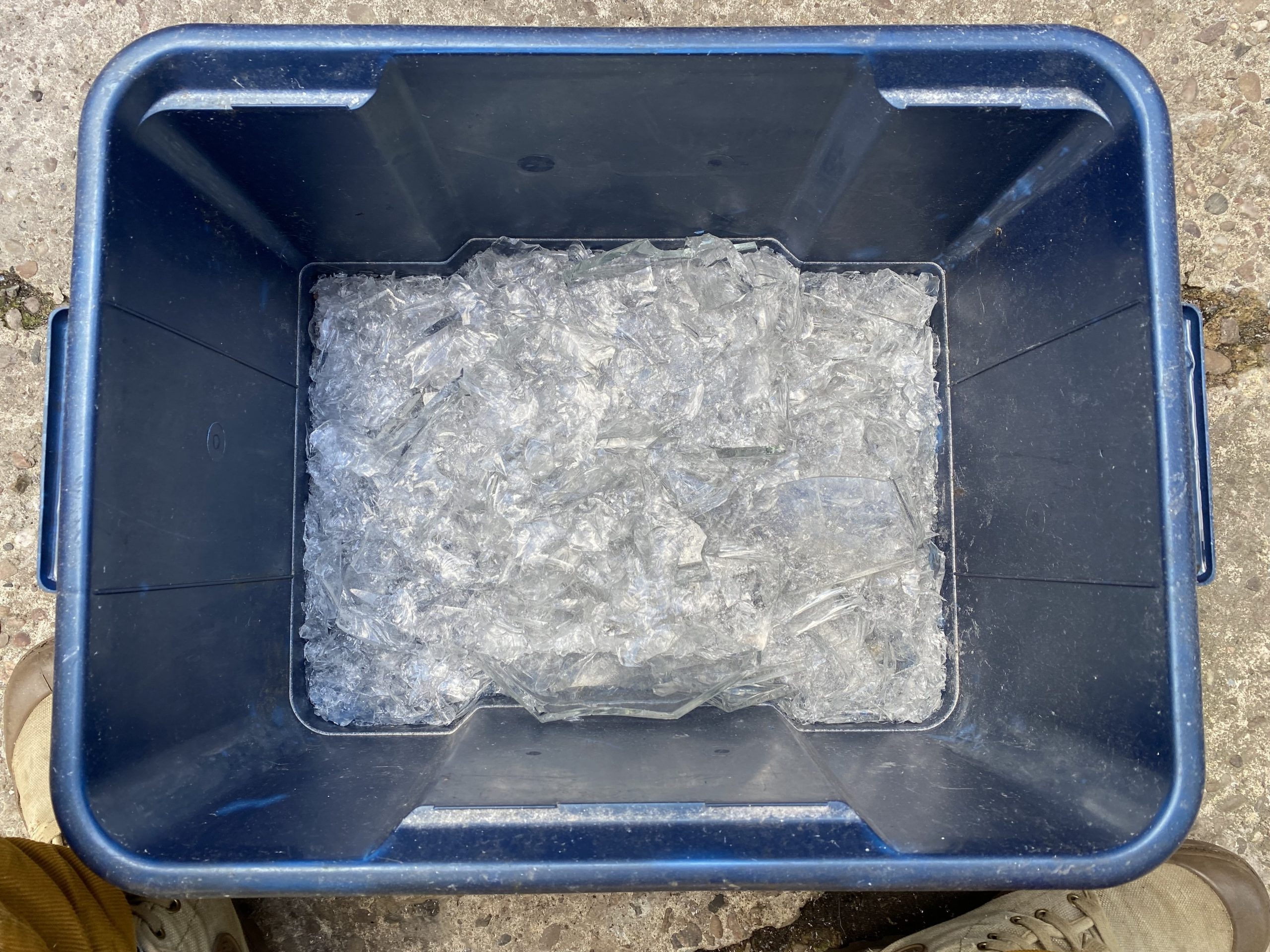
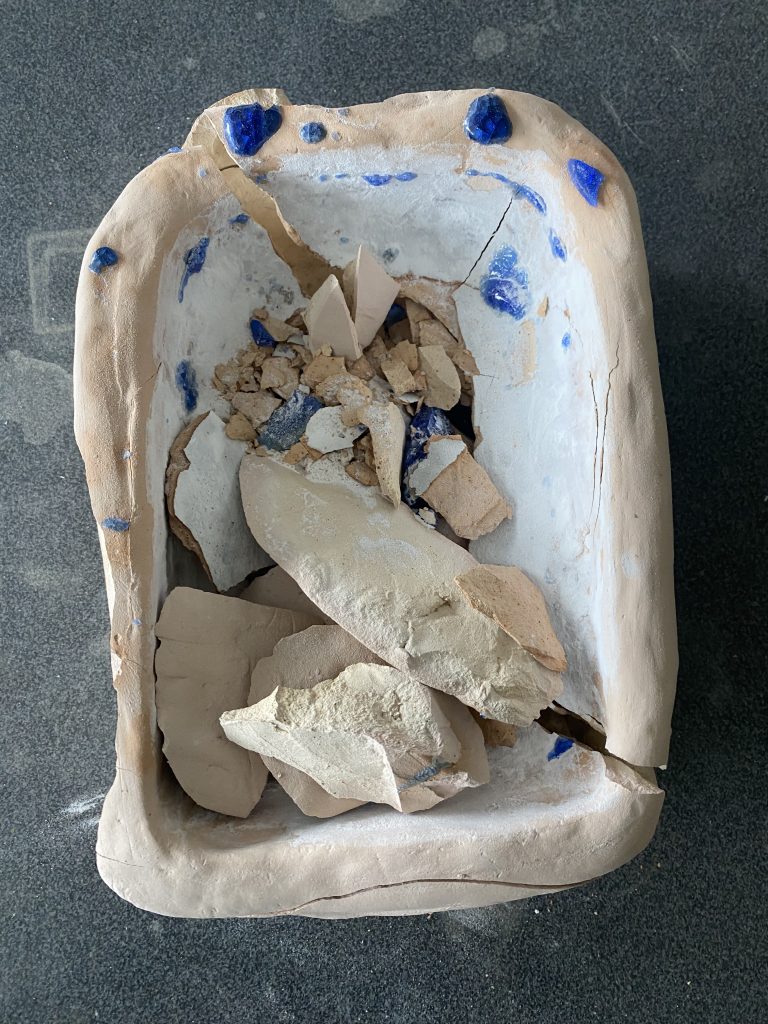
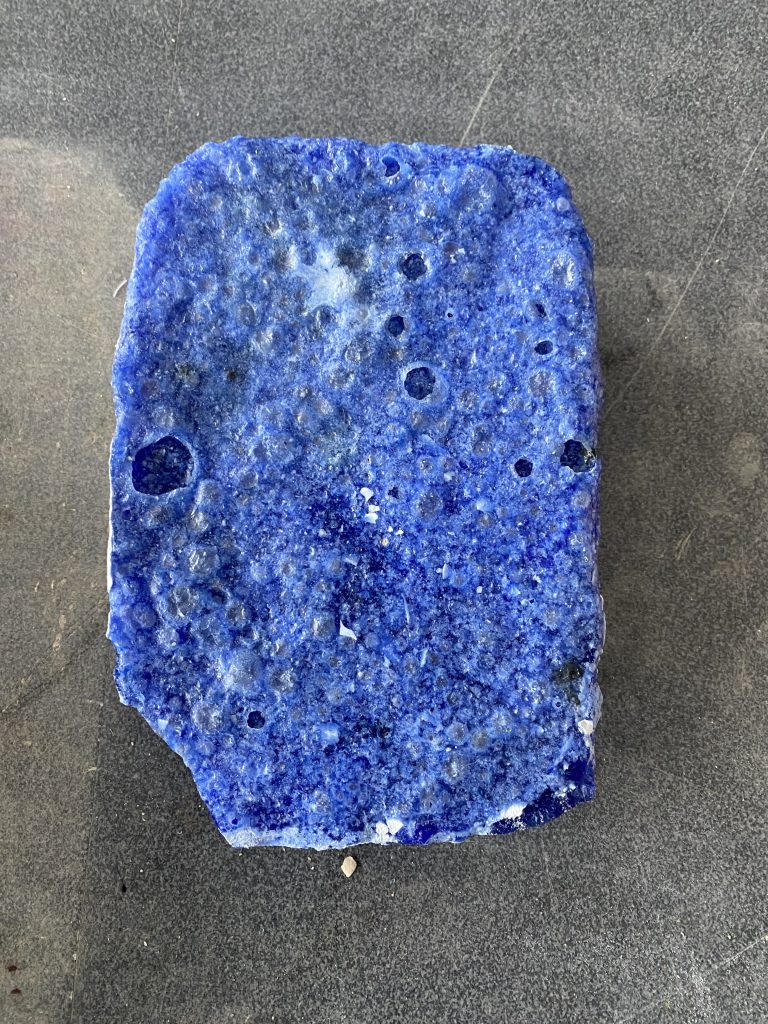
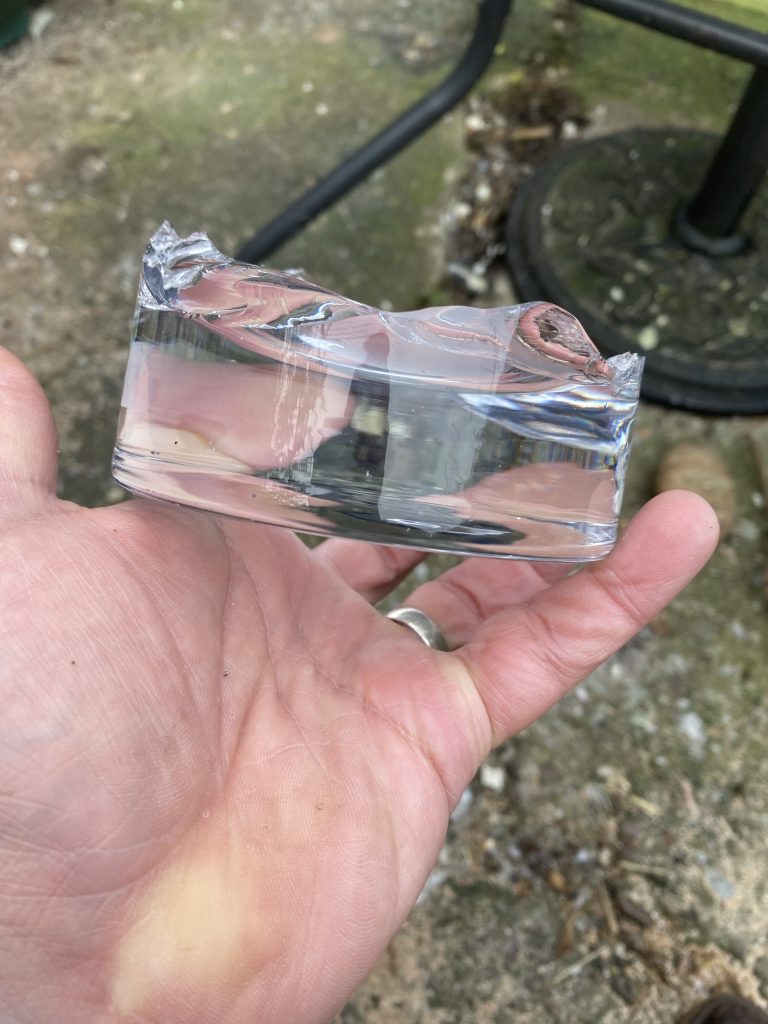
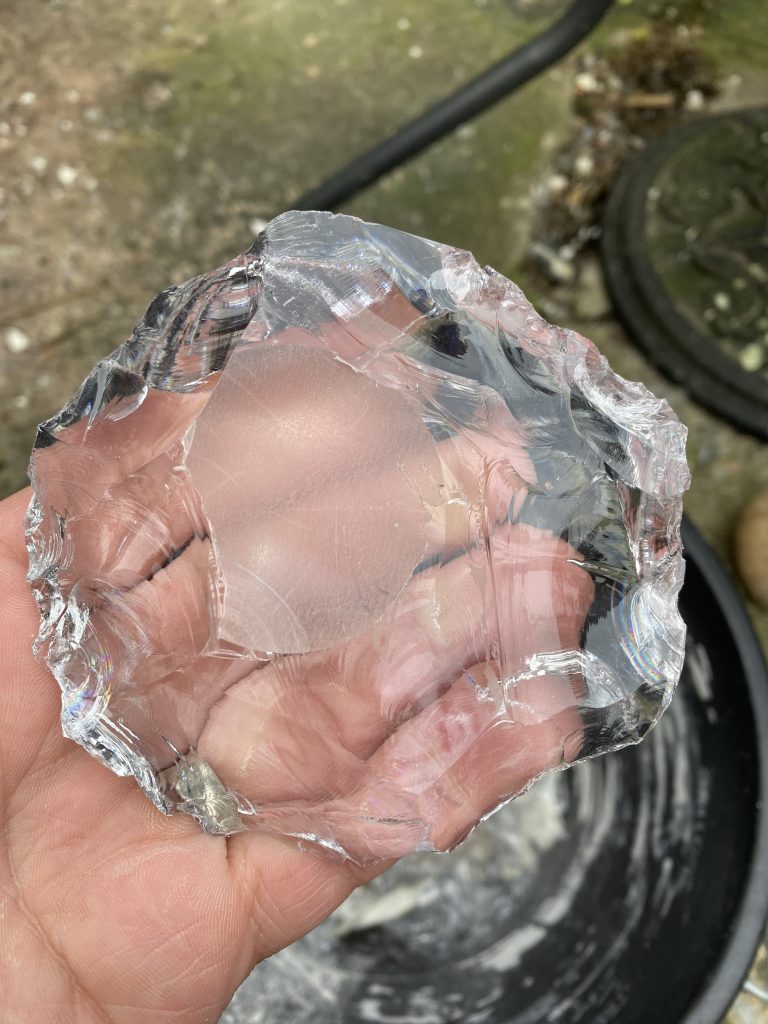
And one day later here we are. The Aluminium Kiln Wash worked but we had to break up the mould to get access to the glass. Once out the glass was actually thinner than I anticipated. The sub-1cm cullet must have had a lot of gaps that it had to fill. Next time we will use the sand only and a slightly higher mould to give the slab more depth.

The glass appeared not ideal. It looked similar to the fused glass blocks produced using Nacho’s kiln. However, once I started to work it I realised that it actually had very good internal cohesion. It flaked well although crumbly.

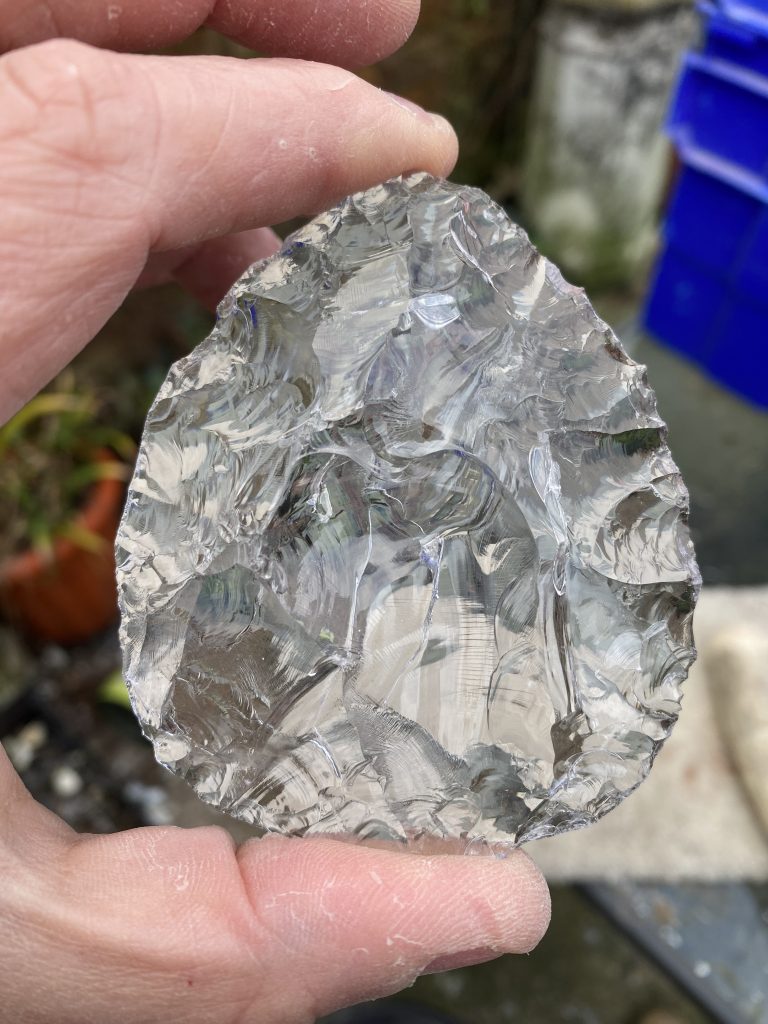
And this is it. The outcome but also a starting point. We need to adjust the mould size and make sure it’s already fired. Use sand rather than sub-1cm cullet and perhaps keep it at 1000 degrees Centigrade for around four hours before allowing a very slow cool off period.

I am actually super happy with this handaxe. Many thanks Holly!

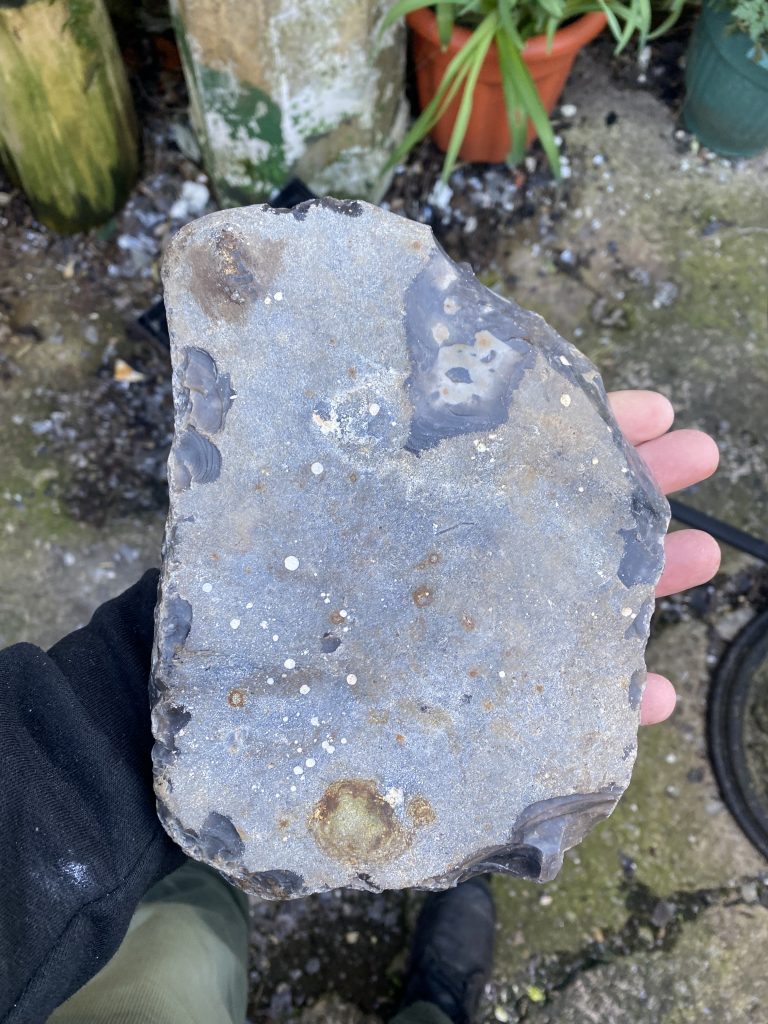
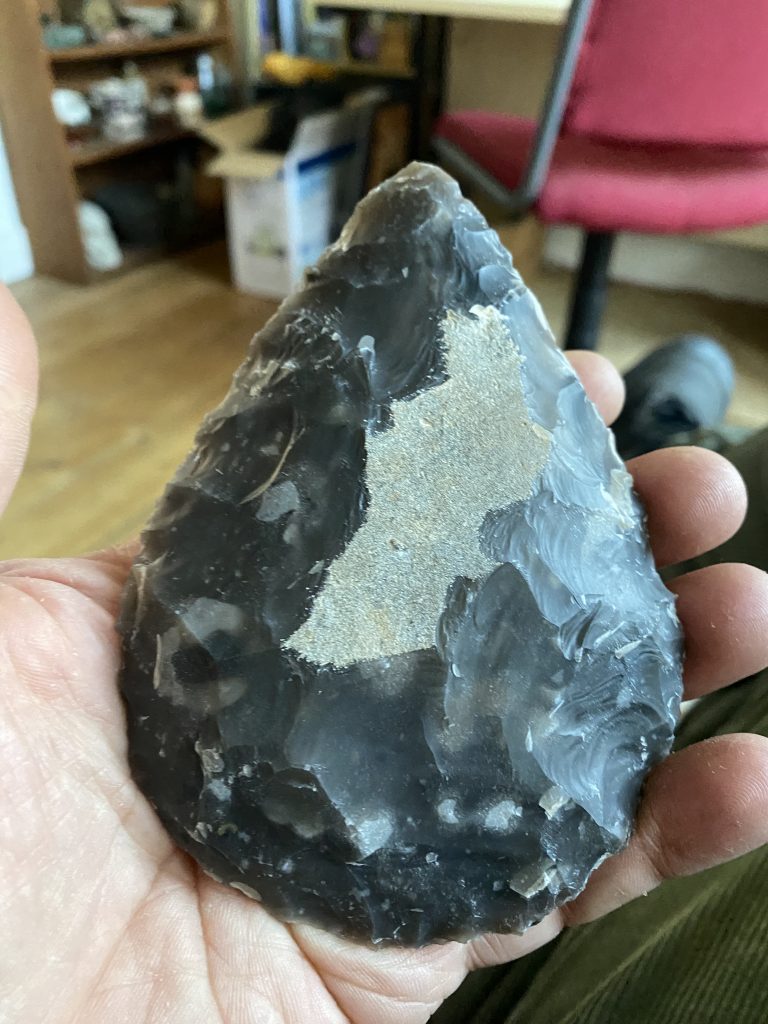
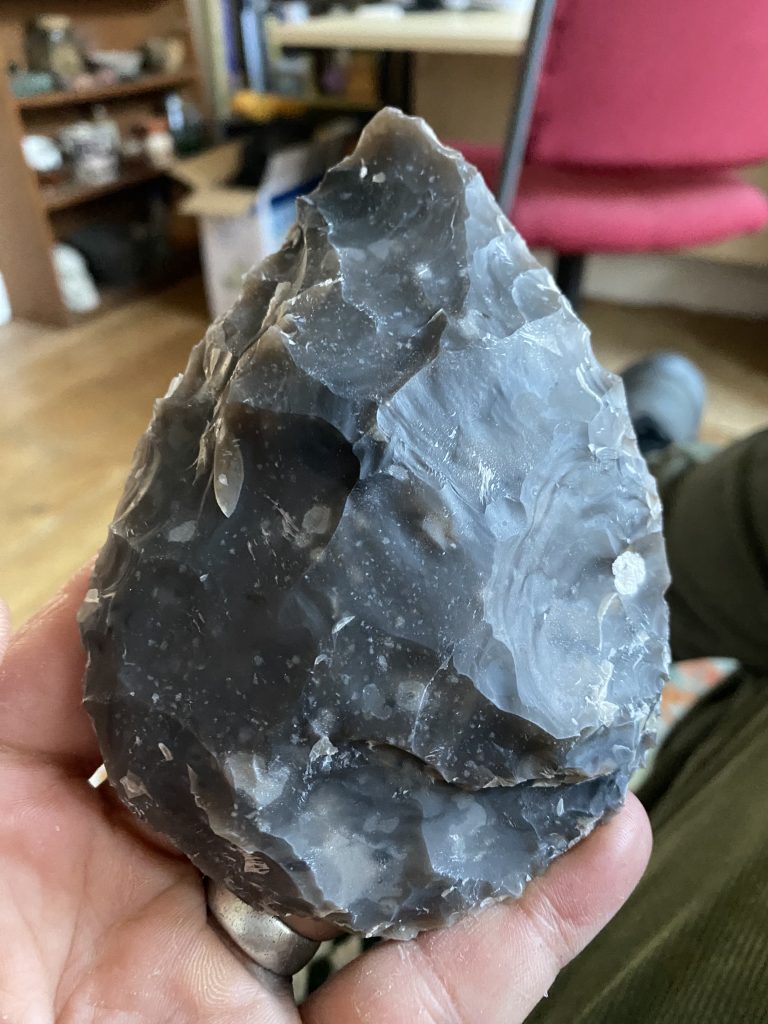
My step fracturey Barmson beach handaxe

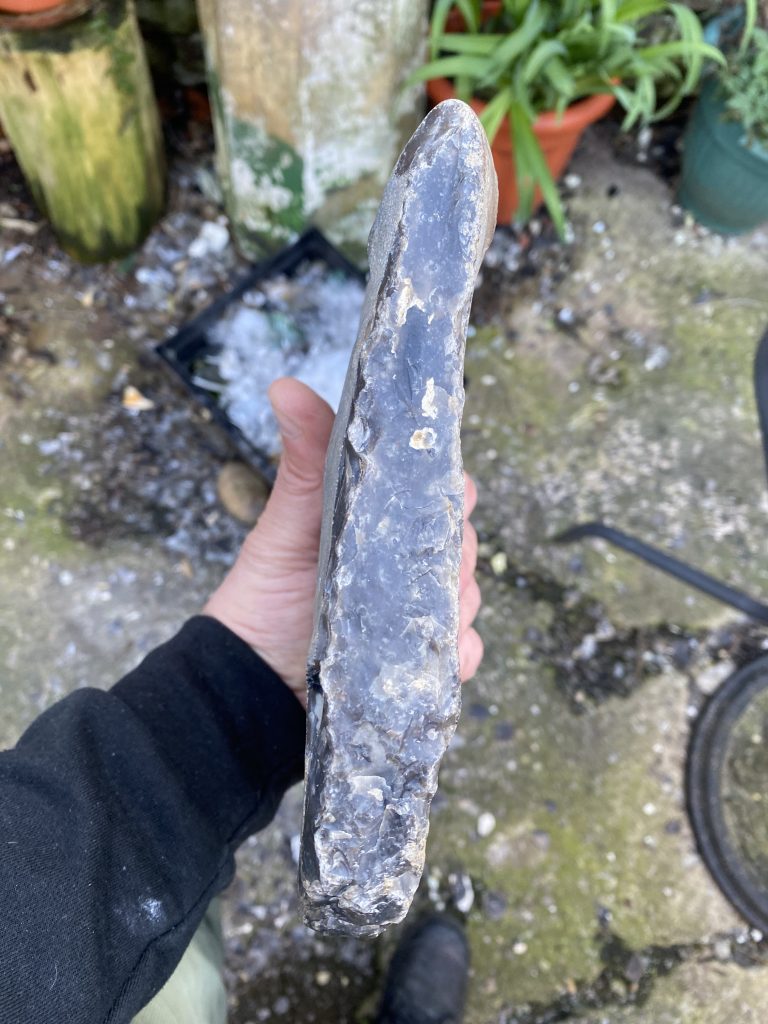
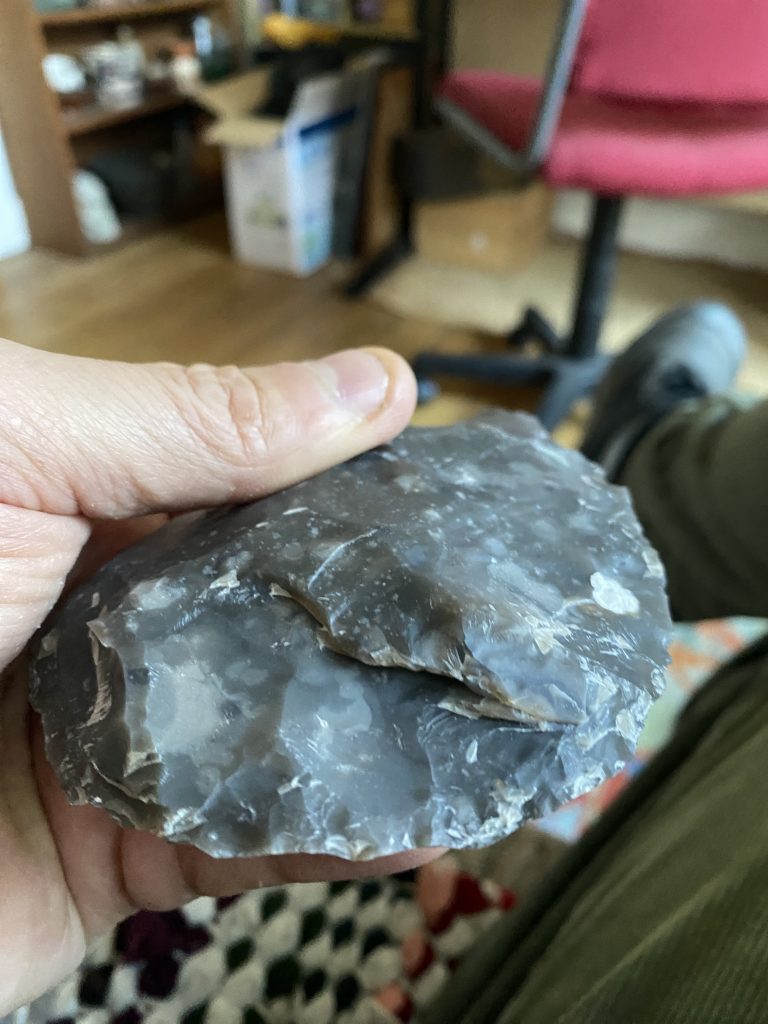
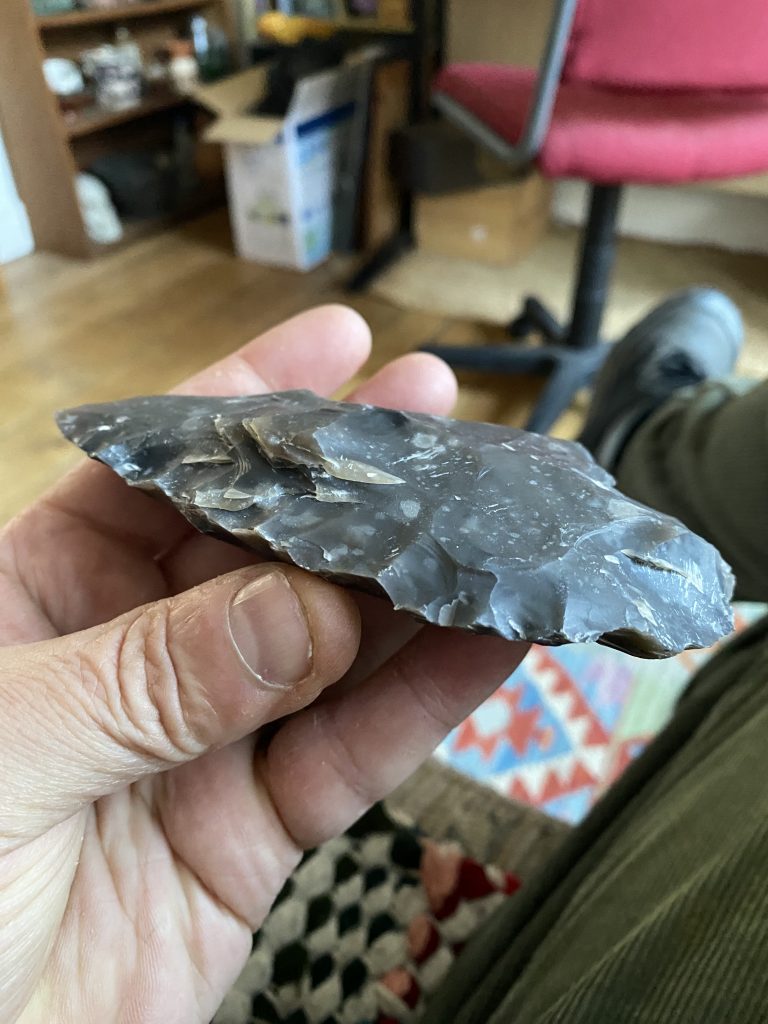
This afternoon I treated myself to two of the larger slabs brought back from Barmston. The flint isn’t as good as I remembered, or the pieces worked so far aren’t. The first one worked well with the hard hammer, but it had a very hard seam in the centre that disrupted the soft hammer blows. That one ended up in the waste flint pile.

The above two photos are of the second flat tablet, and it worked a lot better than the first. I was able to get a good rough out without any major endshock, all good.

And on this side that has worked. The flint fractured approximately according to plan, the edge is sharp and I am happy with the shape.

Flip it over and that’s when you spot the step fractures. That they are all on one side is, I think, something to do with how I work each surface differently, but I am not sure actually how I work it differently.

I think it may be to do with the initial turning of the edge, and by doing so I get a way in, but inevitably the angle is better on one side than the other.

Consequently I get to do all the nice stuff on the good angle side, and then have lots of step fracture action on the other when trying to bring the second face into line but without the suitable angles. That’s my current theory anyway, and fortunately I have quite a few blocks left to play with, and find out if I am right. Watch this space…

New Years Eve in the backyard…

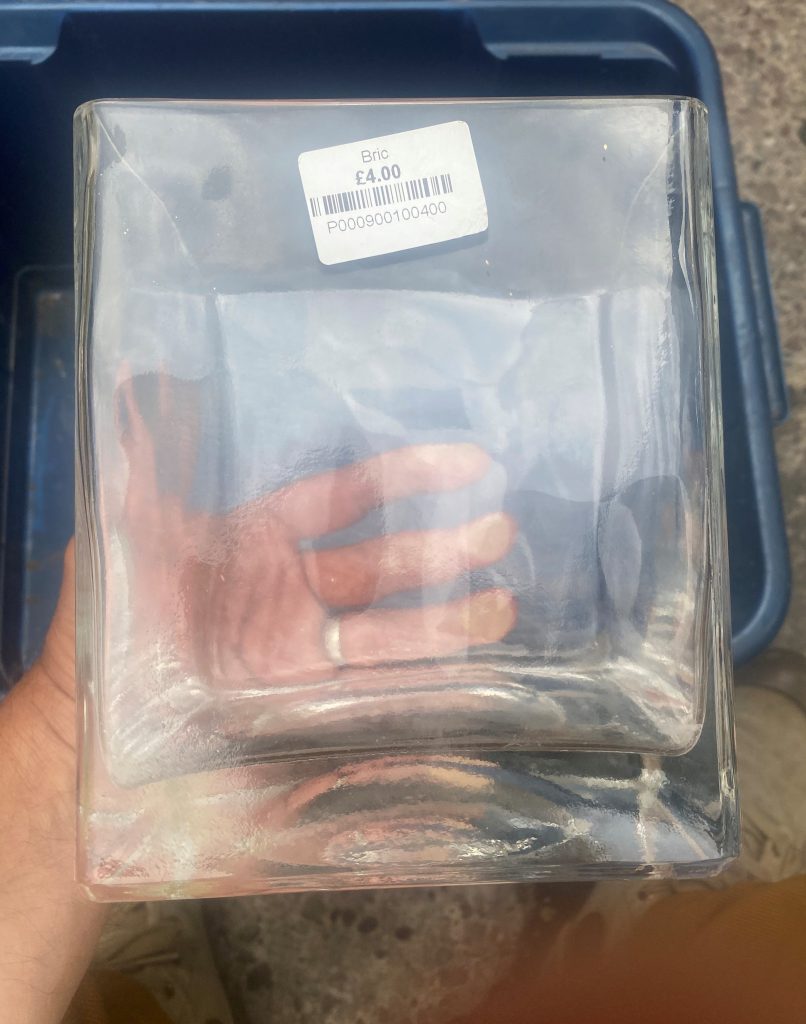
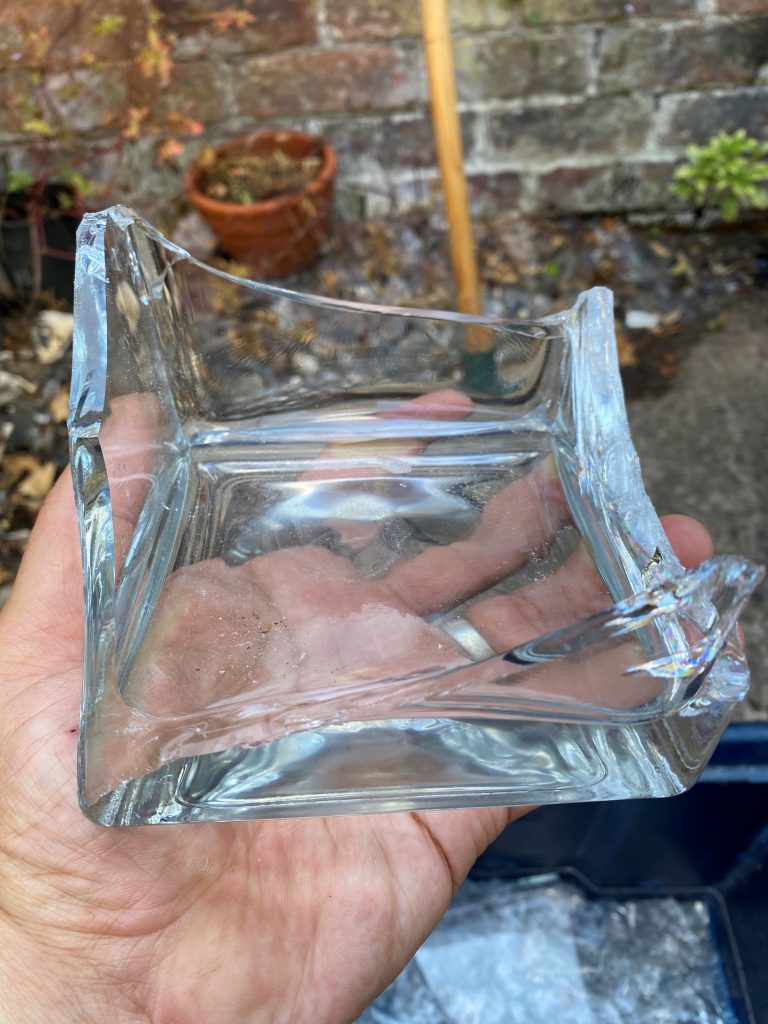
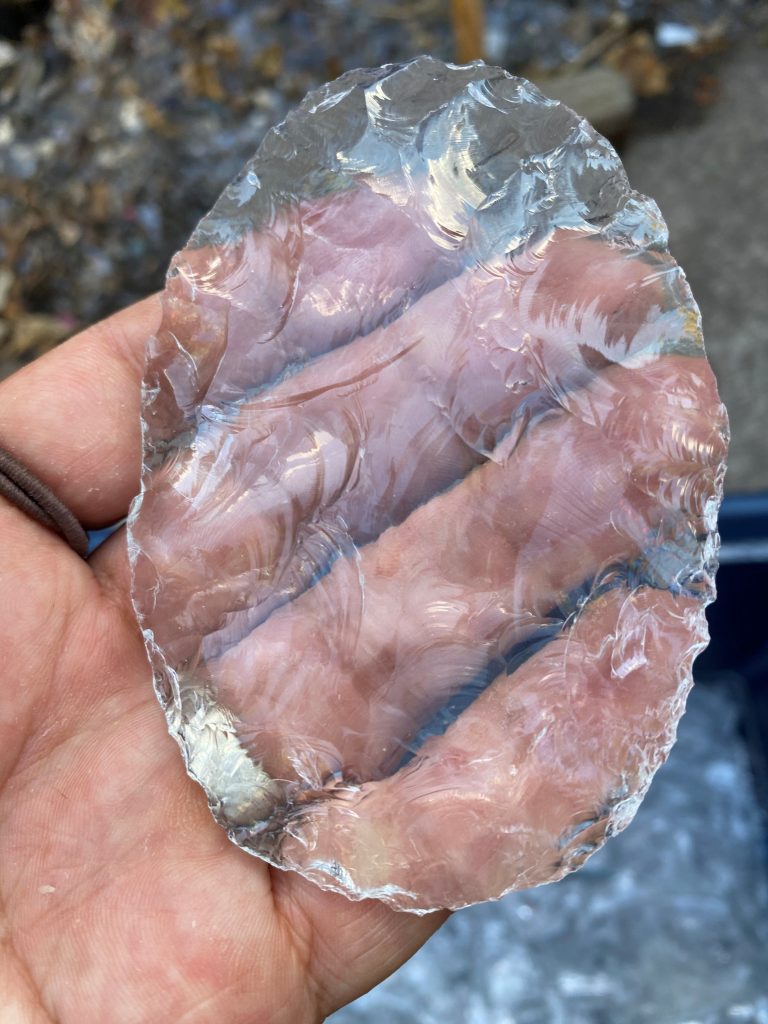
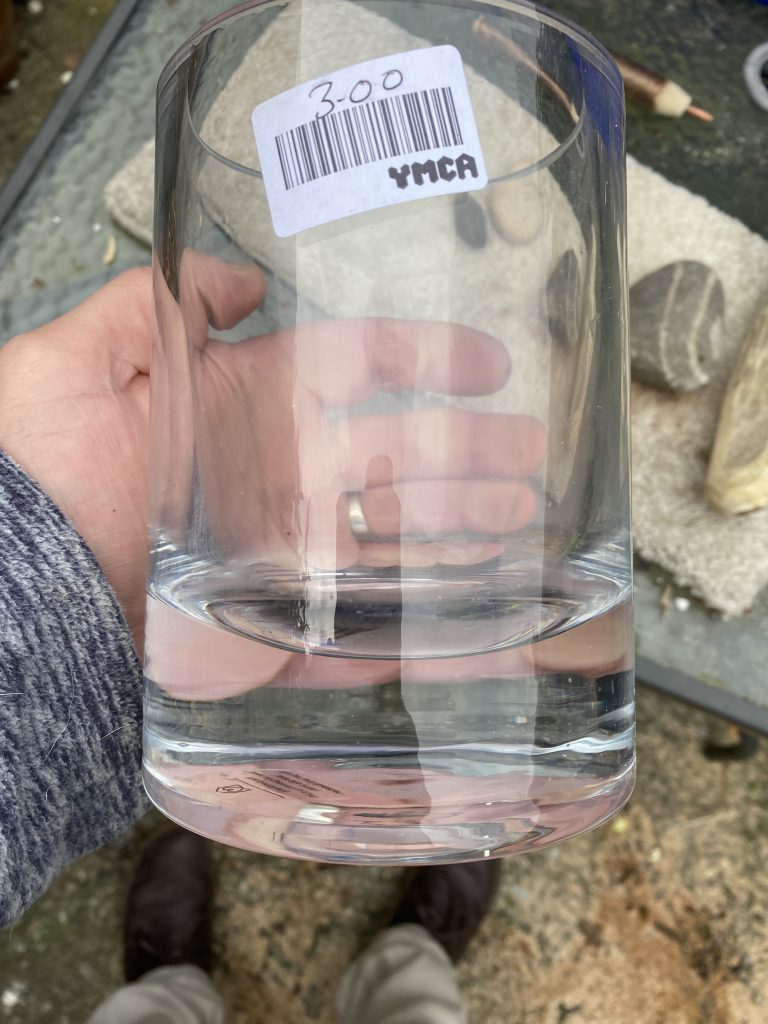
From charity shop to copper pressure flaker in around thirty minutes.

I used a hard hammer to get rid of the walls and isolate the thick base.

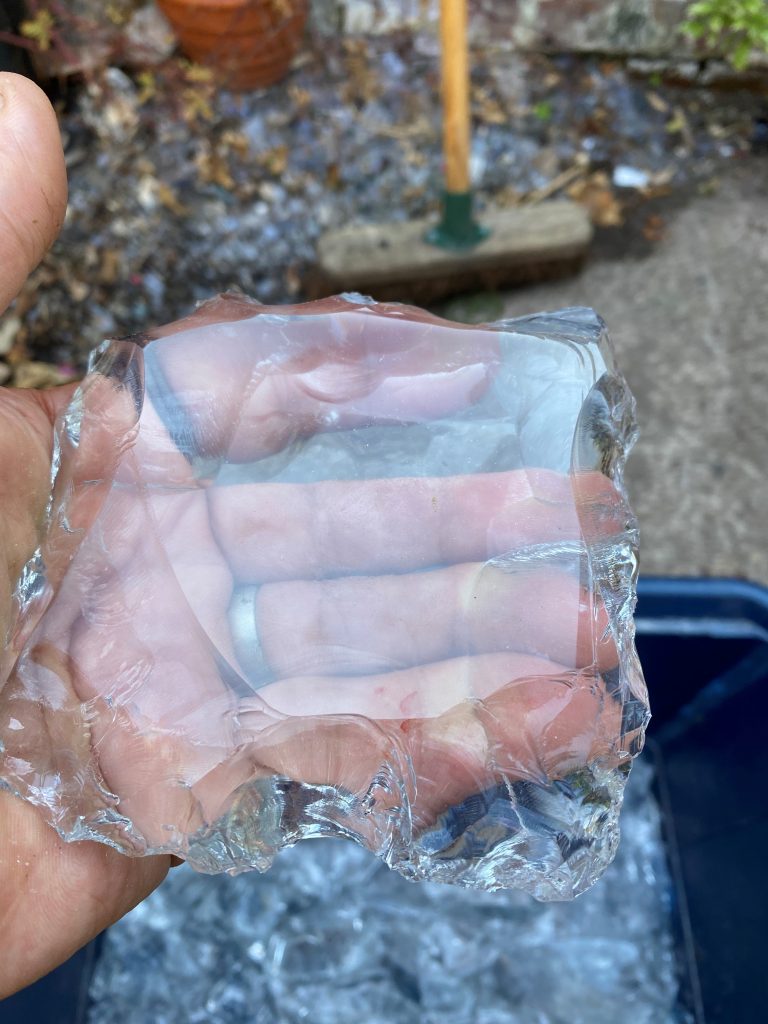
Then used the same hard hammer to ‘turn the edges’ of the thick base and create a ‘way in’ for thinning and shaping with the soft antler hammer.

Thinned and shaped with the soft antler hammer then finished with a copper pressure flaker. Here’s to a peaceful 2026 folks X

My latest dual heritage handaxe

I realised a good while ago that I am interested in categories and boundaries. This is because of my own experience, being ‘half-caste’ in the 60s, 70s and 80s, ‘mixed race’ in the 90s and by the early 2000s I had become ‘dual heritage’. These are all what are termed ‘etic’ or outside categories, how society has characterised me. An ’emic” or internal category would be how I characterise myself, and that would be as ‘Mancunian’. More than just abstract concepts, these labels have implications for the differing ways I have understood myself and been treated in the real world, hence my interest.

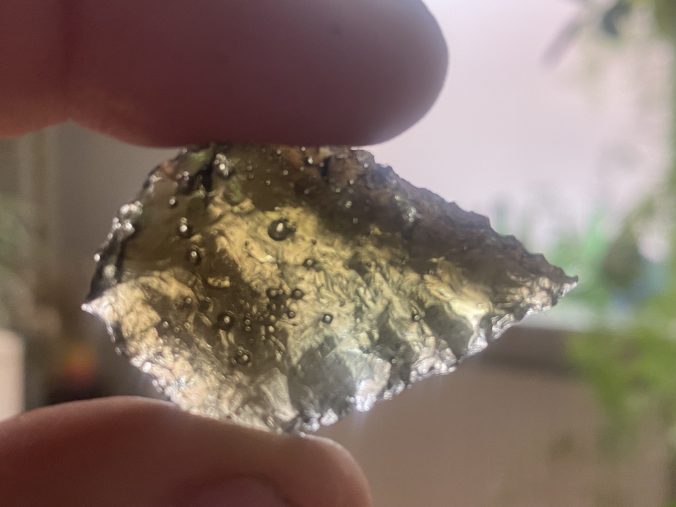
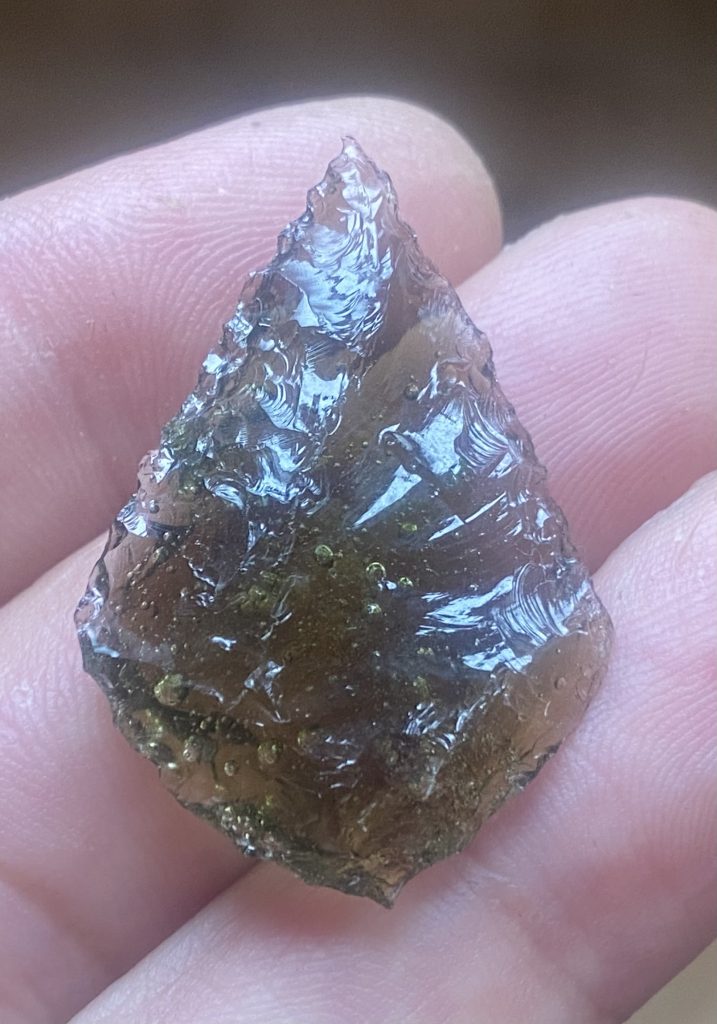
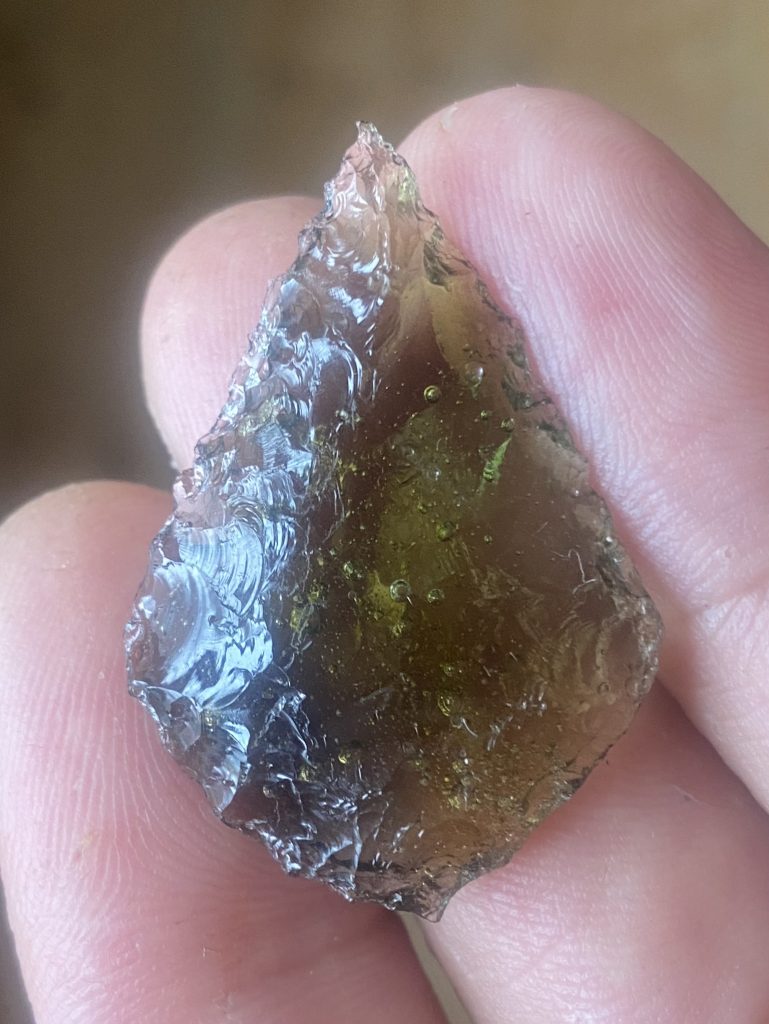
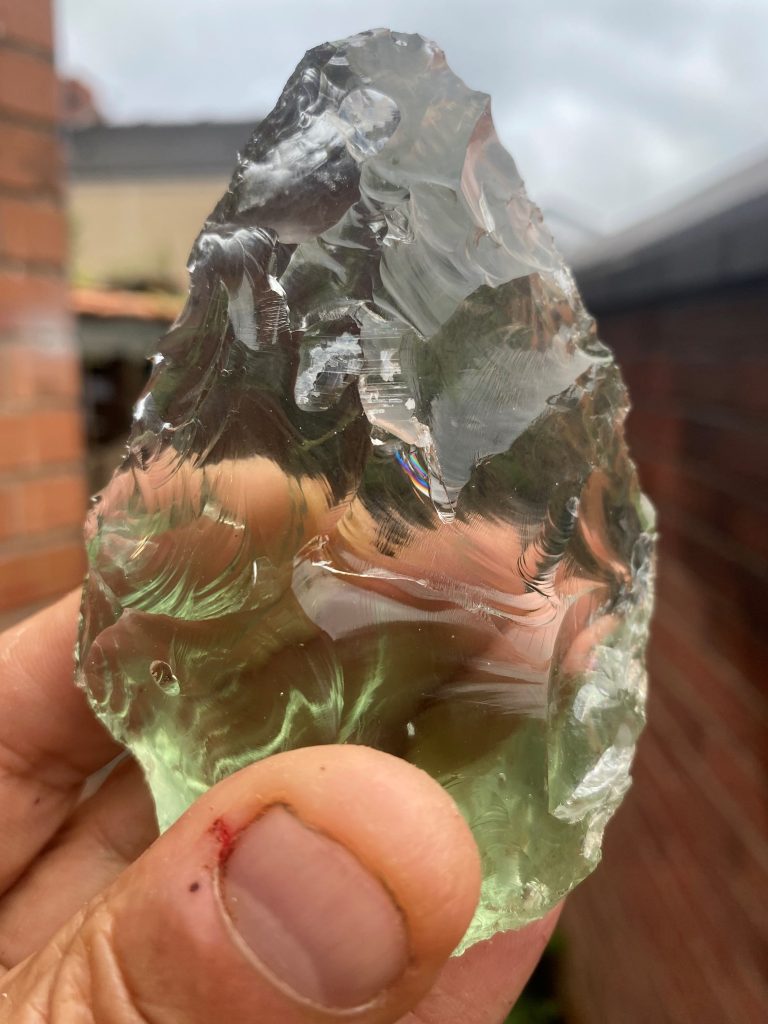
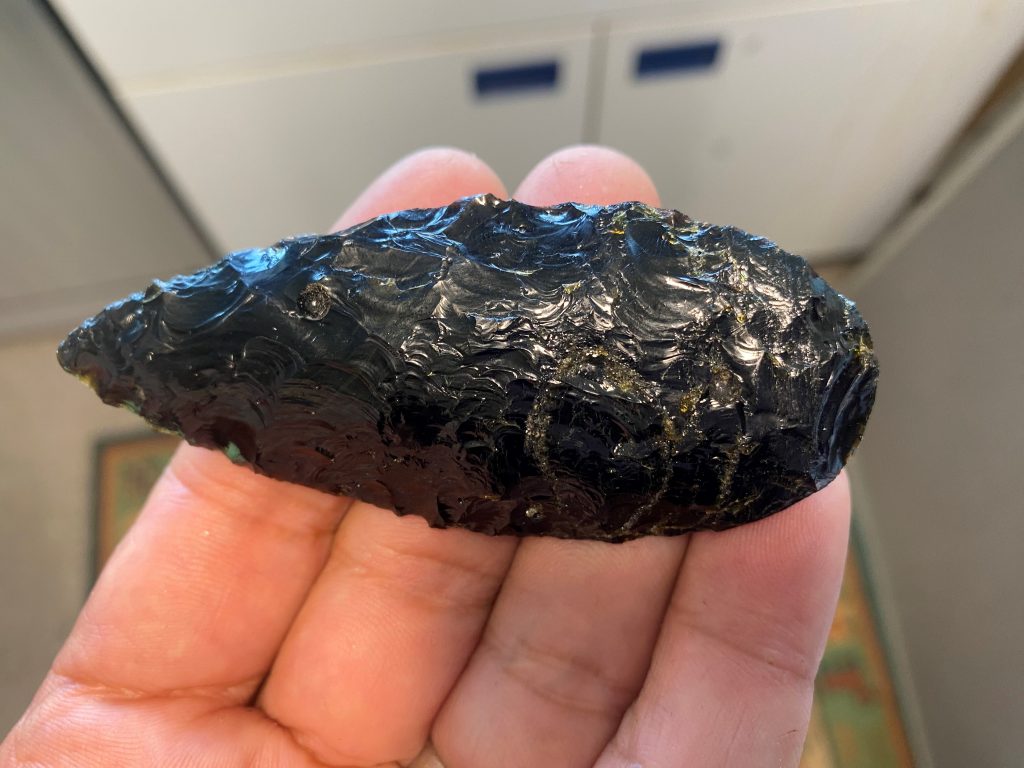
Onto handaxes. I am really liking this most recent offering. It is made from the largest piece of slag glass kindly provided by the folks at Salford Archaeology. I have left the base as is, referencing where it has come from, and in relation to the worked section, I like the thinned serrated edge on both sides. It would make a great cutting tool, and I am super pleased with this one.

So form and potential function if you like, mirror a Palaeolithic handaxe. However, the material it is made from, a slag glass block excavated from a factory in Manchester, anchors it very much in the modern industrial period. It has two, temporally contradictory etic heritages, or narratives captured within one beautiful object.

So what about its emic identity? I don’t think the handaxe itself can tell us, but through my visual and haptic engagement with it I would say it is pretty special. It works for me on every level, and it feels like I have expressed something of myself within the production of this object. It was satisfying to make and I am happy that I have this ability to create things of beauty such as this. And I think that its dual heritage adds to its aesthetic and doubles its narrative value. Happy days!
Reciprocity: the gift that keeps on giving

I have what is probably a good habit of giving away most of the stuff I make. In doing so I have received a range of responses from recipients over the years, from super excited, to super confused. However, it feels at the moment like the boot is on the other foot. This is because over the past two weeks I have been graced with some amazing lithics related gifts and now it is me who is super excited! First up from my lithics friend, Alice la Porta.
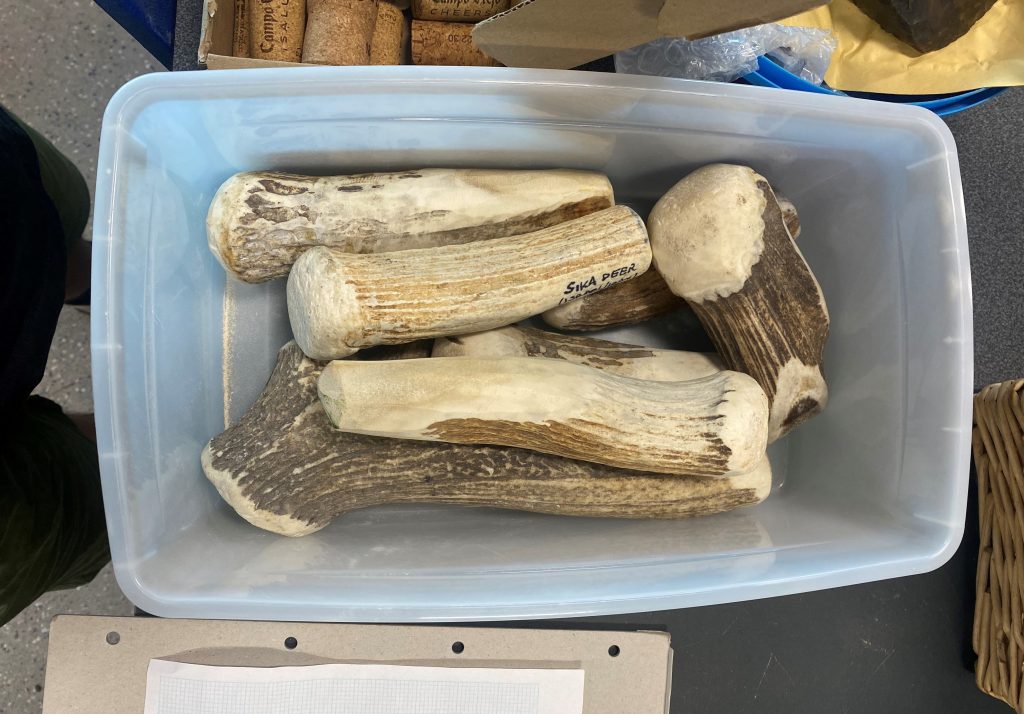
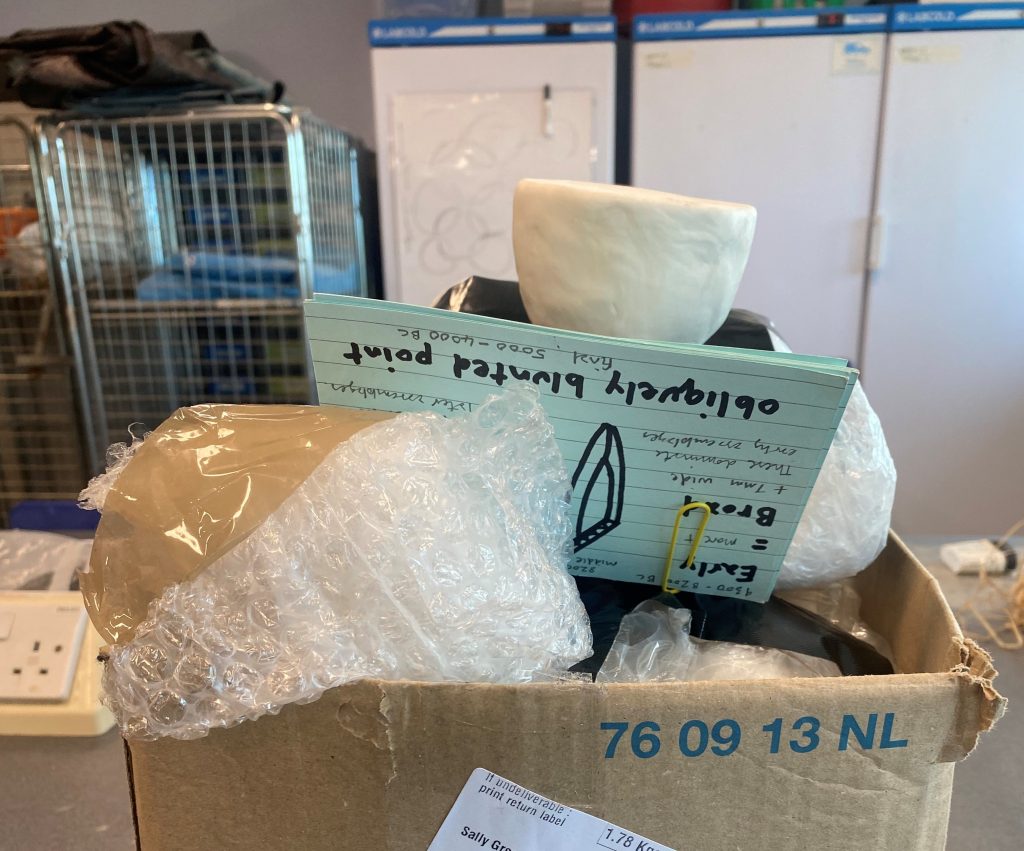
Alice has a new job in Spain, and she had a lot of lithics materials from her post-Doctoral research in Manchester that she didn’t want to take with her, and so she donated them to the Department! Above are some unused heavy antler hammers from a range of deer and countries.

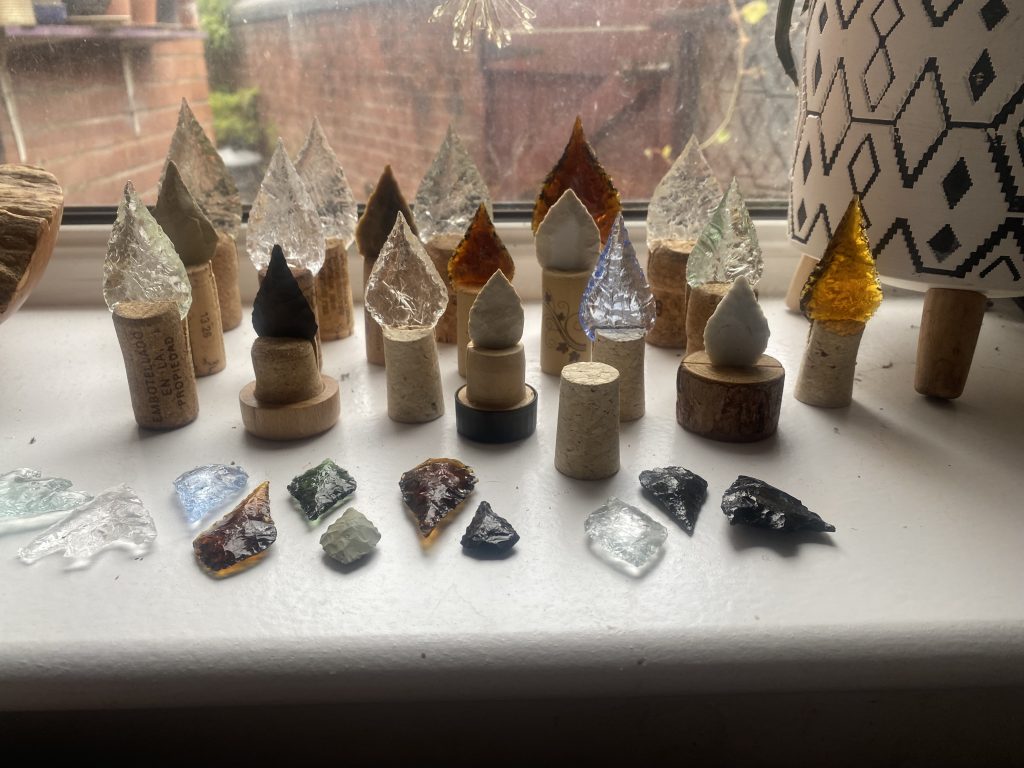
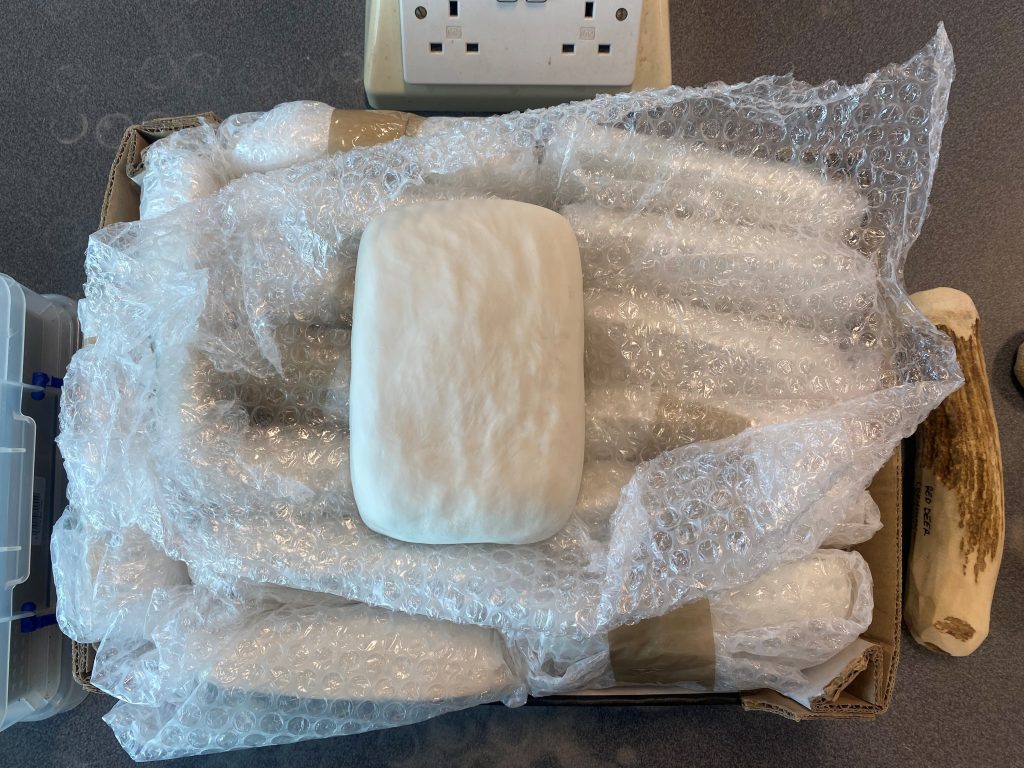
Alice’s post-Doctoral research was looking at the evolution of the human hand in relation to the development of early stone tool technology. To reduce the experimental variability in the handaxe making process she commissioned around 30 porcelain blocks of the same form, so that whoever made the handaxe would be dealing with the same problems. I have inherited around 20 of these!

For the same reasons she had around 50 smaller ‘cores’ produced to standardise bladelet production. We have inherited around 40 of these and this seems an ideal opportunity to organises a microlith making workshop with my Mesolithic friend, Stephen Poole.

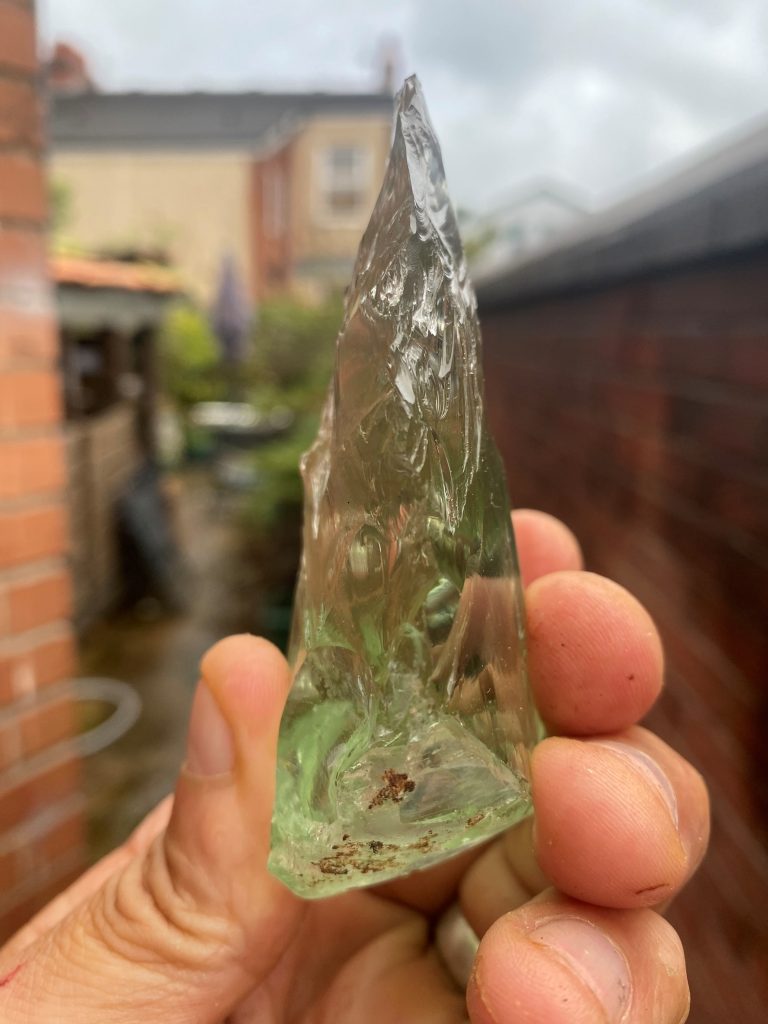
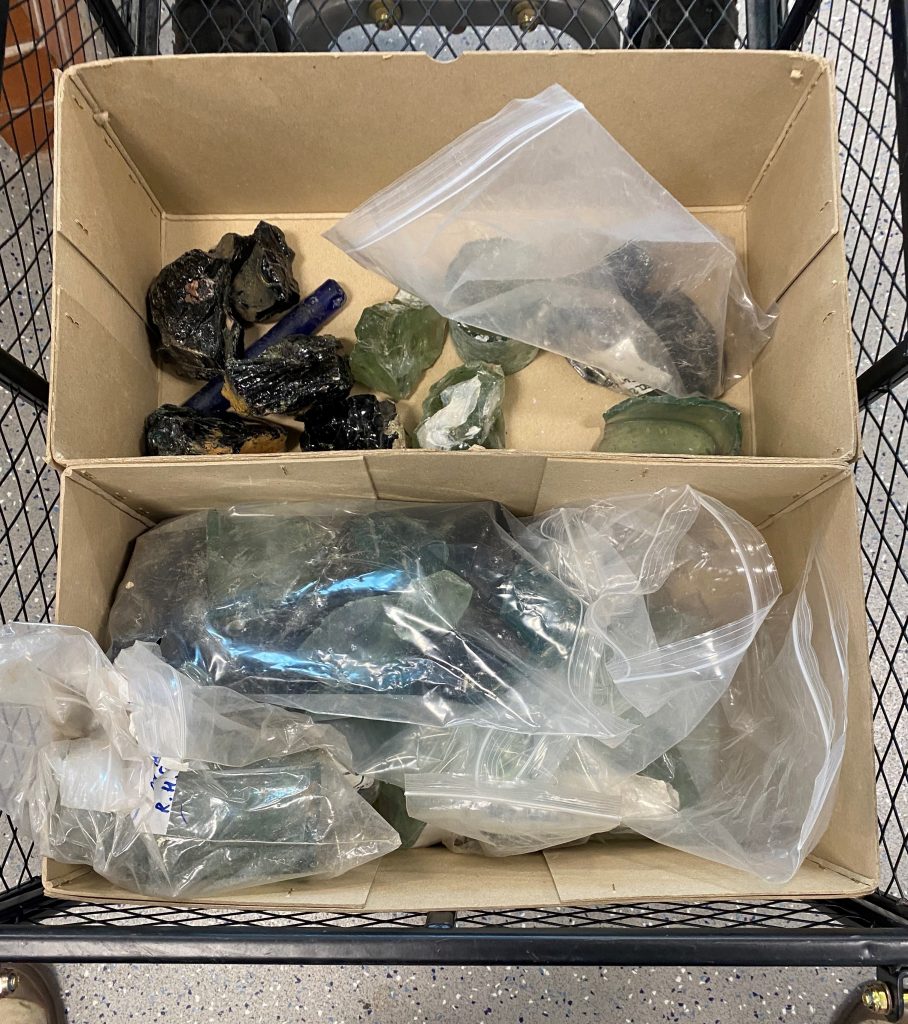
Next up, Jeremy, Ian and Lesley from Salford Archaeology. For various unfortunate reasons, Salford Archaeology has recently closed, and being based in Greater Manchester they had a specialism in Industrial Archaeology. Chatting to Jeremy about sites, I realised they had a lot of glass slag from excavations in Manchester. Fast forward to last week, Jeremy left a large box of glass slag in Ian’s office at the University of Salford and it was passed on to me by Ian’s colleague Lesley . And guess what, it knaps!

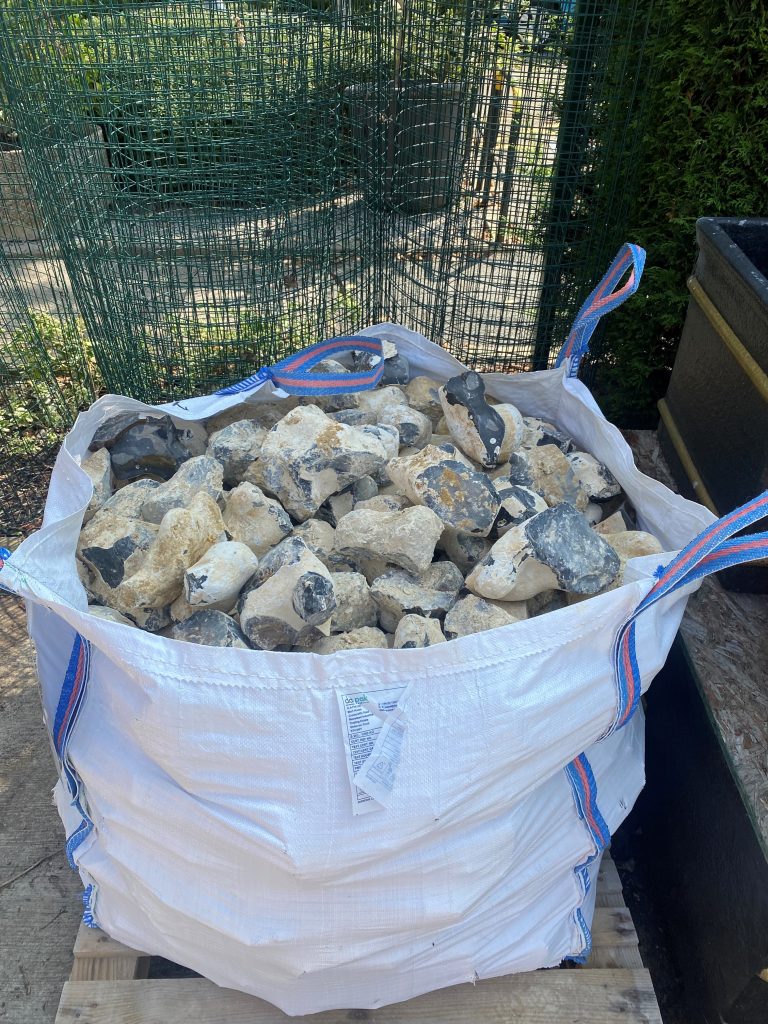
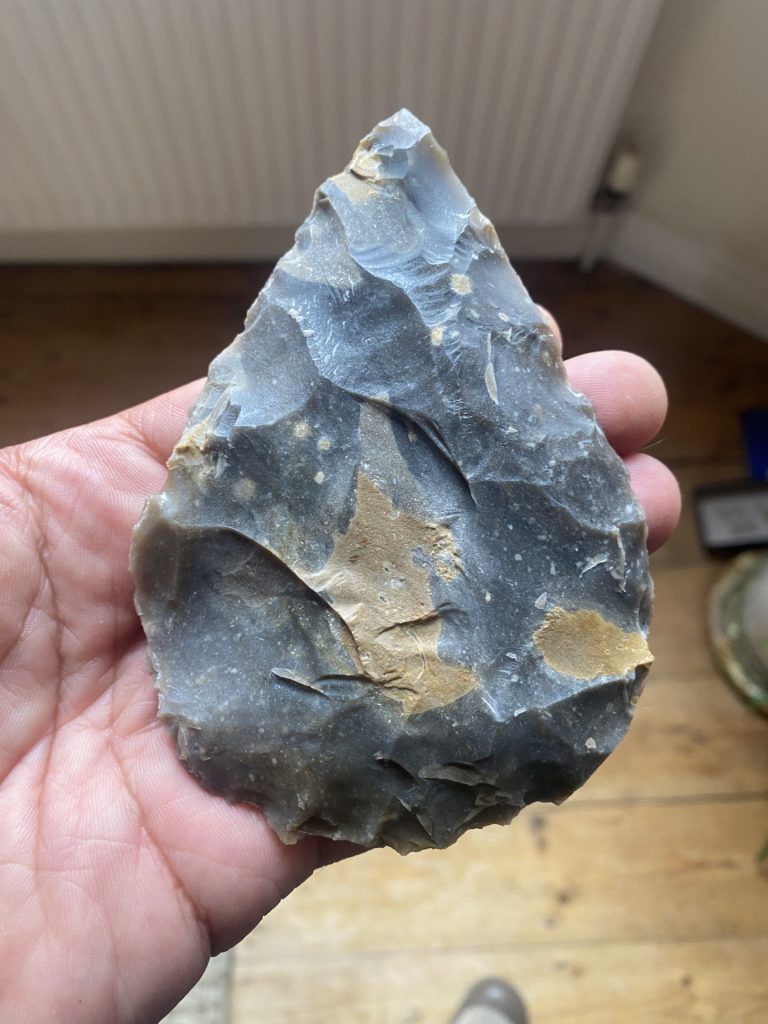
Last but not least, a ton of medium sized flint nodules arrived this morning courtesy of Needham Flints from their quarry in Norfolk. This was an end of budget year bonus, and thanks to Osen and Clare for facilitating the purchase and delivery, and Graham, John and Paul from Estates and Facilities and Environmental Services respectively for receiving and storing the pallet in their yard for us.

I think what this series of fortunate (for me and the department) episodes illustrates is the social role of artefacts and materials within the stone tool making process. I now have a series of large Red and Sika Deer antler hammers from around Europe. The porcelain blocks were custom made in Southampton for Alice. The glass was buried in Manchester until the last decade or so, and as discussed, the flint nodules were quarried in Norfolk. My social links have allowed me to access materials from around Britain and Europe, whilst having no direct connection myself.

Through this process I have initiated new connections at both the Universities of Salford and Manchester, and strengthened relationships with established colleagues and friends at Manchester. Alice received my blue glass handaxe as a small expression of thanks. Jeremy, Ian and Lesley each got a glass arrowhead, I think Osen, Clare, John, Graham and Paul each warrant a nice flint handaxe. These feel less like obligations, and more like commissions, which means I will be making nice examples, that I feel acknowledge the value of what they have kindly done for me and the department. I suppose this is where aesthetics comes in, less a functional butchery tool, more a demonstration of skill to produce an object of perceived value, that forms a positive connection between the giver and the recipient.

Writing this, I realise a real blurring between myself and the department. Absolutely none of this would have happened without me recognising and developing these opportunities. At the same time, being part of an archaeology department has provided me with the platform and infrastructure to have these connections in the first instance. I suppose it is an interplay between myself, my work role, and the connections I encounter and develop within that context, and the currency I use to facilitate and nurture these connections is, as you have probably recognised…stone tools.

One down, four more to go!

I’ve made something I like. Again!

We have just come back from a week in Athens, and the main thing I brought home was a large disc of blue glass, bought at the flea market for five Euros.

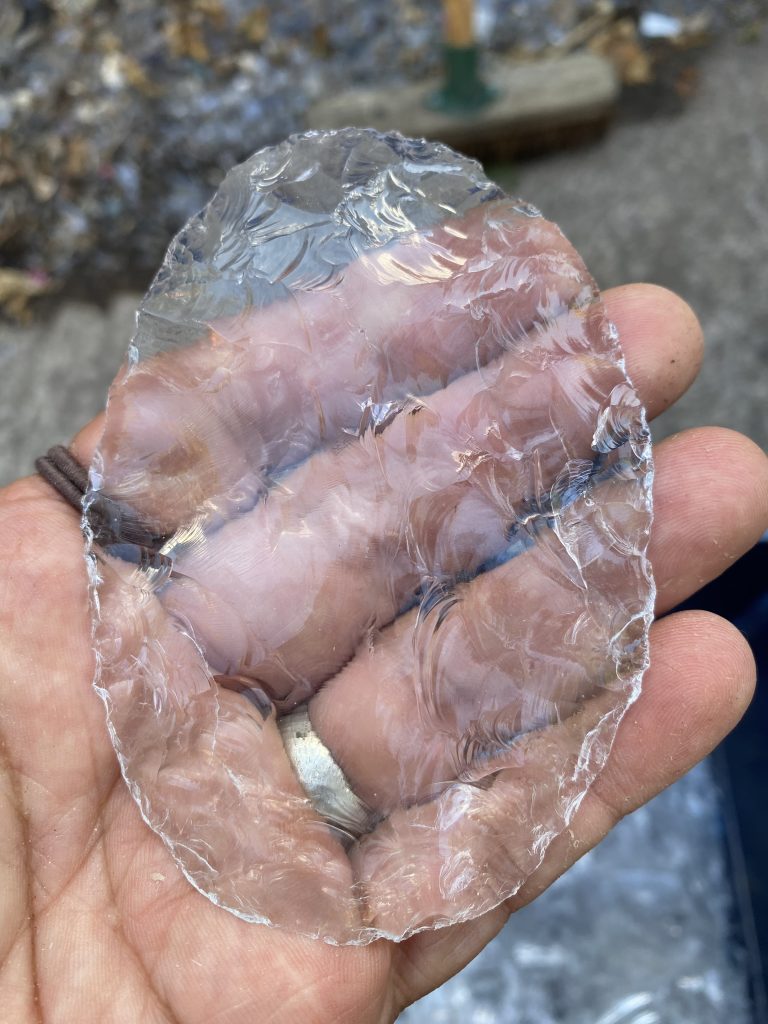
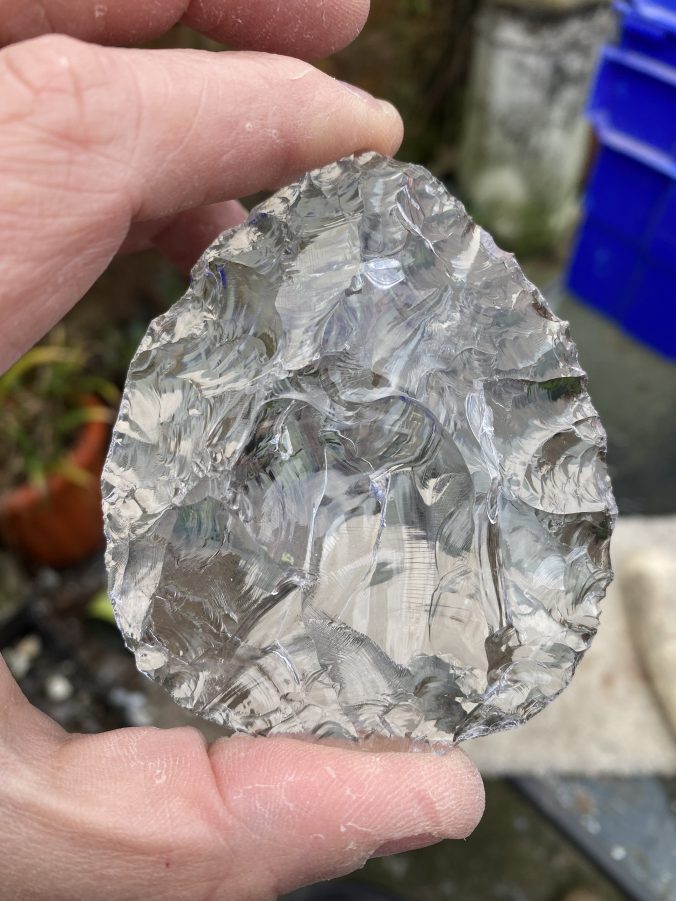
Anyway, I found time to hide in the lab for an hour or so and came away with this very nice blue ovate handaxe.

Everything worked well. Turning the edges with a hard hammer, and then thinning using an antler hammer. This is the second iteration, initially it was larger but wonky.

I brought the wonky version home, lived with it for 24 hours and then the following day finished it off so that it is a shape I can live with. I am currently thinking about the difference in experience between my work with emails, spreadsheets and budgets, and escaping into the lab and the satisfaction of making something beautiful. I suspect it is something to do with what that famous stone tool specialist, Karl Marx, termed ‘Alienation’. To be continued!

Aesthetics as a form of cultural control

What is aesthetics? According to the Oxford English Dictionary (OED) Online the word aesthetic is derived from Ancient Greek and relates to sense and perception. In relation to the French noun esthétique the OED Online provides this explanation from 1819, a: ‘set of rules or standards by which art is judged’. Yesterday my ‘workshops’ friend, Laura Thompson organised for us a handaxe making session for half a dozen academic staff and students in the Archaeology labs. My ‘Mesolithic’ friend, Stephen Poole made a trip in from Rochdale to help me out with the teaching process. In the discussion session at the end the subject of aesthetics came up a couple of times.

However, to start at the beginning, initially I presented a series of handaxes to the participants, both replicas I had made and ‘real’ ones from our teaching collection. These are used to introduce how stone tools were used historically to understand and create a prehistoric chronology. If we take a step back and think about the structure of the session, a group of flintknapping beginners are presented early on with models of ‘correct’ form, explained by myself, a perceived ‘expert’.

To shift the discussion slightly I would like to introduce the phrase ‘Like mom’s apple pie’ as it is interesting to me on two levels, it uses an outcome (an apple pie) or experience (eating the apple pie) to characterise something as inherently ‘correct’ or ‘positive’. It also links generationally, looking backwards to find a ‘correct’ or ‘positive’ model.

So, to link together apple pies and handaxes it would seem to be a common process to identify past examples as an ideal with which to measure present output. This further links to the work of the anthropologist of art, Alfred Gell, who argued that aesthetics is culturally specific. He goes on to argue that aesthetics serve a social function, and are imposed upon objects so that those objects can be used to achieve some social goal.

If we also consider the typological approach, using particular types of objects to denote particular epochs of prehistory or human culture groups, I would argue this is following a similar model. An ‘expert’ has identified certain more or less measurable parameters which certain objects sit within, and others outside. Those objects that fall within are categorised as one particular period or culture group, those outside may be outliers, or belong to a different period or culture group altogether. This system was developed early on by pioneers such as Gabriel de Mortillet using museum collections. By the 1930s field archaeologists were using an object’s archaeological context to help clarify the above models, and by the 1950s archaeologists were looking to process, in order to understand at what stage in its lifecycle an object sat. Famously, this can be in contrast and conflict to the typological approach, as the object changes shape and form as it wears down through use and then re-sharpened.

To return to our workshop, participants are presented at the beginning with idealised models that carry authority because of the context of presentation (University of Manchester Archaeology Laboratories), and the skilled practice they embody. They also carry with them an aesthetic, and for the replicas produced by me, it is my aesthetic. This is separate from any butchery process but clearly embedded within an archaeological teaching and learning environment, and the history of European stone tool research. My stone tool aesthetic is a modern complex of academic models, bodily practice in negotiation with a range of materials, resulting ultimately in a selection of examples I am ‘pleased with’ and presented to the participants.

As the workshop proceeds the skilled practice that the examples embody becomes apparent to the participants, as they attempt to achieve a similar result. Shape, size and form present a model of idealised outcome that participants strive to achieve within a limited three hour window. For teaching and learning purposes I spend the last hour or so making sure everyone goes home with a functional cutting tool, so that they understand that flintknapping is a game they can win.

Back to aesthetics as a form of cultural control. My knowledge of the history of prehistory and the differing theoretical approaches has been shaped by a western Undergraduate, Masters and Doctorate education in Archaeology, theory and lithics. The development of my ability to make stone tools is discussed elsewhere, but the selection of aesthetic examples is indeed designed to elicit certain social responses, a subtle recognition of my ‘expertise’, and therefore a positive consideration of my guidance. Within this reading aesthetics has been something I have interacted with throughout my lithics education. Certain people, objects, texts and drawings will have influenced my aesthetics over the years and I now perpetuate this emergent aesthetic through my own teaching in the present. As such the Western European idea of a handaxe is perpetuated through time and from one generation of archaeologists to the next. To basterdise the 1819 definition I am both consciously and unconsciously selecting and perpetuating a: ‘set of rules or standards by which a handaxe is judged’.

I have started walking to work and there is a lot of this kind of stuff going on in my head at the moment!

On the passing of Kim Akerman

I found out late last month that the Australian archaeologist, Kim Akerman, had died peacefully at his home with his wife, Val, in Hobart. Even typing this makes me feel tearful, for a man who lived on the other side of the world and whom I had never met in person. So why tearful? In spite of the fact that we never met face to face Kim has been incredibly helpful and supportive, and played a fundamental role in my own stone tool making journey.

When I became interested in glass as a material, and Kimberley Points as a focus, a quick search on Academia.edu revealed that Kim was the preeminent scholar when it came to these glass points. I started to download one of his papers and Academia.edu asked me if I wanted to let the author know why I was downloading (Figure 1.). I can’t remember exactly what I put, but it was brief and along the lines of “I want to learn how to make Kimberley Points“.

Figure 1. Academia.edu helping me make new friends.

I was pleasantly surprised when Kim quite quickly got back to me, recommending two out of print books (Figure 2.) and offering to email me two of his own Powerpoint lectures to boot. We swapped emails and Kim sent the relevant lectures over (Figure 3.). By then I really did have a lot of valuable information to start my Kimberley Points journey.

Figure 2. One of the two out of print books Kim recommended.

Figure 3. One of the two Powerpoint lectures Kim sent over.

I had Kimberley Points to look at in Manchester Museum, a plentiful supply of period glass to work with, and Kim’s guidance on equipment and process, so I got on with it. It was by through going through the making process that I realised there were things I didn’t understand. So in 2018 I got back in touch with Kim. In particular I was interested in the correct way to turn the edges of the bottle to start the pressure flaking process, and how to avoid losing too much width. In response, Kim made a Rose Leaf point (Figure 4.) and provided me with this breakdown of the complete reduction sequence.

Figure 4. Kim’s completed Rose Leaf point made from a water worn glass fragment.

I kept in touch with Kim, intermittently sending him any Kimberley Point related publications or media produced here, for his records, as he asked me to do. In looking back through my emails I realise my first contact with Kim was in or around 2016 on my old student email address, which is no longer accessible. In March this year Kim got in touch to to ask me for my actual address (Figure 5.). He had contracted Raynaud’s Syndrome which had affected his ability to work stone, and he had a Calytrix exstipulata, or Turkey Bush wooden pressure flaker that he was happy to send in my direction.

Figure 5. Kim’s email telling me about how Raynaud’s Syndrome had affected his hands.

I thought about how I would feel if my body wouldn’t allow me to flint knap again, and realised that for me, and perhaps for Kim, this would be a significant loss. Anyway, I sent Kim the address and a couple of weeks later the pressure flaker arrived in Manchester (Figure 6.).

Figure 6. The tube and Calytrix exstipulata, or Turkey Bush wooden pressure flaker.

I haven’t used the pressure flaker. It still lives in its tube, partly because the pressure flaker, tube and handwritten details seem to capture something for me. It materialises a relationship and Kim’s kindness at a time that I suspect was quite difficult for him. Having said that, I also suspect he would want me to use the pressure flaker, not transform it into some kind of museum object or religious icon!

Anyway, I found the need to email Kim again last month. I ran two scraper making sessions here in Manchester, and through that process realised that I discussed an Aboriginal focus upon edge angle (Figure 7.), but didn’t fully understand that aspect myself. I emailed Kim to get some guidance on relevant readings.

Figure 7. My Powerpoint slide discussing an Aboriginal perspective on scrapers.

Again I received a very quick response (Figure 8.), but this time it wasn’t something I would be pleased about.

Figure 8. The automatic email response I received late last month.

Kim was a very kind and giving person, not just to me, but as this video from the Tasmania Aboriginal Education Services shows, he made a positive impact on many people’s lives. Whilst writing this post does makes me feel tearful, Kim had a rich life, and as the email stated, he died peacefully at his home with his wife, Val. Perhaps a rich life and a peaceful passing with your loved ones close is the best any of us can hope for.

Figure 9. Kim Akerman being thanked by Craig Everett for sharing his knowledge and skills.

Kim Akerman. 5/11/1947 – 19/9/2024.

< Older posts

© 2026 Learning Through Making. All Rights Reserved.

Up ▴