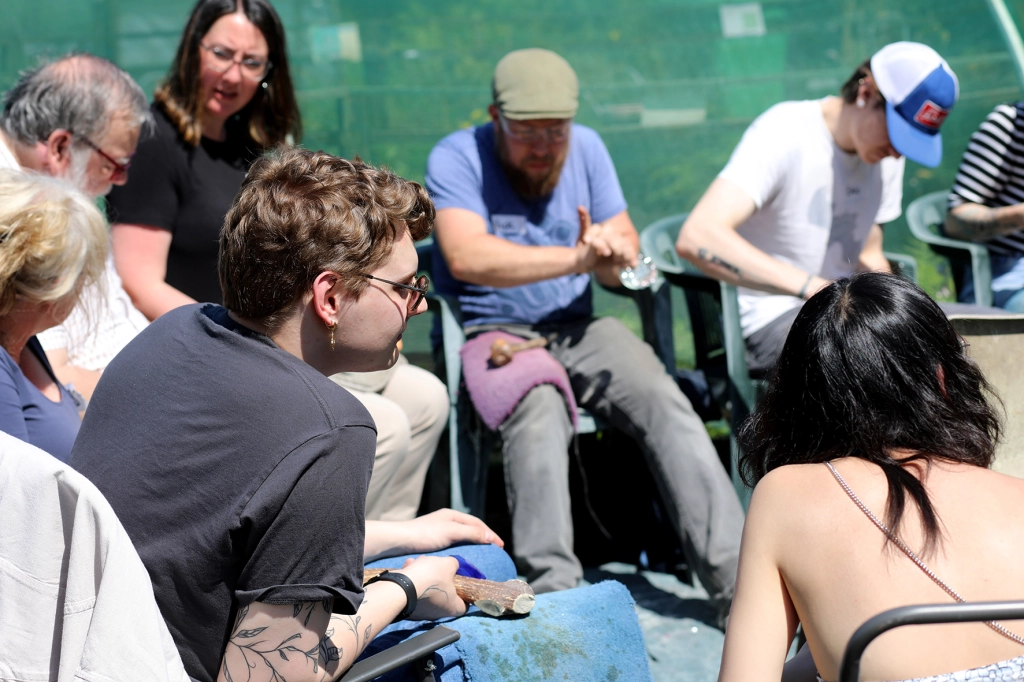
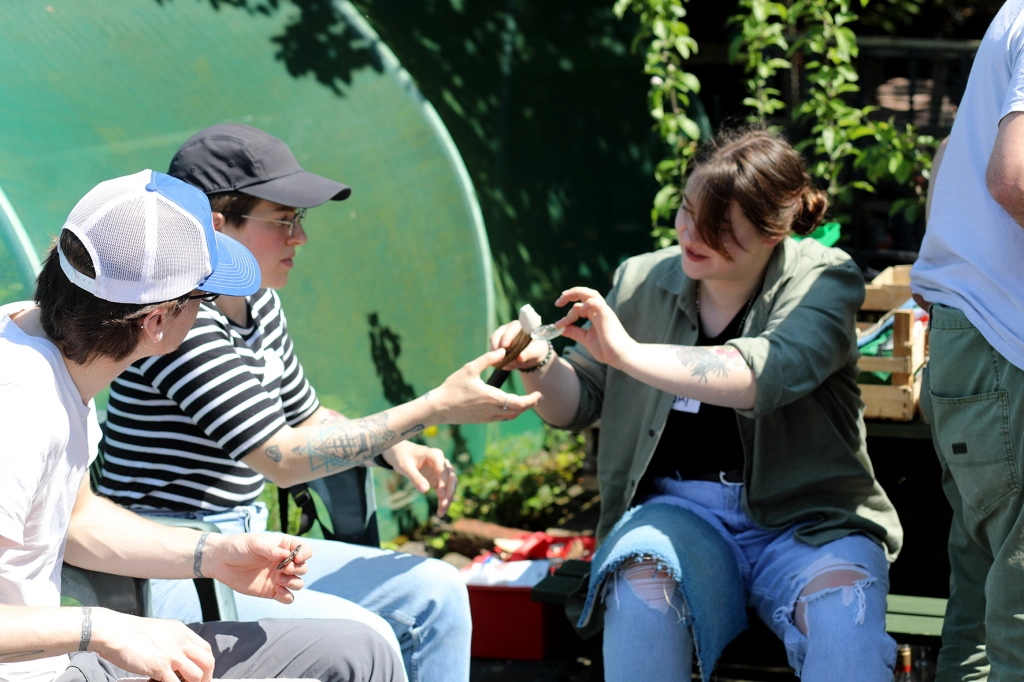
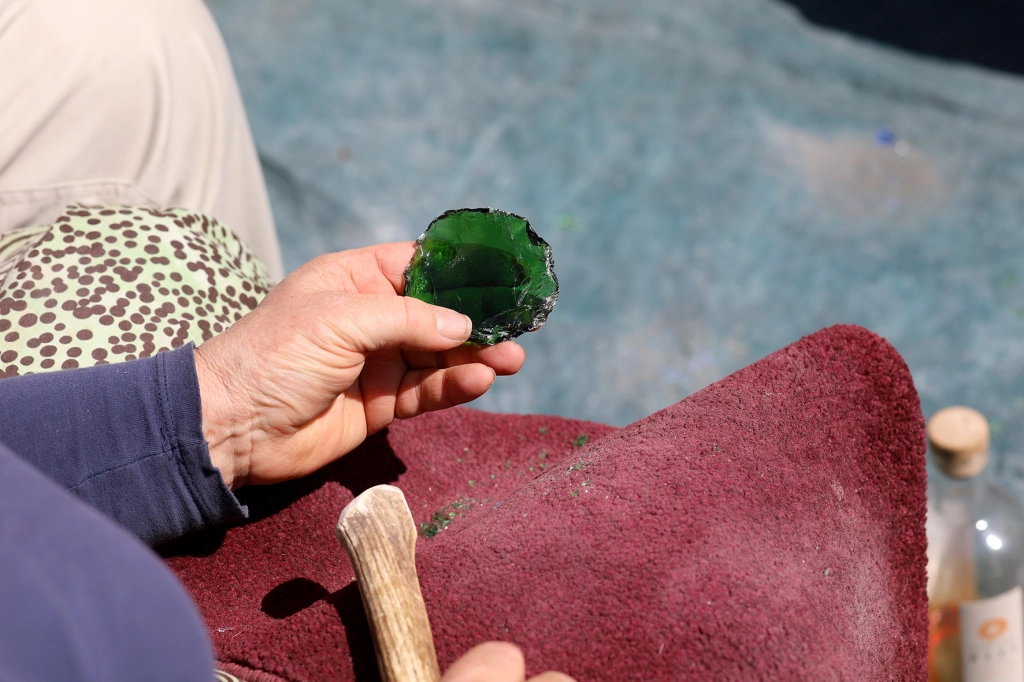
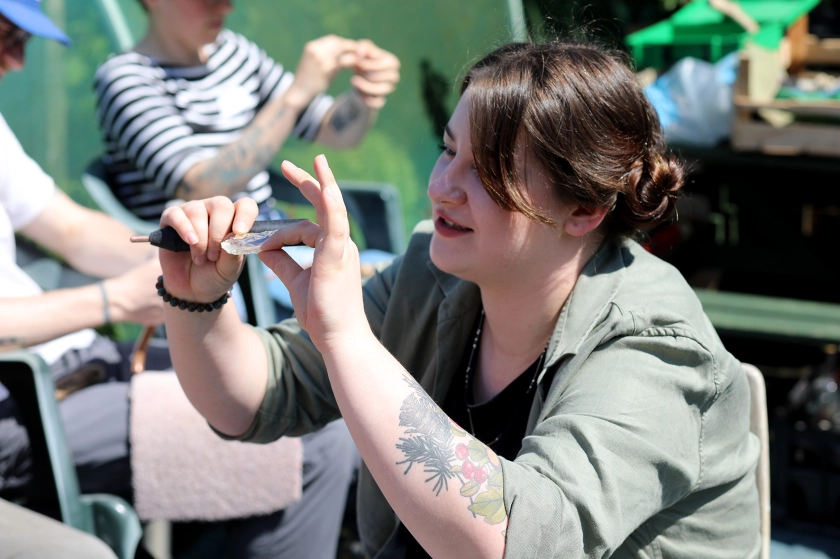
I am off work at the moment and have been in the back yard, taking advantage of global warming, and knapping almost every day.
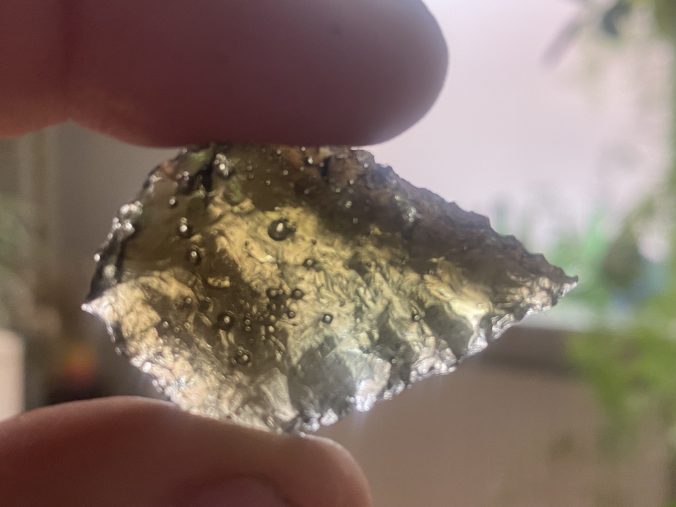
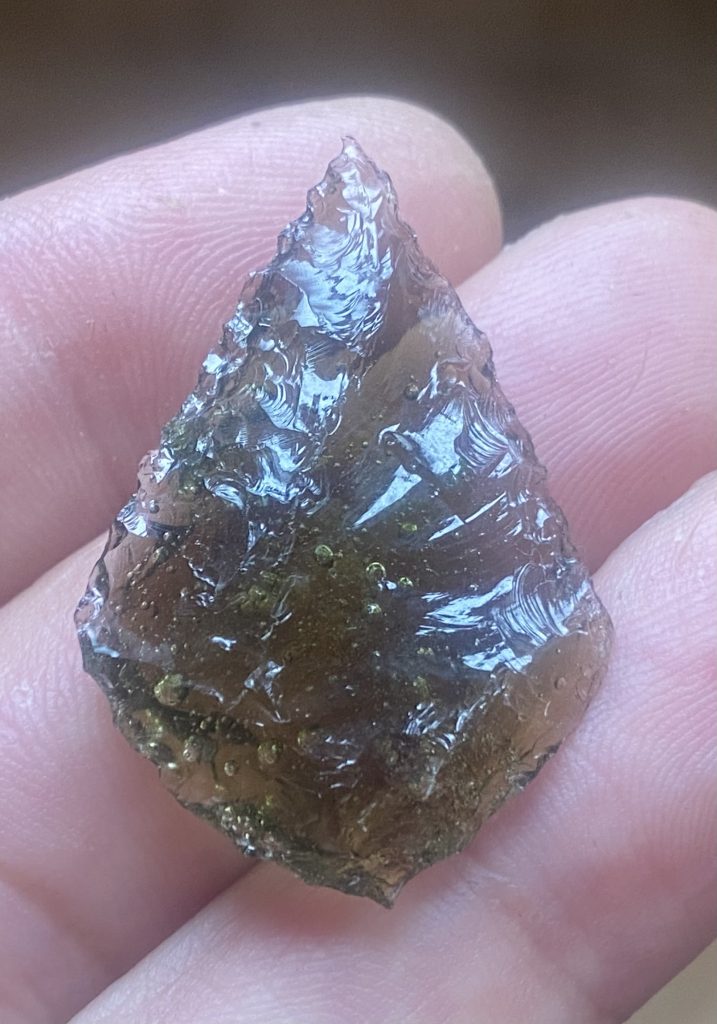
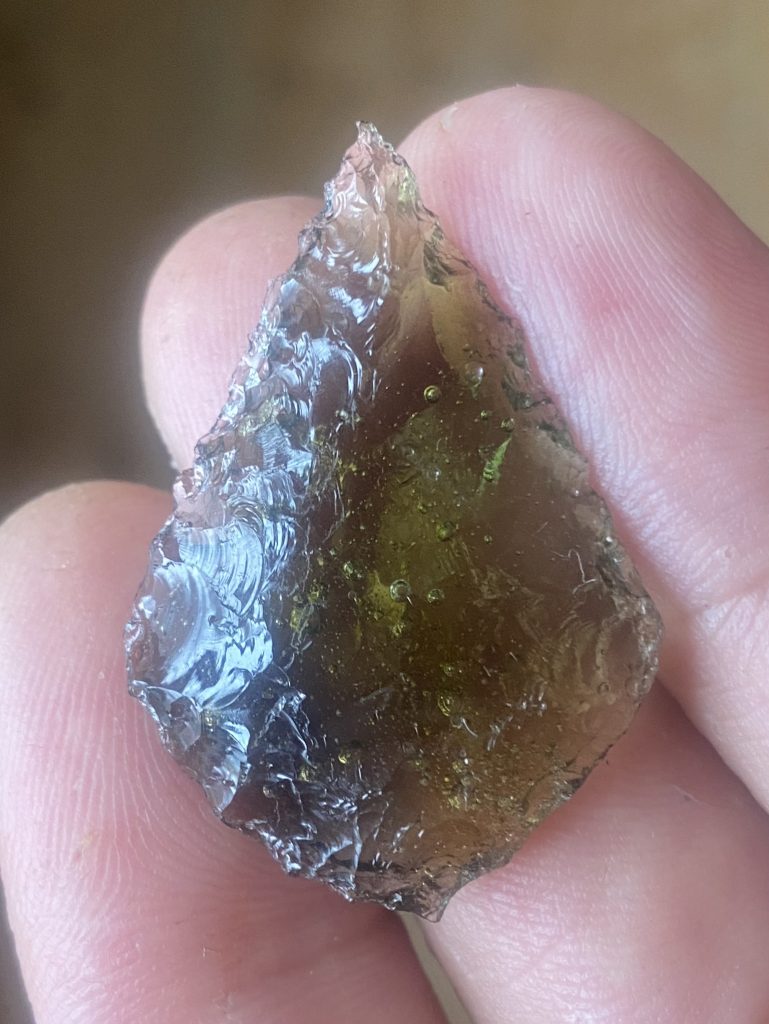
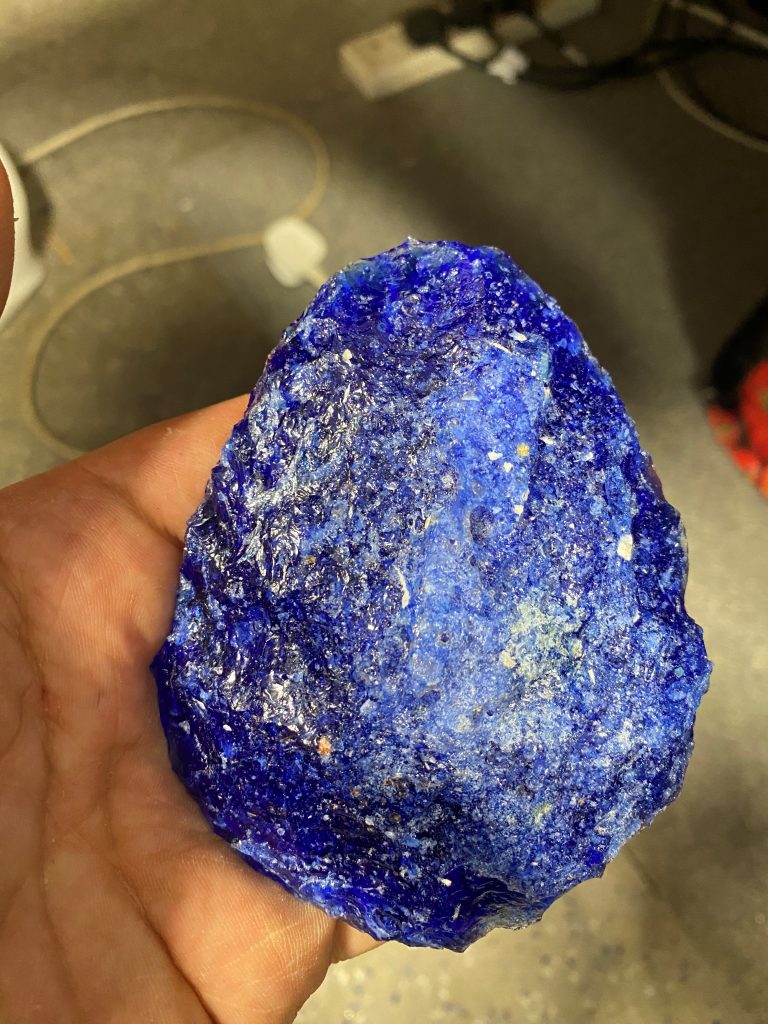
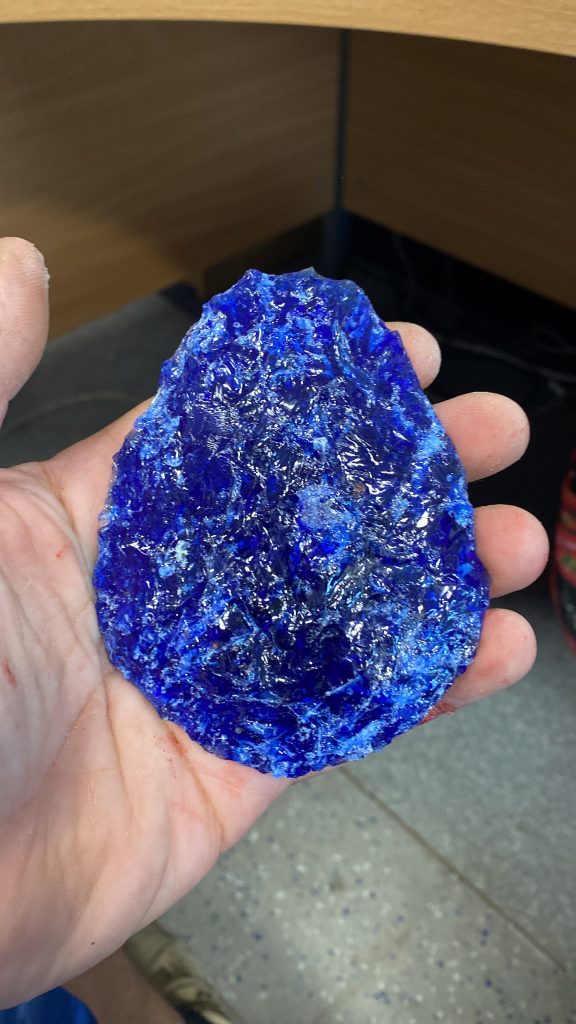
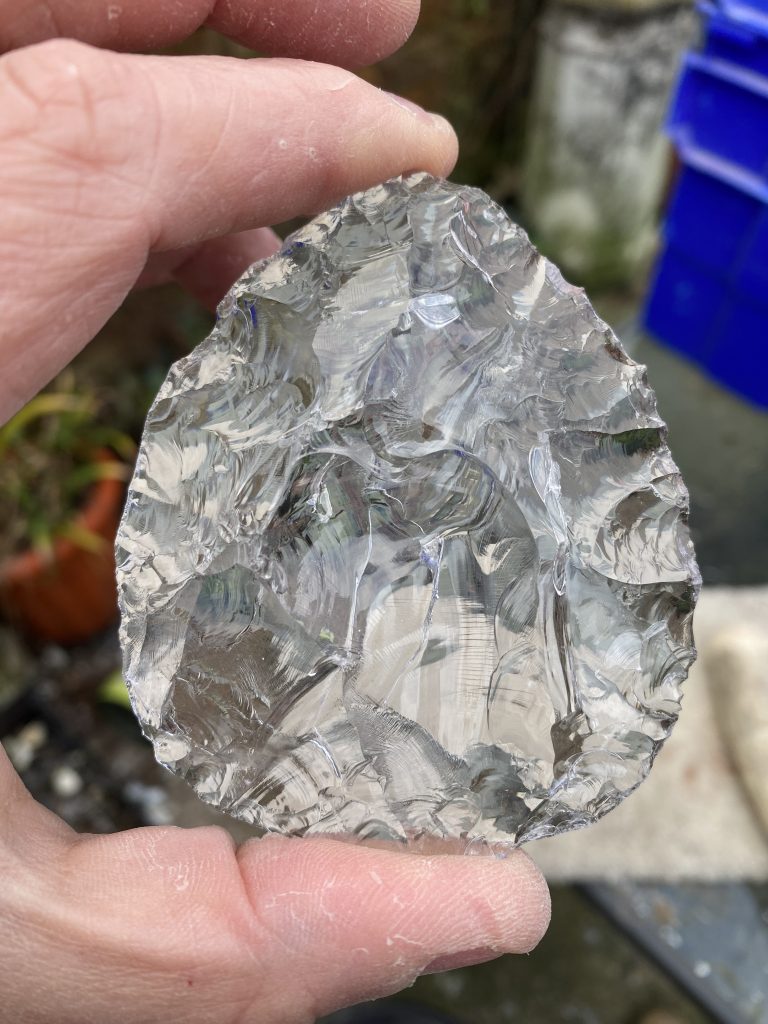
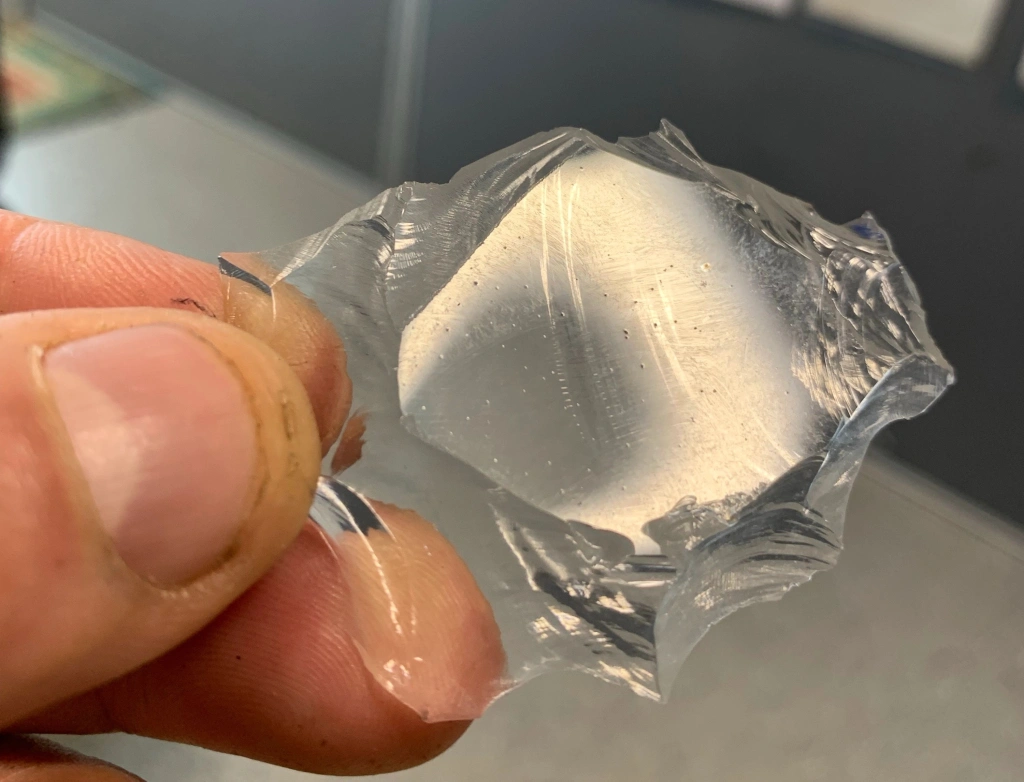
This was a lumpy flake of glass slag. It was either gifted by the Salford Unit before they closed, or from the disused railway line behind the playing fields at Dorstone. I can’t remember, which is a shame. I also forgot to take a ‘before’ photo. I was caught up in knapping rather than thinking of a blog post.
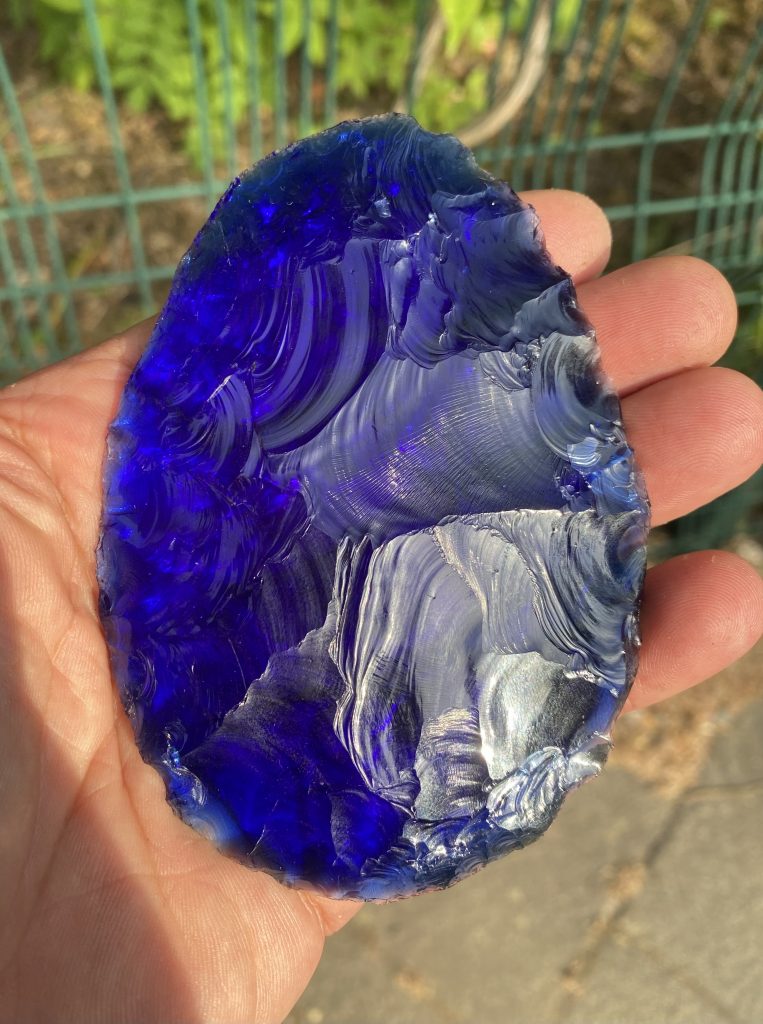
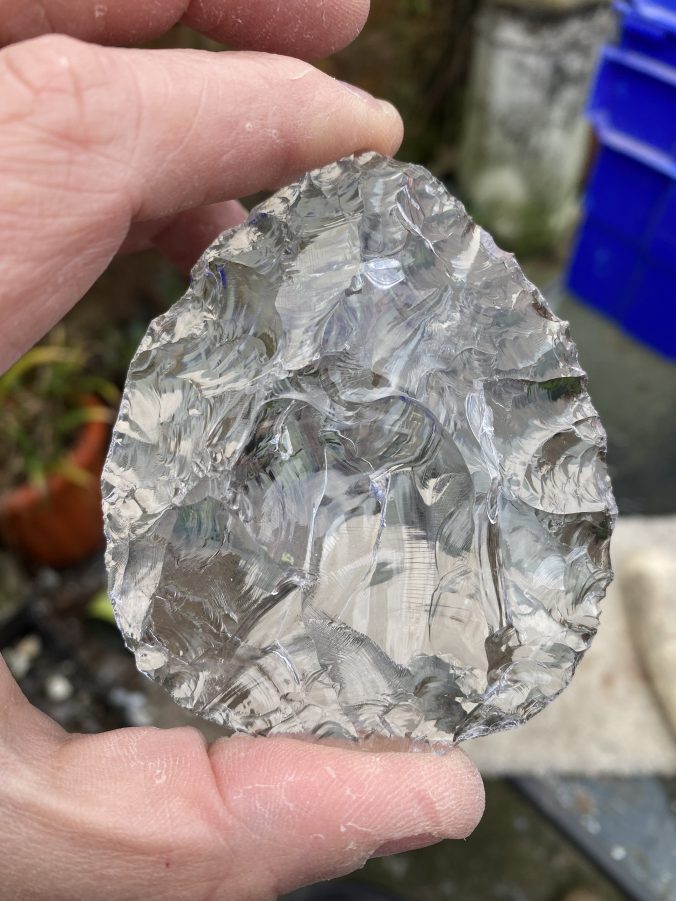
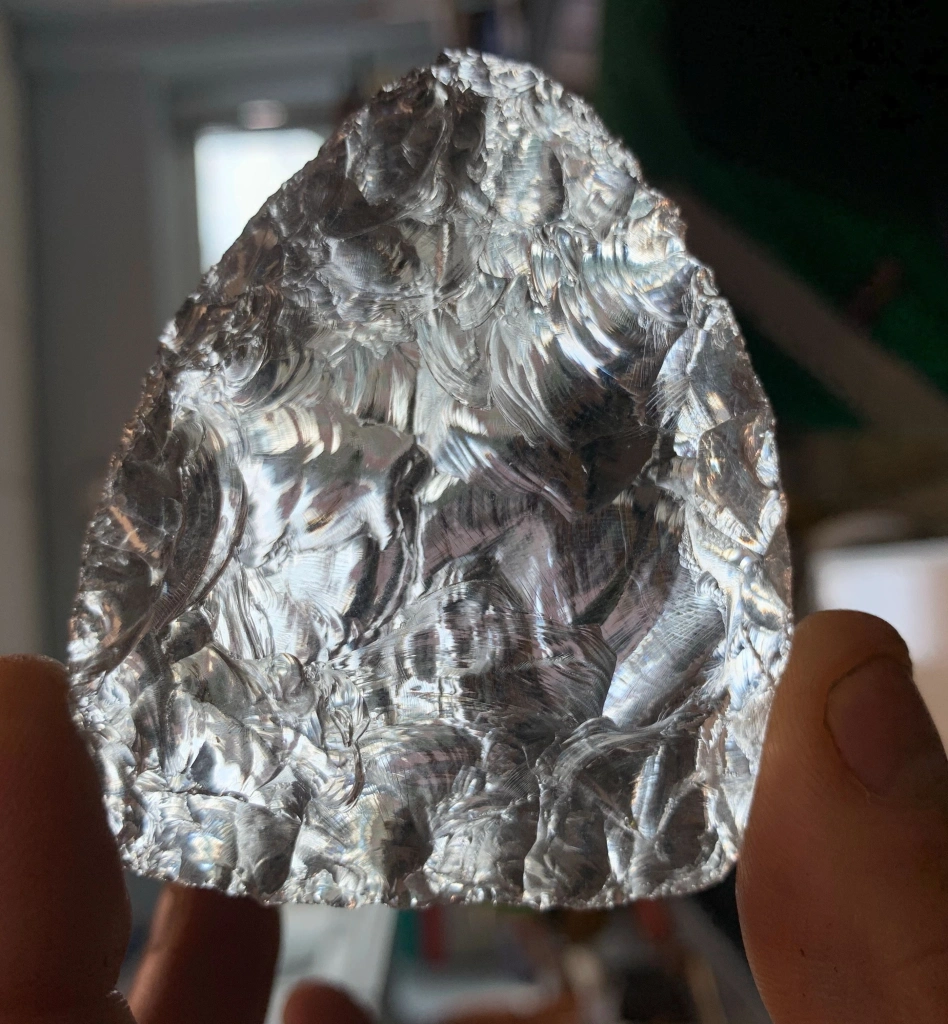
Anyway, in spite of the flakes very uneven thickness it knapped brilliantly. The colour is amazing and I like the bubbles. It has produced a very descent Neolithic leaf shaped arrowhead, although made from industrial glass slag using an iron nail pressure flaker.
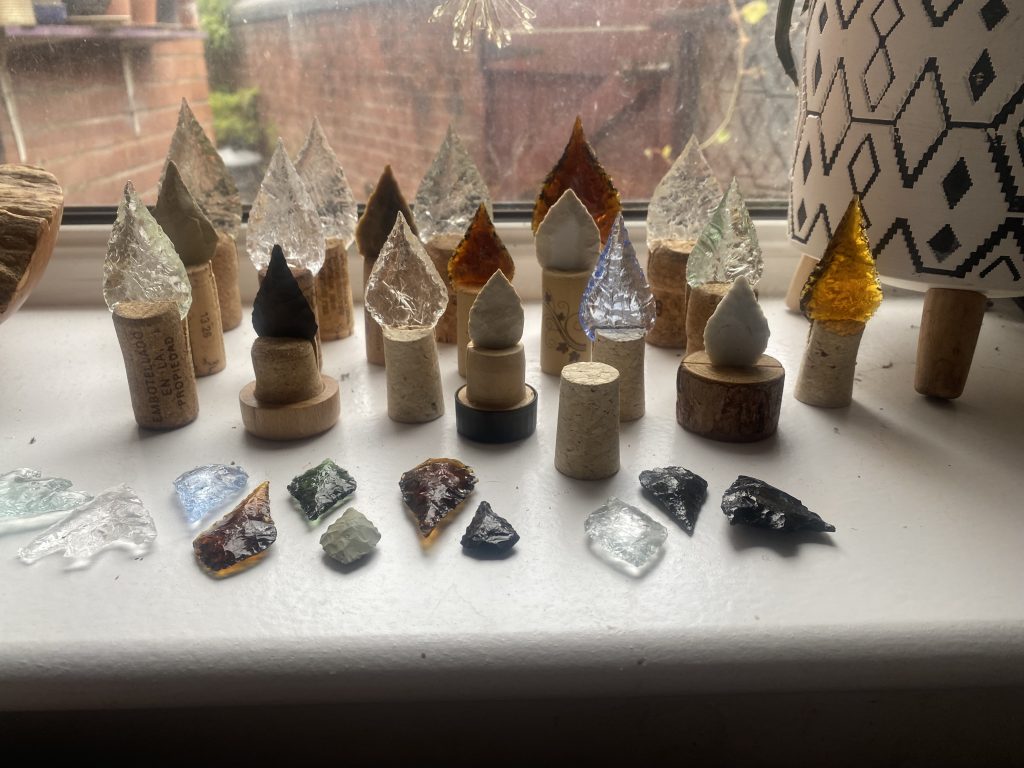
As you can see, our windowsill is morphing into a knapping museum of sorts, an exploration of materials, methods and obsessive behaviour!
I have had some time to sleep on it (not literally), and some more ideas emerged.
I think actually two competing and contradictory ideas are being played out here. As concluded in the last post: perhaps this is a piece of art; inspired by Palaeolithic crafts people; and using the making process to highlight a different attitude and set of values to modern ‘waste’ materials. Perhaps that is what I am doing, and that is what this handaxe is doing.
Idea number one: since the last post I have spoken to two of my friends who work with ceramics, Nacho Jimenez and Lee Page Hanson, and both have agreed to help me by producing some slightly narrower, slightly taller ceramic moulds. As discussed here, Holly has ideas about how the next furnace firing should unfold. There is also the invisible contribution of the people who originally made the blue glass, and then those who abandoned them in the1930s to 1950s for them to end up as a waste material, and then again in the recent past, the bottle diggers who have left the fragmented glass bottles on the surface for me to collect. Then there is my contribution to the narrative as a flint knapper. So, as an object this blue handaxe embodies a number of narratives as well as a number of skilled practices. Perhaps that is part of why I love it?
Idea number two: however, as previously discussed, I also love the recycling of the glass that goes into this, to highlight a different approach to valuing materials. It has occurred to me that this ‘eco narrative’ actually embodies a series of energy intensive processes, such as the the kiln use for the production of the moulds, and then the furnace use to melt the glass to form the block. In that respect this handaxe also has an industrial narrative, using probably non-renewable resources in order to make a statement about the value of recycling materials. In that respect this blue handaxe embodies an inherent contradiction, something I am not so enamoured by.
What is going on? I am an archaeologist, so why am I getting super excited about creating Palaeolithic tools from materials unavailable to people in the Palaeolithic past? Furthermore, this seems more to be an exploration of my own particular aesthetics, albeit with a link to crafts people in the Palaeolithic past. Perhaps they are my inspiration here? Essentially, this process is telling us nothing about Palaeolithic people, so is it a vanity project?
This particular handaxe is not perfect, but I love it. I actually love its idiosyncrasies’, the lumpy central line I couldn’t remove. It fits together perfectly for what it is, in spite of not being something else? By something else I am thinking of my last blue handaxe, classically aesthetic, with smooth, long and clean removals.
I immediately thought, well I collected the glass for this most recent handaxe, and so that must be it. However, I bought the glass disc for the earlier handaxe, from a flea market so although not the same, I was still responsible for acquiring the materials. It may be to do with the extended process, involving mould makers and furnace drivers? It may also be that I am using a waste material, originally abandoned in the 1930s to 1950s, and then again in the recent past, by the bottle diggers who have left the fragmented glass bottles on the surface for me to collect.
I don’t know. As an archaeologist I feel this object should be adding some kind of intellectual value to our understanding of the Palaeolithic past, but it doesn’t. So, is it a vanity project? If so then all art could be classed as vanity projects. Perhaps this is a piece of art rather than a piece of archaeology? I also love the recycling of materials that goes into this, to highlight a different approach to valuing materials.
So perhaps what I am saying here is; this is a piece of art; inspired by Palaeolithic crafts people; and using the making process to highlight a different attitude and set of values to modern ‘waste’ materials. Perhaps that is what I am doing, and that is what this handaxe is doing.
Well now. Lots of thanks to Holly Flannaghan, my technician comrade in Geography who has access to a furnace, and also does her research!
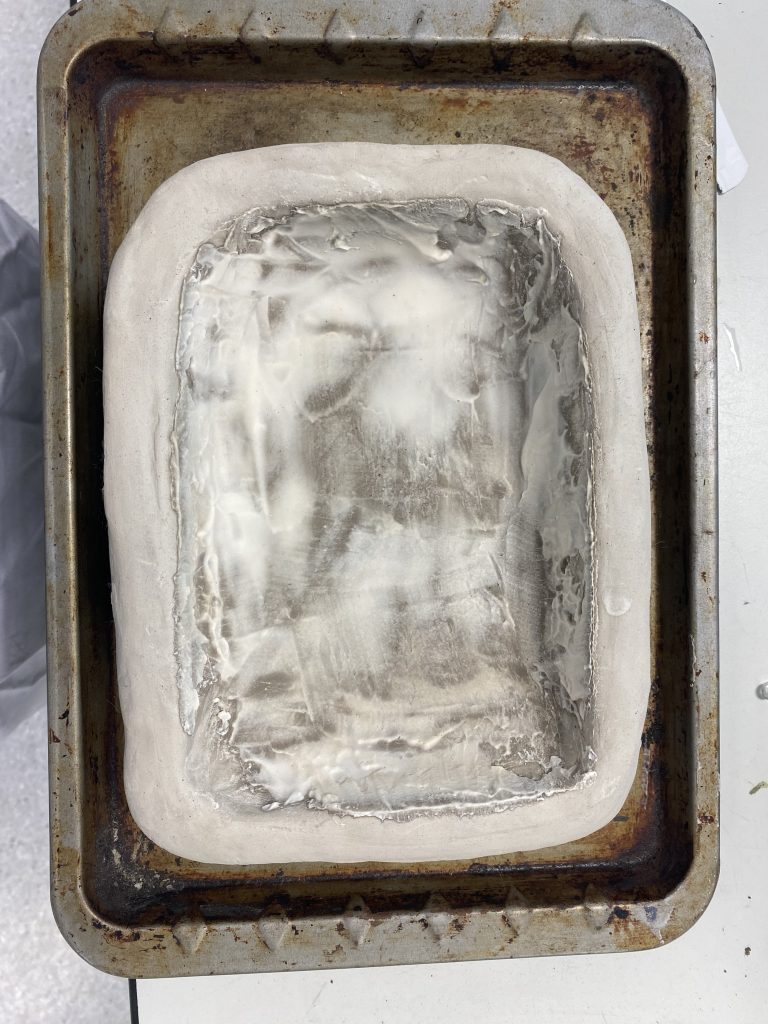
This is Alice la Porta’s mould painted with the Aluminium Kiln Wash to stop the glass adhering to the mould. It did more or less work. The mould was unfired and next time we may use an already fired ceramic mould.
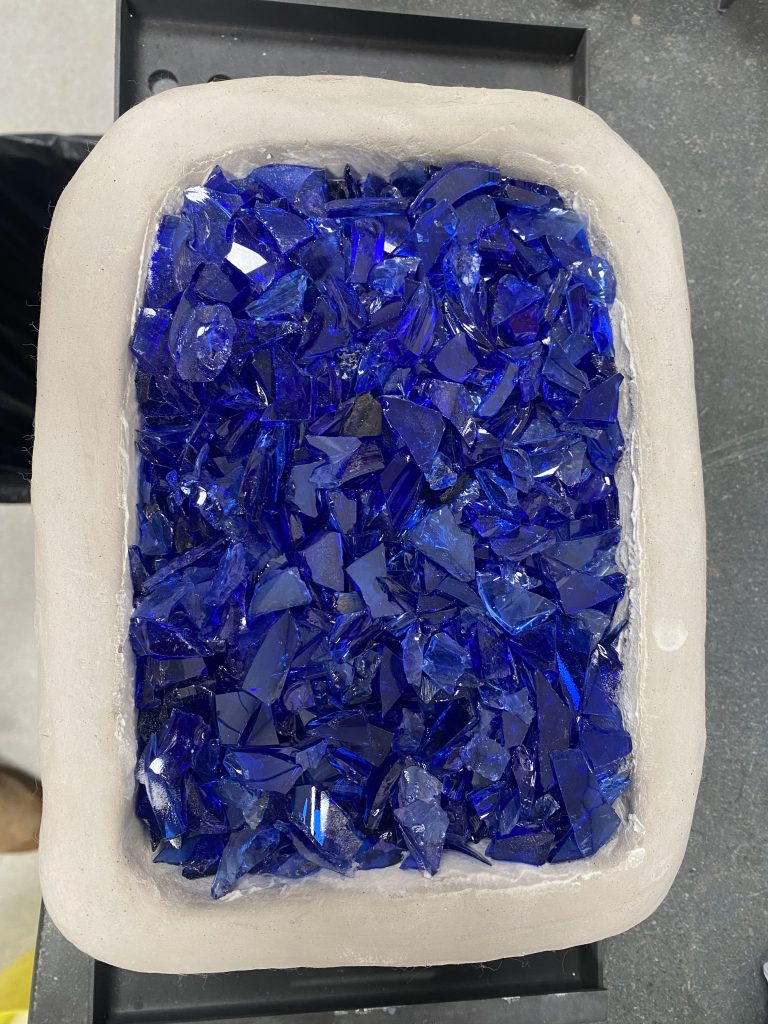
I had three grades of glass cullet. Sand, sub-1cm, and above 1cm. We used the sand and sub-1cm cullet on the top to fill up the mould.
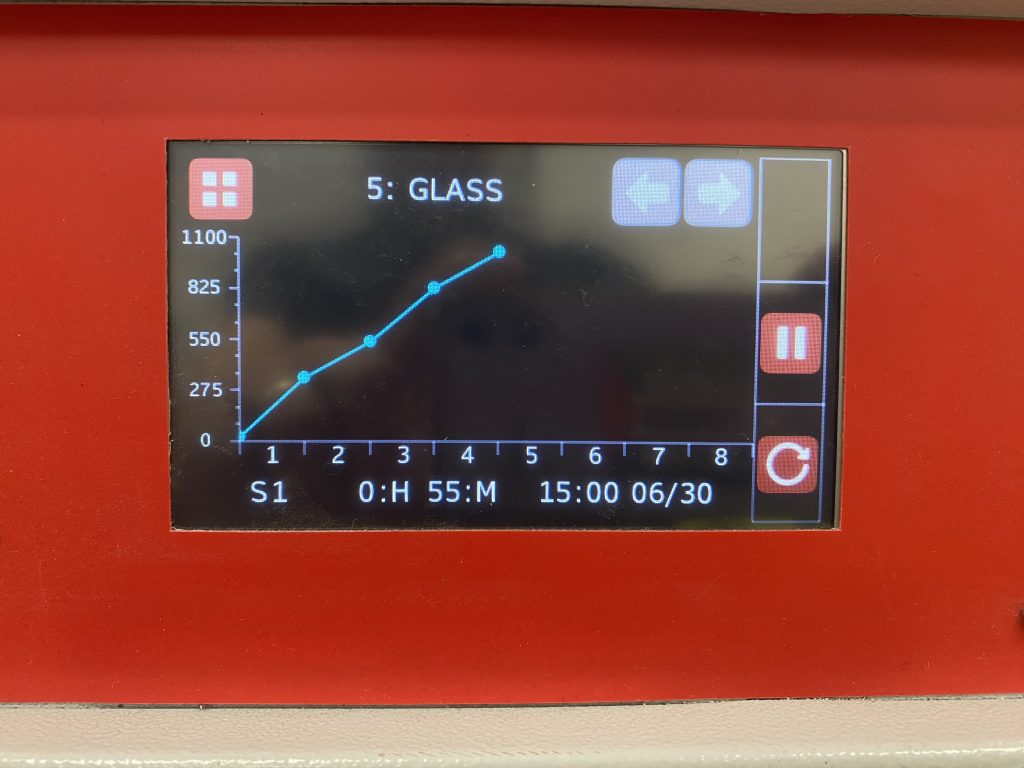
Then Holly performed her magic. Over four hours the temperature was gradually raised to around 1000 degrees Centigrade, and then kept there for two hours or so before starting the slow cooling process.
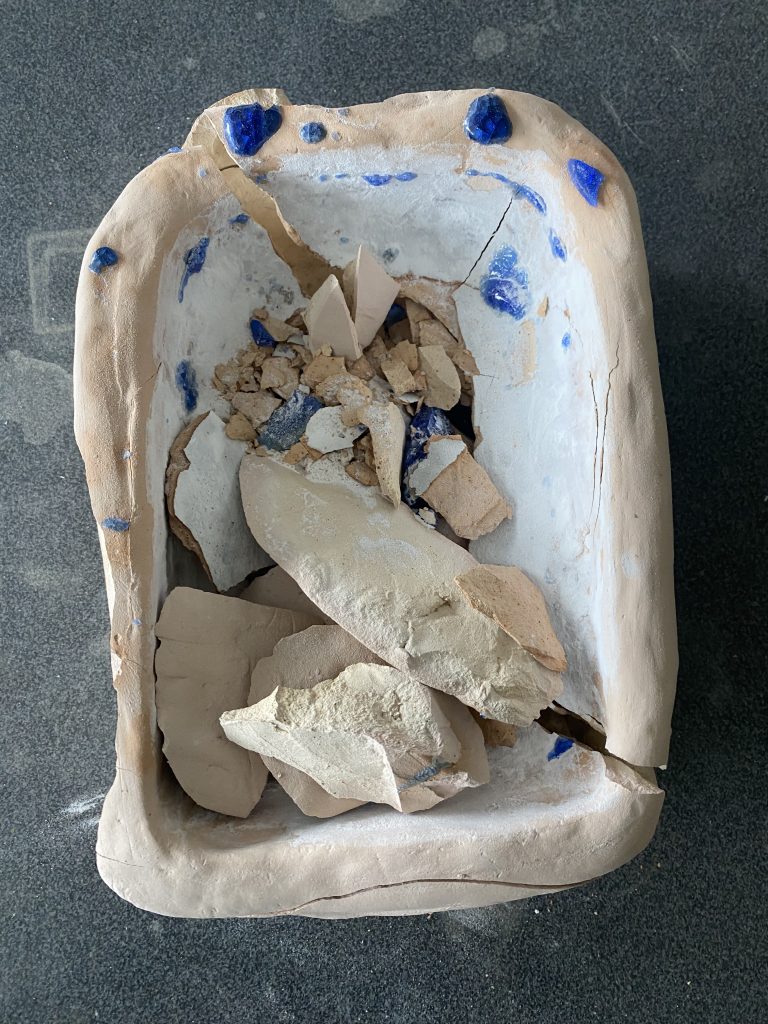
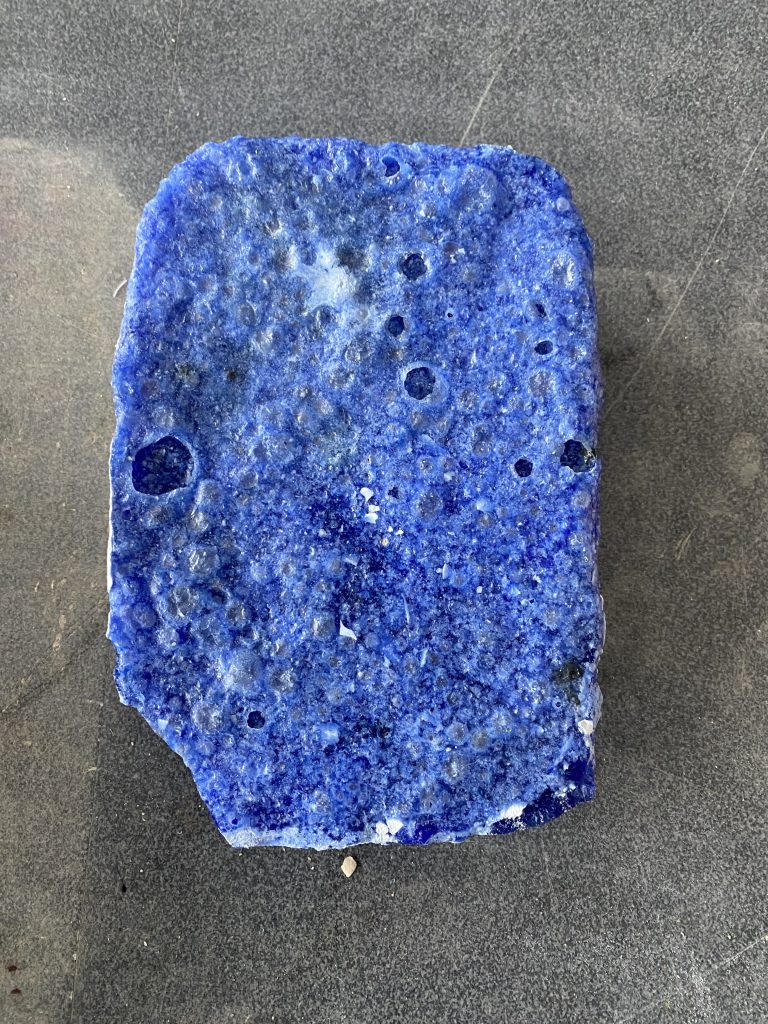
And one day later here we are. The Aluminium Kiln Wash worked but we had to break up the mould to get access to the glass. Once out the glass was actually thinner than I anticipated. The sub-1cm cullet must have had a lot of gaps that it had to fill. Next time we will use the sand only and a slightly higher mould to give the slab more depth.
The glass appeared not ideal. It looked similar to the fused glass blocks produced using Nacho’s kiln. However, once I started to work it I realised that it actually had very good internal cohesion. It flaked well although crumbly.
And this is it. The outcome but also a starting point. We need to adjust the mould size and make sure it’s already fired. Use sand rather than sub-1cm cullet and perhaps keep it at 1000 degrees Centigrade for around four hours before allowing a very slow cool off period.
I am actually super happy with this handaxe. Many thanks Holly!
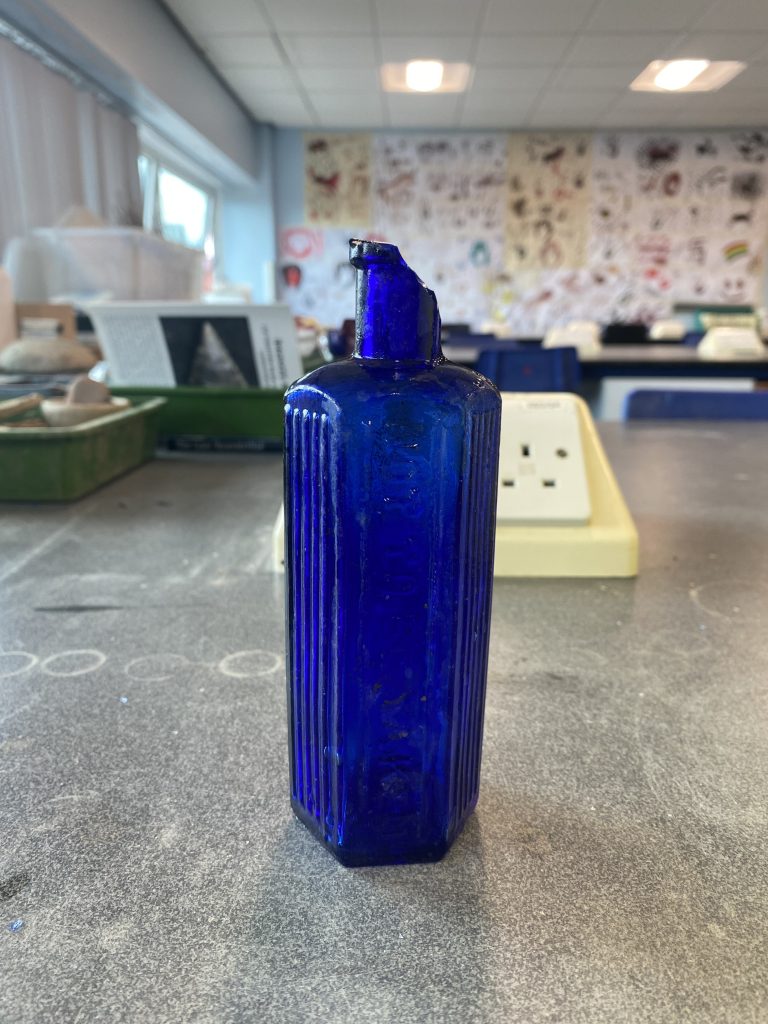
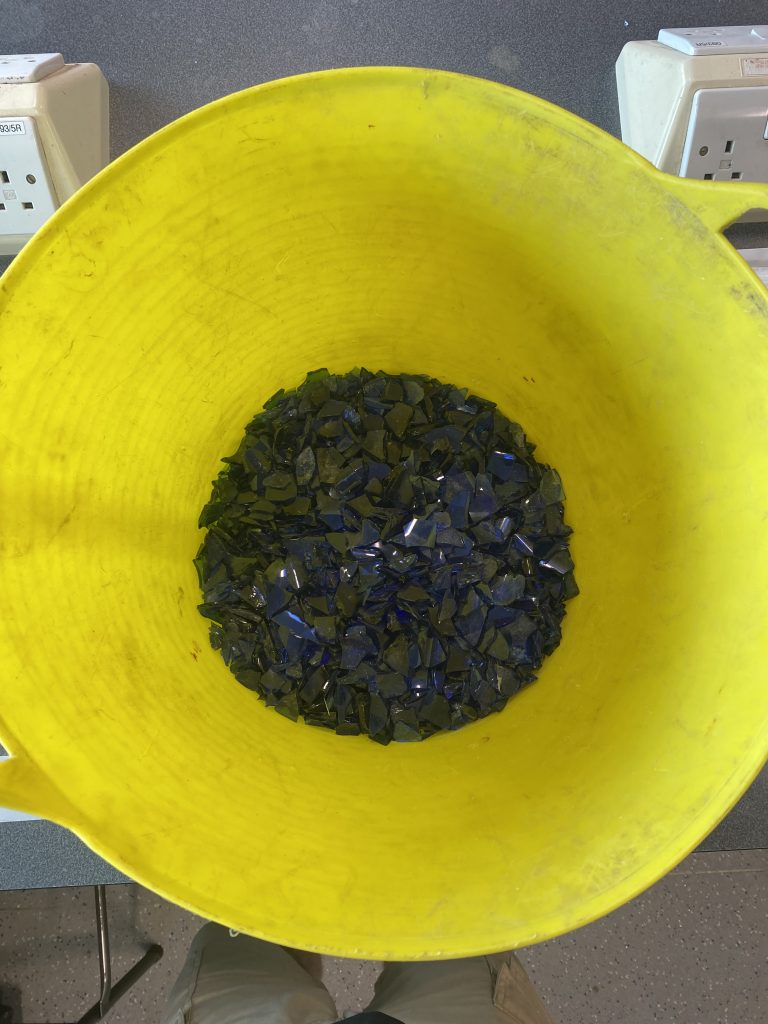
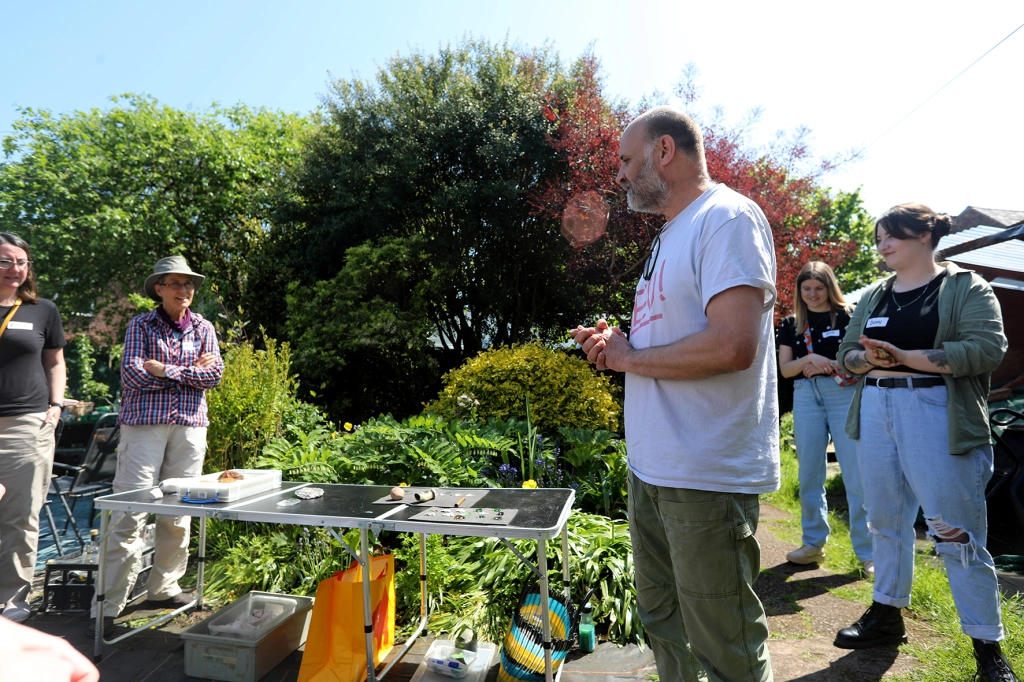
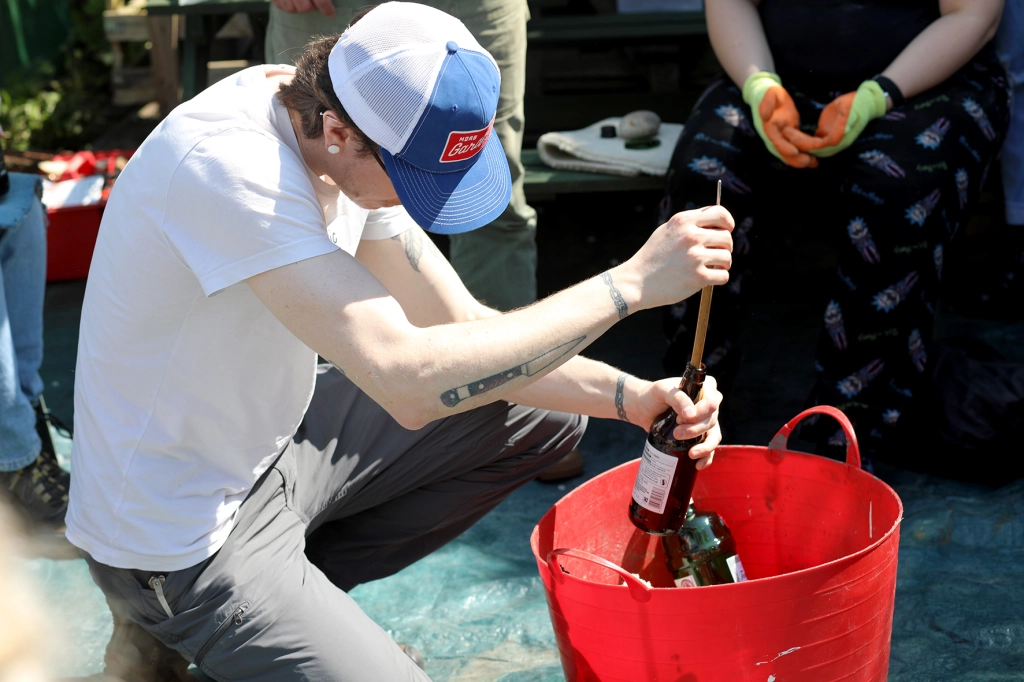
Today we had an Archaeology Open Day which was surprisingly quiet. Consequently I had quite a bit of free time in the lab on my own. I had also had about five blue glass bottles cluttering up my office for what seemed like ages, and so I added two and two together and came up with a trug of blue glass cullet.
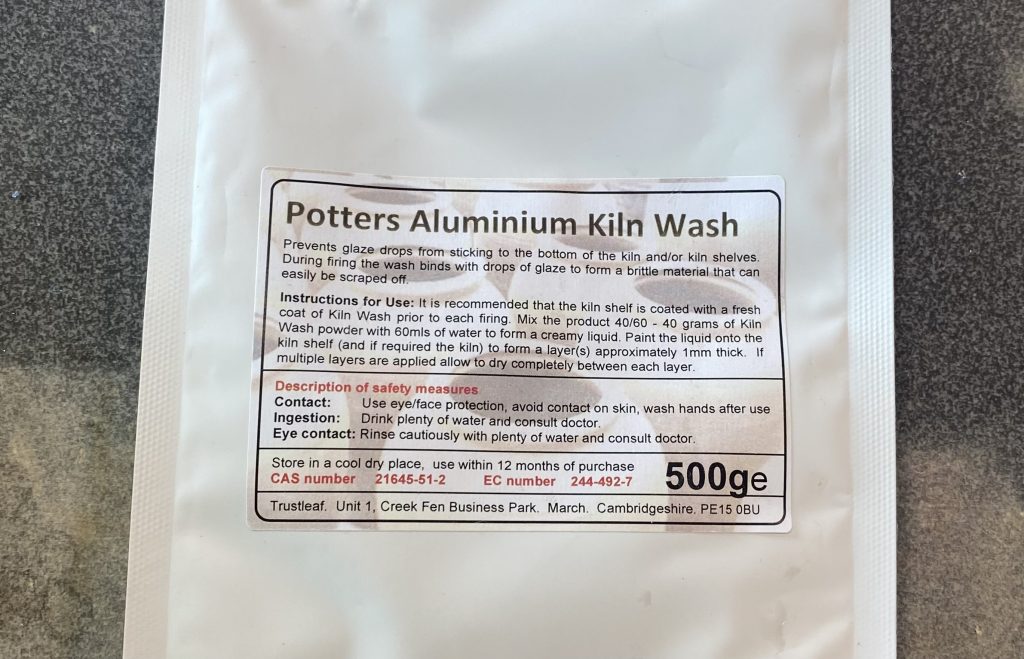
This wasn’t completely out of the blue (pardon the pun). My colleague in Geography, Holly, is in charge of a small furnace and we have discussed the possibility of melting my glass bottles to produce a slab of glass, and Tuesday next week may be the opportunity to do so. However, based upon previous experience I needed a method of stopping the melted glass block adhering to the clay mould. Enter Potters Aluminium Kiln Wash.
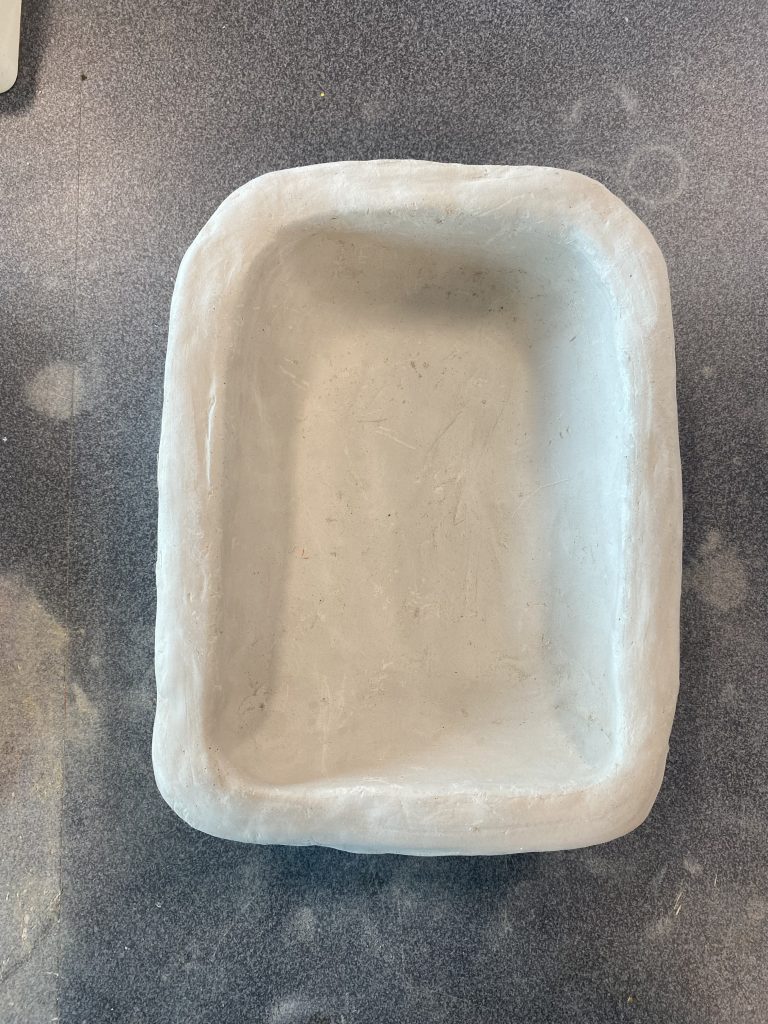
The experiment next week is to use the clay mould given to me by Alice la Porta, and use the Potters Aluminium Kiln Wash to form a layer between the mould and the glass cullet to be melted in the furnace. Holly is going to be in charge of times and temperatures, I will be in charge of keeping my fingers crossed.
This is the mould Alice gave me, let’s see how it goes…
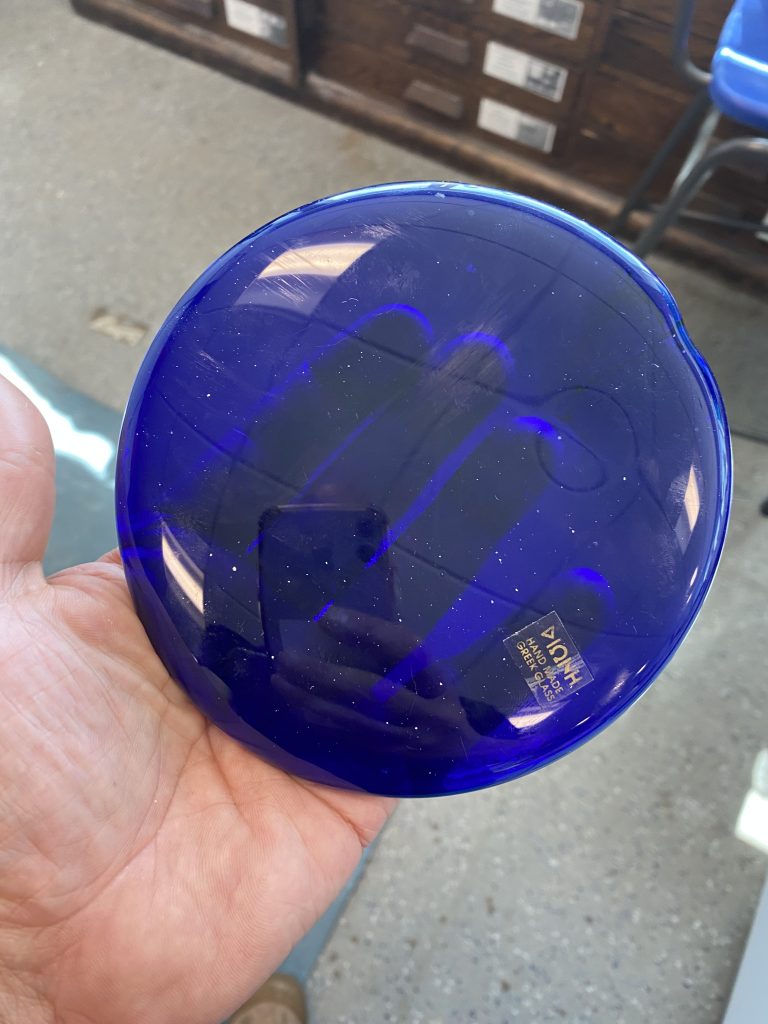
We have just come back from a week in Athens, and the main thing I brought home was a large disc of blue glass, bought at the flea market for five Euros.
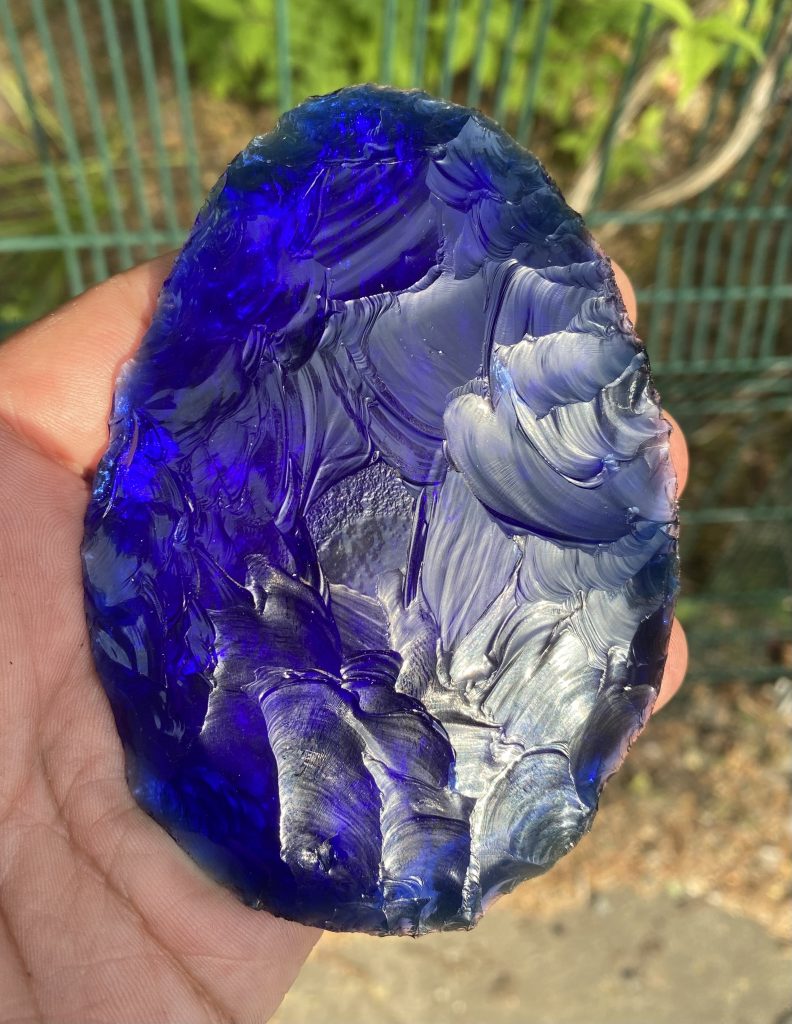
Anyway, I found time to hide in the lab for an hour or so and came away with this very nice blue ovate handaxe.
Everything worked well. Turning the edges with a hard hammer, and then thinning using an antler hammer. This is the second iteration, initially it was larger but wonky.
I brought the wonky version home, lived with it for 24 hours and then the following day finished it off so that it is a shape I can live with. I am currently thinking about the difference in experience between my work with emails, spreadsheets and budgets, and escaping into the lab and the satisfaction of making something beautiful. I suspect it is something to do with what that famous stone tool specialist, Karl Marx, termed ‘Alienation’. To be continued!
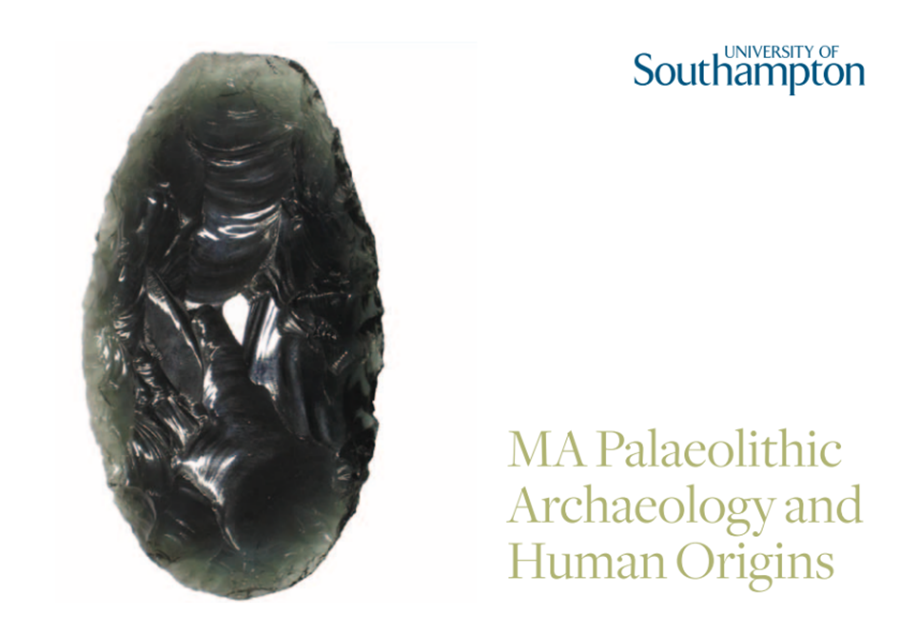
The image above is from a postcard I picked up in 2011 (I think) whilst at an archaeology conference at the University of Southampton. It has been framed and sat on my wall since then and I only recently found out the the glass replica of a Boxgrove handaxe featuring on the postcard was made by a knapper called Tim Ace. Tim’s handaxe inspired me then and has been instrumental in my enthusiasm for glass as a material to work with now.
Fast forward to 2016 and I had finished my stone tool based PhD and found I had time to learn how to flintknap. This was something I had failed to do up to then, in spite of working closely with both John Lord and Karl Lee. The main issue was lack of practice due to a lack of access to flint in the north west of England where I live. The above video was really useful in reminding me of the value of using glass to practice, and it was this video that got me going with arrowheads.
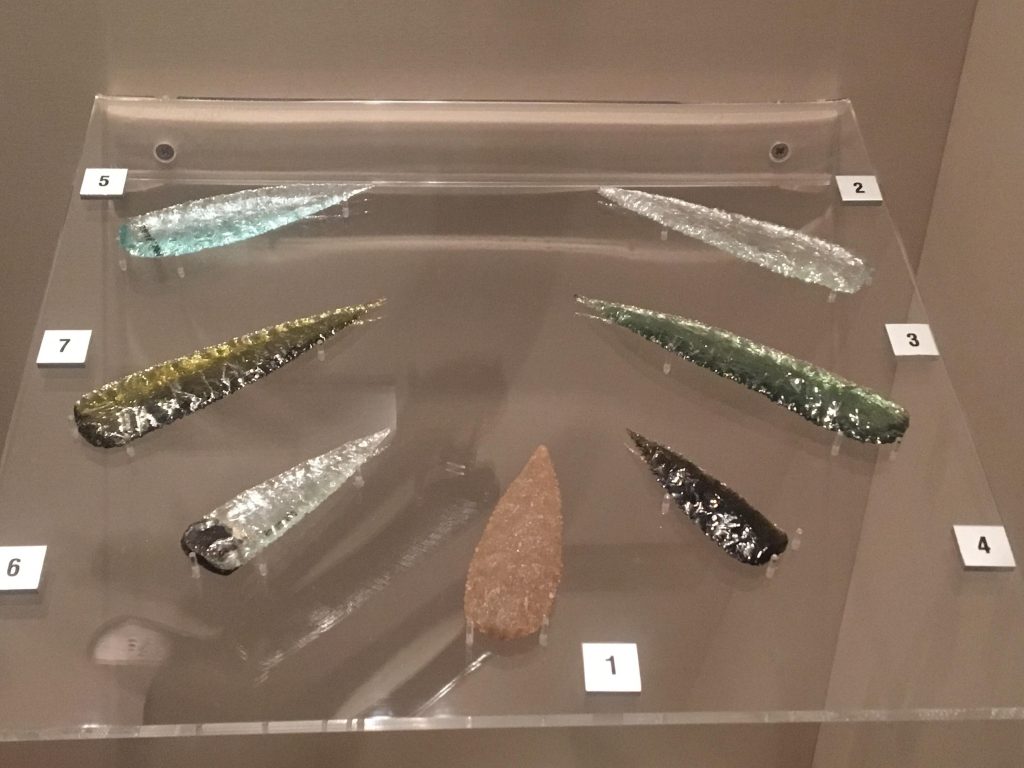
The above image was taken in the Liverpool World History Museum in 2017 (I think) and is of their collection of glass and stone Kimberley Points. When I realised Australian Aboriginals also used glass I became really excited about researching their points and methods. A number of people helped me on this learning journey as discussed here, but as well as helping me develop my pressure flaking skills, this journey provided me with a real insight into the social aspects of stone tools and their production.
And now it is 2024, and after many years spent hunched over in my back yard, I sort of know what I am doing. The above was a big flat slab of good quality glass from the Didsbury Oxfam shop (£3) and it is now a large pointy handaxe. We are in the lovely Spanish city of Valencia at the moment, and today I came across a woman in her studio making glass to produce her own glass jewellery. That would be like a dream for me. Having my own small studio space in a lovely city like Valencia, and being able to knap beautiful glass handaxes all day, interrupted only by the occasional cafe con leche.
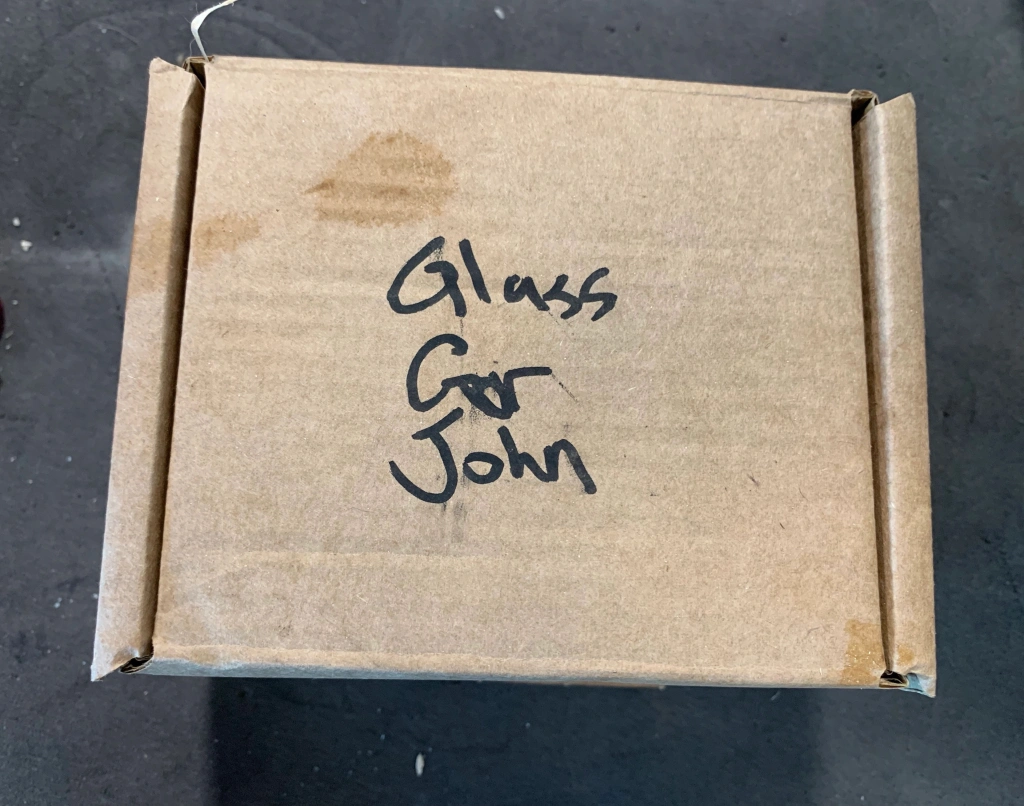
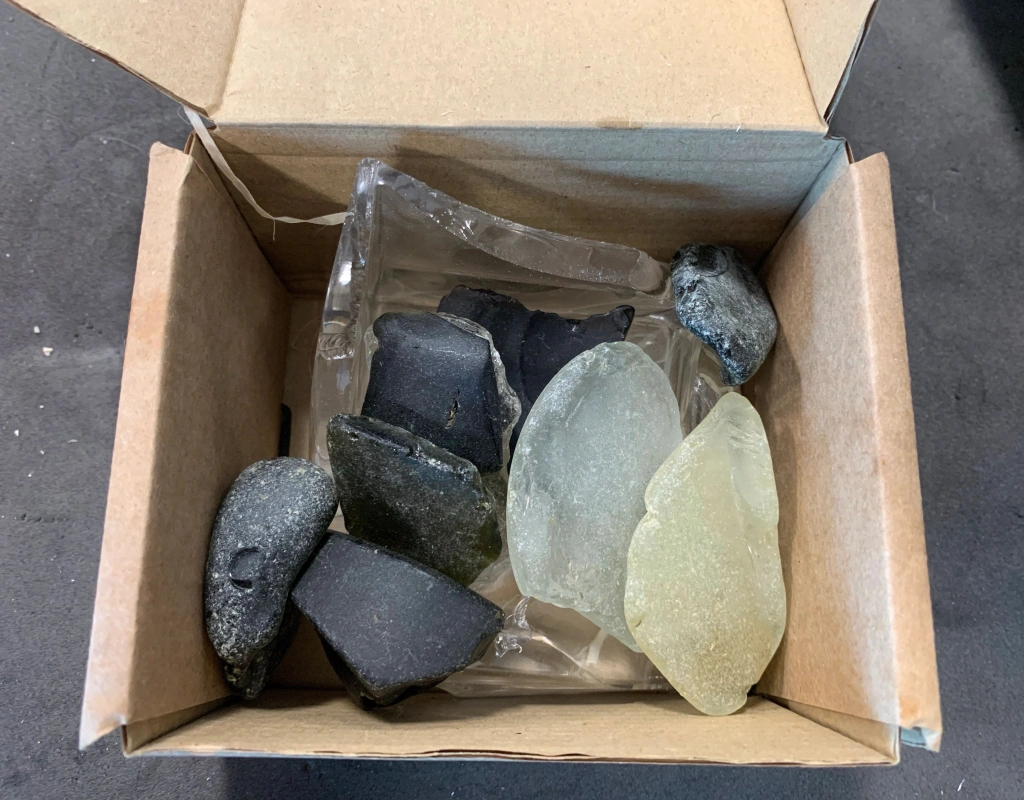
Since coming back from fieldwork I have slowly been sorting out stuff at home and in the labs. In doing so I came across this box given to me by Pete Yankowski at the Chorlton Arts Festival knapping session (see previous post).
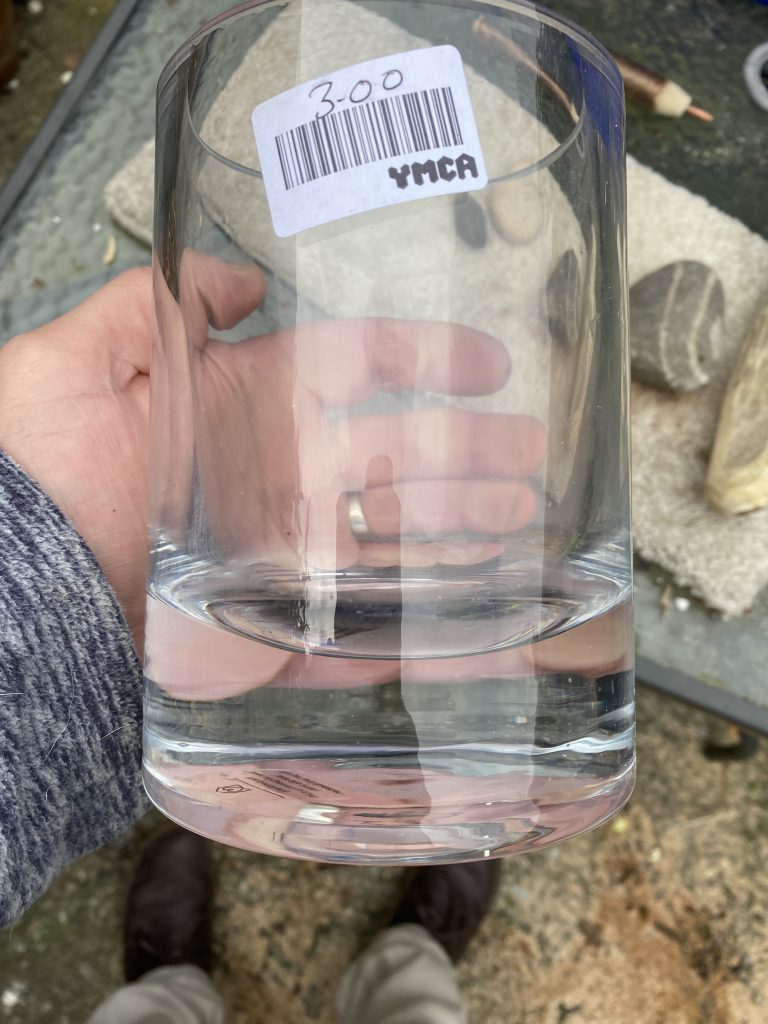
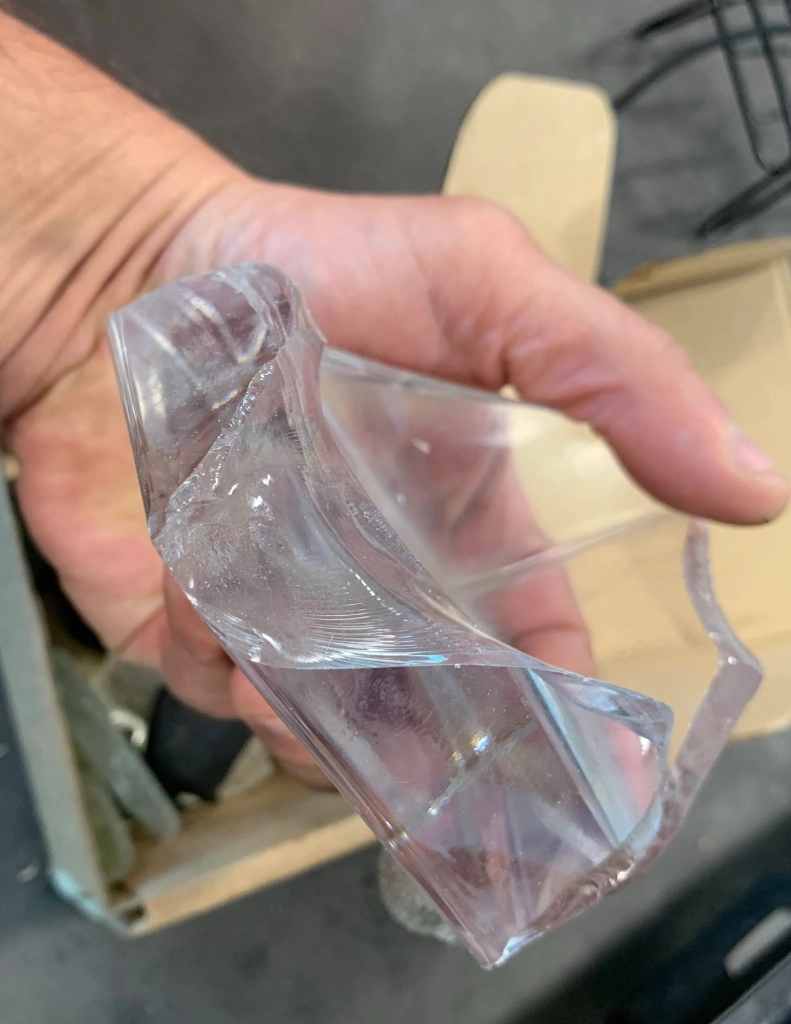
As you can see it is full of treasure, however the thing that caught my immediate attention was the modern broken vase base, languishing at the bottom of the pile.
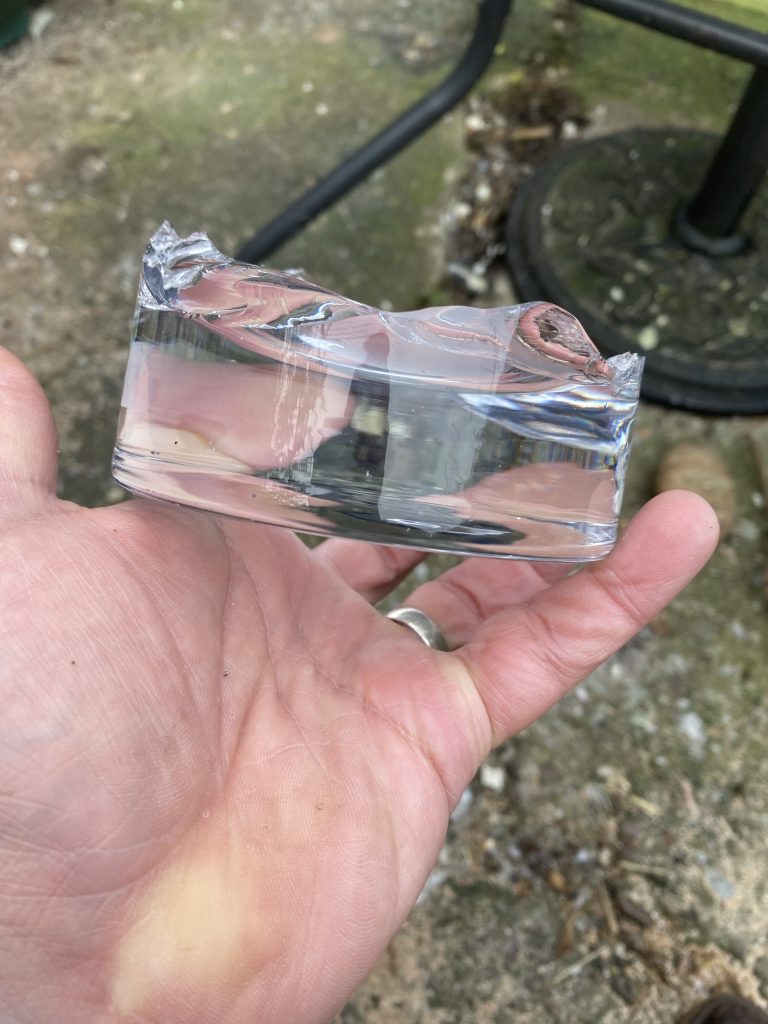
As you can see, it is both thick and has a way in, and so I spent a little time with this yesterday. A day earlier I had worked on another glass base, but hadn’t prepared the edges as well as necessary. Consequently I ended up with an artefact with a ‘step fracture island’ on one face, and some original surface left on the other. Most unsatisfactory! Consequently, I spent quite a lot of time on this one, turning the edges as well as possible.
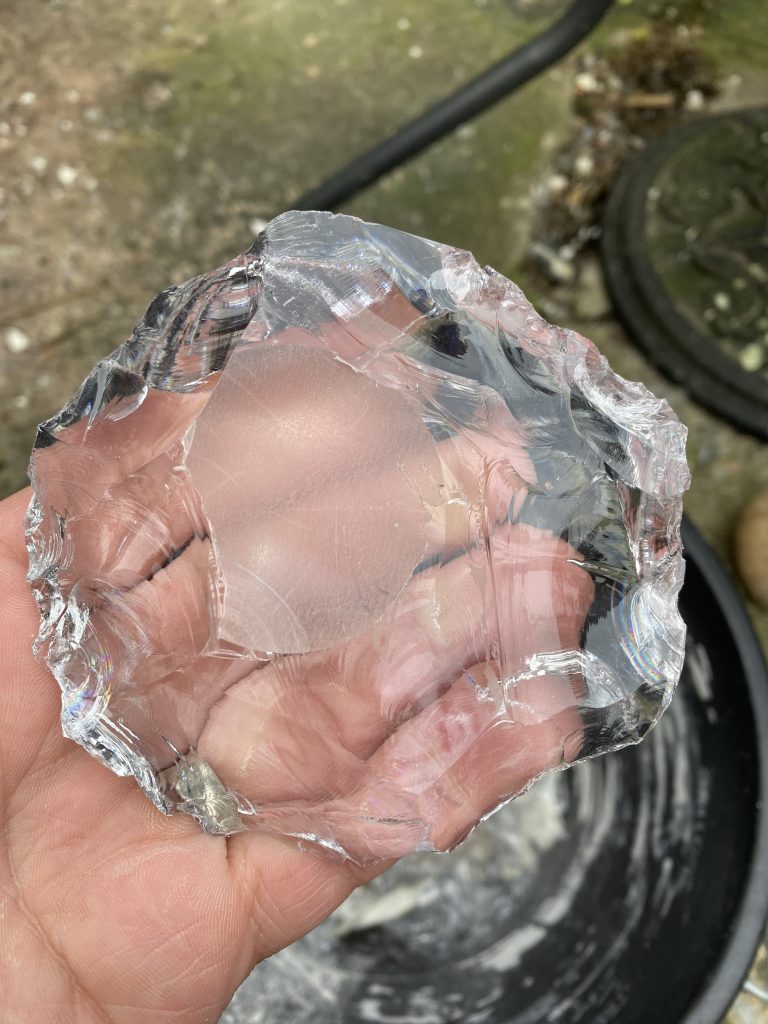
This particular flake has a story. The reflective bit is a section of original surface that was sitting at the centre of one face, and it needed to go. Because I had spent time creating well prepared edges and platforms I was able to remove it with one accurate and hard blow of the antler hammer. This meant both faces were fully bifacially worked. Most satisfactory!
Anyway, the result is a small and wonky cordate handaxe. There are a couple of small step fractures that I could get rid of, but that would mean losing width, so I am going to live with them. Or should I say, Pete is going to live with them, as the handaxe and flake are now winging their way to him, as a thank you for the original box of treasure.