I found out late last month that the Australian archaeologist, Kim Akerman, had died peacefully at his home with his wife, Val, in Hobart. Even typing this makes me feel tearful, for a man who lived on the other side of the world and whom I had never met in person. So why tearful? In spite of the fact that we never met face to face Kim has been incredibly helpful and supportive, and played a fundamental role in my own stone tool making journey.
When I became interested in glass as a material, and Kimberley Points as a focus, a quick search on Academia.edu revealed that Kim was the preeminent scholar when it came to these glass points. I started to download one of his papers and Academia.edu asked me if I wanted to let the author know why I was downloading (Figure 1.). I can’t remember exactly what I put, but it was brief and along the lines of “I want to learn how to make Kimberley Points“.
Figure 1. Academia.edu helping me make new friends.
I was pleasantly surprised when Kim quite quickly got back to me, recommending two out of print books (Figure 2.) and offering to email me two of his own Powerpoint lectures to boot. We swapped emails and Kim sent the relevant lectures over (Figure 3.). By then I really did have a lot of valuable information to start my Kimberley Points journey.
Figure 2. One of the two out of print books Kim recommended.
Figure 3. One of the two Powerpoint lectures Kim sent over.
I had Kimberley Points to look at in Manchester Museum, a plentiful supply of period glass to work with, and Kim’s guidance on equipment and process, so I got on with it. It was by through going through the making process that I realised there were things I didn’t understand. So in 2018 I got back in touch with Kim. In particular I was interested in the correct way to turn the edges of the bottle to start the pressure flaking process, and how to avoid losing too much width. In response, Kim made a Rose Leaf point (Figure 4.) and provided me with this breakdown of the complete reduction sequence.
Figure 4. Kim’s completed Rose Leaf point made from a water worn glass fragment.
I kept in touch with Kim, intermittently sending him any Kimberley Point related publications or media produced here, for his records, as he asked me to do. In looking back through my emails I realise my first contact with Kim was in or around 2016 on my old student email address, which is no longer accessible. In March this year Kim got in touch to to ask me for my actual address (Figure 5.). He had contracted Raynaud’s Syndrome which had affected his ability to work stone, and he had a Calytrix exstipulata, or Turkey Bush wooden pressure flaker that he was happy to send in my direction.
Figure 5. Kim’s email telling me about how Raynaud’s Syndrome had affected his hands.
I thought about how I would feel if my body wouldn’t allow me to flint knap again, and realised that for me, and perhaps for Kim, this would be a significant loss. Anyway, I sent Kim the address and a couple of weeks later the pressure flaker arrived in Manchester (Figure 6.).
Figure 6. The tube and Calytrix exstipulata, or Turkey Bush wooden pressure flaker.
I haven’t used the pressure flaker. It still lives in its tube, partly because the pressure flaker, tube and handwritten details seem to capture something for me. It materialises a relationship and Kim’s kindness at a time that I suspect was quite difficult for him. Having said that, I also suspect he would want me to use the pressure flaker, not transform it into some kind of museum object or religious icon!
Anyway, I found the need to email Kim again last month. I ran two scraper making sessions here in Manchester, and through that process realised that I discussed an Aboriginal focus upon edge angle (Figure 7.), but didn’t fully understand that aspect myself. I emailed Kim to get some guidance on relevant readings.
Figure 7. My Powerpoint slide discussing an Aboriginal perspective on scrapers.
Again I received a very quick response (Figure 8.), but this time it wasn’t something I would be pleased about.
Figure 8. The automatic email response I received late last month.
Kim was a very kind and giving person, not just to me, but as this video from the Tasmania Aboriginal Education Services shows, he made a positive impact on many people’s lives. Whilst writing this post does makes me feel tearful, Kim had a rich life, and as the email stated, he died peacefully at his home with his wife, Val. Perhaps a rich life and a peaceful passing with your loved ones close is the best any of us can hope for.
Figure 9. Kim Akerman being thanked by Craig Everett for sharing his knowledge and skills.
I am leading seminars at the moment on an undergraduate second year module at Chester called ‘Communicating the Past’. To complete the module, students have to produce a 1000 word essay discussing the academic sources used for a proposed Key Stage 2 primary school children’s prehistoric activity. They also need a 2000 word plan for the primary school teachers, showing how the children’s activity works, and fits within the curriculum. Finally, they need to produce a 1000 word reflective piece outlining what the students themselves have learnt from the process. I want to use this post to illustrate why I find reflective learning a valuable tool at all stages of the academic process, and beyond.
To do so, I am going to use an activity I have developed for undergraduate archaeology students to introduce them to the stone tool making process. This 50 minute activity involves around 15 students each making a flint scraper and it is assumed they have no prior knowledge of the process. Having run this session over a number of years, it was only at the most recent session at Manchester where a discussion with a student made me reflect and then rethink and develop my understanding of the teaching process.
To link with the module outcomes necessary at Chester, I have broken this discussion down to consider three key elements:
The value of academic texts
Explaining a curriculum activity
Reflecting on, and learning from the process
For the purposes of this blog post, I am going to start with the activity plan and how I relate it to an undergraduate archaeology curriculum.
My activity plan and how it relates to the archaeology curriculum
I primarily use this activity to introduce the students to the bodily process of making a flint scraper. However, it is also useful on a number of other levels. In particular: as an introduction to the terminology associated with a flint flake; to understanding the relationship between material, kinetic energy and angles within the making process; but also to show how our modern western understanding of a scraper is both historically and culturally situated. These elements feed into undergraduate archaeology modules at both Manchester and Chester (e.g. Doing Archaeology 2, HI4001) and within the actual session I deal with the theoretical bit at the beginning using three Powerpoint slides.
Figure 1. Francois Bordes and a Culture History approach
This first slide (Figure 1.) references the 1950s work of French prehistorian and flint knapper, Francois Bordes, who saw a particular type of scraper, in this instance one he categorised as a Quina scraper, as representative of a particular Neanderthal group. I use this slide to illustrate the ‘Culture History’ approach to interpreting artefacts.
Figure 2. Harold Dibble and the Processual approach
The second slide (Figure 2.) references the 1970s work of the American flintknapper and researcher Harold Dibble. Dibble was interested in the life cycle of the scraper, in particular how the shape changes as the scraper is used, and then resharpened (see illustrations on the right hand side of the slide). He used the fact that shape was dynamic and not static to argue that it was not so useful to think of scrapers as typological signifiers for culture groups. I use this example to illustrate a ‘Processual’ approach to archaeology.
Figure 3. Anthropology and an Aboriginal Australian approach
The third slide (Figure 3.) takes an anthropological perspective, and looks at how Australian Aboriginals would be concerned not with shape, but things like material colour and texture, as well as edge angle. As the slide outlines, totemic ties, kinship relations and what the scraper was designed to be used for, these were the issues an Aboriginal would be looking at.
After ticking the ‘academic box’ we move onto the making process. I direct the students to the necessary protective equipment before providing a demonstration. I select a large flake so everyone can see my process, and explain the difference between the smooth ventral and scarred / cortical dorsal surface. After highlighting the platform and bulb of percussion, I use a felt tip pen to draw the desired scraper shape onto the ventral face, with the bulb of percussion as the potential ‘handle’ (Figure 4.).
Figure 4. A large flake with scraper shape outlined using felt tip pen
I then select a hammer stone, show the correct angle to hold the flake, ventral surface uppermost, and start taking removals from the edges, moving towards the central felt tip outline. As I encounter thicker areas, I draw attention to how the sound changes, and then provide a discussion of how to hit things effectively. Once the desired shape has been achieved, I use a coarse sandstone to abraid away any sticky out bits. Finally, I demonstrate scraper use on a thin birch branch removing the bark. After the demonstration, the students select their own flint flake and hammerstone and then have a go.
Reflecting upon what I have learned from this process
Going around the students, I check where they are up to and help them overcome any difficulties, such as how to hit harder or more accurately. One student had finished his scraper and scraped the branch, but I could see his scraper was blunt, and the edge he had produced was not at an ideal angle for scraping. My diagnosis was that he had held the flake at an incorrect angle when making the scraper. This was not the end of the world as we could remedy this when he re-sharpened it. However, it made me start to think. I learnt how to make a scraper from the professional flint knapper, Karl Lee, and he emphasised the angle at which to hold the flint flake to produce a useful scraper. As discussed above, I have repeated this instruction to students over the years but without considering the Aboriginal perspective that I present at the beginning of the session (figure 3). I have unconsciously absorbed the idea that there is one correct angle to hold the flake in order to make a scraper. However, if the slide about Aboriginal knappers that I present is correct, then there must be more than one way of holding the flint flake in order to get more than one edge angle. Why had I not recognised this before? Probably because I am not using scrapers in practice and so I am not so knowledgeable about the different uses, and therefore the various edge angles.
The academic sources I am using
This leads to the interesting bit. Because I have been delivering this session over a number of years, I could not remember where I had read about the Aboriginal perspective on scrapers. This is obviously a missing component that could really enrich my session, so I am now at the stage of having to find out more information. Being a big fan of the social aspects of archaeology, my first step was to email my main contact in Australia, Kim Akerman, an academic and stone tool maker who has been really helpful to me in the past by directing me to relevant sources when I was originally looking into Kimberley Points. I would always encourage people to contact specialists in the area they are interested in, however, this is another story. Using the library search facility and term: Aboriginal Australian scraper edge angle, I am currently working through the relevant papers that come up, with the aim of understanding more fully the Aboriginal relationship with edge angle and tool function. I can then integrate this knowledge into my undergraduate scraper making exercise.
Concluding thoughts
I emphasise reflective learning because I think it it illustrates how both teaching and learning is a process, not a product. I have a stone tool based PhD, am a competent stone tool maker and have been teaching undergraduate archaeology modules for the last six years. Whilst I have a good level of archaeological knowledge and understanding, I am absolutely still on my learning journey. As part of the PhD process, it is necessary to learn about teaching theories and learning styles, to understand the range of ways we learn, and therefore the range of ways we can teach. One of the most useful learning styles I have adopted is that of David Kolb and his experiential learning cycle. Kolb’s learning cycle has four stages. He presents an initial ‘active’ or ‘concrete’ phase of doing, let’s say, making a scraper. This active phase is followed by a reflective phase, considering how things went, and what changes to process could be made so that a better end result is achieved. The third phase of Kolb’s cycle involves doing the activity again, but this time integrating the considered changes to the process. The fourth phase is again reflective, looking at what has been produced and considering whether or not the change to process has helped to achieve a better end result, or scraper.
At first encounter, the reflective process can seem passive, sat thinking, devoid of action. I have found writing this blog / website a useful and active reflective learning tool that has really helped me develop my understandings. This has been primarily in relation to learning the stone tool making process, but as you can see with this post, also with my teaching and learning within archaeology more generally. In other words, doing something, like making a scraper, then writing about the process, is valuable in helping us to learn. Funnily enough, this is exactly what this Chester module is asking students to do; to develop an active reflective process. As discussed here, reflective learning is a strategy that has value at whatever stage of the academic process you are working at, and I would argue, beyond a particular subject area. Many archaeology students go on to work in areas beyond archaeology and the aim of this blog post is to illustrate the value of learning strategies as well as subject specific knowledge. For those who are interested, this link provides more information on David Kolb’s learning cycle, and experiential learning in general.
I recently went on the above workshop, mainly because I know that flintknapping creates dust and I should make sure that we are practicing safely.
So this week two colleagues from Geography popped over to measure the amount of dust generated in a mini handaxe making workshop. The main outcome was, I need to hoover up rather than brush up afterwards, as that is when most of the dust is airborne.
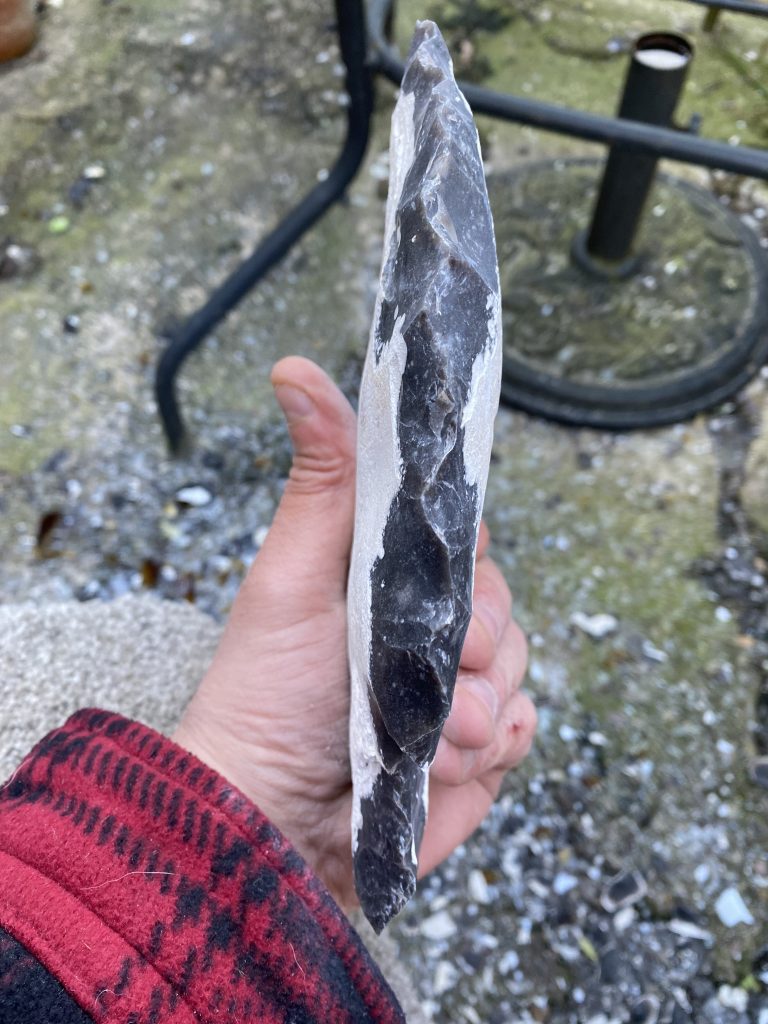
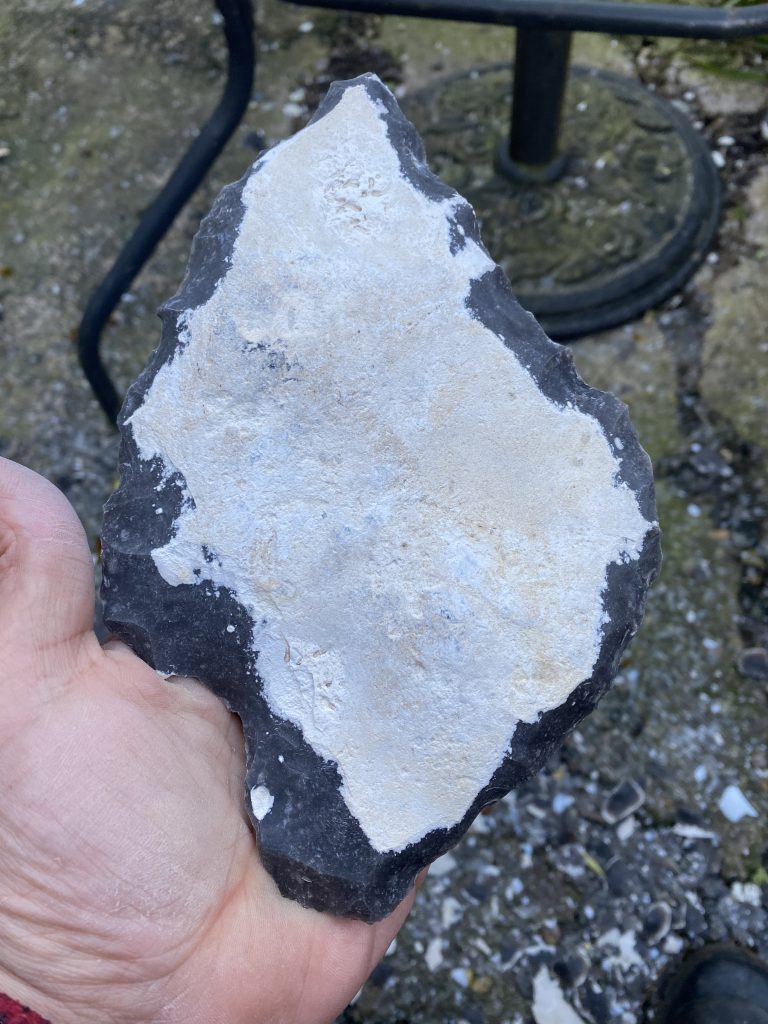
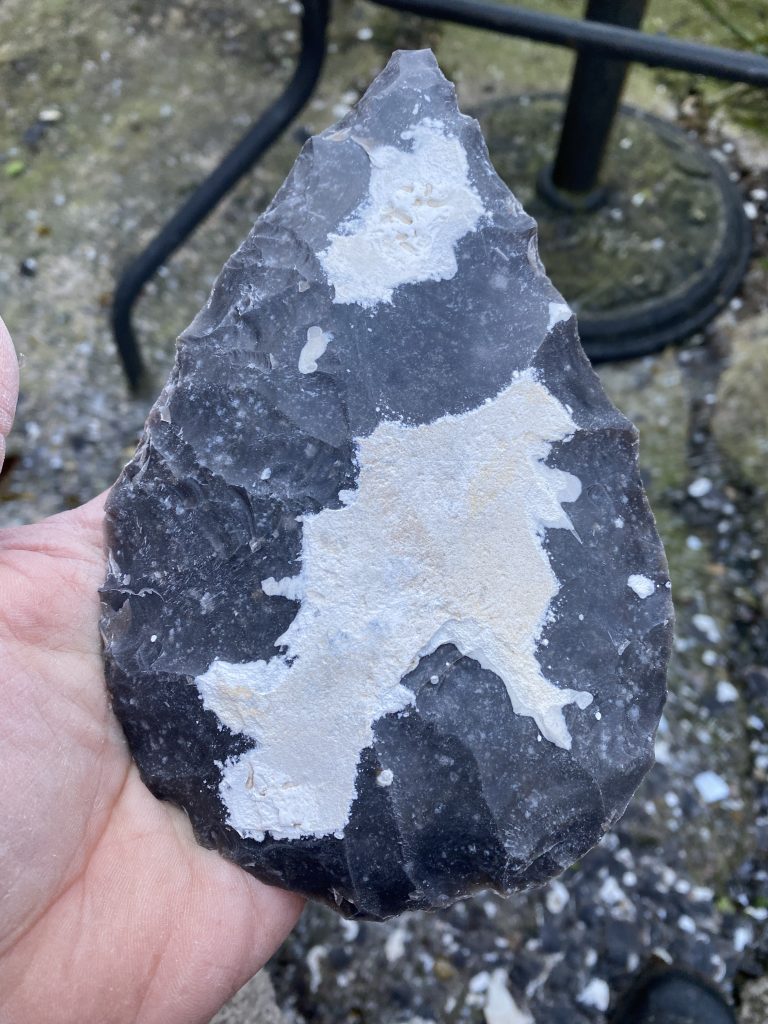
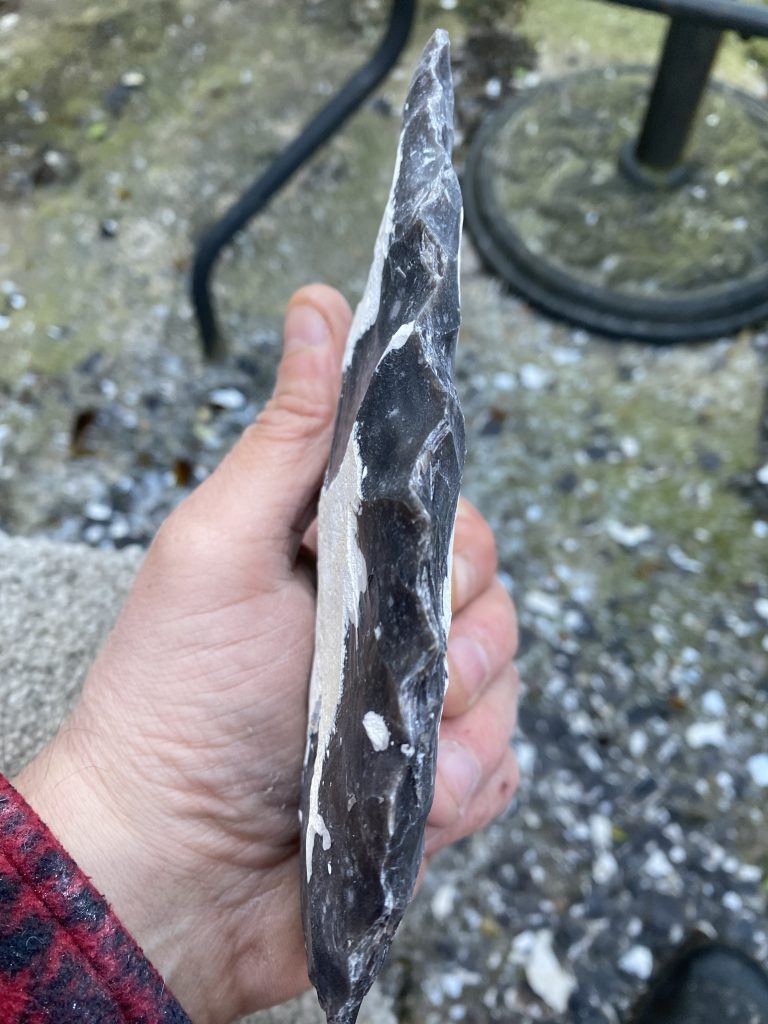
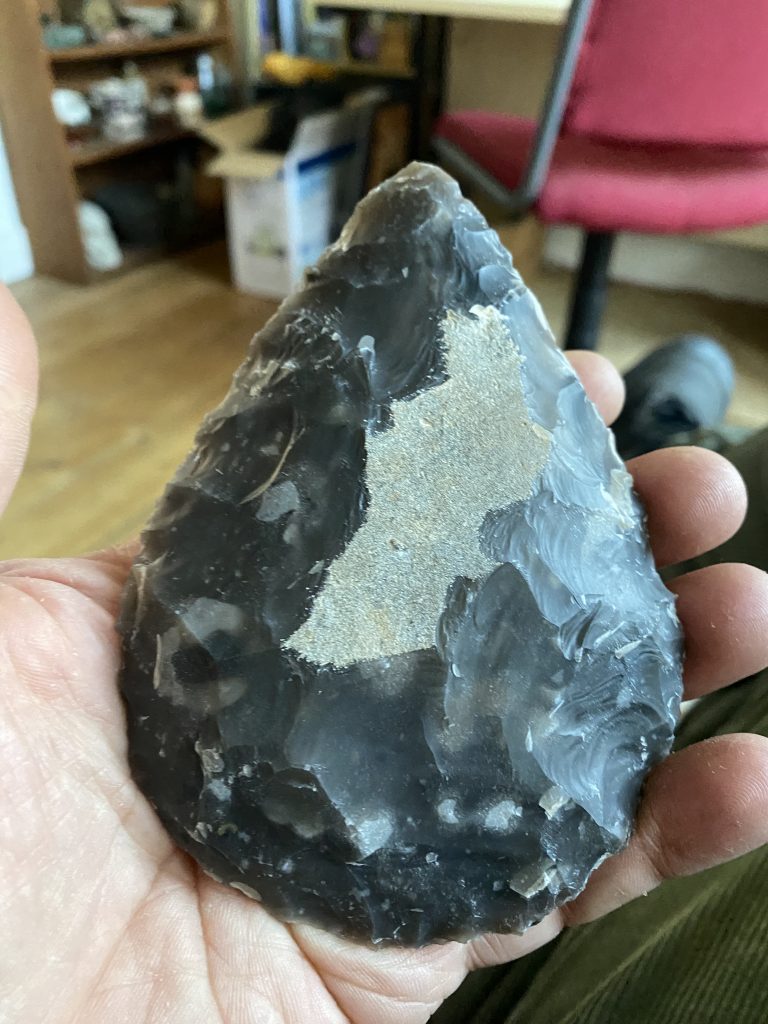
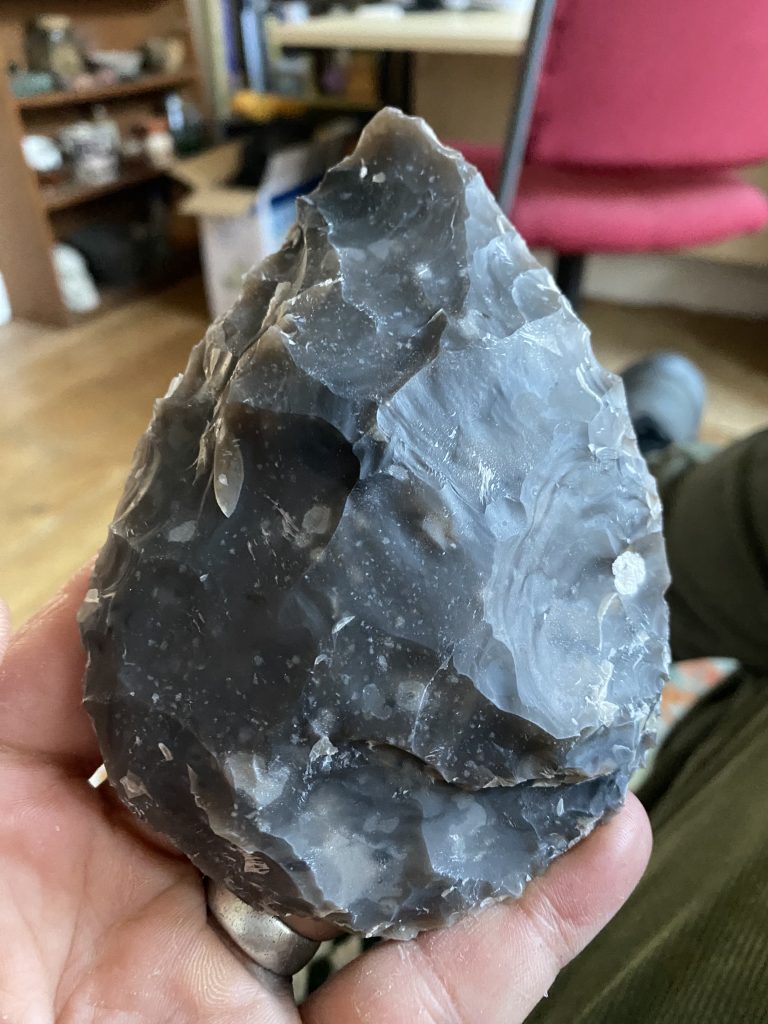
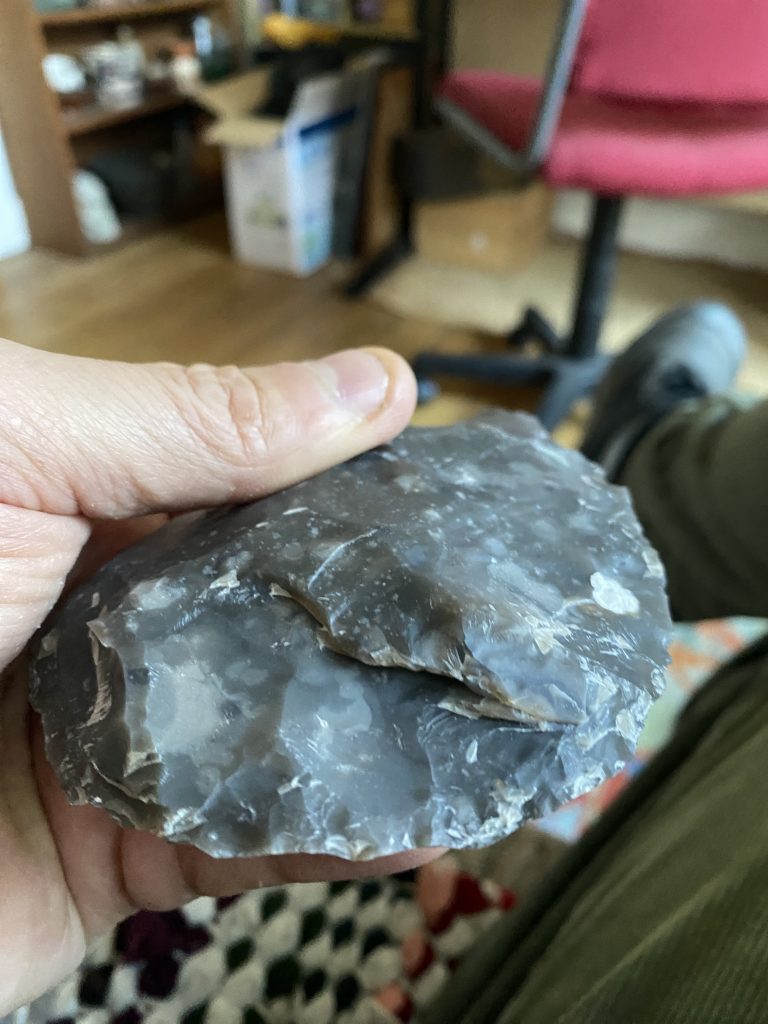
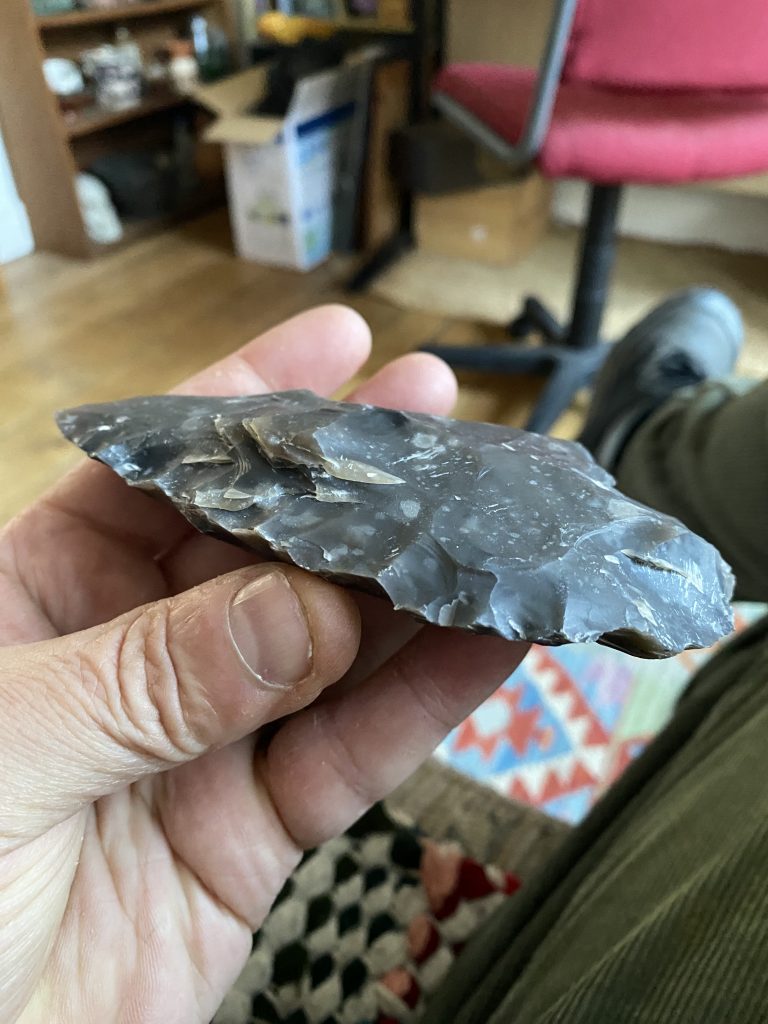
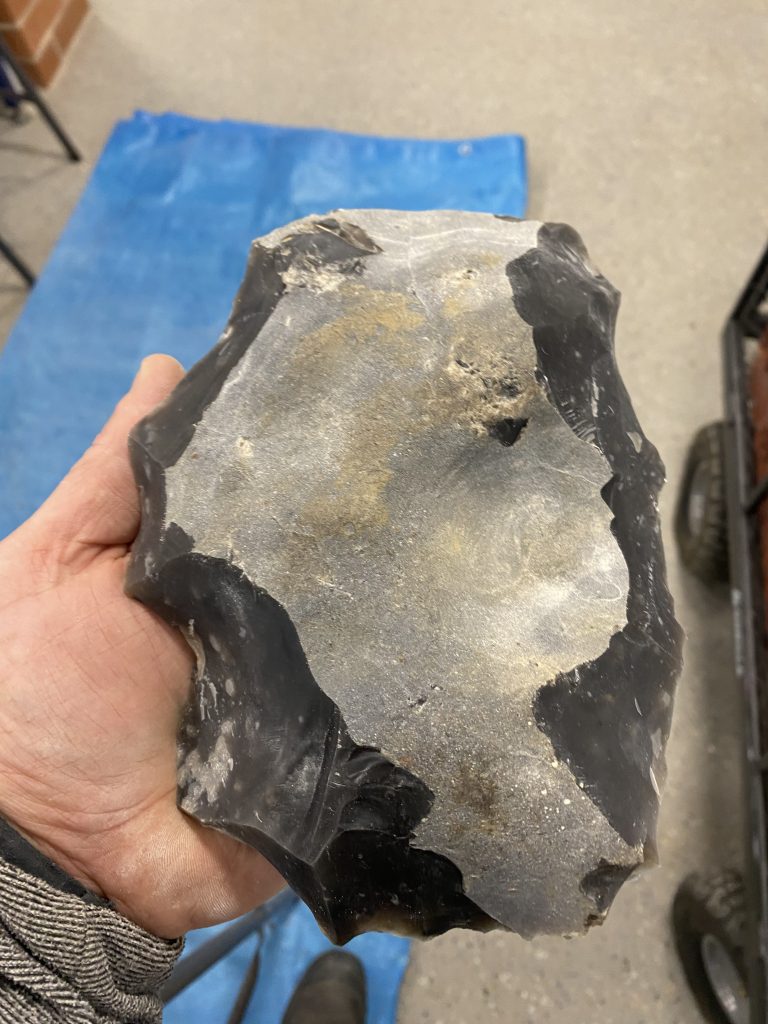
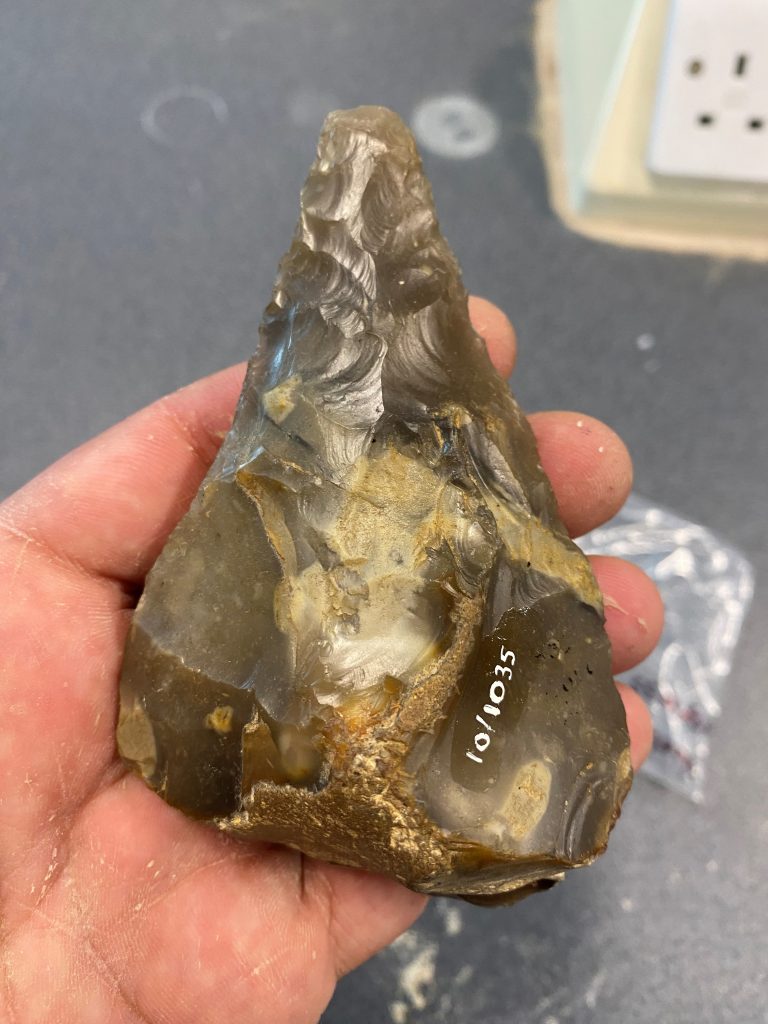
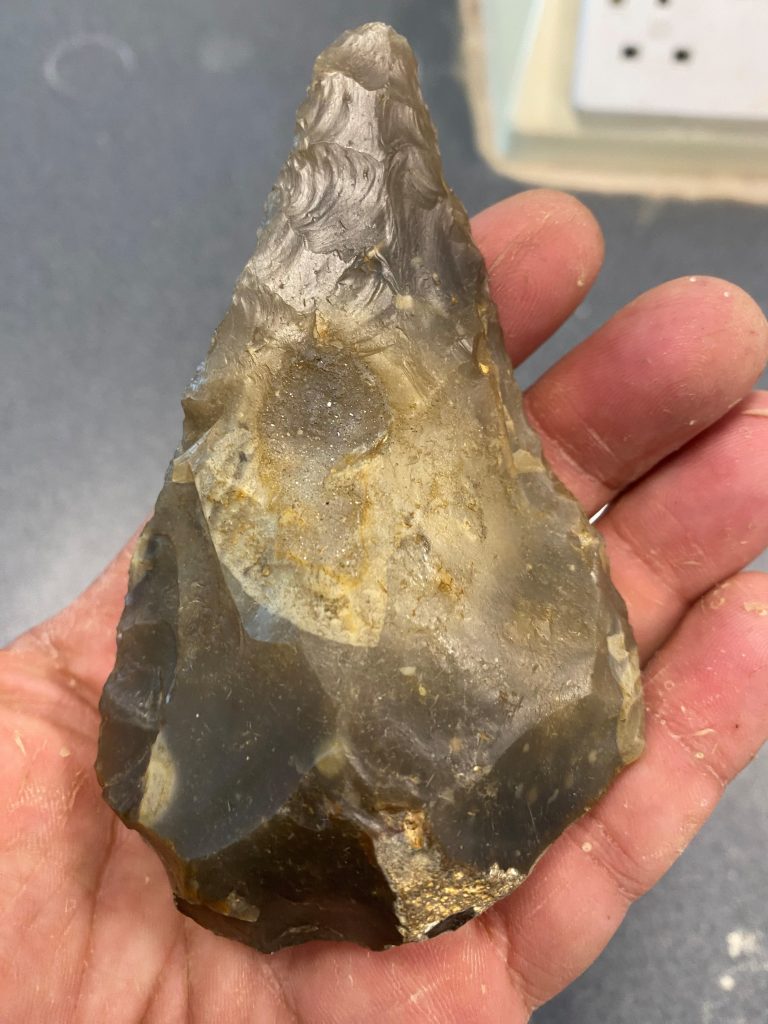
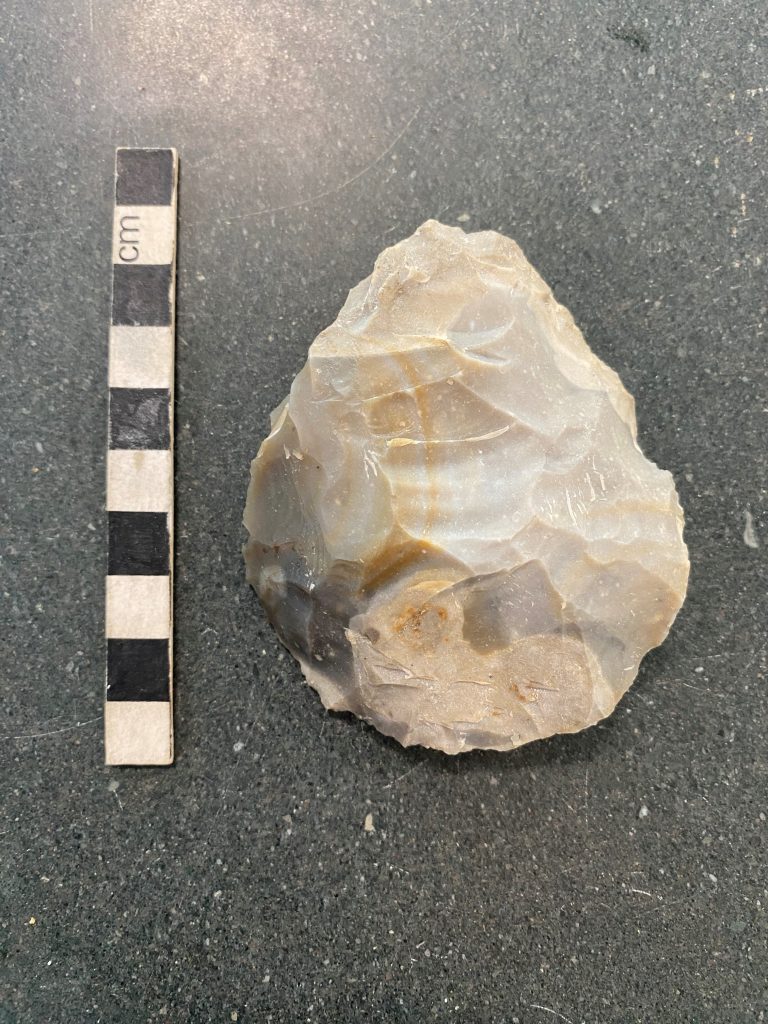
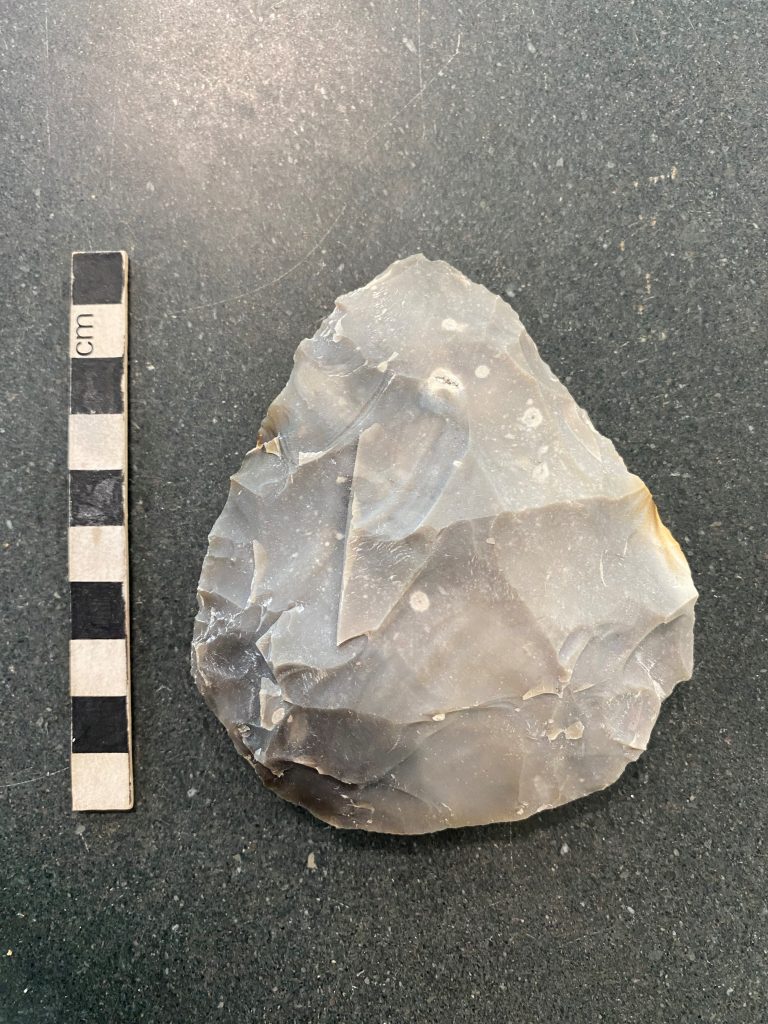
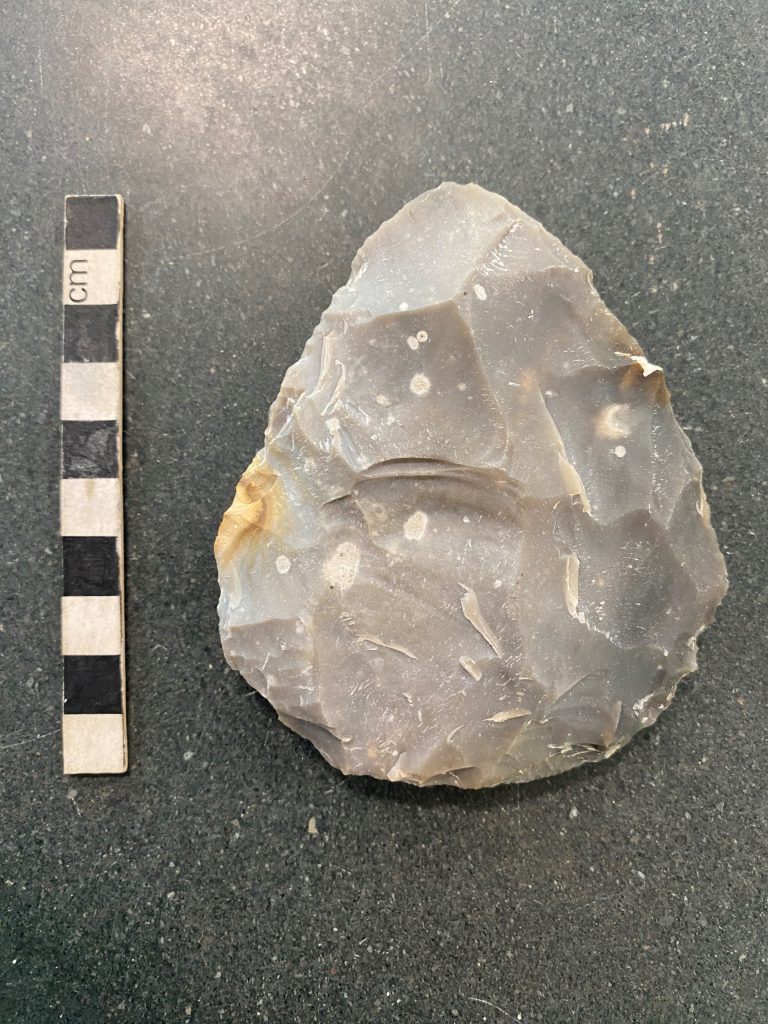
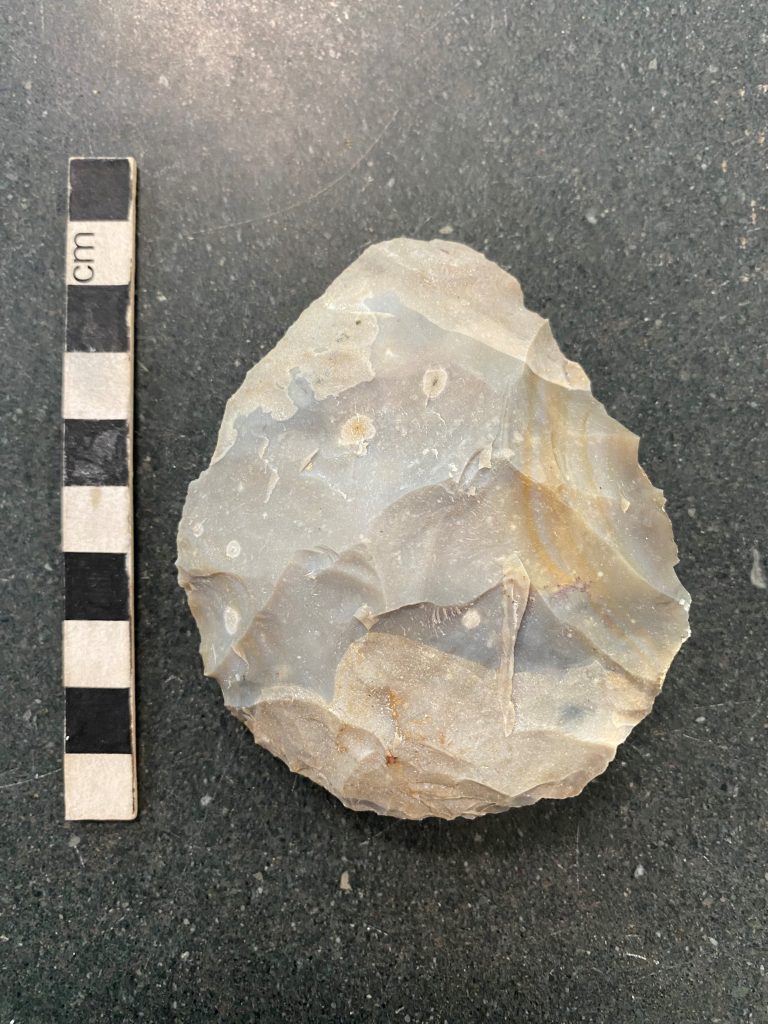
A second outcome was a spare flake left over and I turned it into this nicely shaped handaxe on Friday. Anyway, it has some interesting features. Mainly cortex on the dorsal surface, and some areas of original flake ventral on the other surface.
I was a little disappointed that I didn’t clear all the original ventral from the surface, however, from a teaching and learning perspective it illustrates dorsal and ventral really well. My relationship to this handaxe has changed since making it. I have shifted from aesthetically disappointed to pedagogically excited. It just took me a while to become fully acquainted!
This is a strange time of year for me. Relatively quiet diary wise and along the corridor, but work wise I have a lot to do within the couple of weeks before term starts.
This flexibility inevitably means I end up in the lab and doing what I am obsessed with at the moment, making handaxes. However, over the past two days things have not gone so well.
I have been trying to work the big chunks I have had lying round for a long time, but seem to be just destroying stuff, rather than being able to make anything. I think it is because I have so much going on in my head it is difficult for me to slow down and focus.
Anyway, I was pretty pleased with this handaxe preform. It was a large clean flake removal from the bottom right nodule in the cage. So far so good. The hard hammer shaping went well and I moved onto the soft hammer. The thing to note on the above photo is the dark brown inclusion at the bottom near my little finger. This material was a lot harder than the flint it was sat within.
This is a better view of the hard section. Soft hammer wise I do not have so much choice, they are all a pretty similar size, and I could have done with something heavier to take longer flakes from this particular flint, but I did not have that option, so I just had to hit it faster with the aim of increasing the kinetic energy and therefore impact. Above is an example of what I would class as a good platform, both low and isolated, or sticking out a bit. All the ingredients to produce a good clean removal.
However, I hit the platform of hard material, again and again with no result, until this happened. Increasing the impact at one end has split the handaxe preform in the middle. I know this as endshock, although I do not fully understand the phenomena, I just avoid hard hits at one end of a handaxe. With this example I was working with it on my leg, held down at the distal end and hitting hard the proximal. I wonder if my leg acted as a fulcrum and it gave way in the middle? Is this the same as endshock? I don’t know, but I am keeping this as a really interesting example of something or other.
The image above is from a postcard I picked up in 2011 (I think) whilst at an archaeology conference at the University of Southampton. It has been framed and sat on my wall since then and I only recently found out the the glass replica of a Boxgrove handaxe featuring on the postcard was made by a knapper called Tim Ace. Tim’s handaxe inspired me then and has been instrumental in my enthusiasm for glass as a material to work with now.
Fast forward to 2016 and I had finished my stone tool based PhD and found I had time to learn how to flintknap. This was something I had failed to do up to then, in spite of working closely with both John Lord and Karl Lee. The main issue was lack of practice due to a lack of access to flint in the north west of England where I live. The above video was really useful in reminding me of the value of using glass to practice, and it was this video that got me going with arrowheads.
The above image was taken in the Liverpool World History Museum in 2017 (I think) and is of their collection of glass and stone Kimberley Points. When I realised Australian Aboriginals also used glass I became really excited about researching their points and methods. A number of people helped me on this learning journey as discussed here, but as well as helping me develop my pressure flaking skills, this journey provided me with a real insight into the social aspects of stone tools and their production.
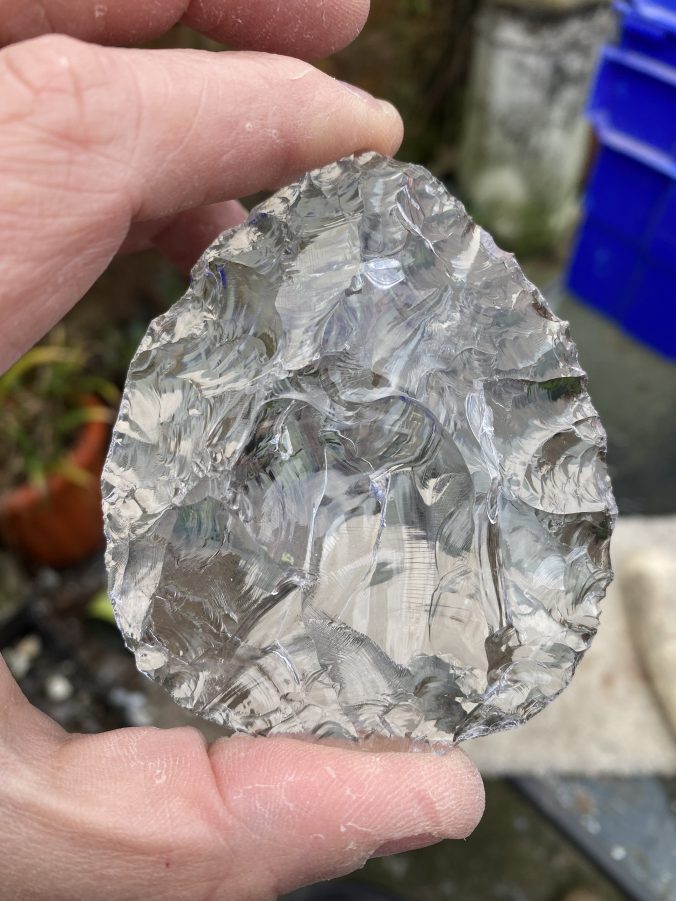
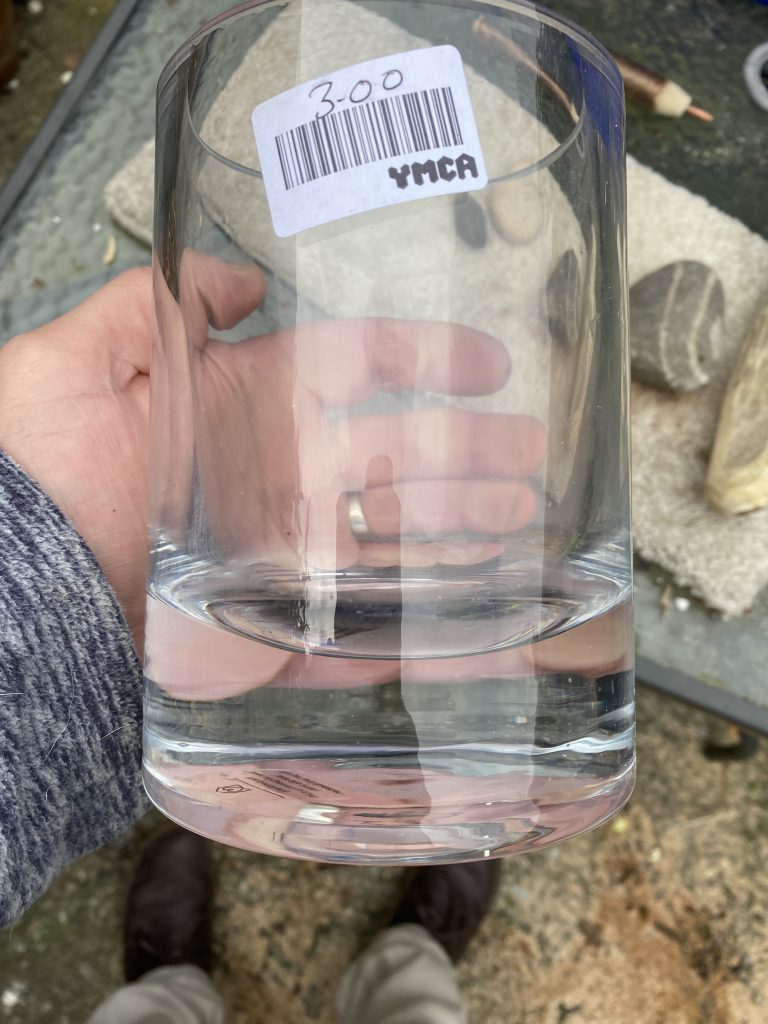
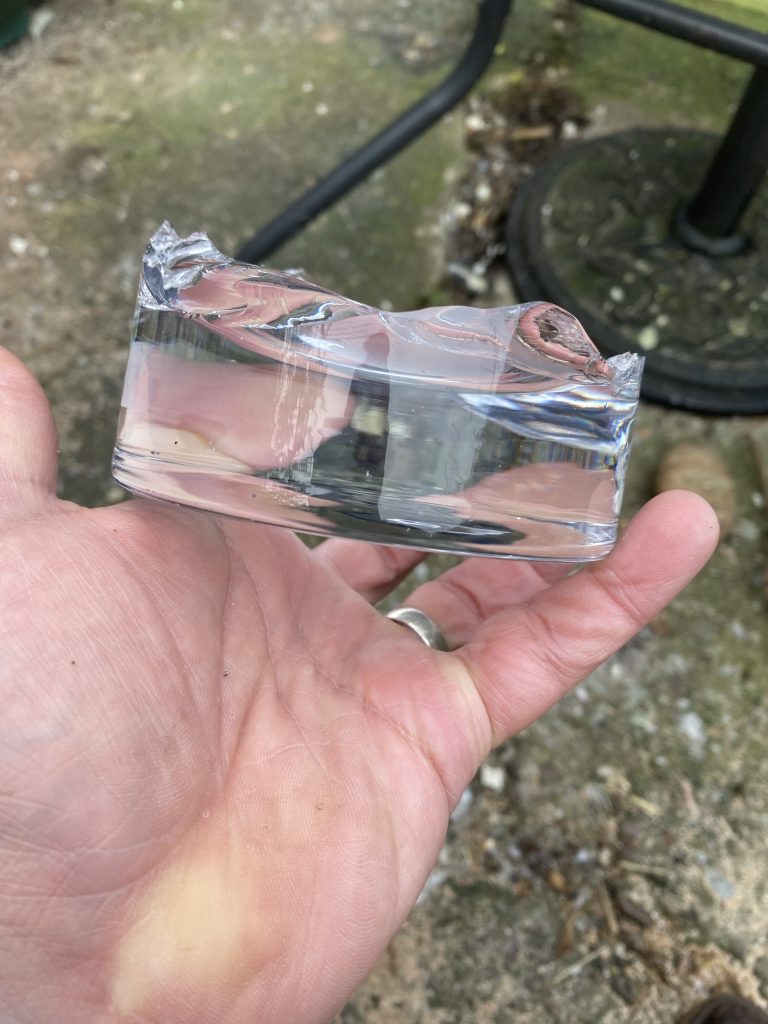
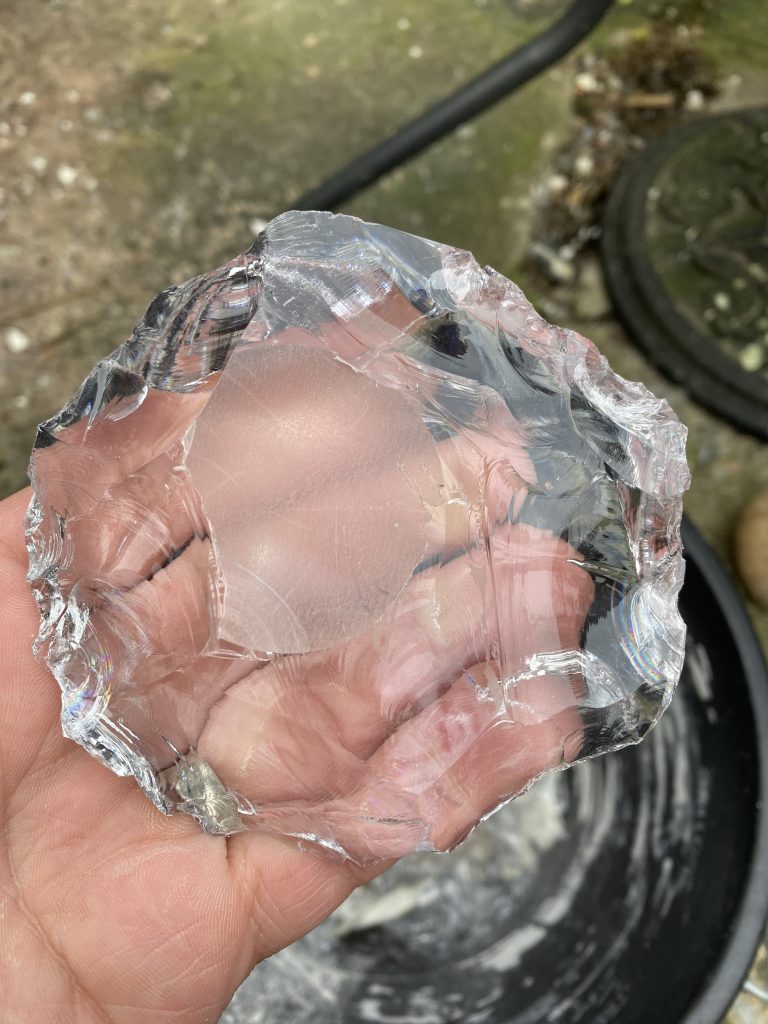
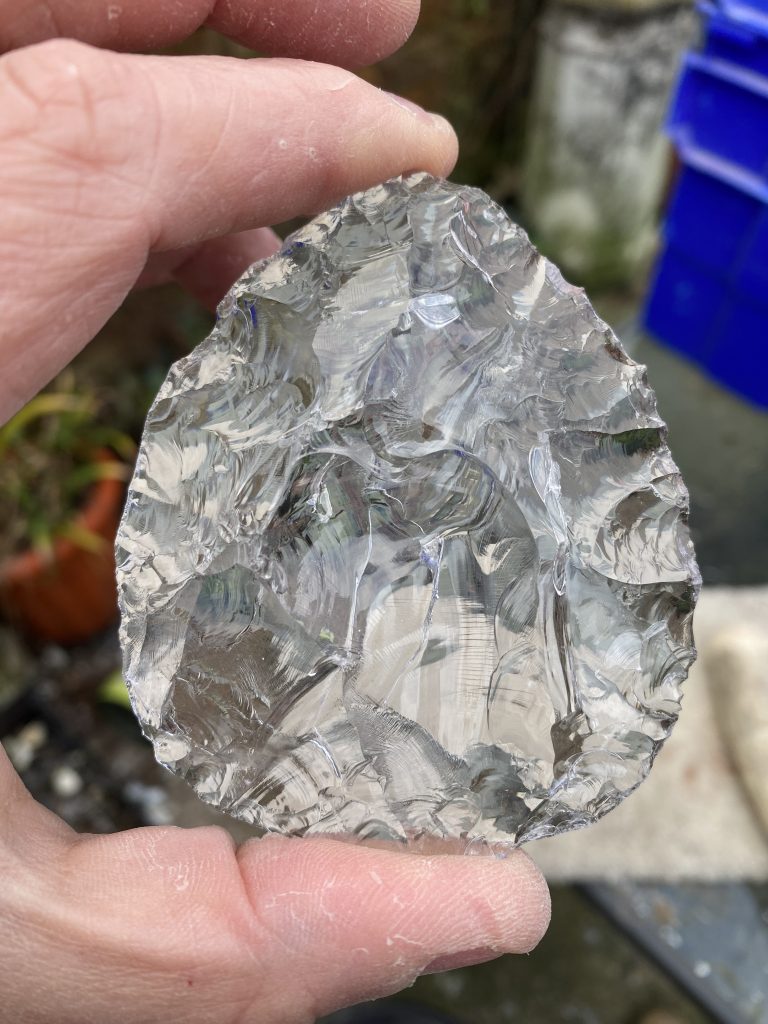
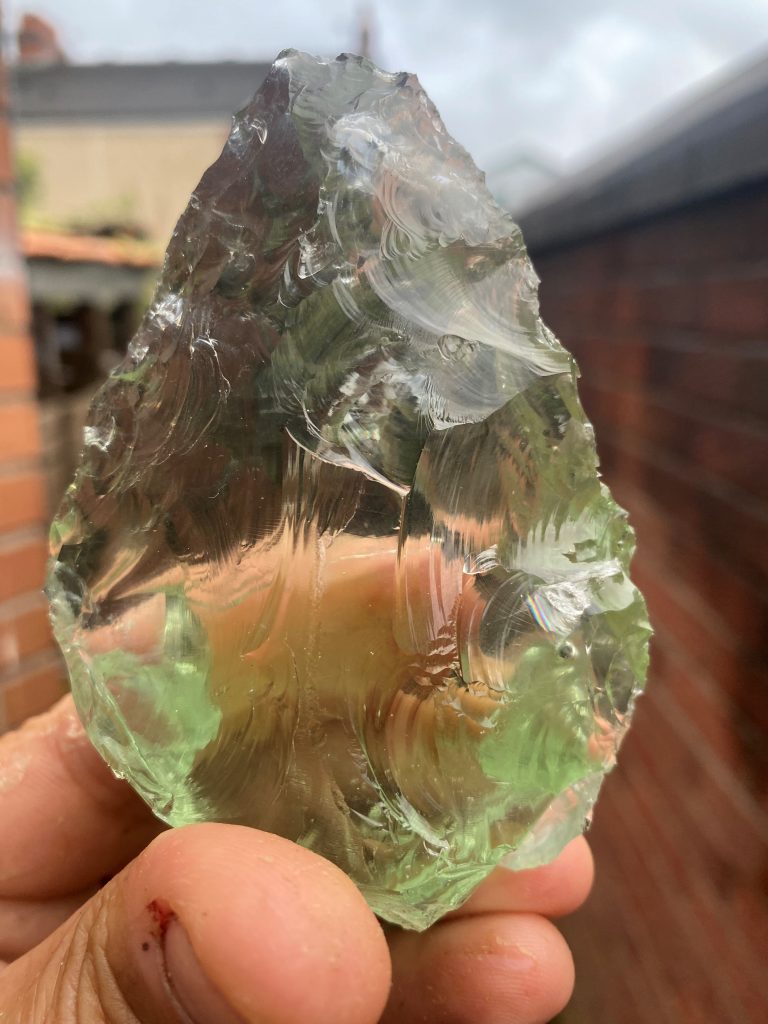
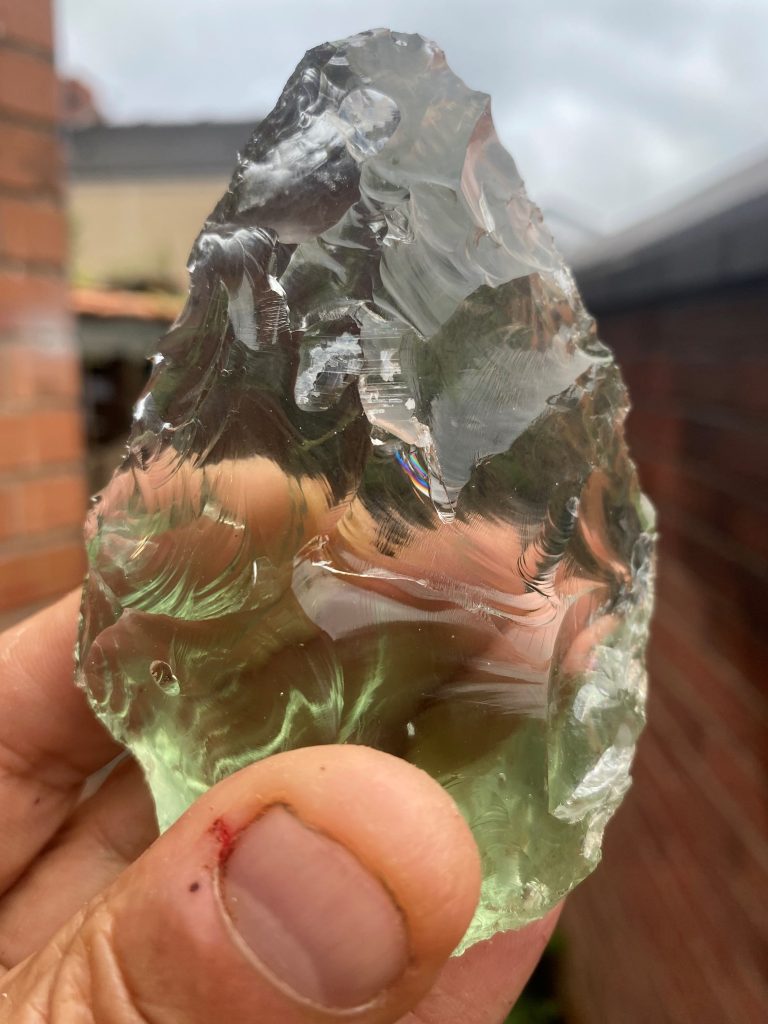
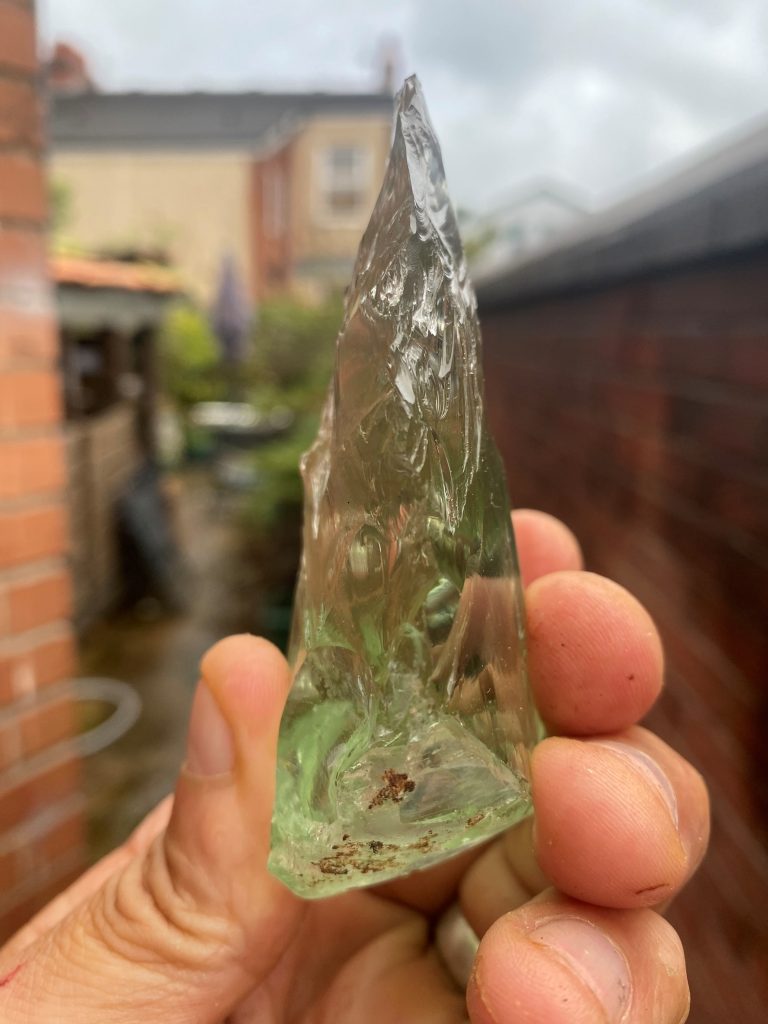
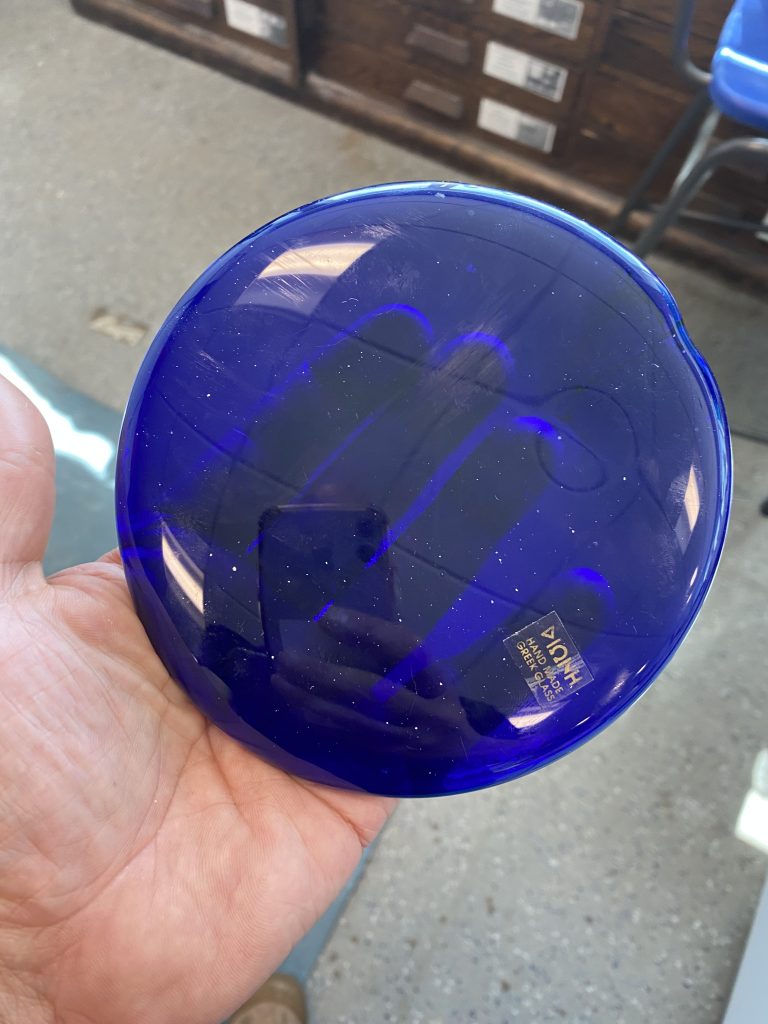
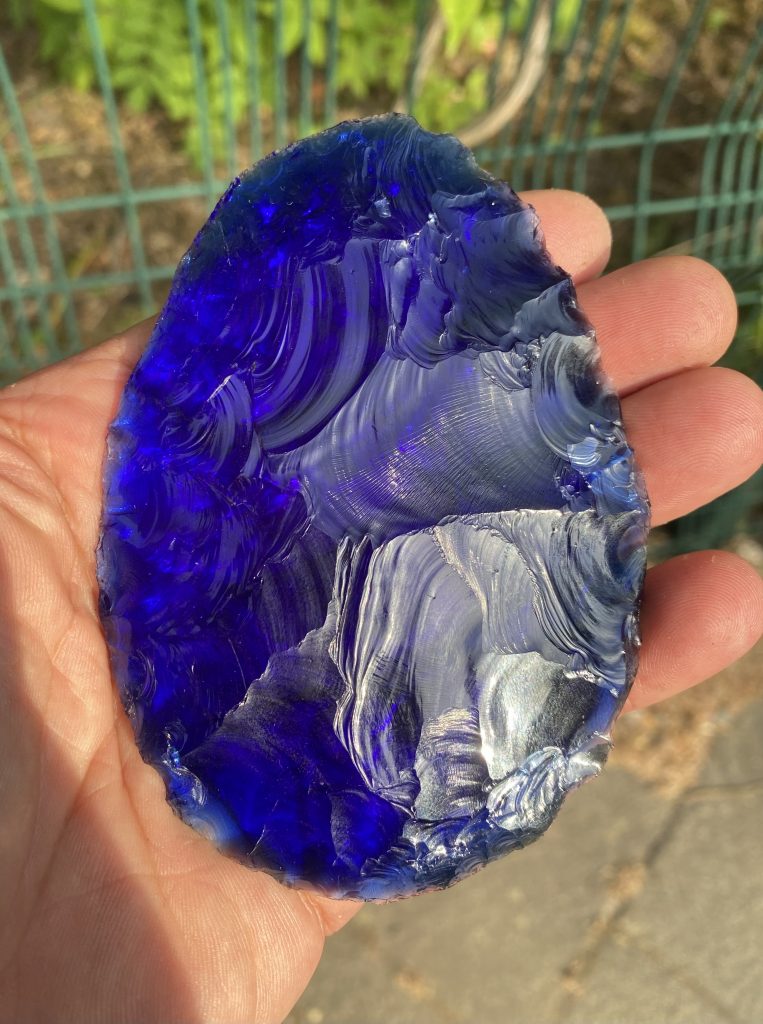
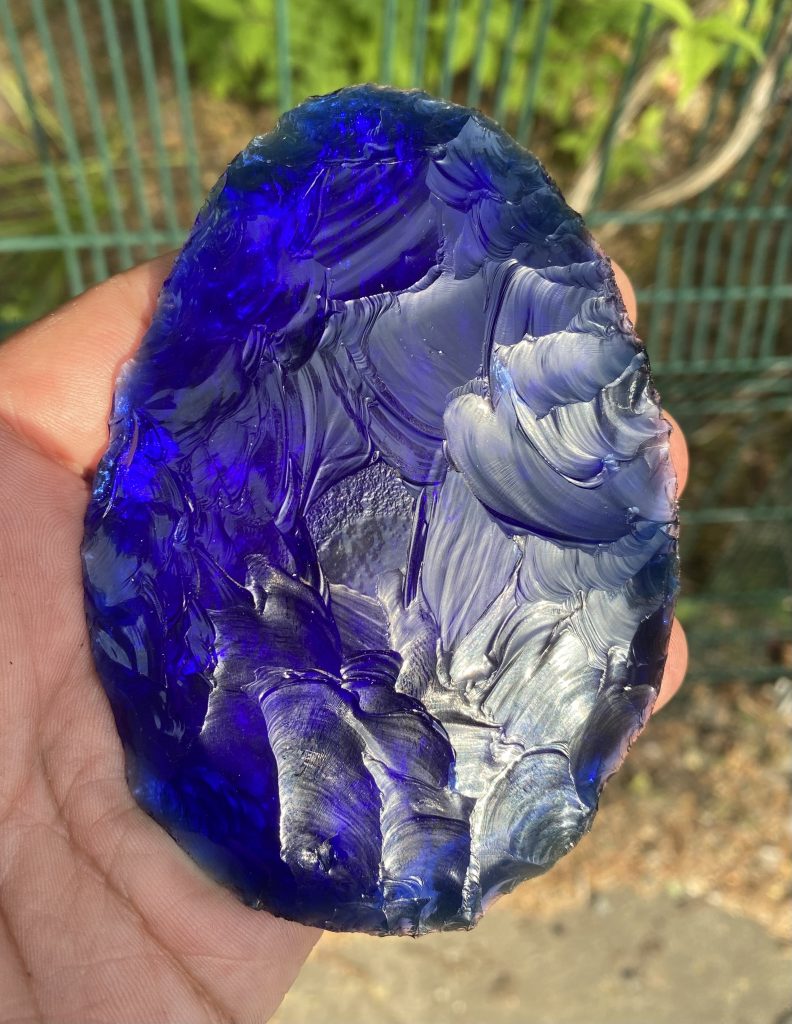
And now it is 2024, and after many years spent hunched over in my back yard, I sort of know what I am doing. The above was a big flat slab of good quality glass from the Didsbury Oxfam shop (£3) and it is now a large pointy handaxe. We are in the lovely Spanish city of Valencia at the moment, and today I came across a woman in her studio making glass to produce her own glass jewellery. That would be like a dream for me. Having my own small studio space in a lovely city like Valencia, and being able to knap beautiful glass handaxes all day, interrupted only by the occasional cafe con leche.
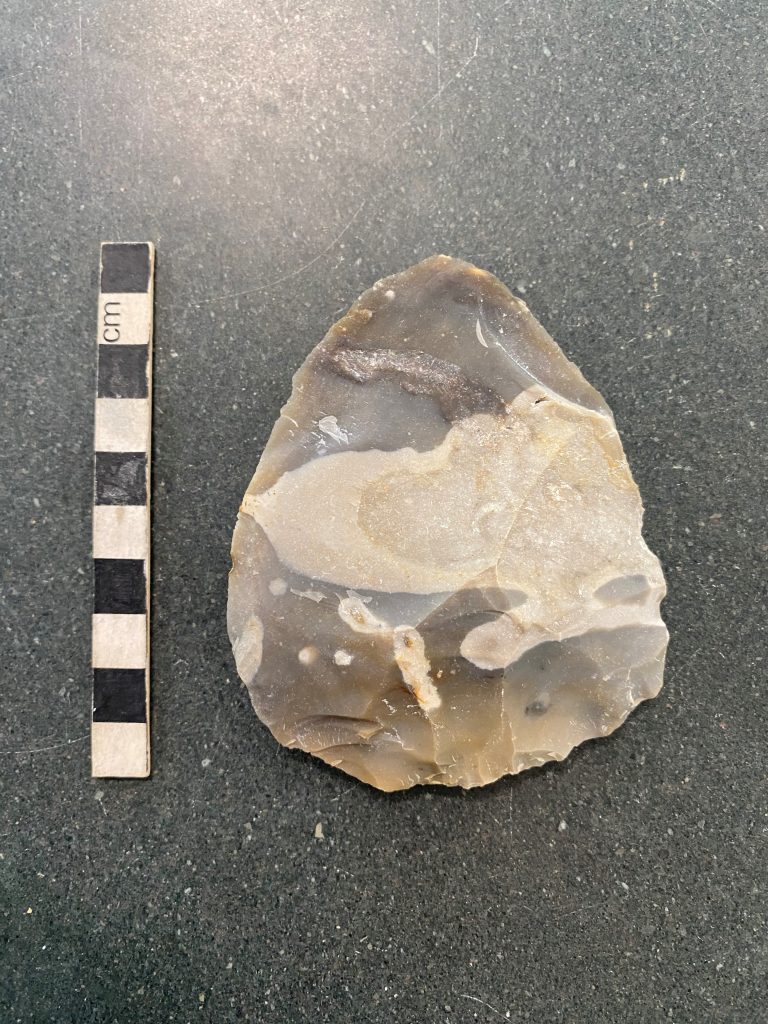
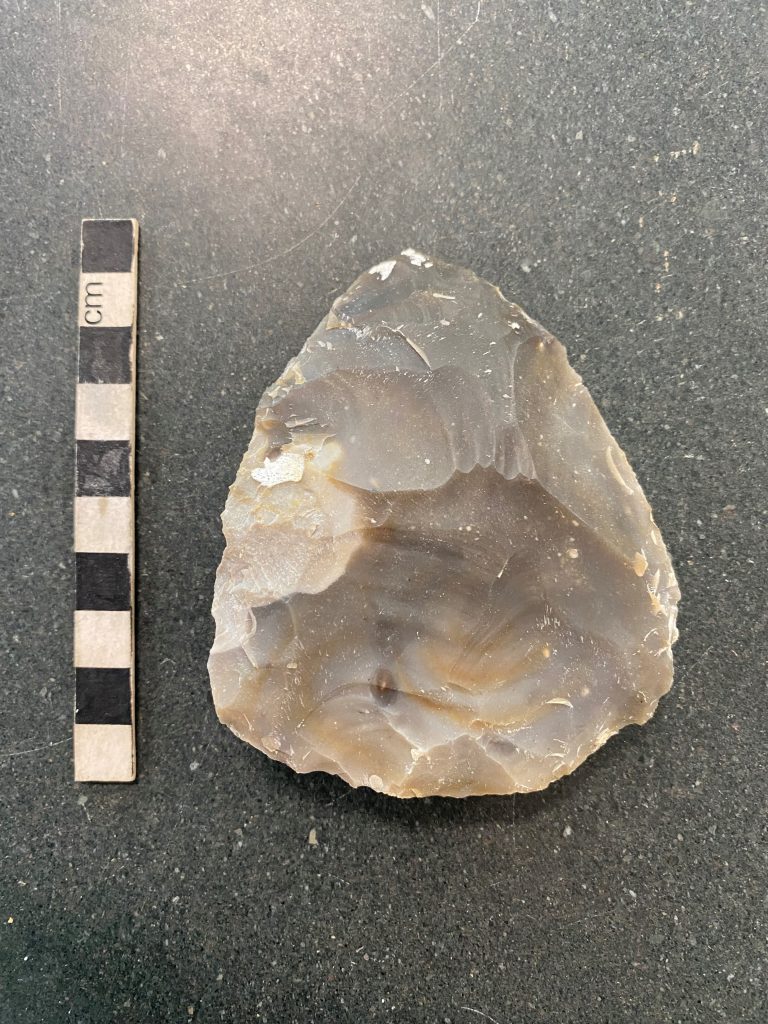
I have been making quite a few handaxes recently, but only just detected that I have a style. It occured to me when I saw these two next to each other and recognised how similar they are. Shape and size was an obvious similarity, and so these two can be recognised as the same ‘type’, and that would be cordate, or heart shaped.
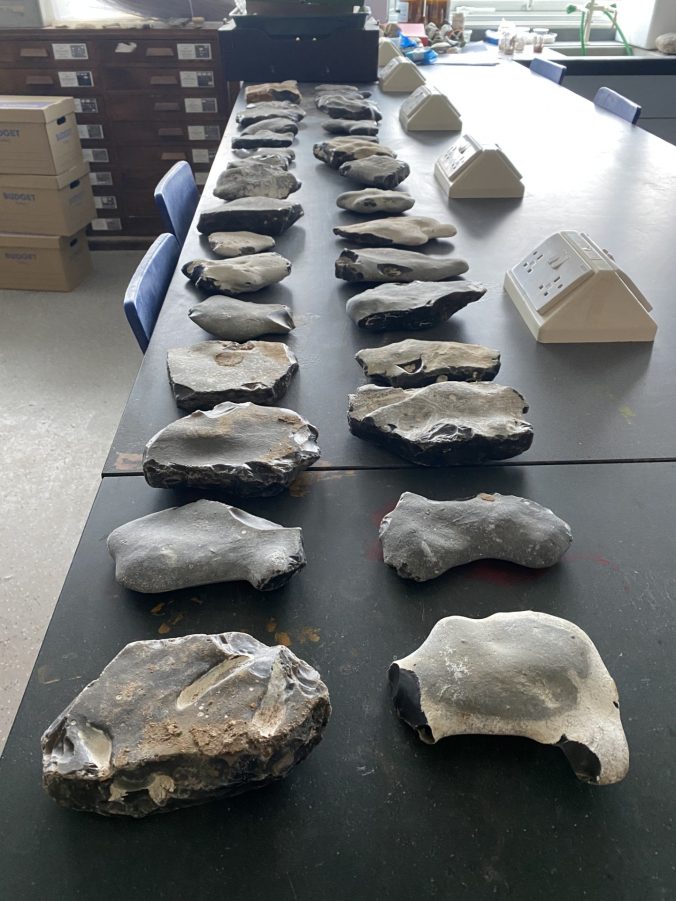
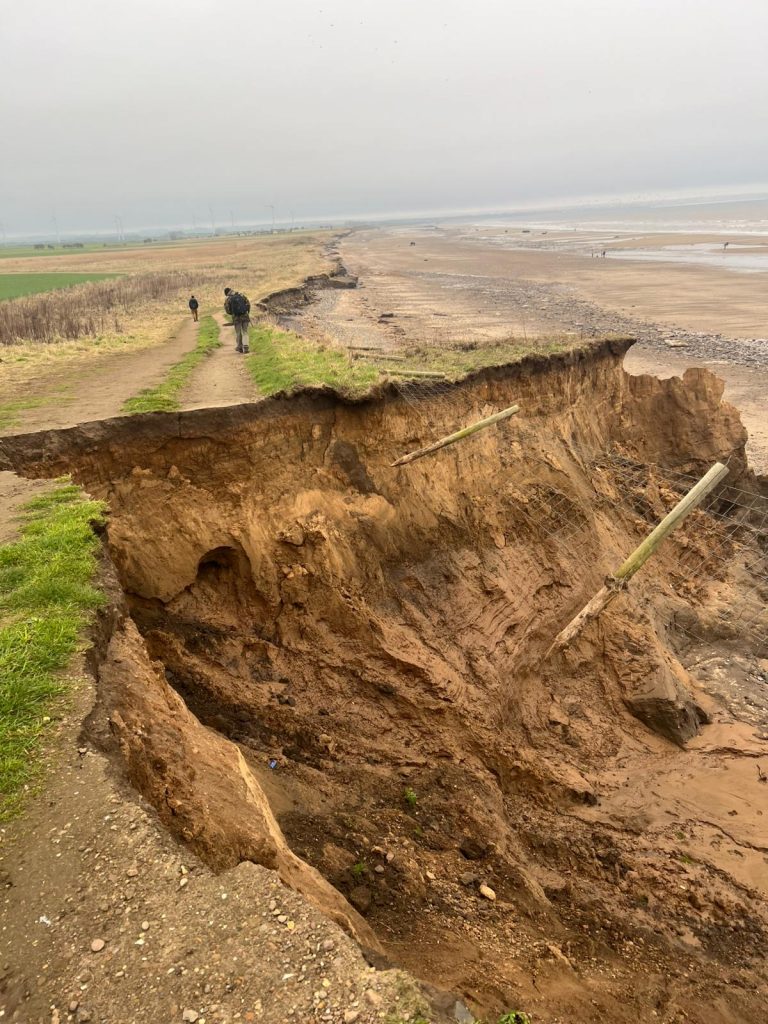
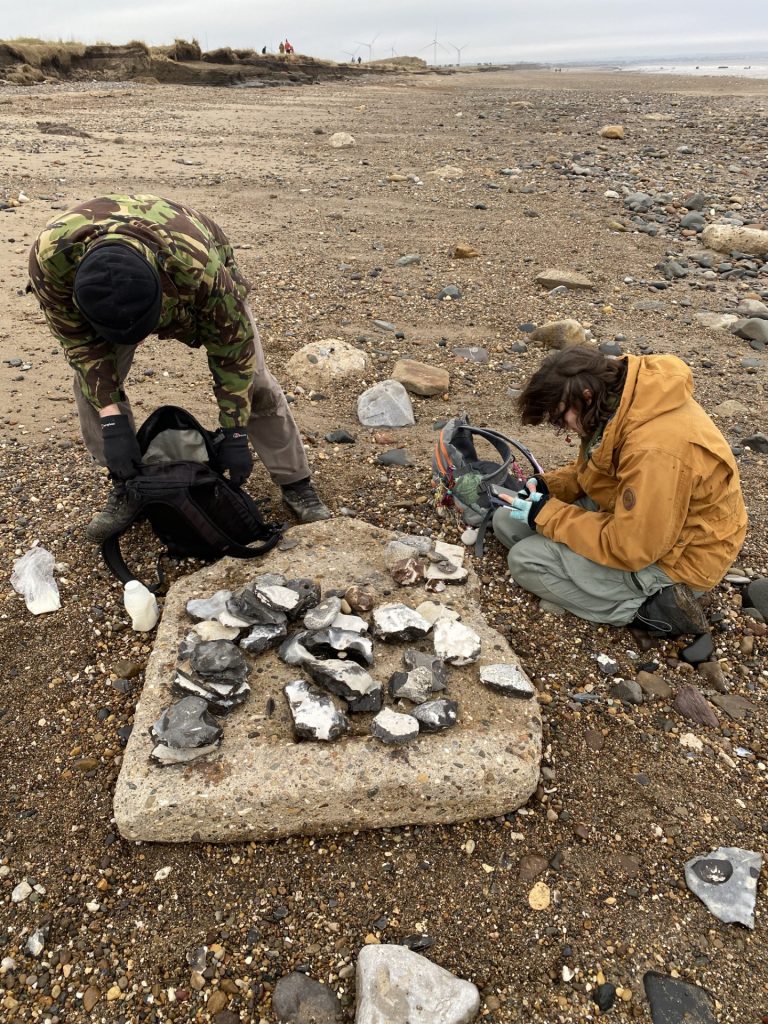
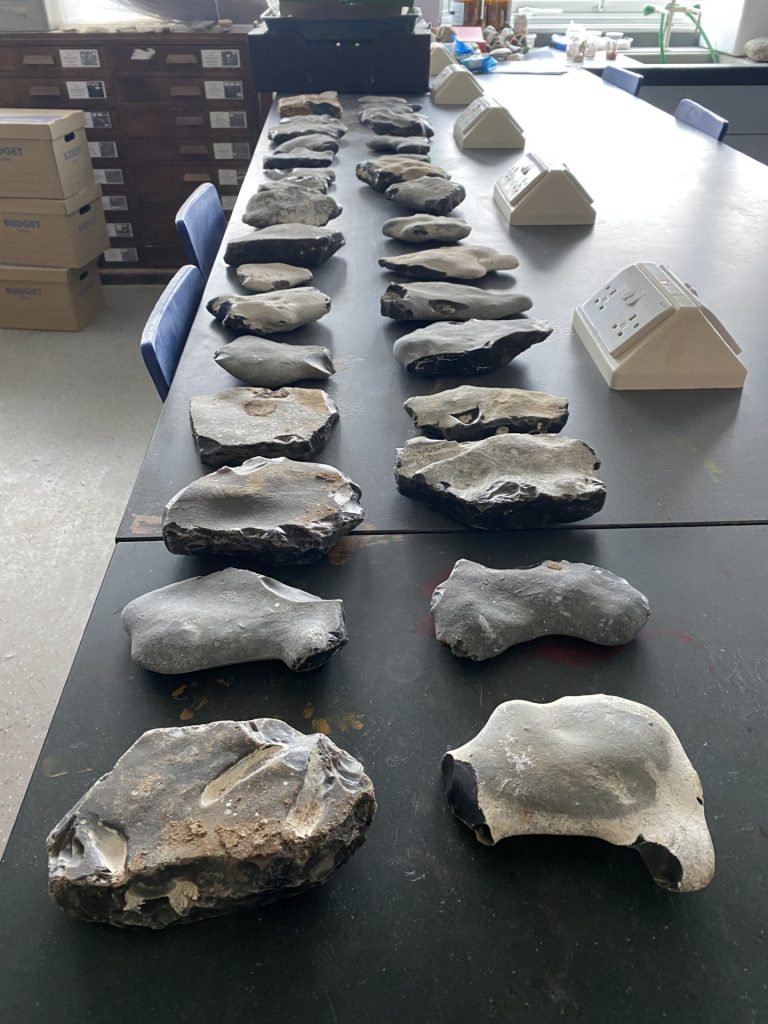
However, it is the process, or ‘technology’ that is the real connector and this relates to how I get my initial flakes. We have very large and chalky nodules, as discussed here and these nodules need breaking down into flakes in order to make a handaxe. Flakes have a thick, bulbar ‘proximal’ end, and a thin and sharp ‘distal’ edge at the other. Intuitively, I seem to make my handaxes with a heavily thinned bulbar section on one side, and a minimally thinned distal edge on the other. This method has developed unconsciously, and I have only became aware of it with these two, and then looking at earlier examples.
In the above video you can first of all see the minimally worked ‘distal’ edge, then the more intensively worked bulbar section, and finally the ripples of percussion indicating this was originally the ventral face of the flake. I’m not sure why my body chooses to work the flakes in this way. I will have to make some more handaxes to find out!
I have become a bit obsessed with twisted cordate handaxes, and in particular, understanding the bodily process of making them. This is my third one, the other two were not ‘quite right’ and ended up being destroyed in the process of getting them ‘right’. This one is not exactly right but has survived. Perhaps it is because it is five o’clock on Friday afternoon I has given it a reprieve.
I need to have the archaeological example next to me whilst making to keep checking I have the twist right. I have read about the making method which was useful, but it is not a conceptual understanding I am after. My aim is for my body to get it, without need of a reference. Watch this space…
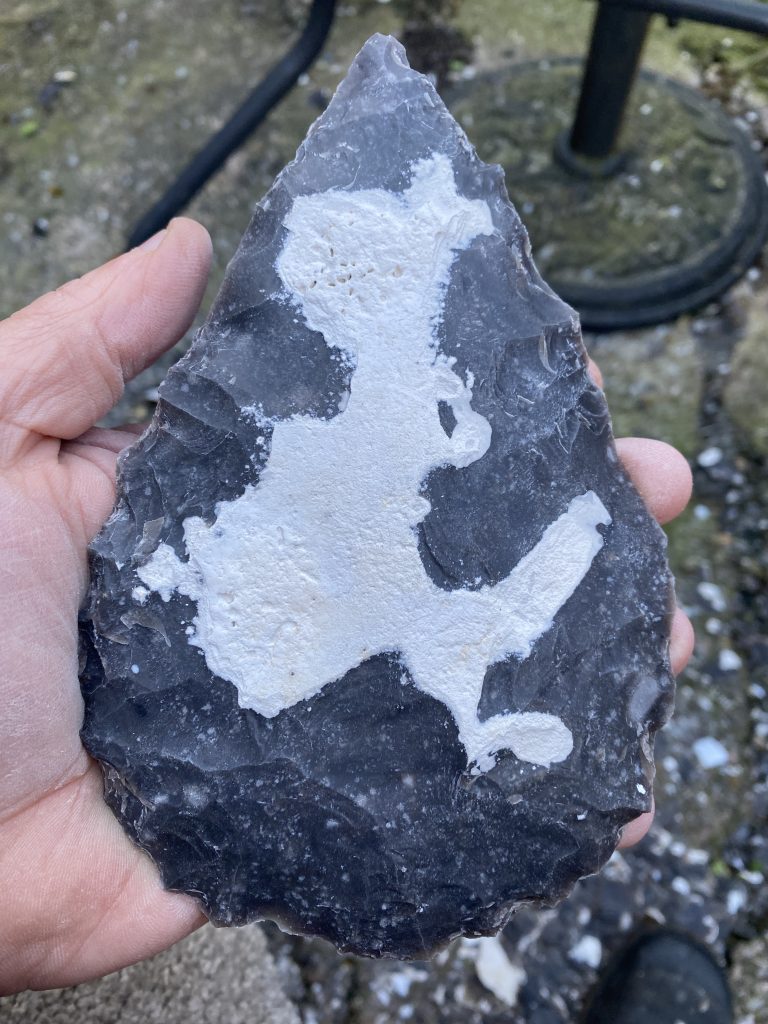
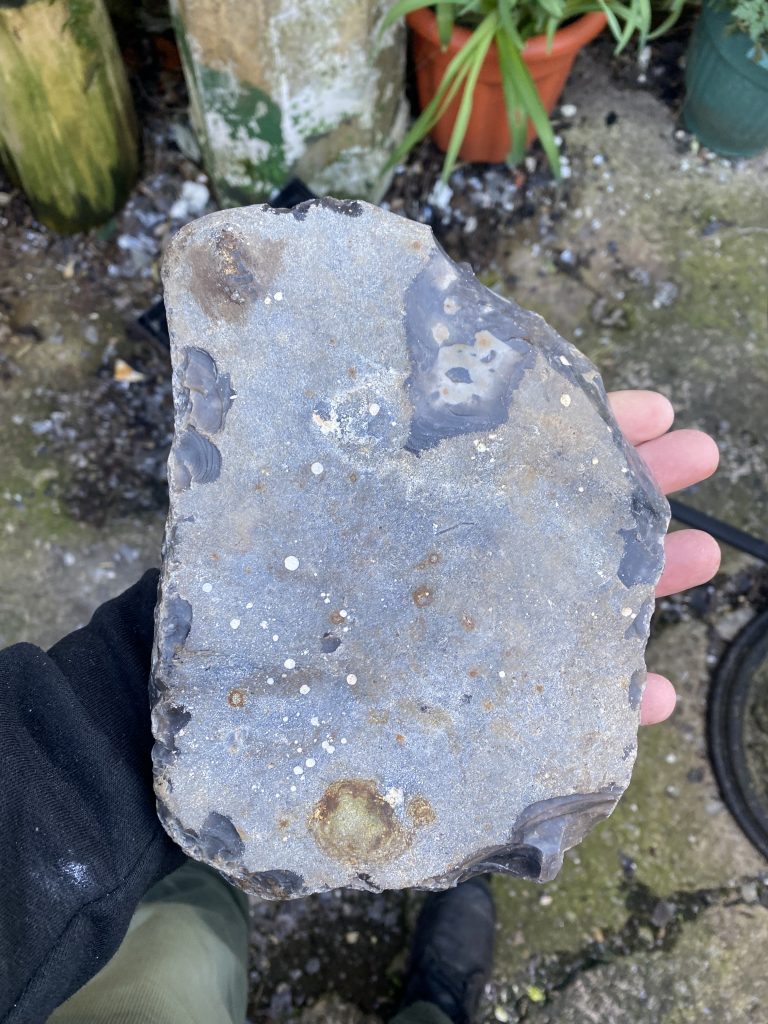
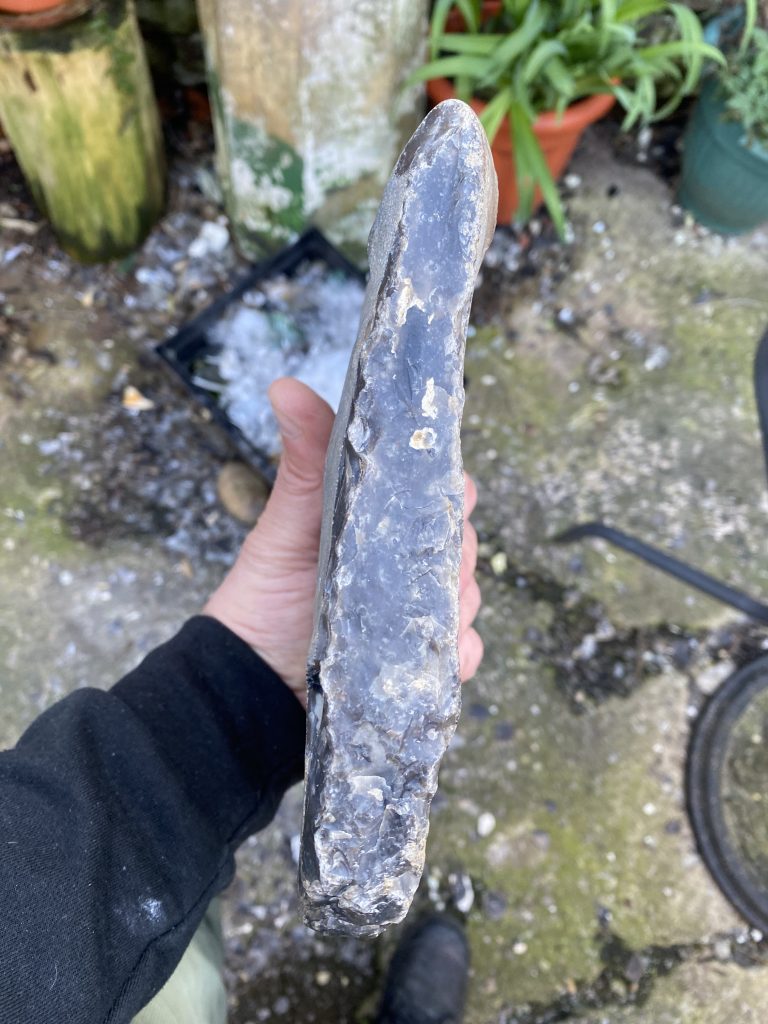
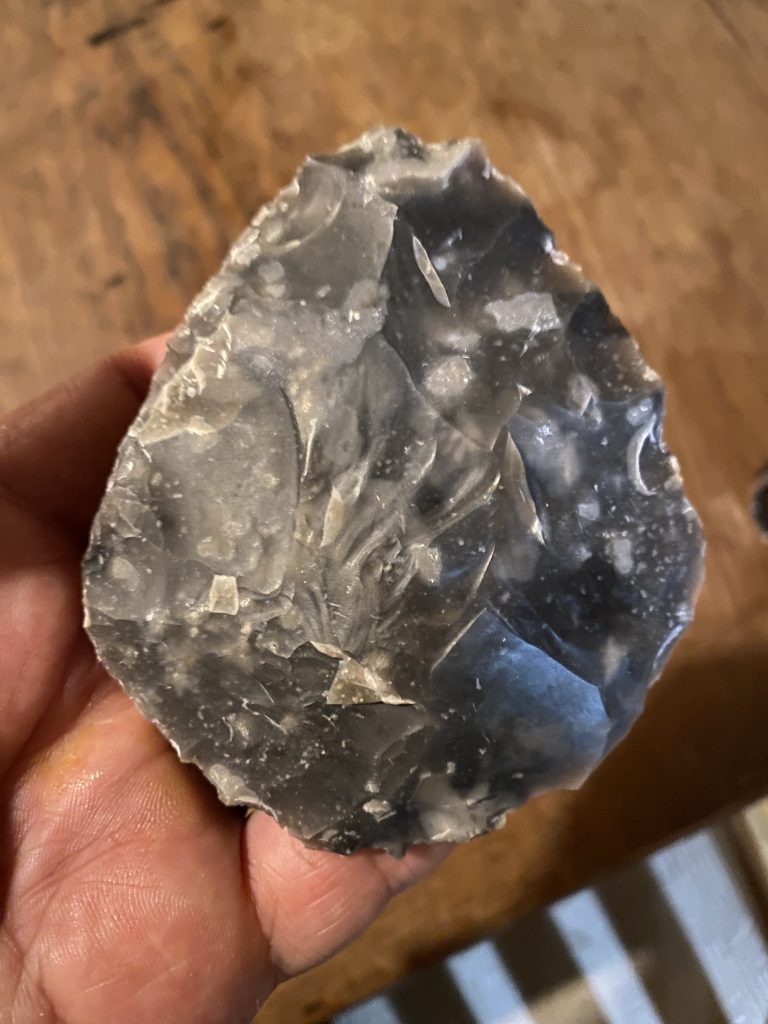
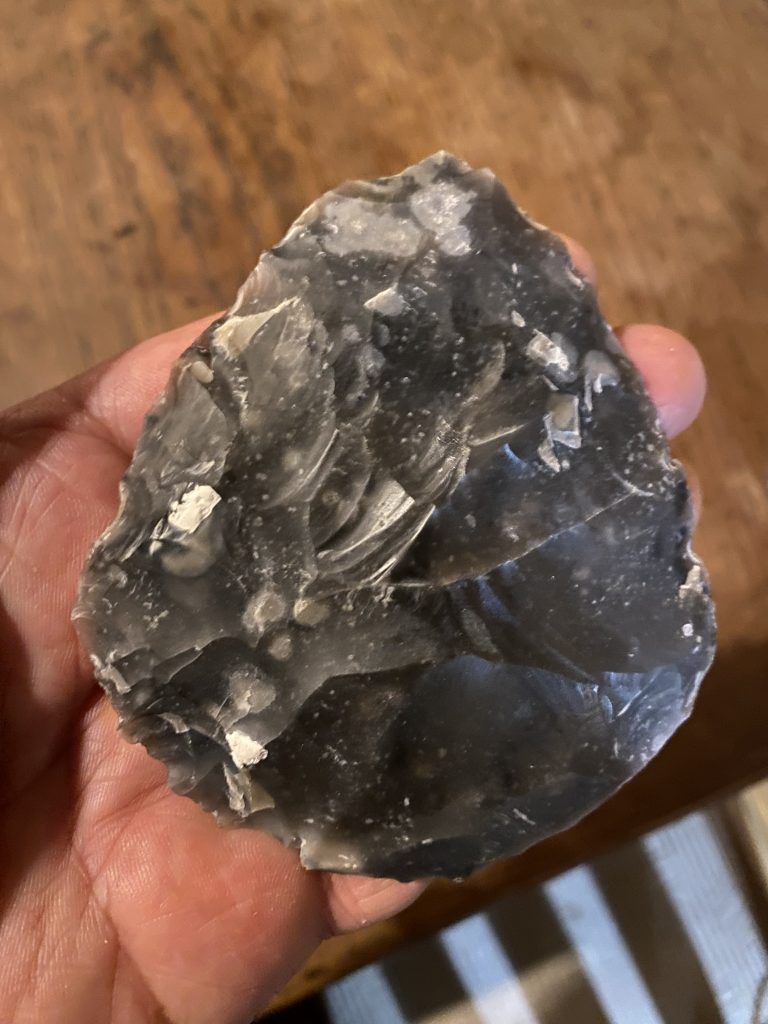
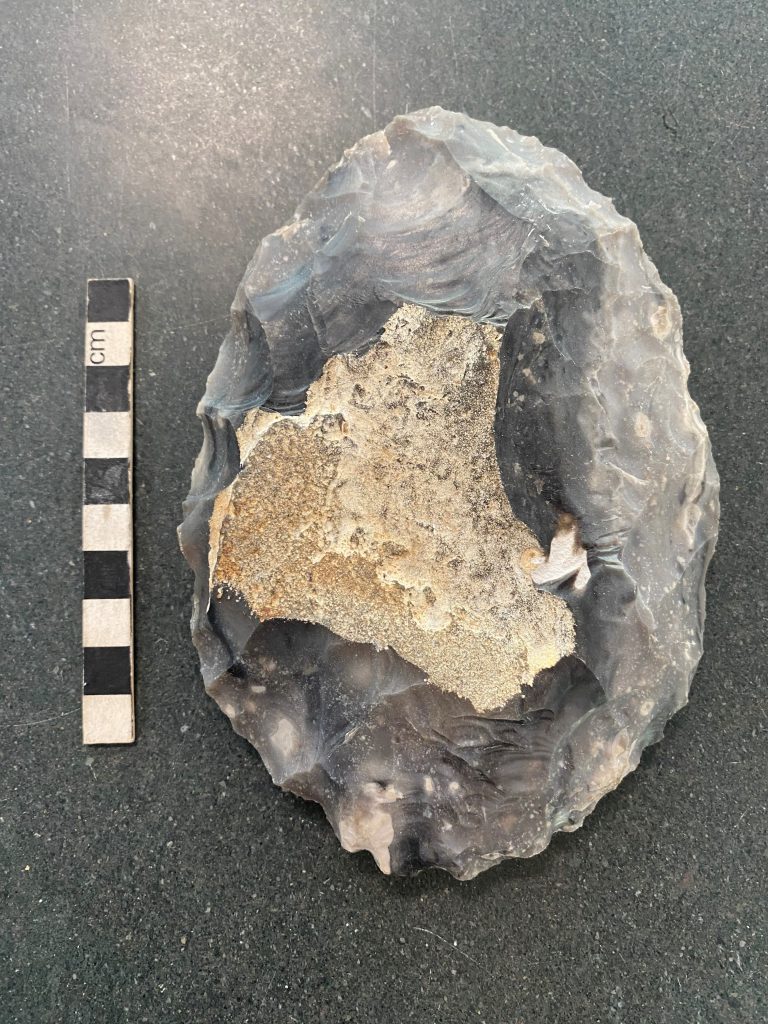
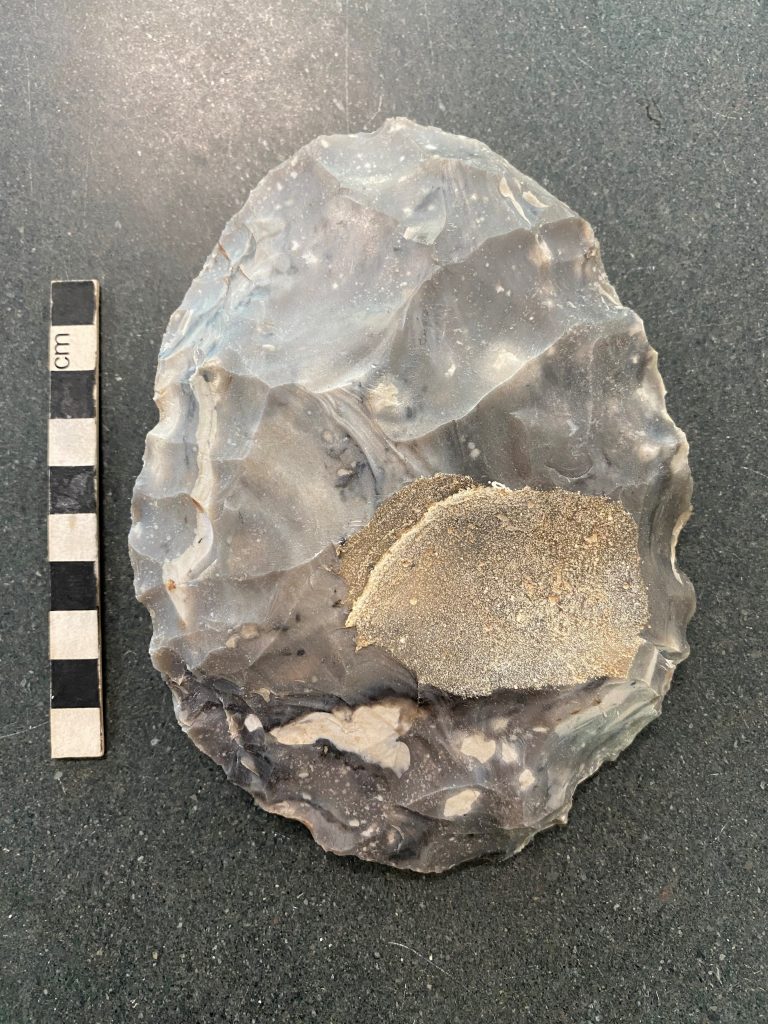
As discussed in the previous post Ian brought not one, but two of Mrs Anning’s handaxes to site for me to have a look at. This second handaxe is another amazing example, for both similar and different reasons to the first.
Dealing with ‘similar’ first, you can see from comparing these two photographs that the patina on each surface is different. It looks like the more orange face sat uppermost, whilst the more cream coloured face was face down and protected, for many millennia (my hypothesis).
Moving onto different reasons, the echinoderm in the room is the amazing fossil sitting at the top of the photograph below. I sent a picture of it to my Geology friend, Stephen Poole, and he got back to me with the term: echinoderm. A number of well known handaxes have fossil inclusions and this has led to debates about evidence for Palaeolithic aesthetics. The most recent paper I read (Flanders & Kay 2023) argues that with the famous West Tofts example, it was simply left in because it would have been difficult to remove. I have discussed similar in a previous post.
There is a potentially long and interesting discussion on Palaeolithic aesthetics, however I think we first need to speak to Mrs Anning!
Reference: Emily Flanders, Alastair Key, The West Tofts handaxe: A remarkably average, structurally flawed, utilitarian biface, Journal of Archaeological Science, Volume 160, 2023, 105888, ISSN 0305-4403, https://doi.org/10.1016/j.jas.2023.105888.
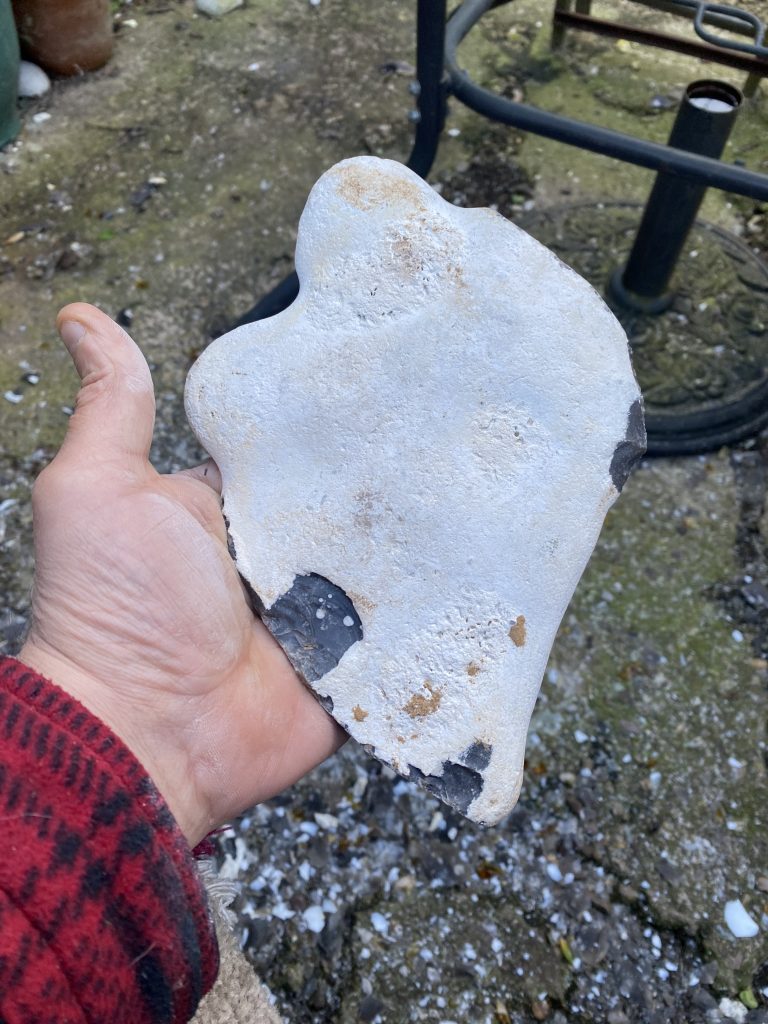
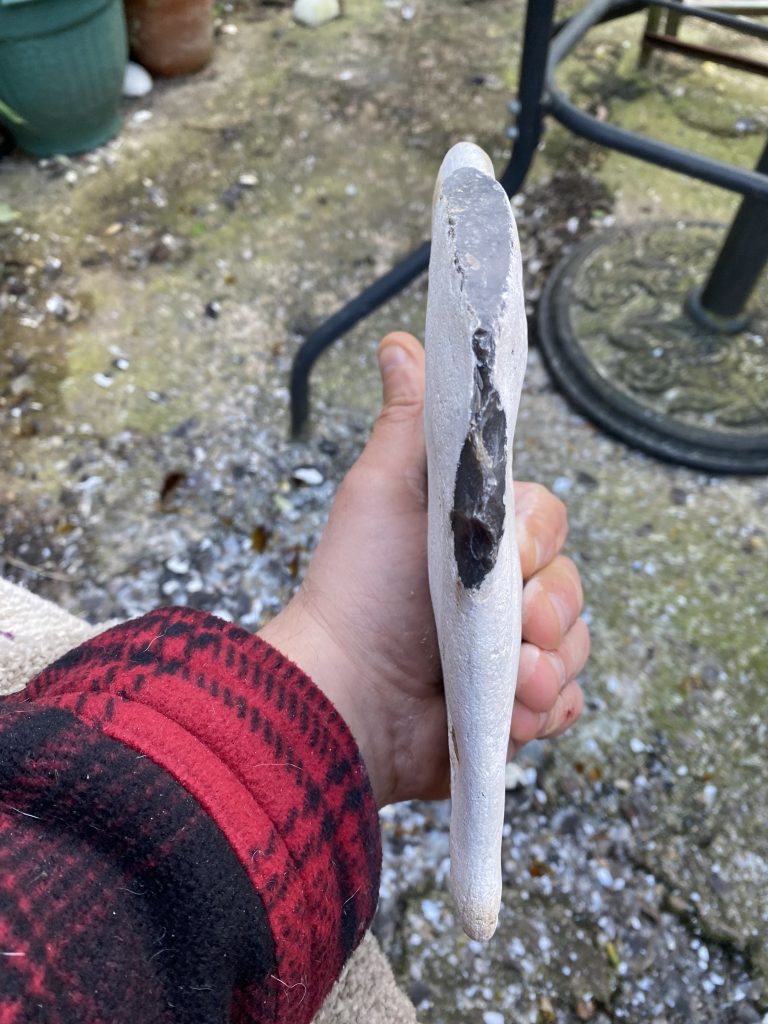
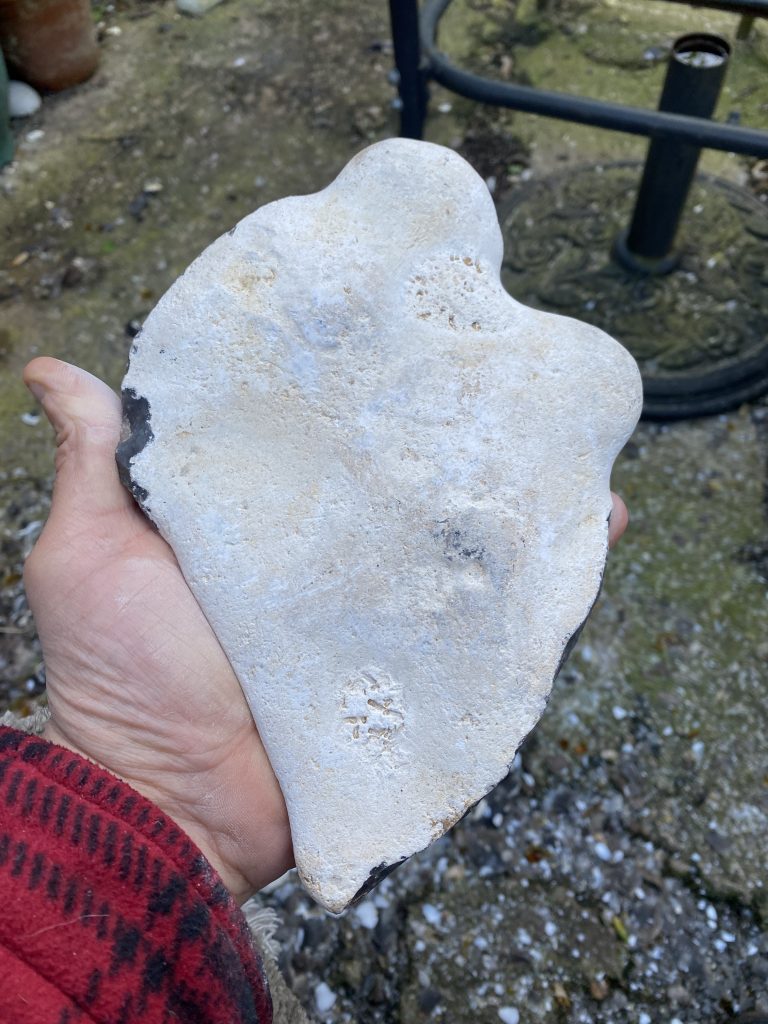
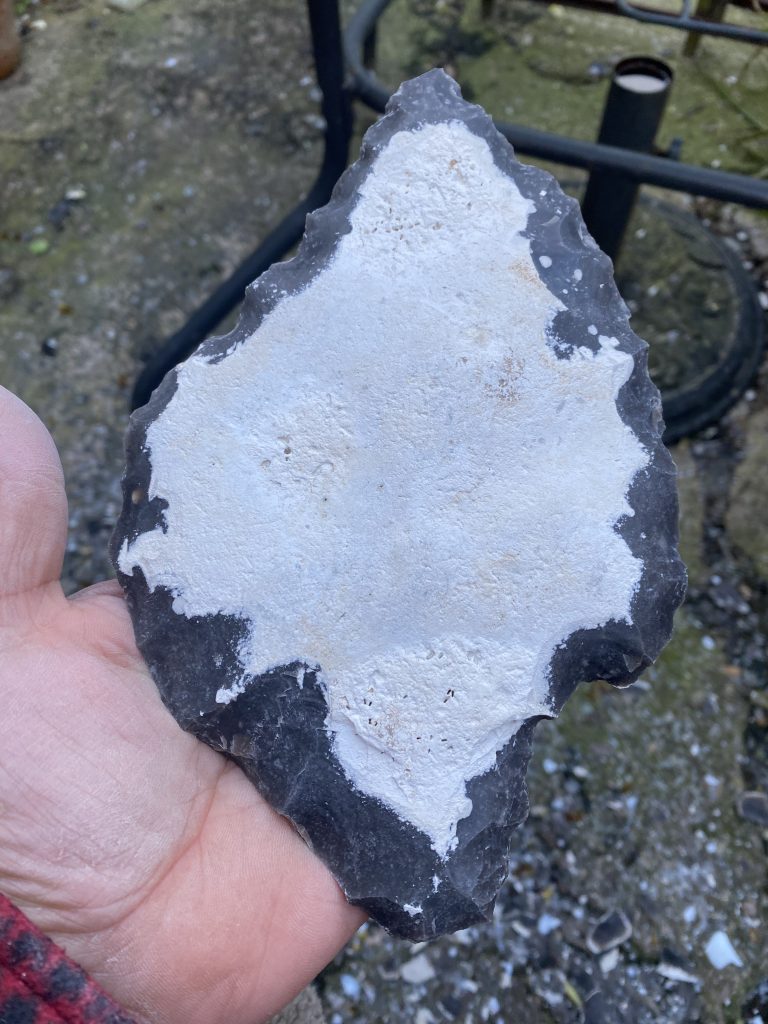
We were away on fieldwork in Herefordshire over July and I am very slowly catching up with things. One of those things is Mrs Anning’s twisted cordate handaxe. Ian Elliott has worked on our sites over a number of seasons, and this year he brought some lithics for me to have a look at, in particular two fantastic handaxes, one of which I will discuss in this post.
As you can see from the video this handaxe is what is termed a twisted cordate. Twisted because the cutting edge undulates around the tool, cordate because it is heart shaped. It bears a striking resemblance to my favourite handaxe within our teaching collection, a 3D model of which can be seen here: https://skfb.ly/ooCKM.
As can be seen with these two photographs, the patina, or colour on one face is different to that on the other. This indicates that it has been sat for a considerable length of time and the lower surface has patinated at a different rate to the exposed upper surface. The edges are in good condition and indicate that it has not been rolled around much if at all. Like the one we have, it is in very good condition. White, Ashton and Bridgland (2019 open access) looked at the recorded contexts of this particular type of handaxe in Britain and dated them to around Marine Isotope Stage 11, so around 400,000 years ago.
The handaxe(s) were donated to Ian’s local primary school, St Mary’s in Dilwyn, Herefordshire by a Mrs Anning. They asked Ian to give a talk about our site, he told them we had very few finds and in response they showed him their donated stone tools. I am both really keen to find out from Mrs Anning where she got the handaxes from, I think Ian is on the case there. I am now keen to make one of these twisted handaxes.
White, Ashton and Bridgland explain the technological process and it sounds complicated, so I am really interested to see if the actual systematic reduction process is as complicated as the descriptions. Watch this space!
References: White M, Ashton N, Bridgland D. Twisted Handaxes in Middle Pleistocene Britain and their Implications for Regional-scale Cultural Variation and the Deep History of Acheulean Hominin Groups. Proceedings of the Prehistoric Society. 2019;85:61-81. doi:10.1017/ppr.2019.1
Above is a photograph of the protective equipment I use. Starting from the left, gloves. I do not use gloves myself as I find they inhibit fine motor movement, but for workshops I always offer the option of using gloves for participants.
Next up is the First Aid Kit. I do not use gloves and I get plenty of small cuts on my hands. Consequently, plasters, bandages and bandage tape are the main consumables I use. There is also a great product called ‘Fingerbobs‘ specifically for protecting fingers after being cut. They are excellent and highly recommended.
Third on the list is protective eye equipment. I use glasses as I have reached an age where I need them to see detail, so glasses both protect my eyes from flying flint, and also allow me to see where I am hitting. The goggles are again for workshop participants who do not wear glasses but do absolutely need eye protection.
Finally, some carpet samples that rests on the thigh and are useful for both pressure flaking plus hard and soft hammer work. I am getting more and more used to knapping whilst standing up, and that is interesting in that it limits the size of materials that can be handled and worked (as in the past?). However, in a teaching and learning environment we are generally seated and the carpet is ideal thigh protection.
General guidance for participants on workshops before they arrive is to wear trousers and boots, especially when handling large nodules, but that is about it. I am a trained First Aider for work and fortunately, using the above protective equipment, the worst I have had to deal with is cuts to hands. Happy days!