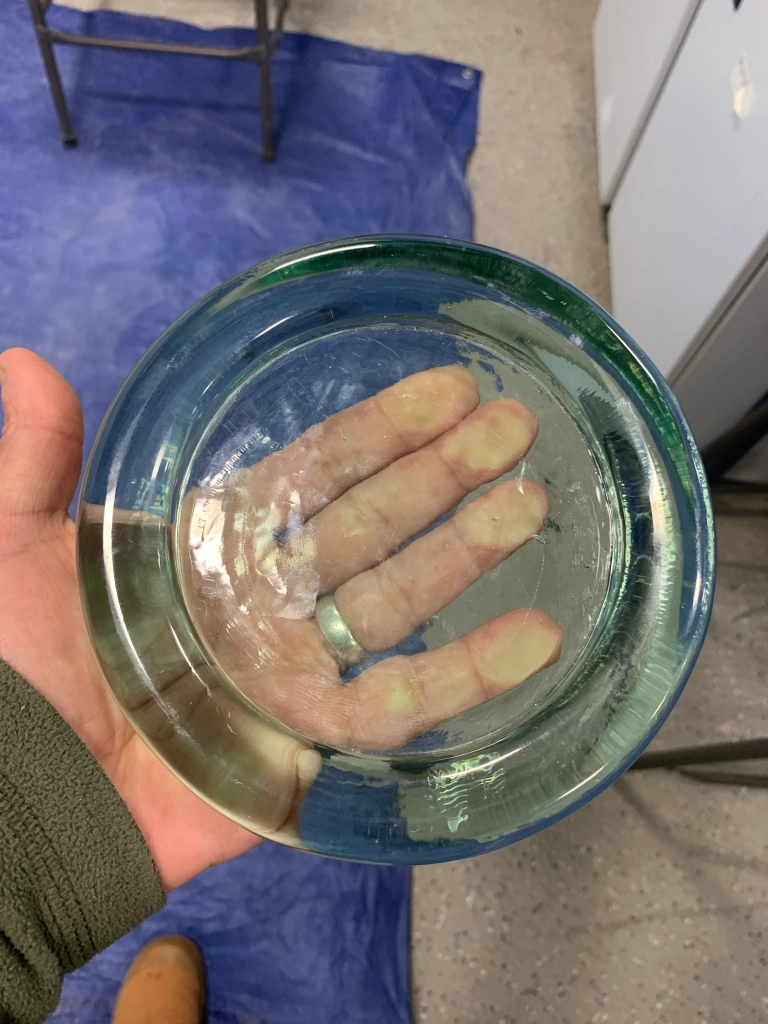
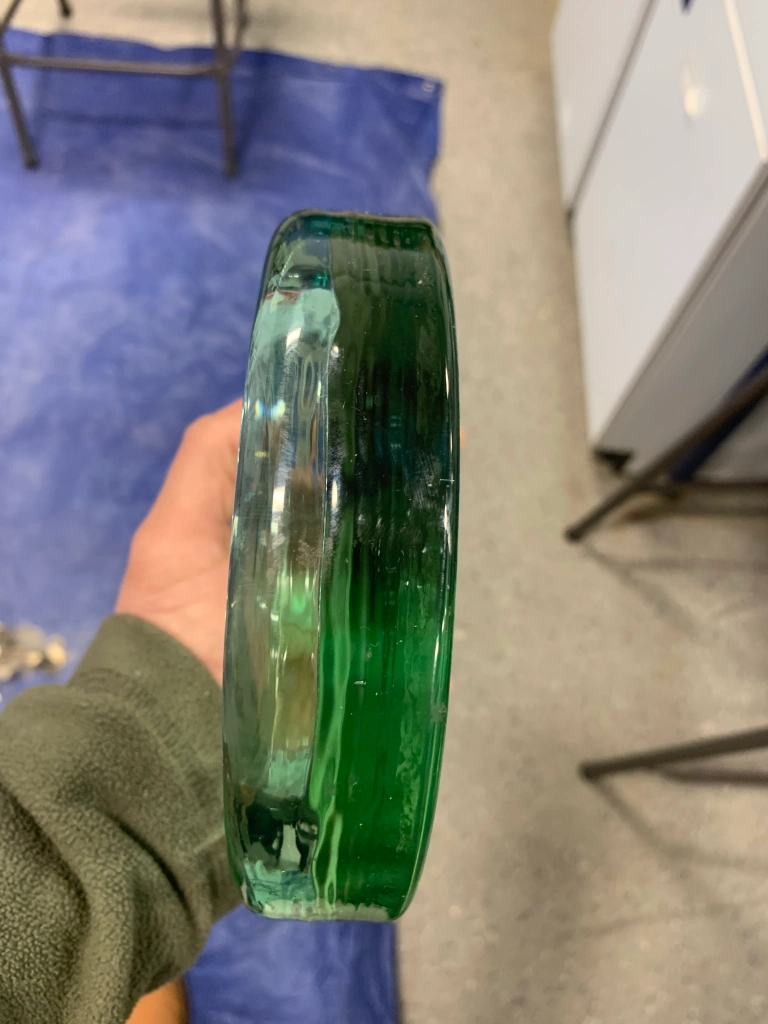
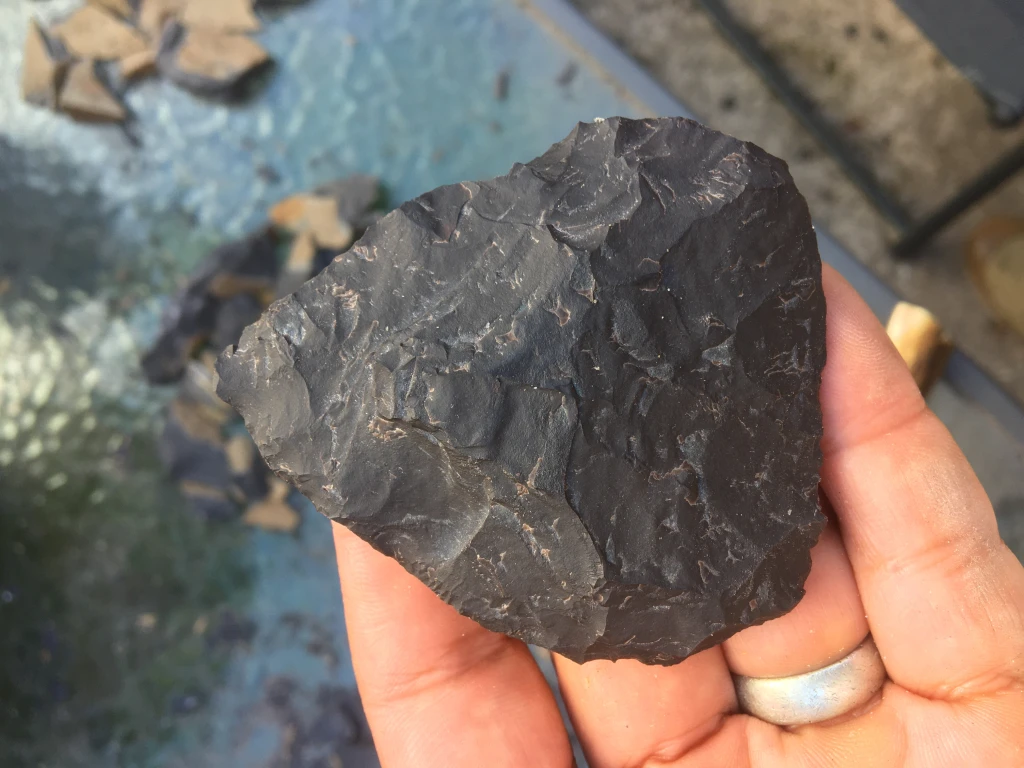
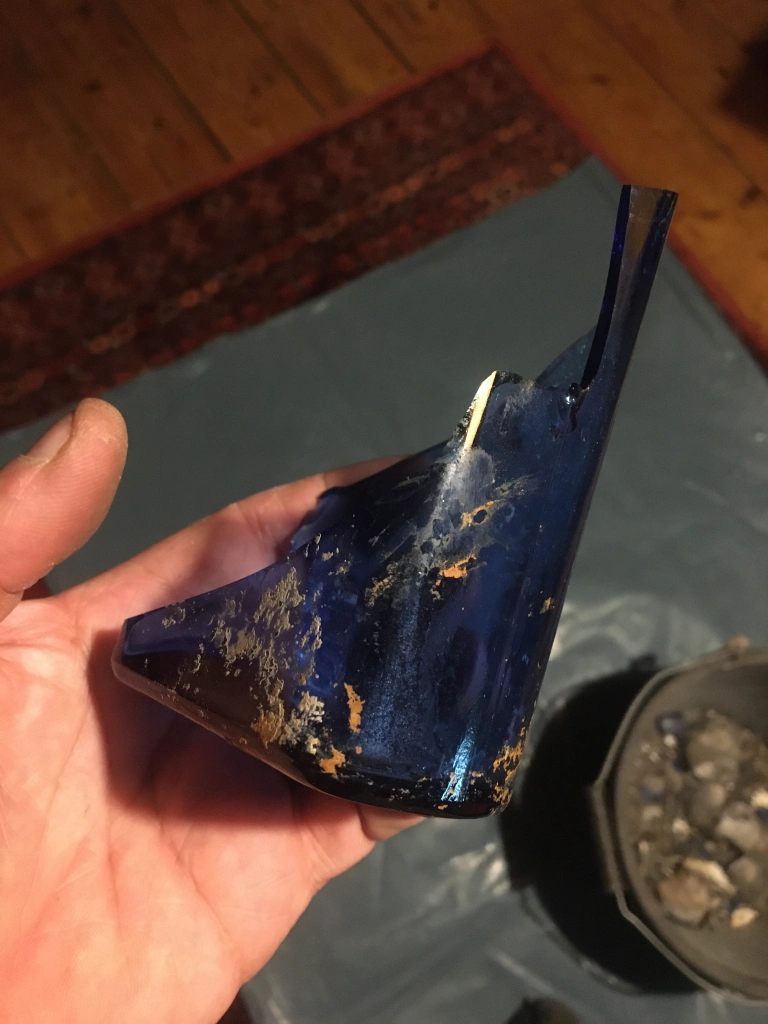
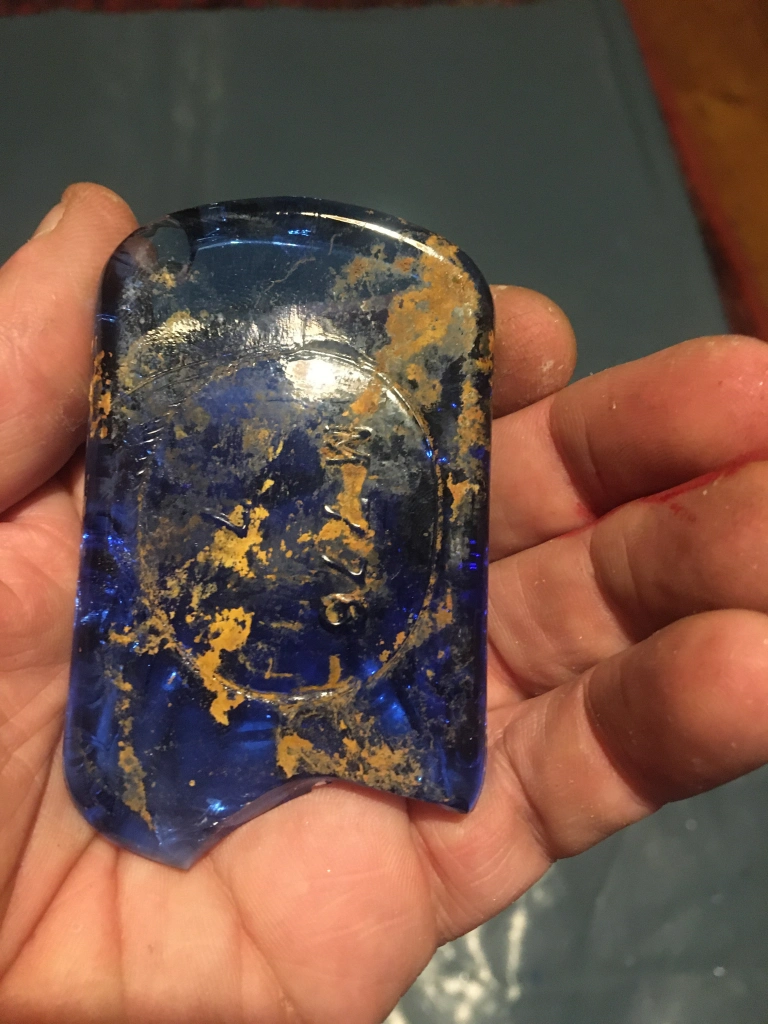
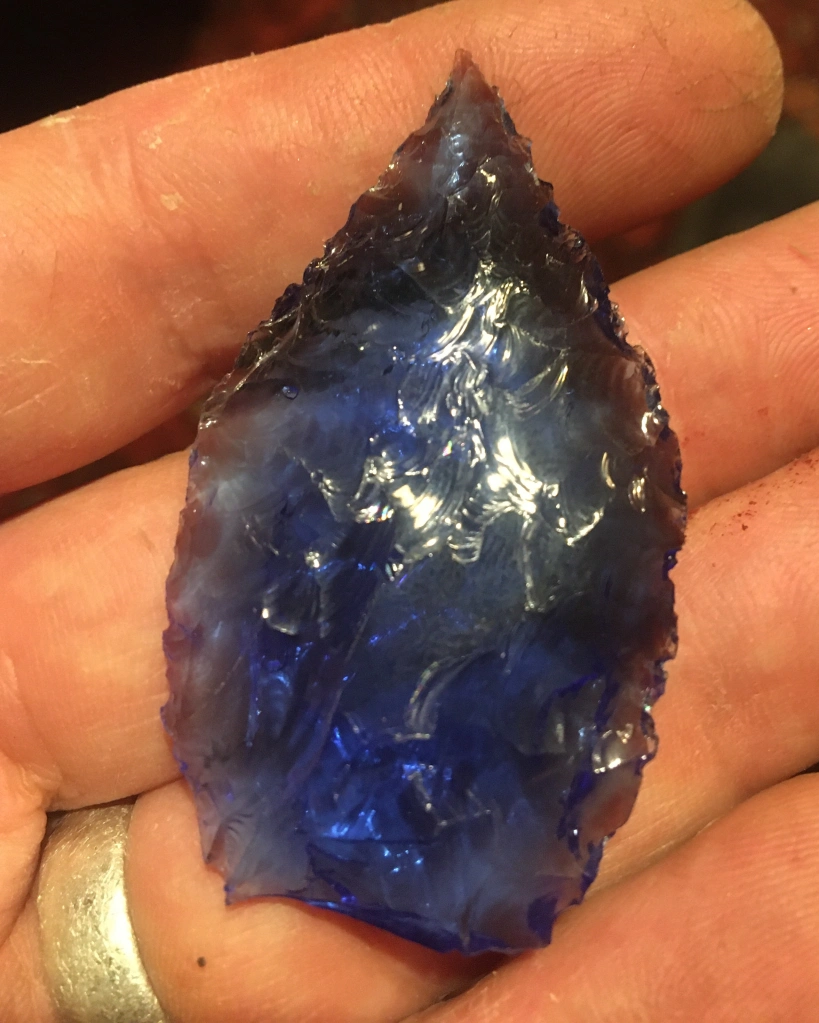
I don’t normally destroy perfectly functional things in order to make my stone tools, however…I found this nice thick glass ashtray in Oxfam and it reminded me of the glass slabs I want to produce with Nacho.
So £3.99 and 24 hours later I was sat in the lab with a small hard hammer. The glass was really good to work even if it took me a while to get rid of the ‘walls’ of the ashtray.
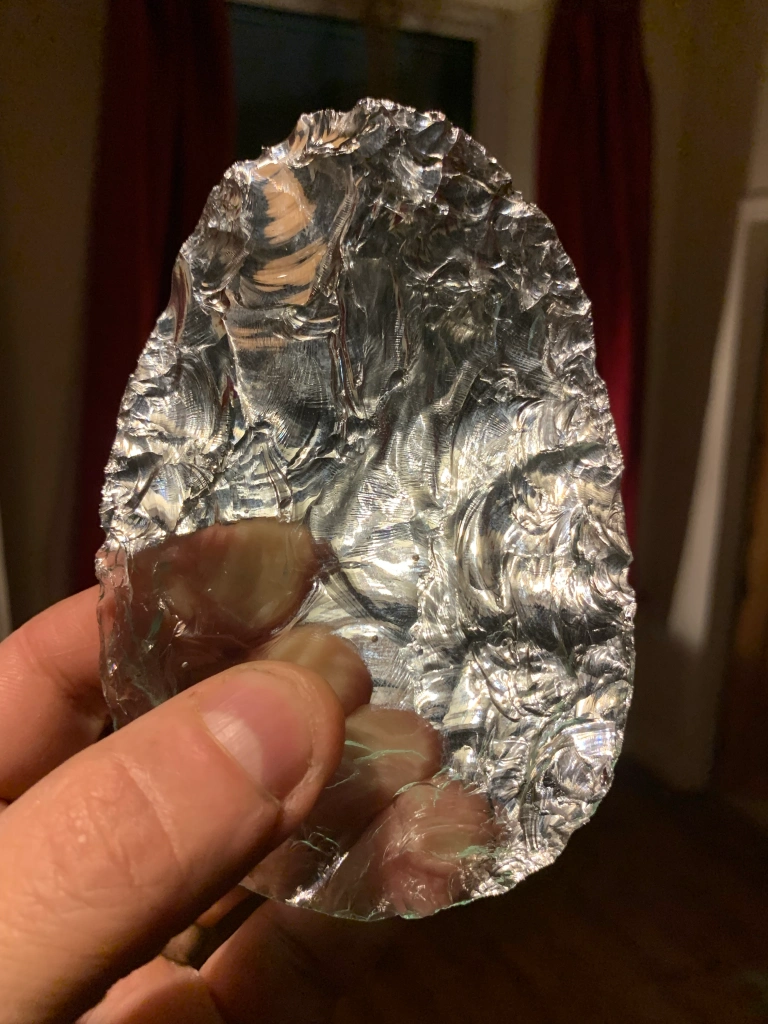
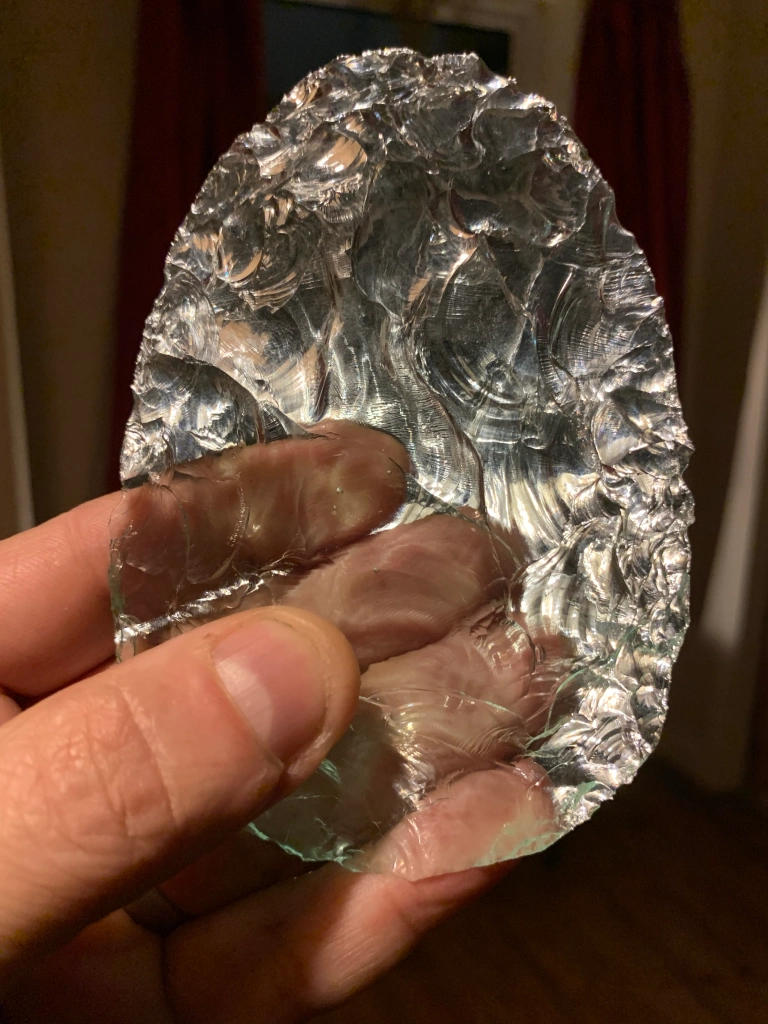
Like the older glass I am used to, this ashtray glass had bubbles in it. I knew what I wanted, a large ovate handaxe, and my earlier removals, when I had more material were better. I have some nice flakes that will be good for arrowheads at some point.
It looks half decent, is fully bifacially worked (no original surface left) and I have retained a good size. However, it is not my best. Harder to see from the pics is a step fracture ‘island’ on one face. I relaxed a little and went ‘intuitive’, which felt right, but failed to produce descent removals.
I was concentrating more on outcome than process, and in doing so stopped giving each removal the due consideration it deserved. By the time I realised I didn’t any longer have a good way in to remove the steps. If I really wanted to make it into something I like I would lose size, and it would end up like many of my smaller ones that are either made from smaller pieces, or like this, takes me lots of removals to get it ‘right’. Anyway, the hour in the lab was the thing. It’s been a while and it was great.
My understanding of how to hit things has developed not through flintknapping but martial arts. Consequently, this also influences how I teach other people as I find the principles to be transferable. The first issue is cultural, that generally we are taught that hitting is a bad thing, and so we don’t get that much practice. A first step then is to just get people used to hitting flint with a hammerstone and I have previously done a whole two hour session at Chester on just that.
I then move on to a discussion of impact, or kinetic energy. My understanding is quite processual, in that kinetic energy is a result of the relationship between the mass of an object (hammerstone) and the speed it is travelling upon impact. Whilst the mass of your selected hammerstone will be constant, one variable we can play with is speed at impact. If we remove angles and accuracy from this discussion, a high impact speed increases the kinetic energy, and this in turn increases the chances of getting a clean flake removal. To increase the speed of the hammerstone it is necessary to have a relaxed arm, and relaxation comes from a familiarity with the hitting process (see paragraph one). So far, so good.
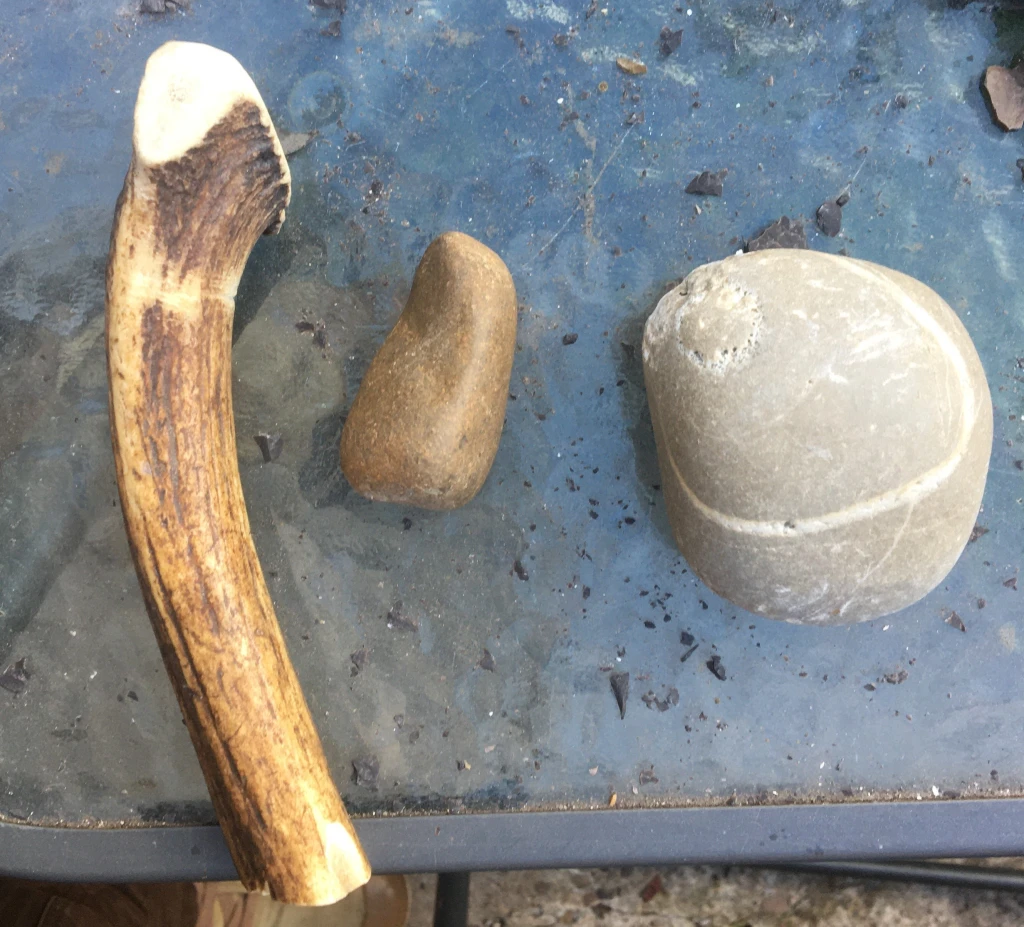
Anyway, I was at home and most of my knapping gear is at work and I was feeling a little bit stressed and saw a nice tabular piece of material in the back yard. I am 99.9% sure I picked it up at the Mynydd Rhiw site earlier this year, but my problem was that I only had a very large and very small hammerstone to hand, and a small antler hammer that I usually use on glass. None of the tools were ideal but I wanted to have a go, and if my above theoretical understanding was correct, I should be able to adapt my speed of hitting to compensate for the overly large or overly small size of the tools being used.
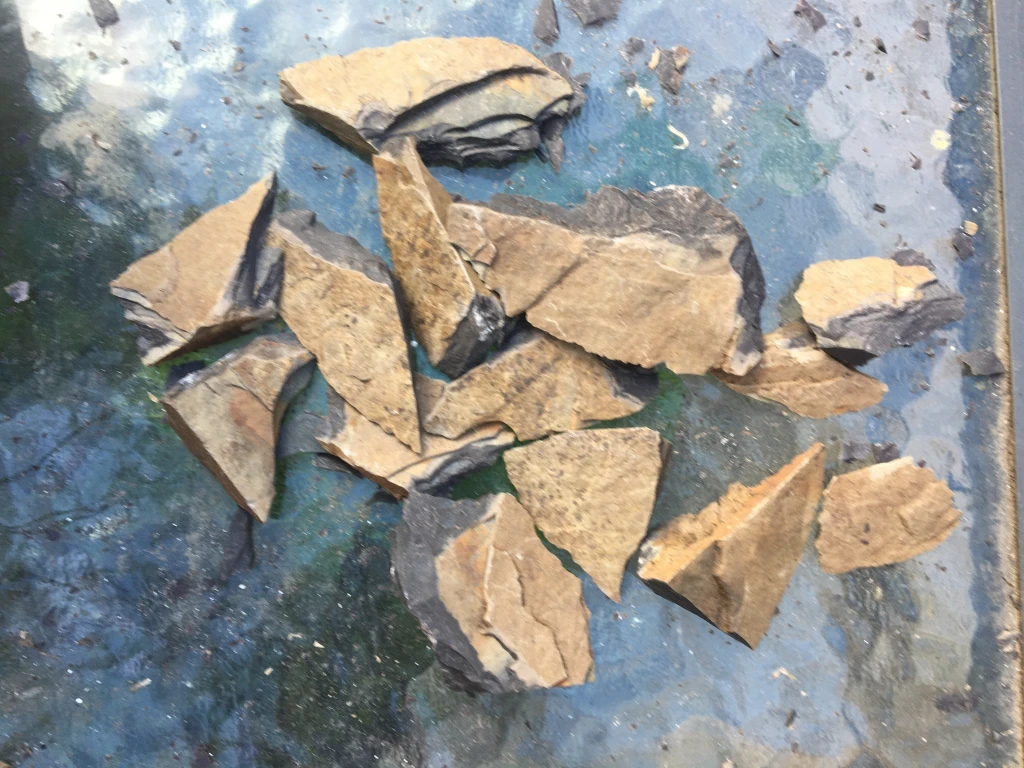
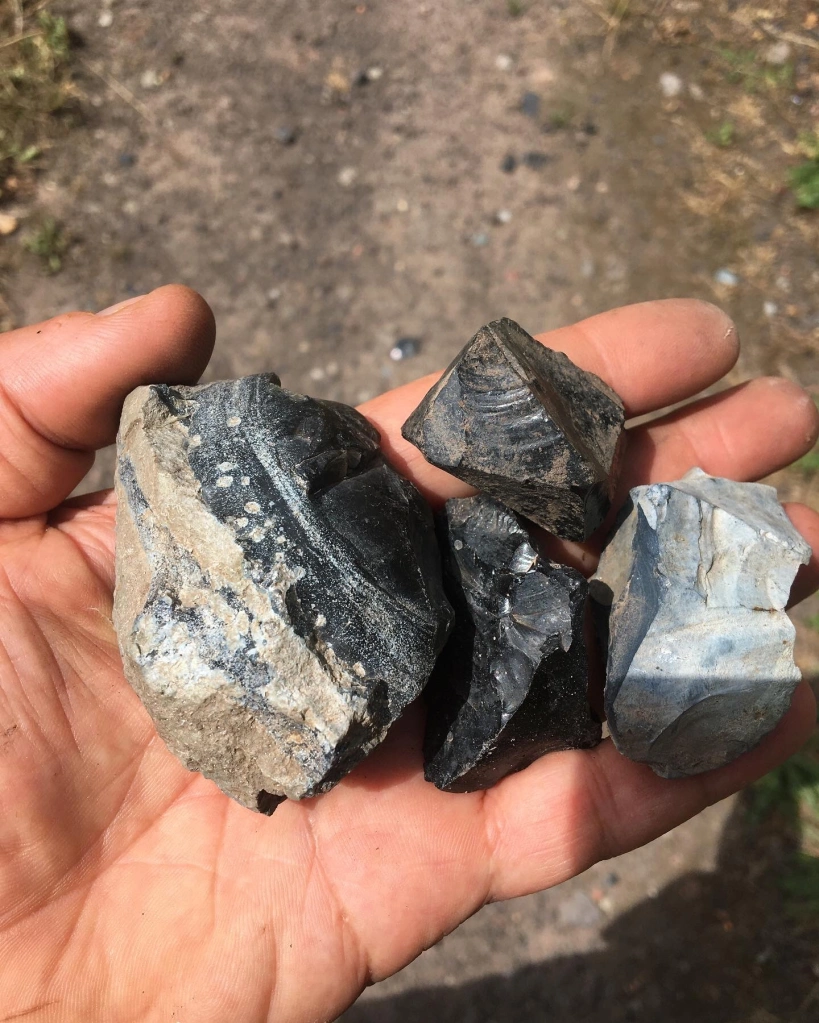
So that is what I did. The large hammerstone was good for the first stage of cortical removals. As you can see, each of these pieces has between 80% and 100% of cortex on the dorsal face.
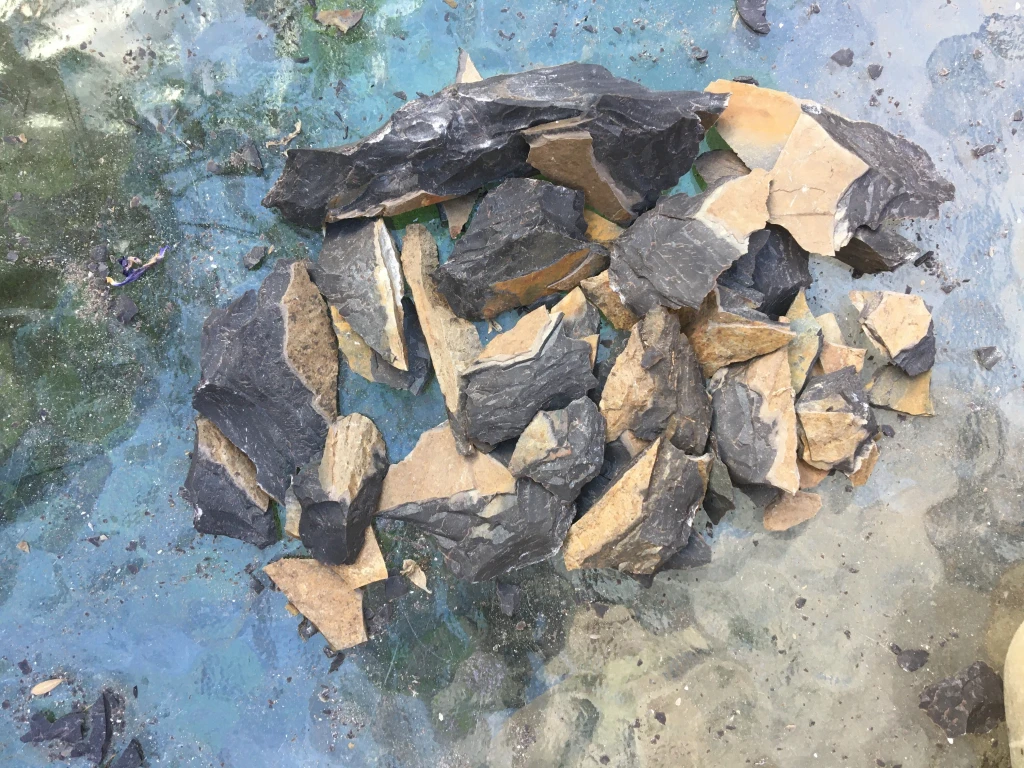
The next stage was a little more tricky, as I could have done with a slightly smaller hammerstone and larger antler hammer for the shaping and thinning process. As you can see, these pieces are characterised by around 50% cortical surface and they are generally smaller.
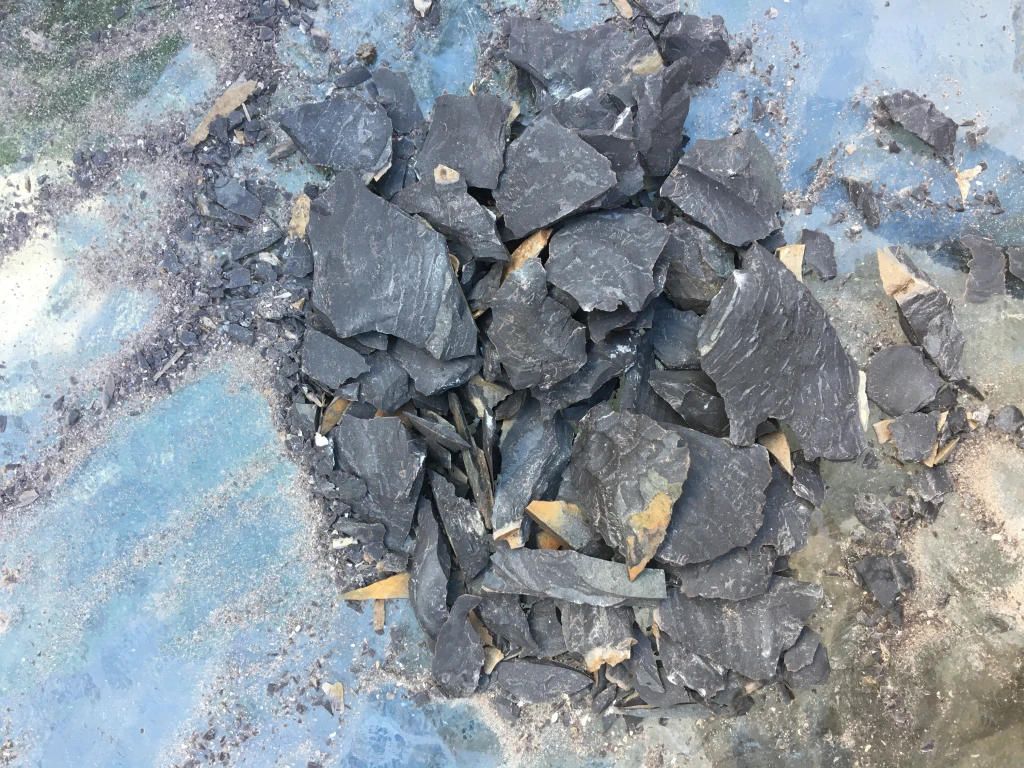
With the final stage I really had to hit the material hard with the small antler hammer. A bigger one would have worked better, but my approach succeeded and I did manage to get some nice soft hammer flakes off. As you can see, these are characterised by minimal cortical surface present.
Anyway, if the material was indeed from Mynydd Rhiw I should have made a Neolithic polished stone axe, but being me it became a small flat based cordate handaxe. This is technically incorrect because the material was originally quarried even though I picked it up from the surface. At one point it had a large step on one surface, which I removed by replacing a removal and using that as a punch to get rid, and it worked really well.
The speed thing does work, but it is hard work, and the intuitive way I normally select the appropriate tool does save me energy. There is more to hitting than this, I deliberately avoided a lengthy discussion of angles and accuracy, however this post does go some way towards exploring and explaining (my understanding of) the underlying complexity of what is generally perceived to be a simple process.
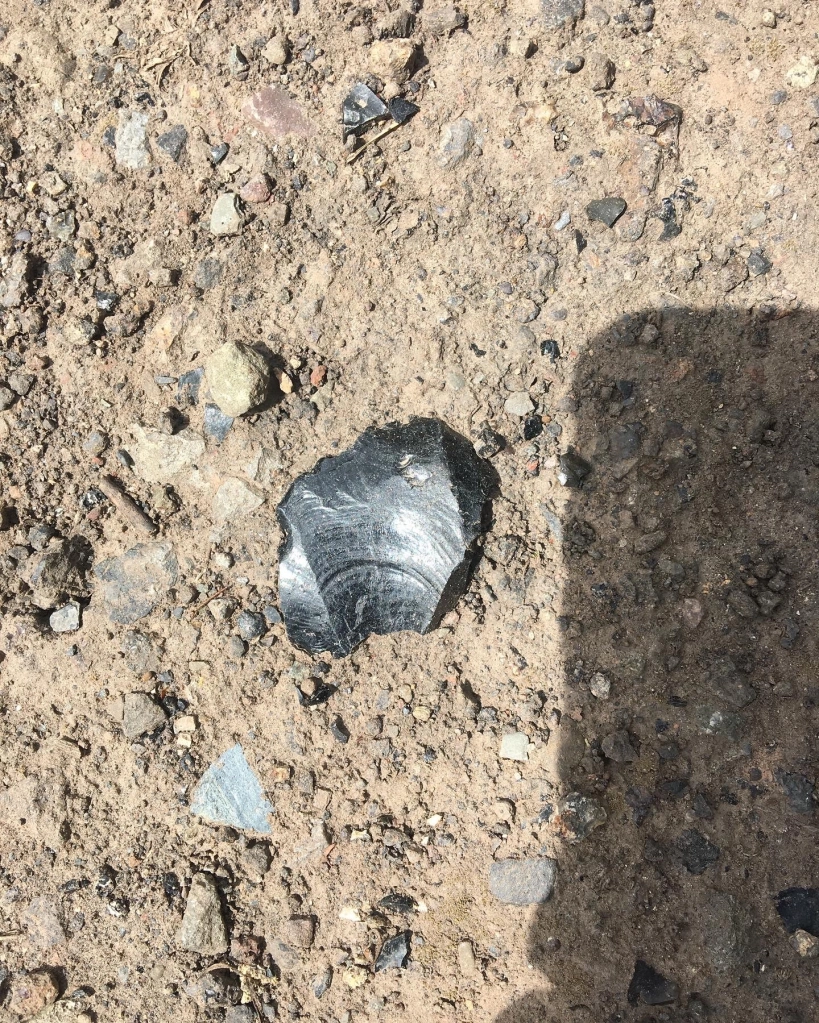
On our Herefordshire fieldwork project we camp on the local Dorstone village playing fields behind which runs an old straight track. On a dog walk last year I noticed a section that had some inclusions with conchoidal fractures.
I stored this in my memory bank, and this year ended up going on a super impromptu walk with a group of students interested in lithics. The aim was to introduce them to the art of finding knappable materials in the landscape (something I am getting good at).
Anyway, as well as an opportunity to all get to know each other a little better, it turned out to be a surprisingly enjoyable material locating and testing exercise.
I told Tim Hoverd, Herefordshire County archaeologist, about our adventure and he pointed out that this particular old straight track used to be a railway line, hence the glass slag that we were finding. I wanted to end this post with some kind of witty Alfred Watkins reference. However, I have now ended up reading about the Golden Valley Railway on Wikipedia. C’est la guerre.
Thanks to Alice la Porta we now have the best part of a tonne of flint nodules in the Teaching Lab. Thank you Alice! Earlier this afternoon I went to a talk by Julian Thomas about excavations at the early Neolithic site of Dorstone Hill in Herefordshire. Of particular interest was the pattern of rock crystal deposition. Whilst flint was found across the site, rock crystal was almost exclusively associated with cremated remains.
And whilst present in the form of very small pieces of debitage, no rock crystal tools were recovered, and the small size of the debitage suggests none were produced. The process of reduction seems to have been the thing. This is in stark contrast to the typological focus of modern archaeology discussed in Grace’s previous post.
Anyway, at about 5.30pm I found myself in the lab with a large hammer stone reducing a large nodule into manageable flakes. I have posted some pics of one of the handaxes made, but to reiterate, the process is the thing. I like the handaxe but I stole the 50 minutes or so of the day when I could be alone in the lab making something. Why is this process so precious?
We had an excellent handaxe making workshop in the labs yesterday, and I will do a separate post about it when I get some feedback from participants. This post is about one small part of the session. Before the handaxe making started in earnest we watched a ten minute video of an American knapper produce a large handaxe from a flat tablet of Texas chert.
The American knapper was highly skilled and produced a long symmetrical handaxe within something like 25 removals. Impressive. However, I lost interest early on. We had looked at the handaxes in the teaching collection and these real examples were much less refined. In our session we were also using knobbly flint nodules from Norfolk with fossils, holes and differential texture throughout.
The video was a performance of control by a highly skilled knapper using high quality material of an optimum shape and size. The factors being controlled, size, shape, material quality, were exactly those we were negotiating. To me the video was a sales pitch to archaeologists looking for machine like knappers to take part in ‘scientific’ experiments.
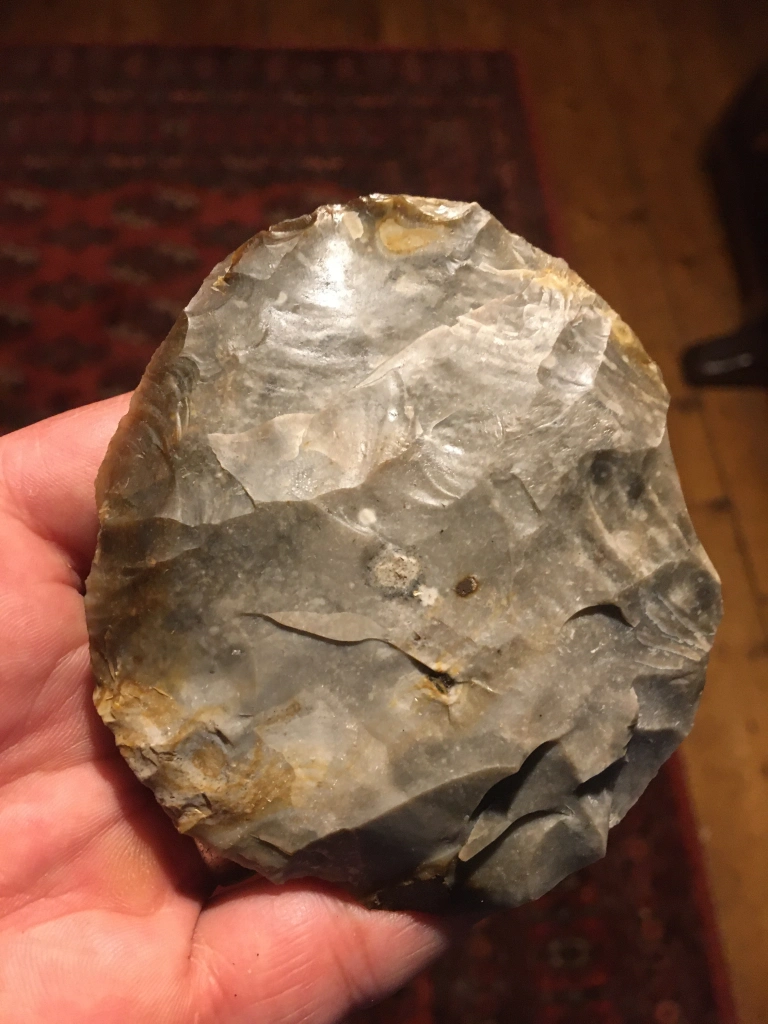
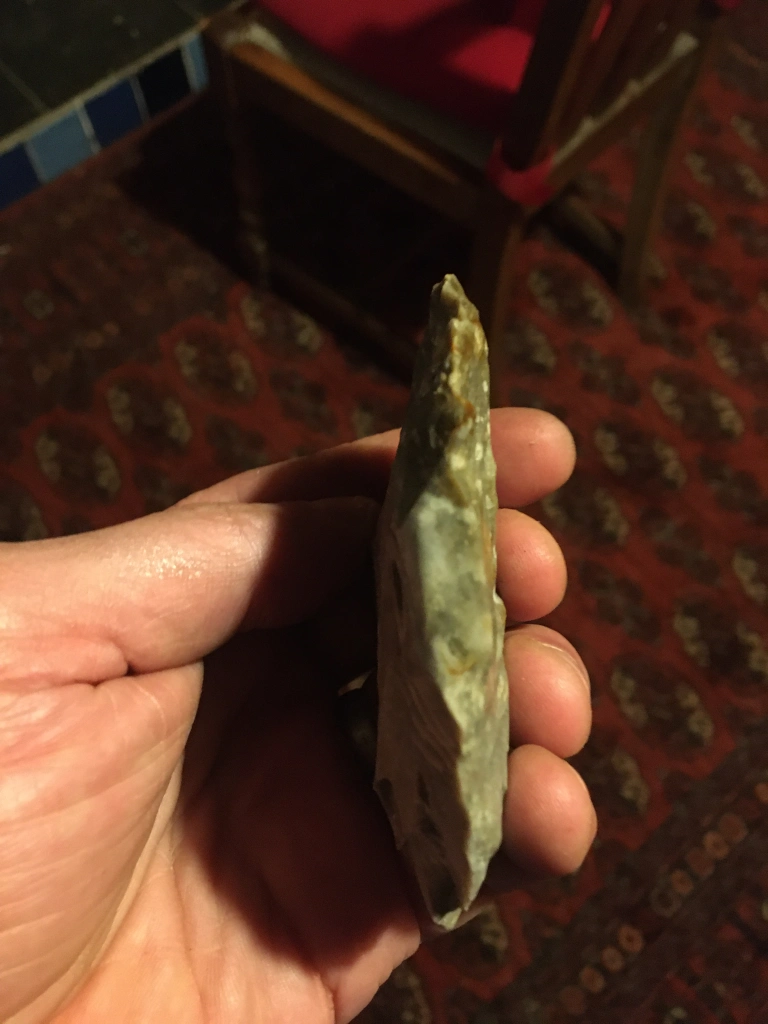
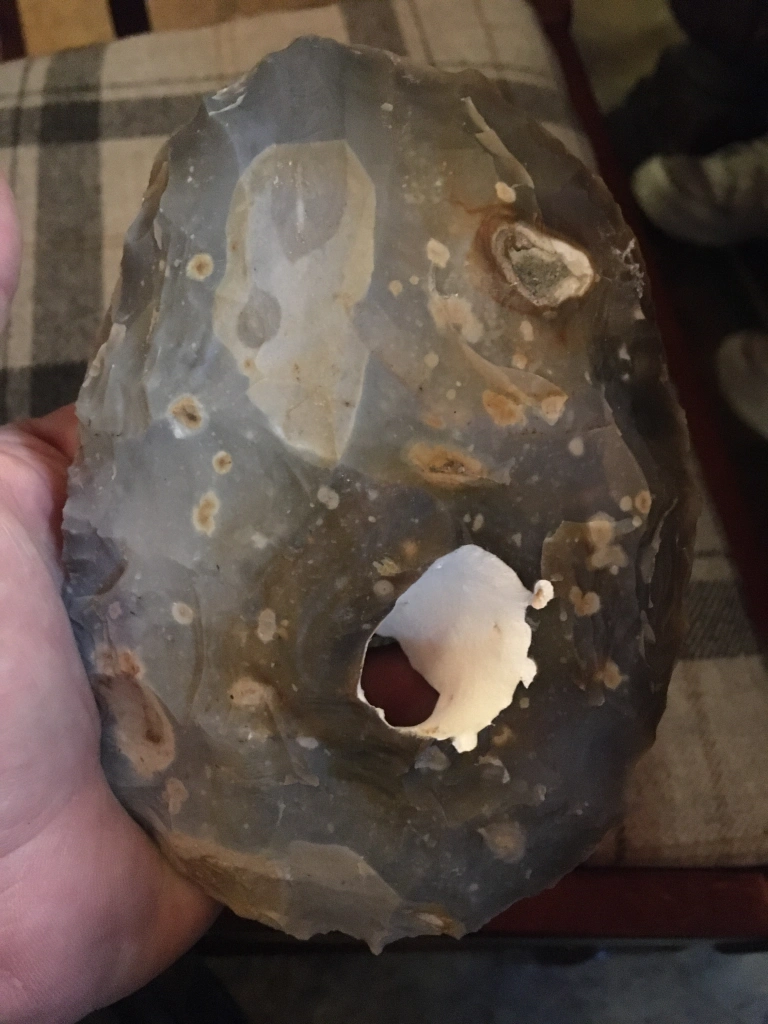
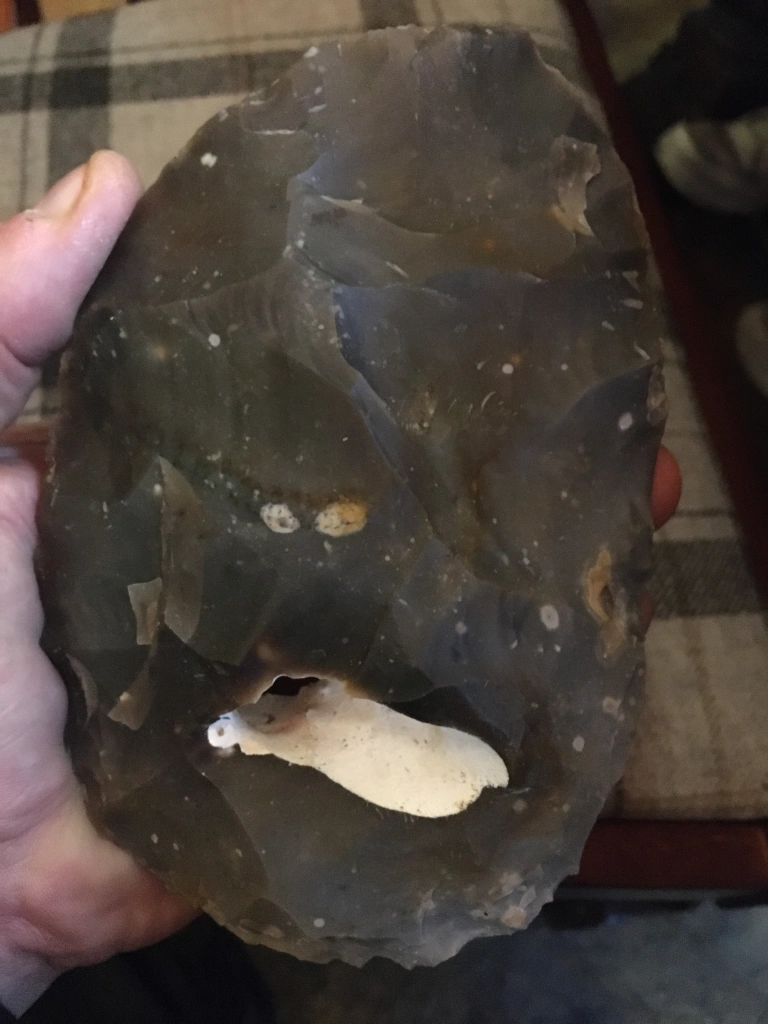
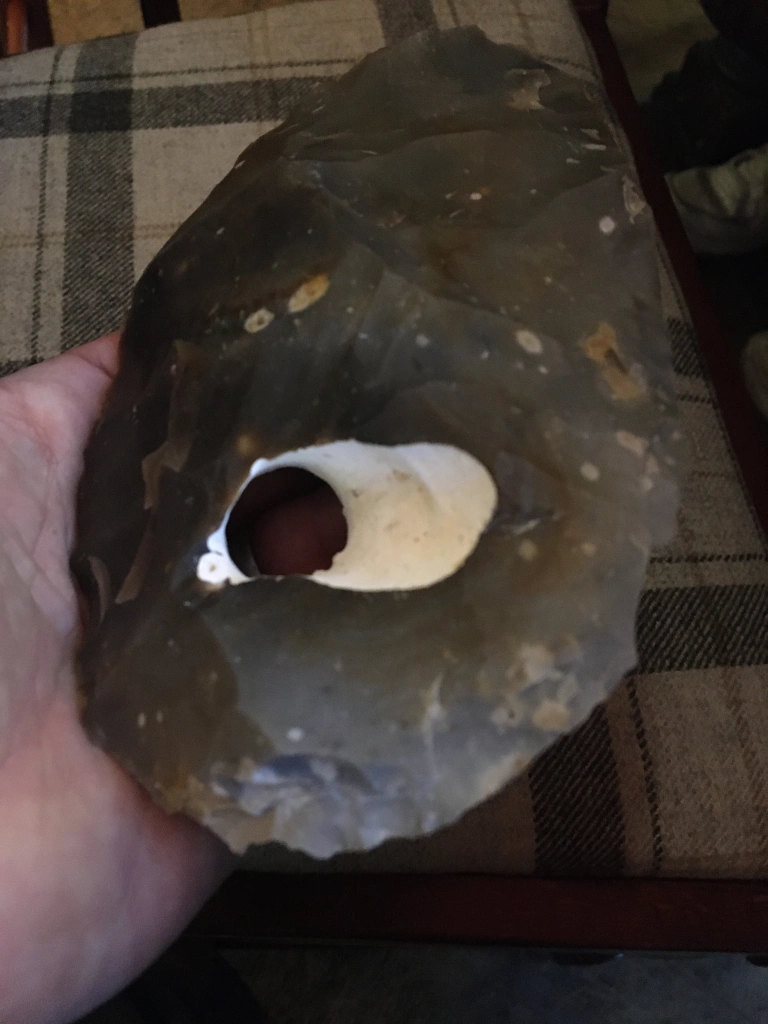
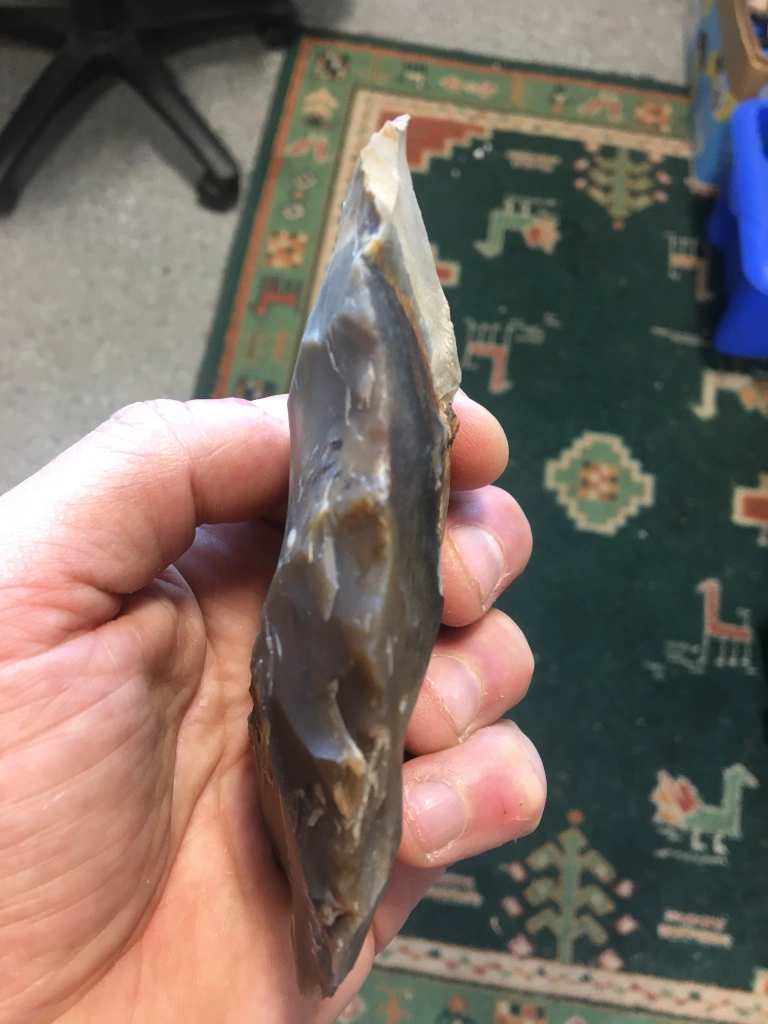
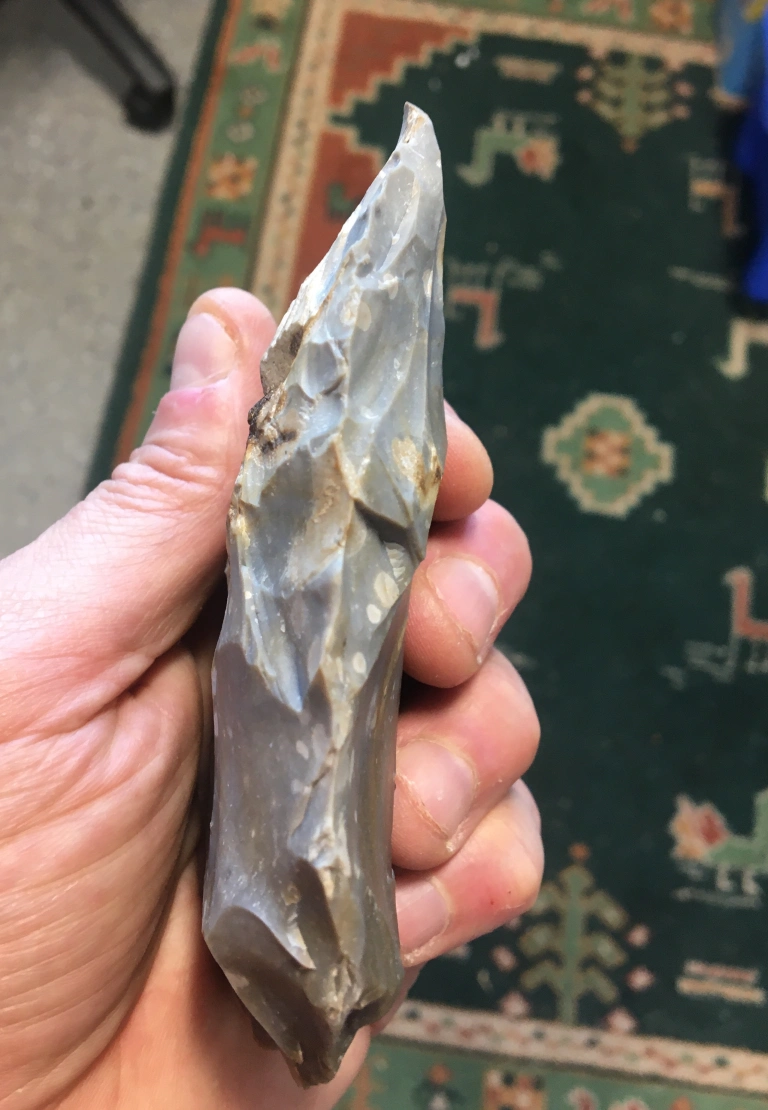
However, our exploratory negotiations with less than ideal materials resulted in artefacts much closer to the examples in the teaching collection. The handaxe in the photos was made before the workshop from a large flake with a big hole, small fossil, and course grained sections. My perspective is perhaps related to a current obsession with this brilliant track by the band James, describing the messiness of life and how we engage, make mistakes, change tack, and that we are ultimately, just getting away with it.
Whilst I felt the American knapper’s video was a performance of control, our knapping session was more like the performance of being human, and I loved it.
I have a number of projects on the go, all of which need people and dates to coincide. I find this kind of scheduling activity stressful at the best of times, and I have three immediate ones to deal with and a lecture to produce.
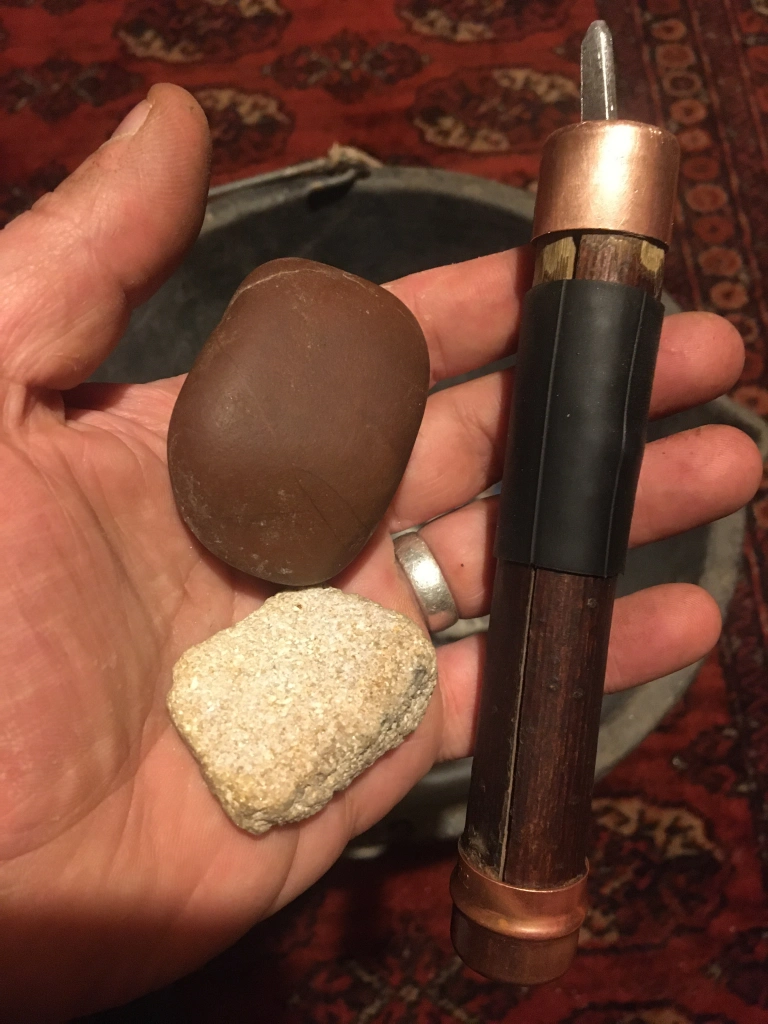
So after doing a significant chunk of lecture producing I treated myself to some time in the lab. This was a big flake and I reduced it down systematically. I need some new hammer stones and antler hammers as all of mine are worn.
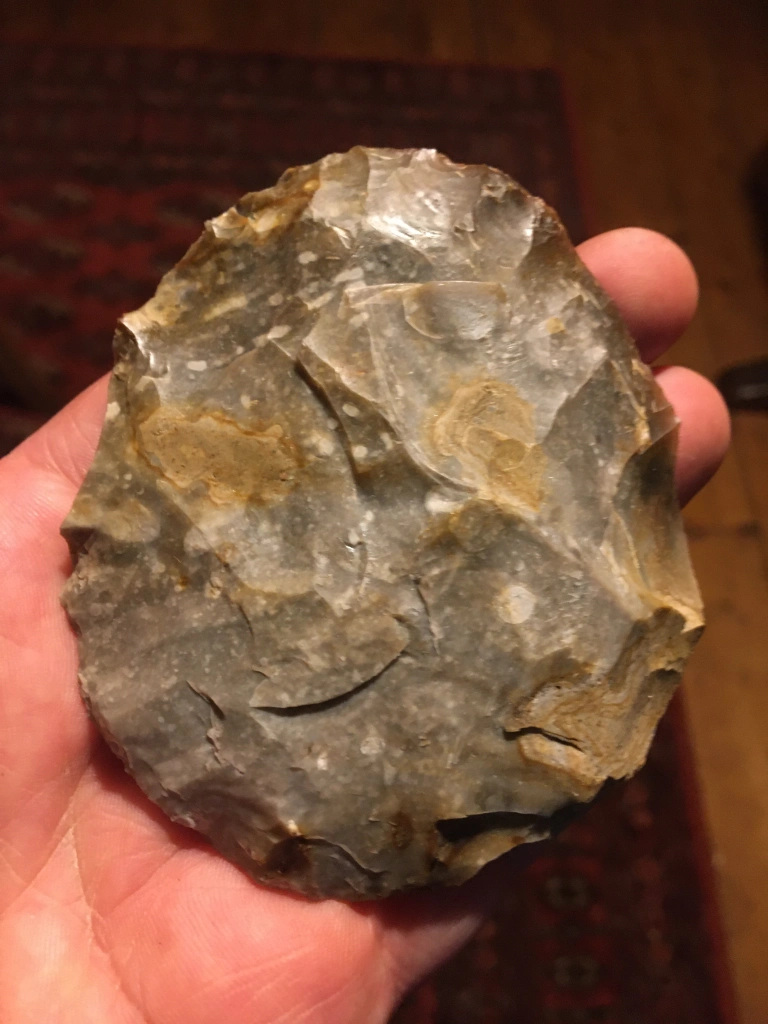
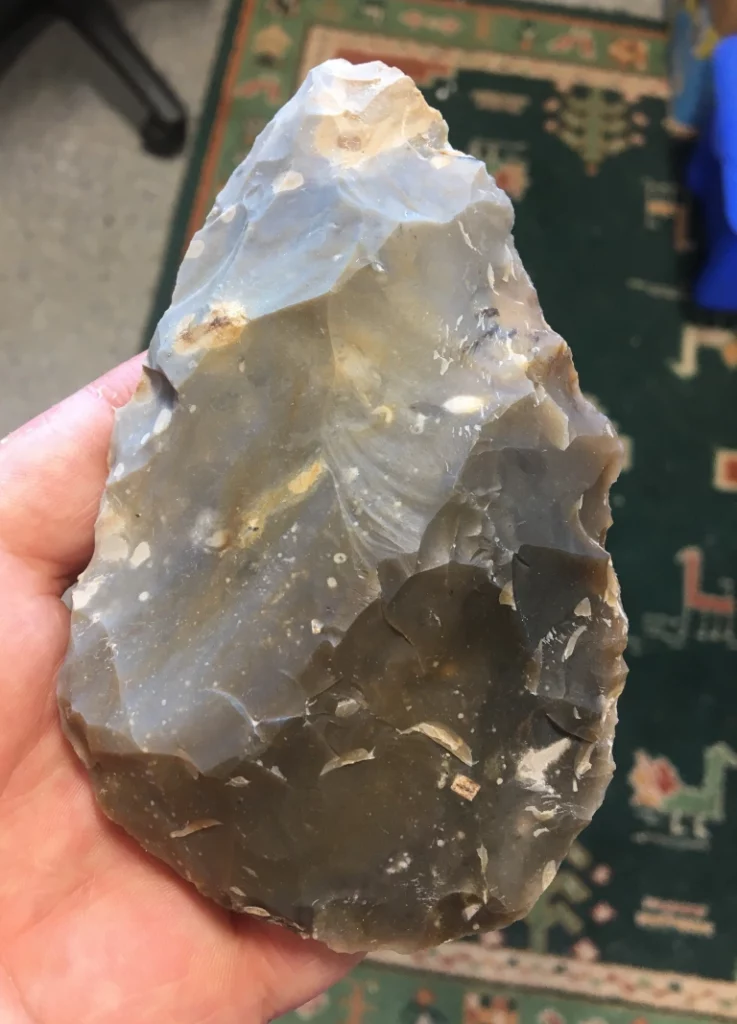
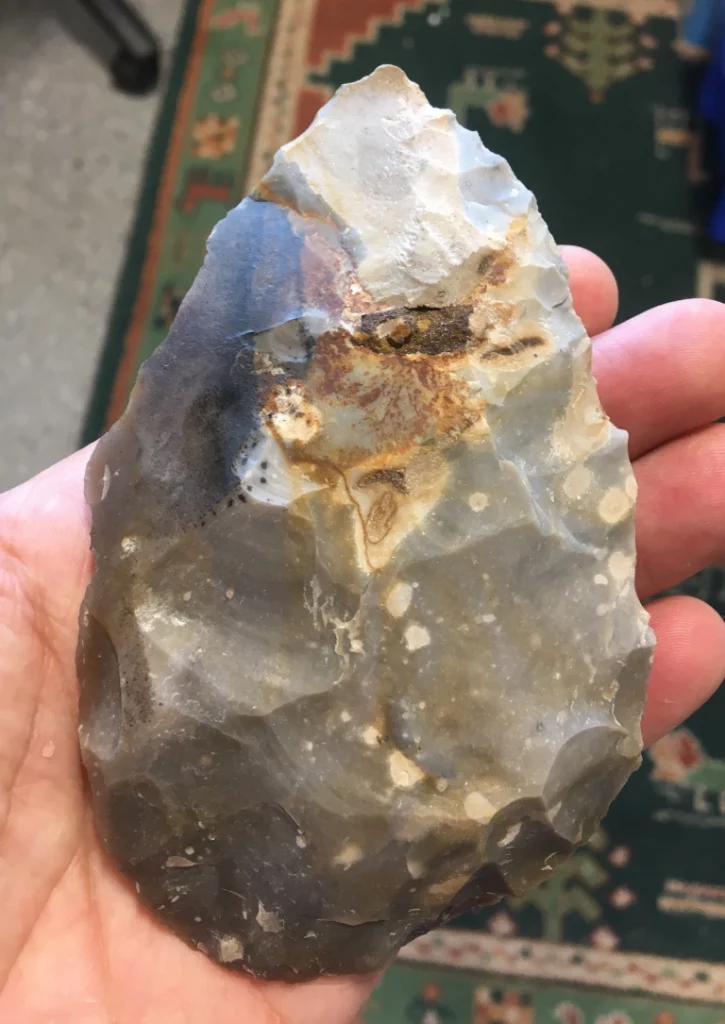
The handaxe is asymmetrical, but in a way I can live with. The edges are all sharp, but best of all, it is a double A side. Both faces are equally interesting. The first picture shows two good thinning flakes meeting in the middle, and coincidently delineating a colour and flint consistency change.
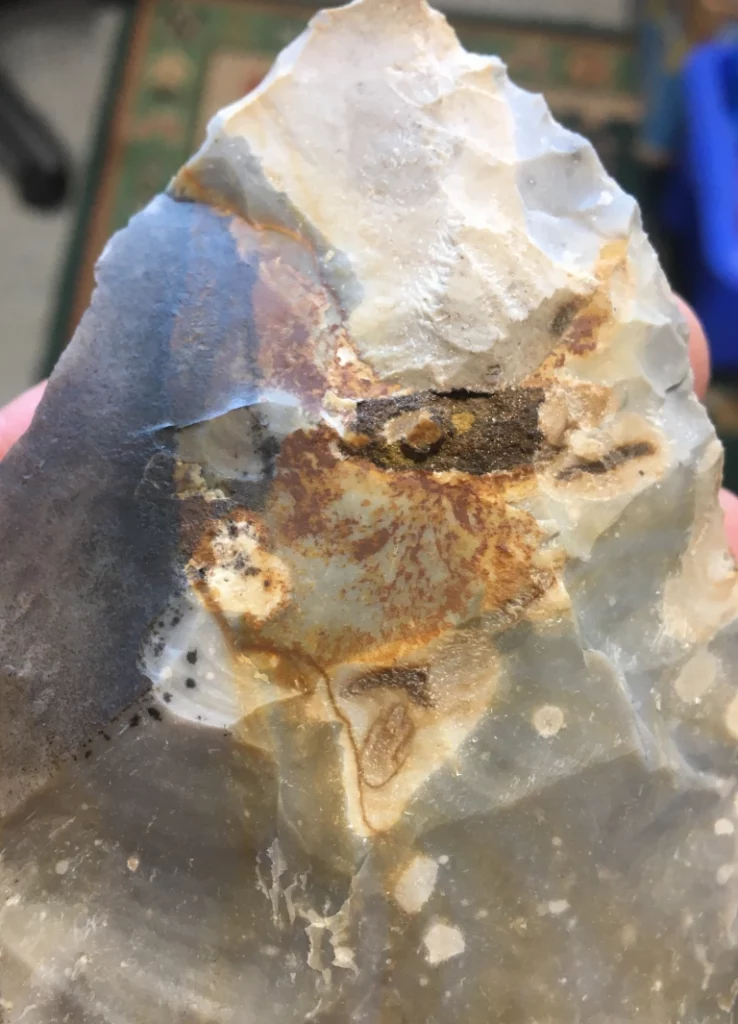
The other face has this interesting fossil in it. I didn’t plan it like that but the texture of the flint around the fossil made me work around it and so it was a negotiated settlement. The rust colour is usually where water has penetrated the flint through flaws in the nodule.
Hammer stone and worn antler problems made me realise how I normally unconsciously choose the right tool for the job at hand. I struggled a bit trying to use a stone that was too large but unworn. This made me think about handaxe reduction.
This handaxe is…hand size! perhaps a lot of the handaxe reduction process was to transform an already useful flake into a good fit with the hand. None of the above handaxe characteristics were planned above and beyond thinking about bifacial reduction. And on that note, back to scheduling