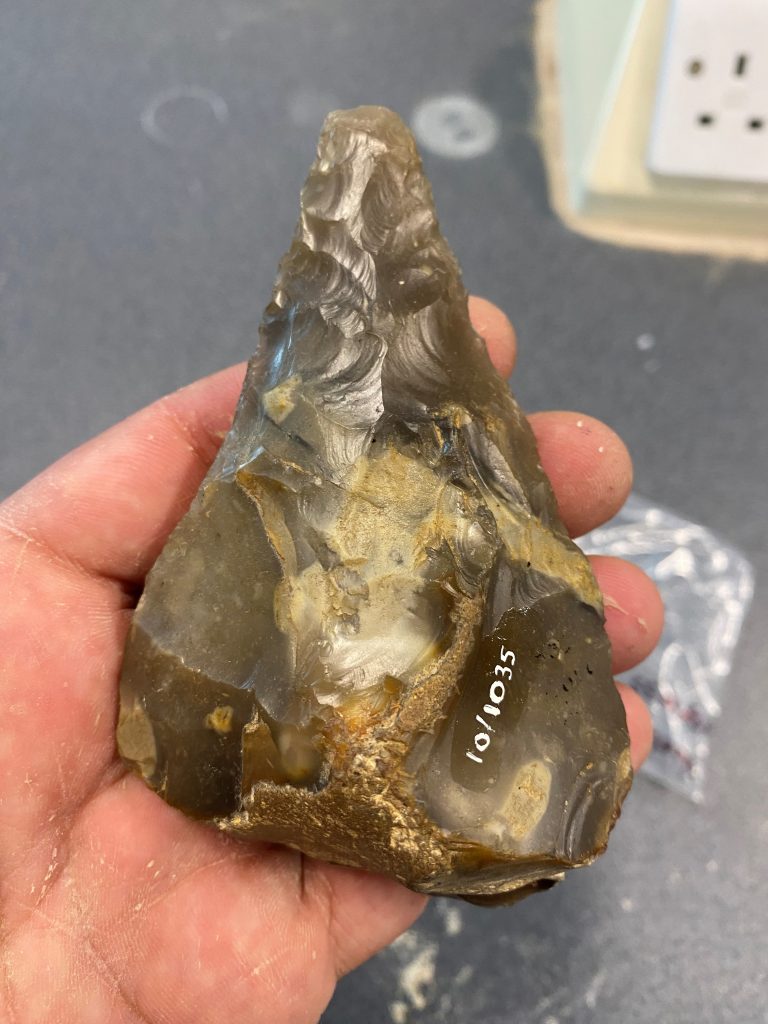
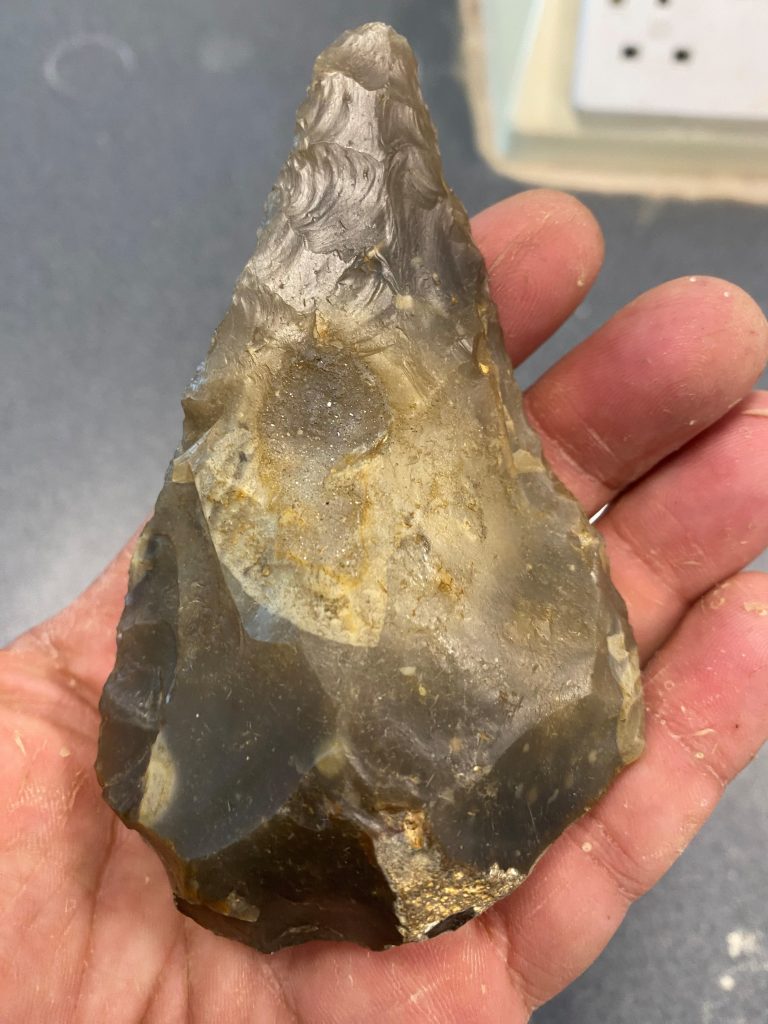
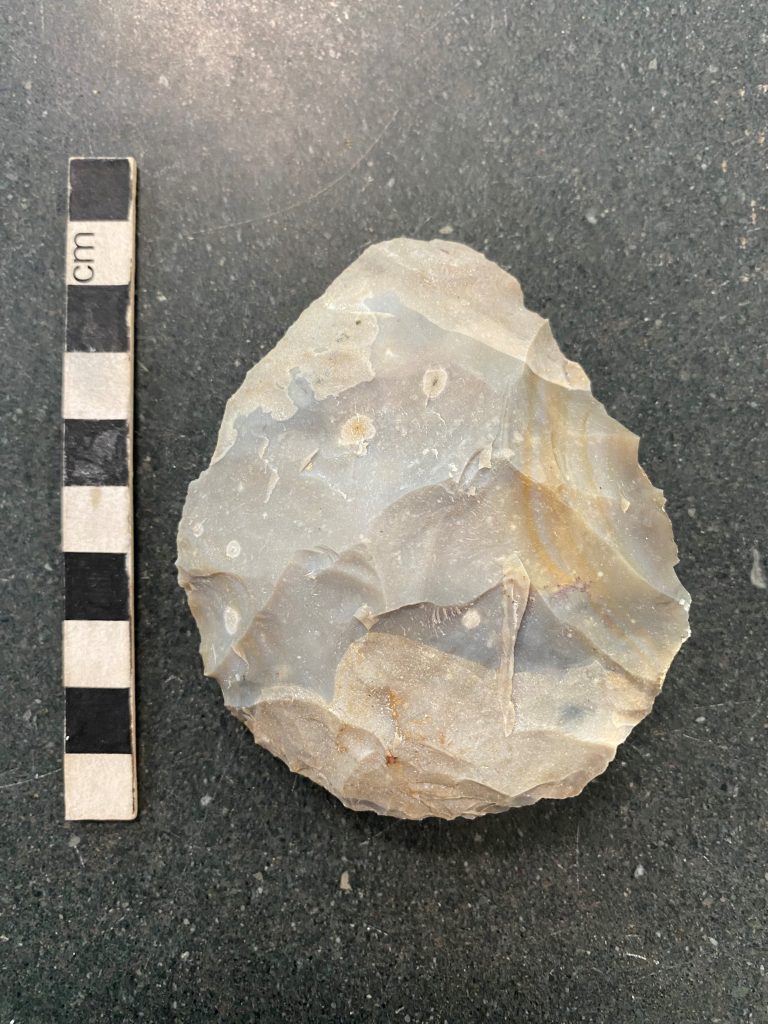
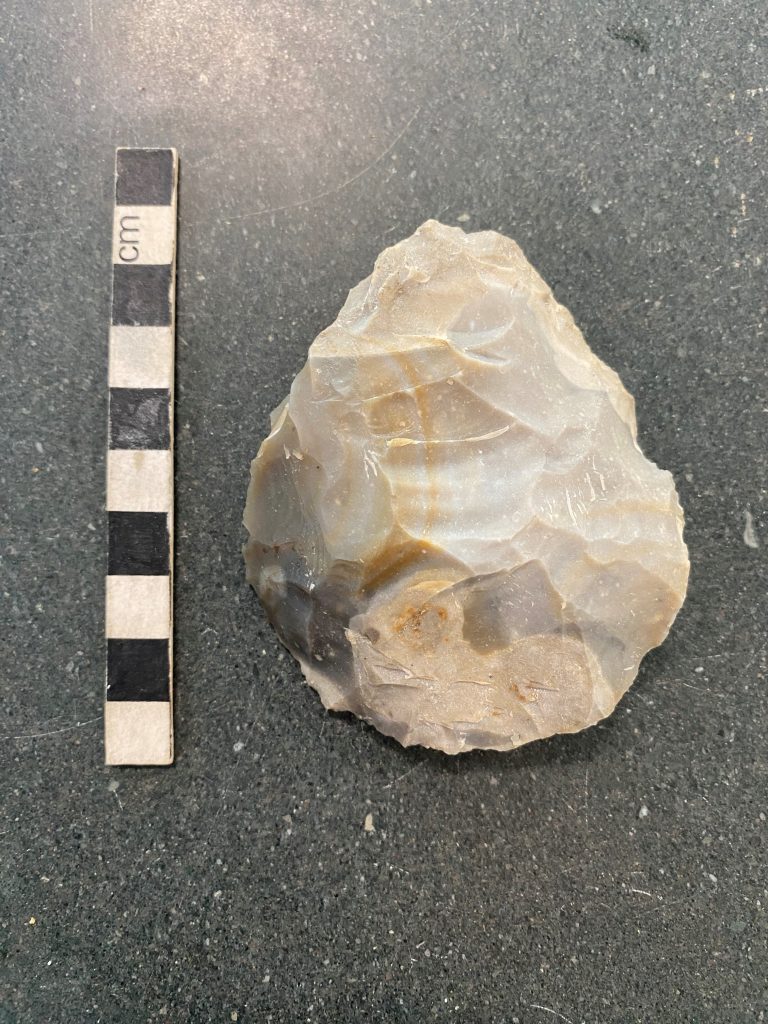
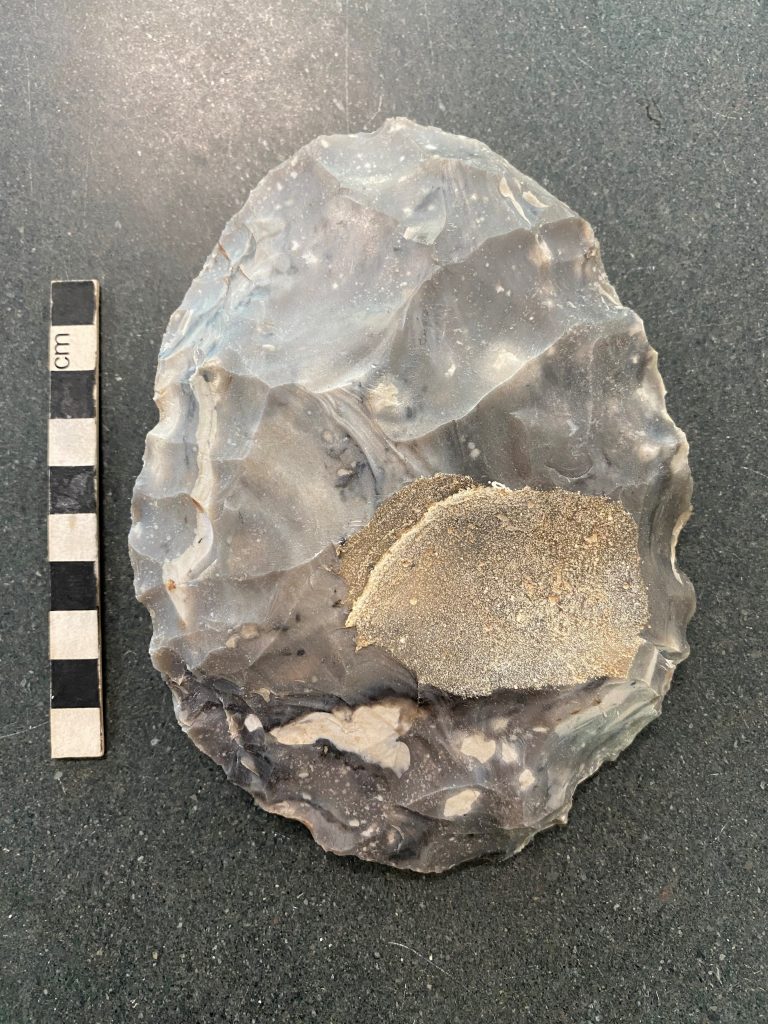
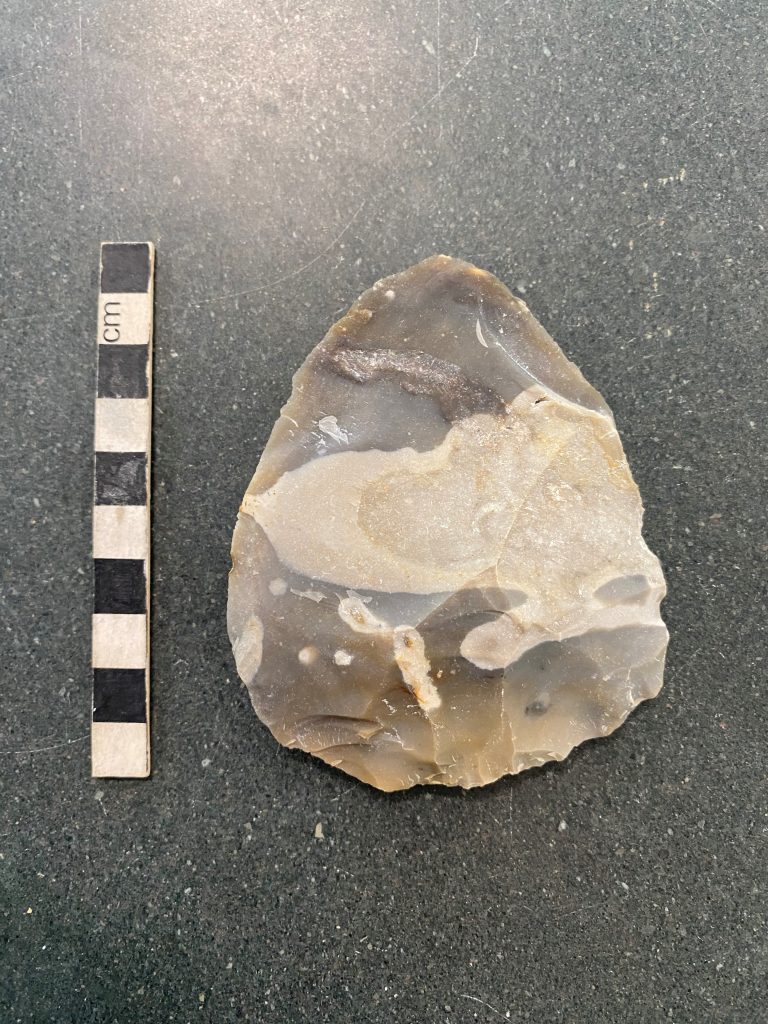
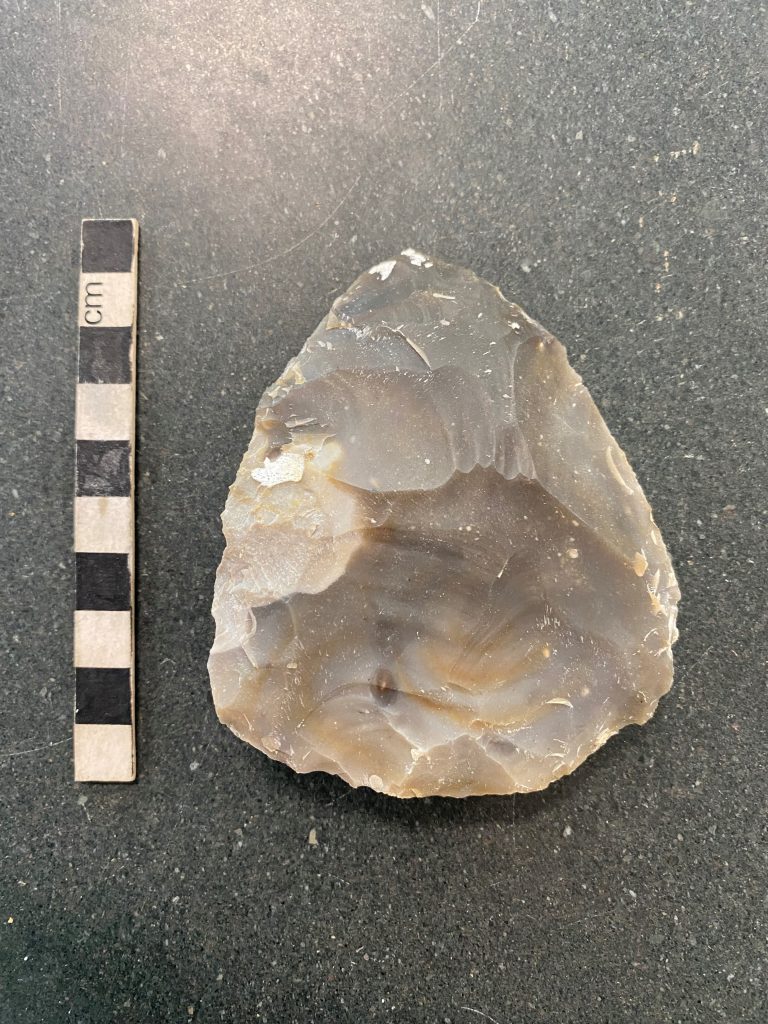
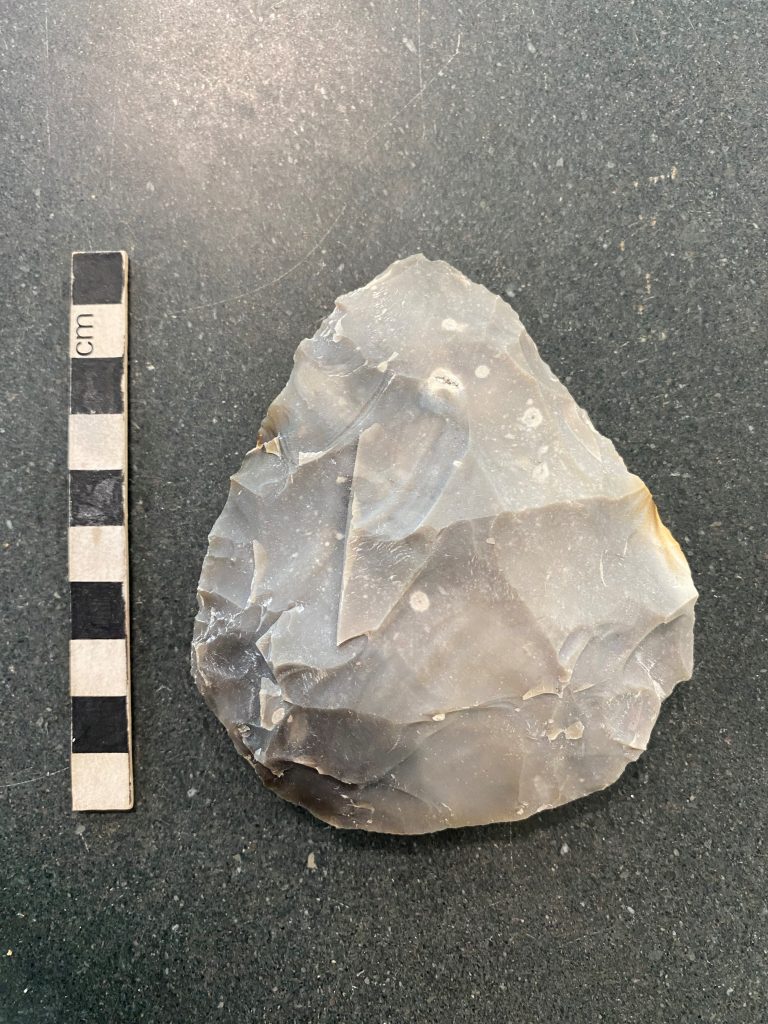
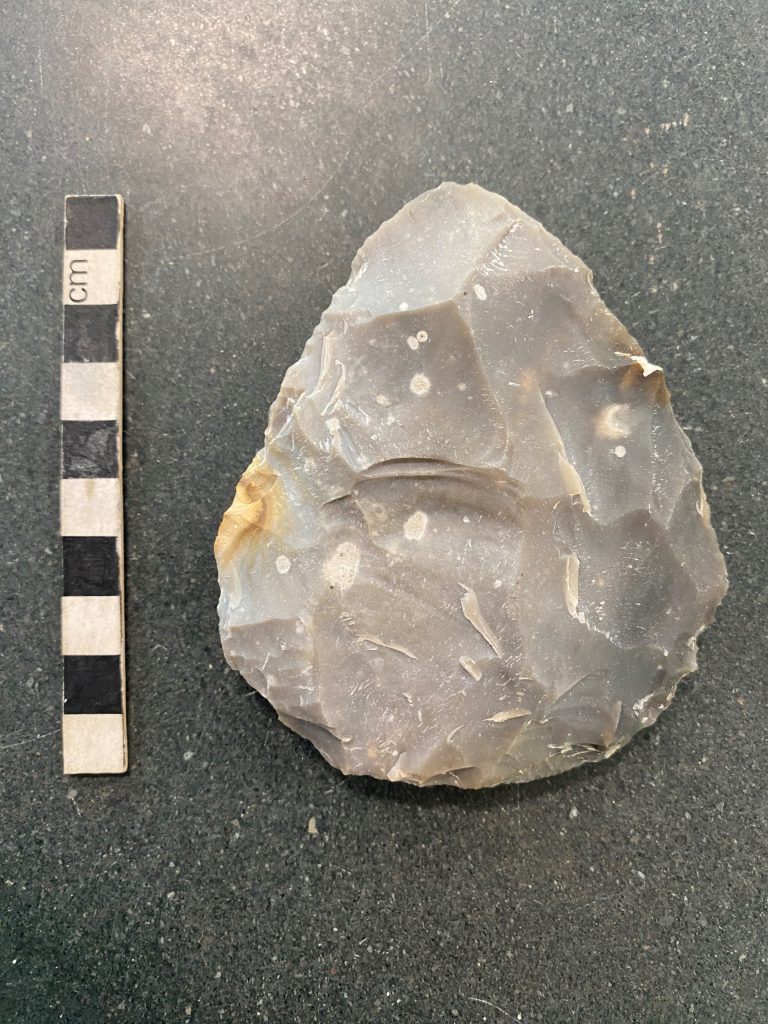
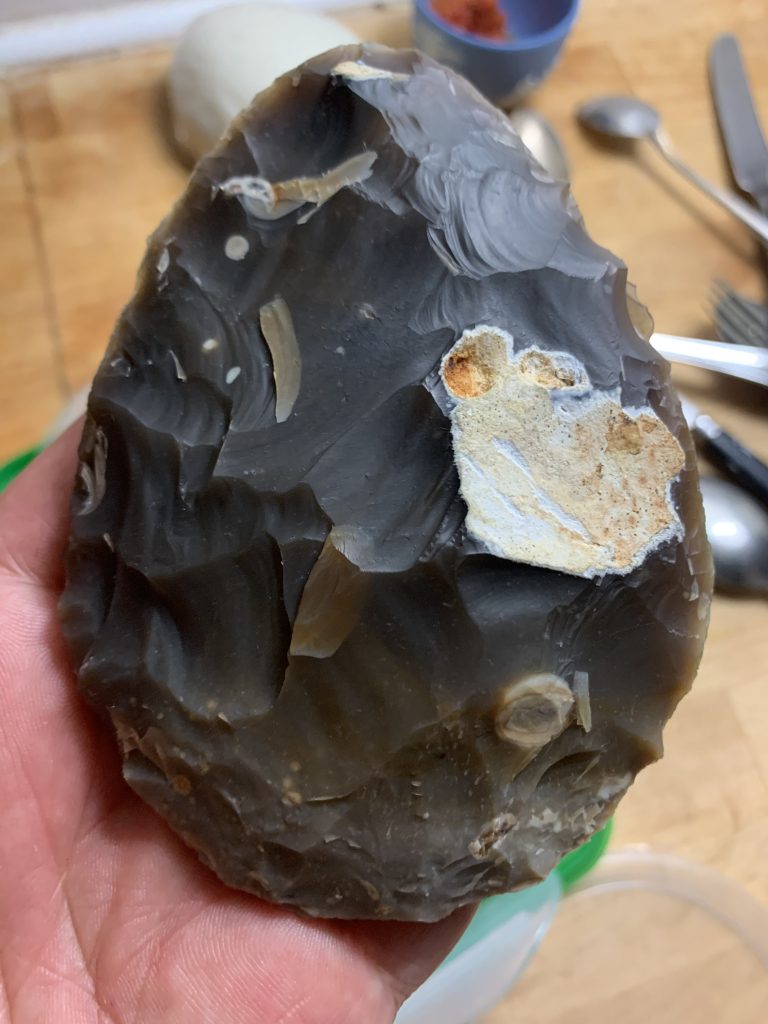
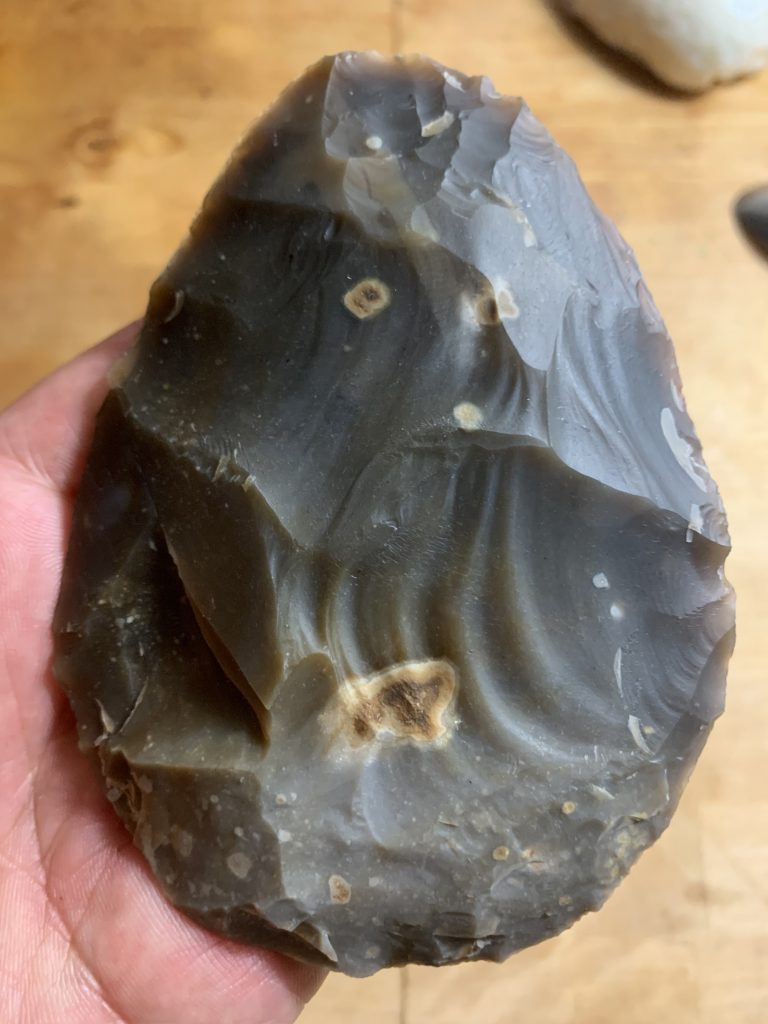
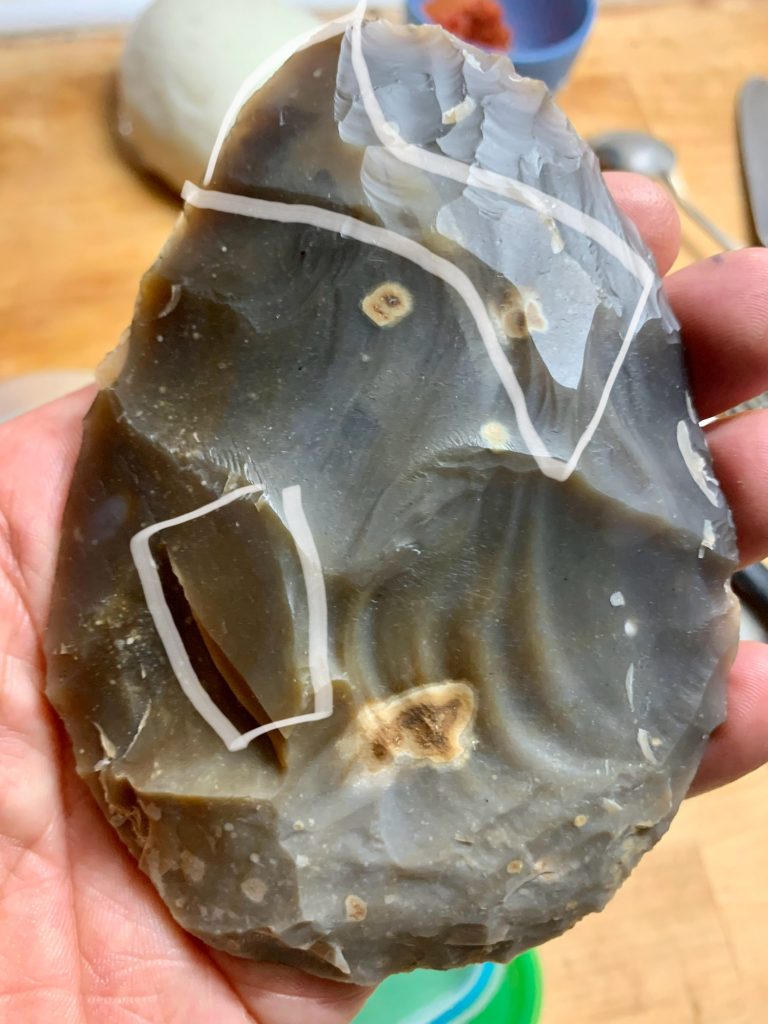
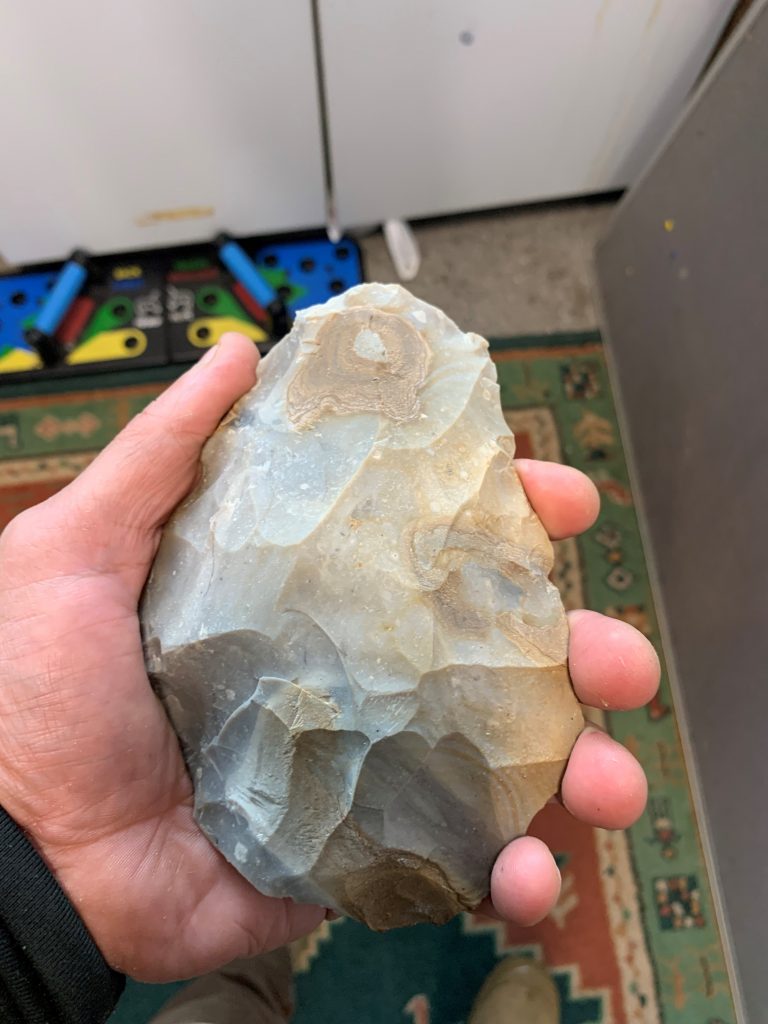
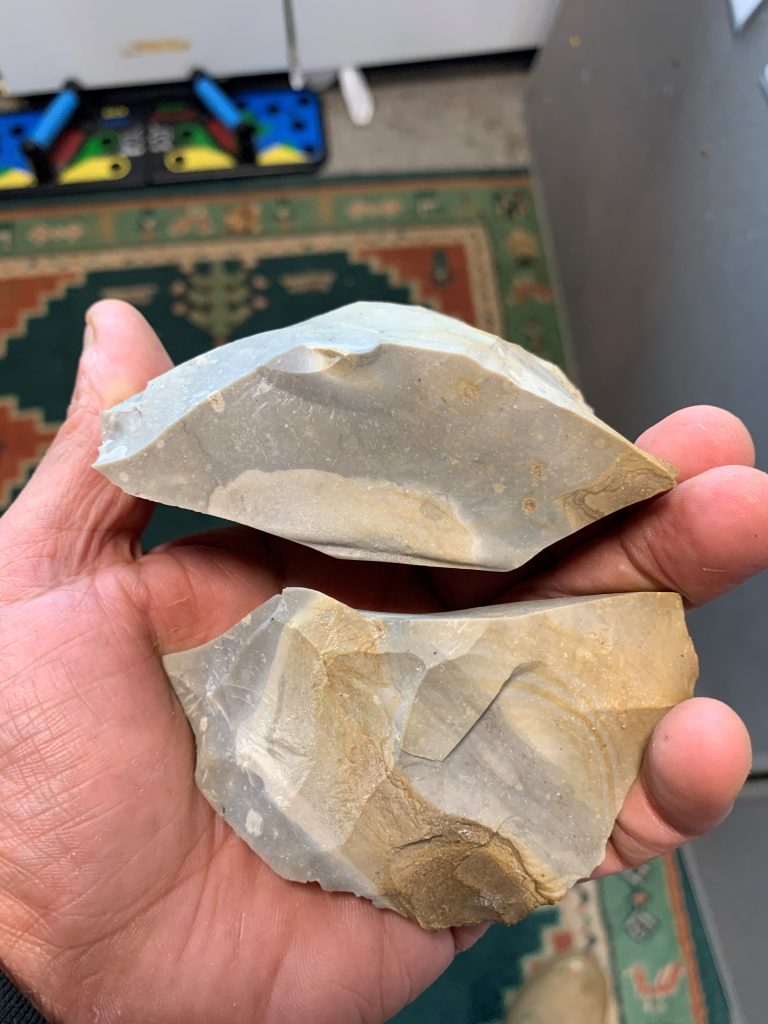
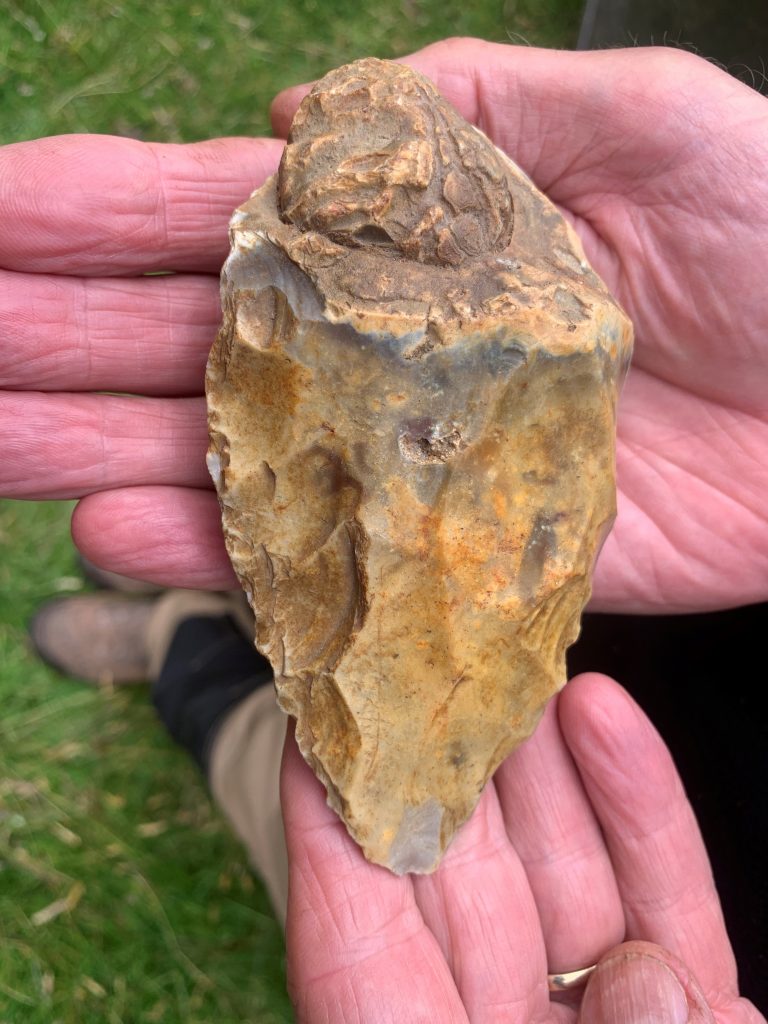
The above handaxe was found by one of my colleagues in our teaching collection, mislabelled as a ‘Neolithic flint handaxe’. It appears to have been produced on a beach cobble and I really like the contrast between the large flake scars on the proximal end, and the much finer scars at the distal. This suggests to me a resharpening process. I also like the shape.
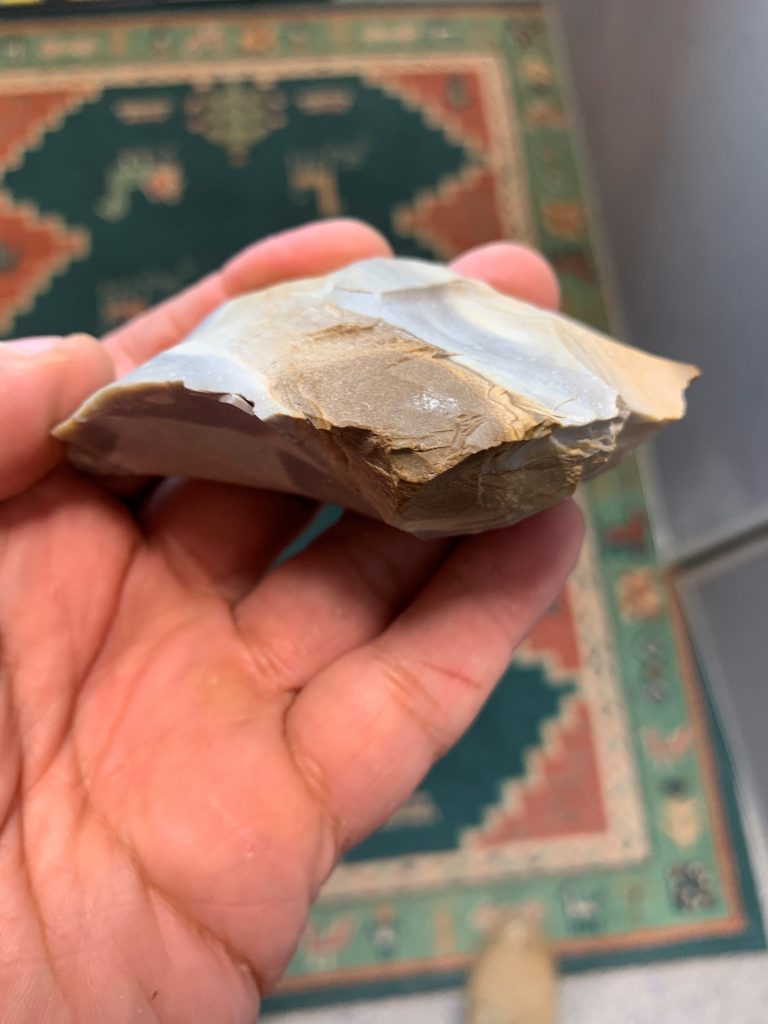
The other face is equally interesting, and I can see this shape and type is what I am going to be playing with over the next few making sessions.
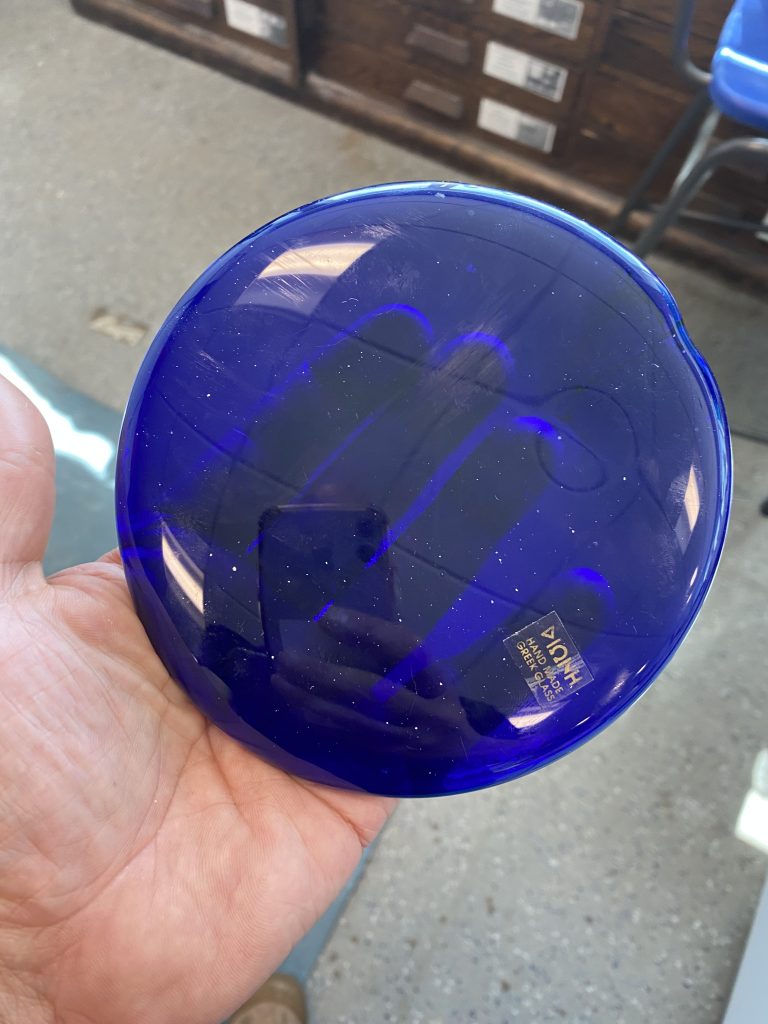
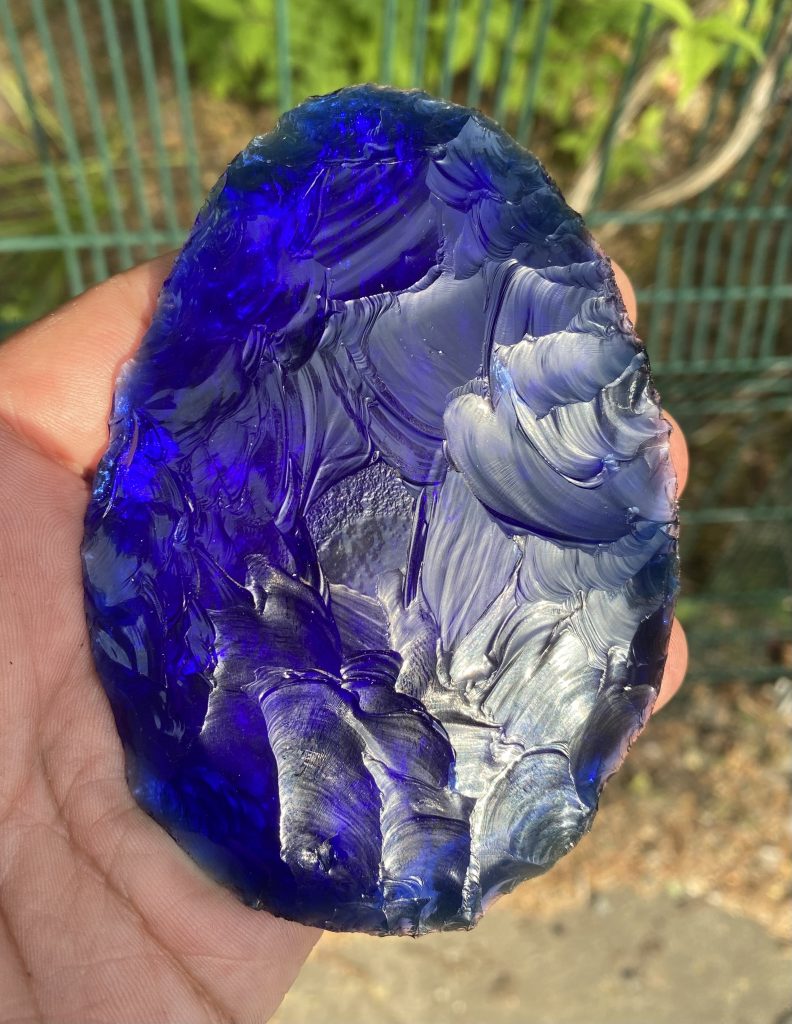
We have just come back from a week in Athens, and the main thing I brought home was a large disc of blue glass, bought at the flea market for five Euros.
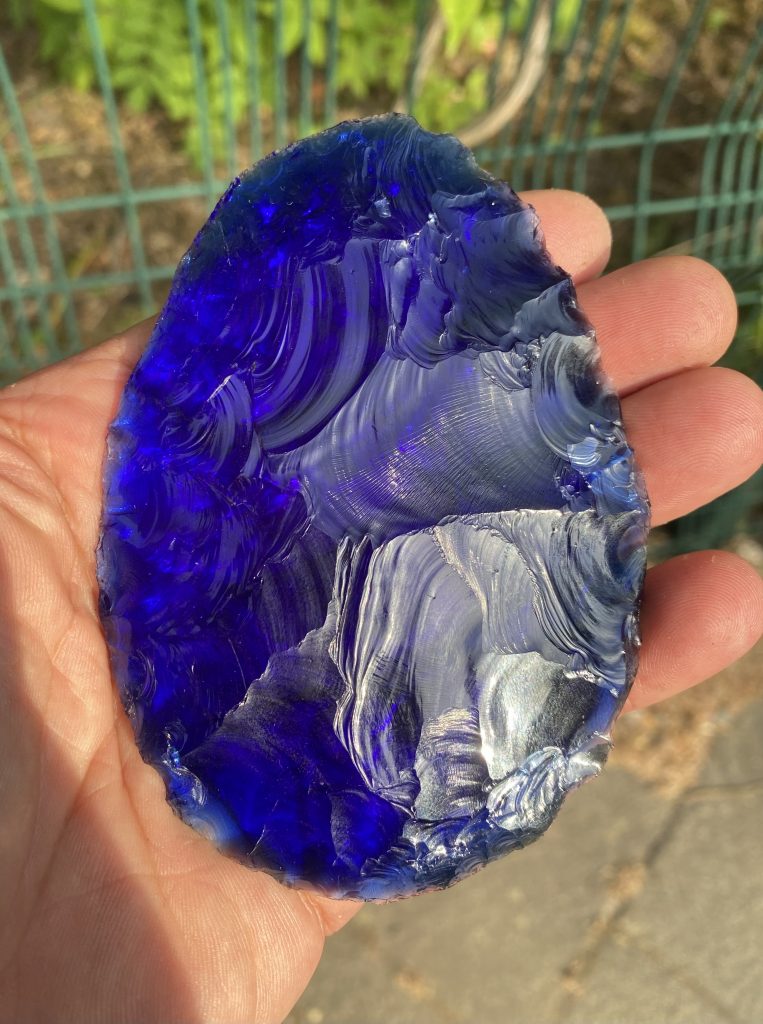
Anyway, I found time to hide in the lab for an hour or so and came away with this very nice blue ovate handaxe.
Everything worked well. Turning the edges with a hard hammer, and then thinning using an antler hammer. This is the second iteration, initially it was larger but wonky.
I brought the wonky version home, lived with it for 24 hours and then the following day finished it off so that it is a shape I can live with. I am currently thinking about the difference in experience between my work with emails, spreadsheets and budgets, and escaping into the lab and the satisfaction of making something beautiful. I suspect it is something to do with what that famous stone tool specialist, Karl Marx, termed ‘Alienation’. To be continued!
What is aesthetics? According to the Oxford English Dictionary (OED) Online the word aesthetic is derived from Ancient Greek and relates to sense and perception. In relation to the French noun esthétique the OED Online provides this explanation from 1819, a: ‘set of rules or standards by which art is judged’. Yesterday my ‘workshops’ friend, Laura Thompson organised for us a handaxe making session for half a dozen academic staff and students in the Archaeology labs. My ‘Mesolithic’ friend, Stephen Poole made a trip in from Rochdale to help me out with the teaching process. In the discussion session at the end the subject of aesthetics came up a couple of times.
However, to start at the beginning, initially I presented a series of handaxes to the participants, both replicas I had made and ‘real’ ones from our teaching collection. These are used to introduce how stone tools were used historically to understand and create a prehistoric chronology. If we take a step back and think about the structure of the session, a group of flintknapping beginners are presented early on with models of ‘correct’ form, explained by myself, a perceived ‘expert’.
To shift the discussion slightly I would like to introduce the phrase ‘Like mom’s apple pie’ as it is interesting to me on two levels, it uses an outcome (an apple pie) or experience (eating the apple pie) to characterise something as inherently ‘correct’ or ‘positive’. It also links generationally, looking backwards to find a ‘correct’ or ‘positive’ model.
So, to link together apple pies and handaxes it would seem to be a common process to identify past examples as an ideal with which to measure present output. This further links to the work of the anthropologist of art, Alfred Gell, who argued that aesthetics is culturally specific. He goes on to argue that aesthetics serve a social function, and are imposed upon objects so that those objects can be used to achieve some social goal.
If we also consider the typological approach, using particular types of objects to denote particular epochs of prehistory or human culture groups, I would argue this is following a similar model. An ‘expert’ has identified certain more or less measurable parameters which certain objects sit within, and others outside. Those objects that fall within are categorised as one particular period or culture group, those outside may be outliers, or belong to a different period or culture group altogether. This system was developed early on by pioneers such as Gabriel de Mortillet using museum collections. By the 1930s field archaeologists were using an object’s archaeological context to help clarify the above models, and by the 1950s archaeologists were looking to process, in order to understand at what stage in its lifecycle an object sat. Famously, this can be in contrast and conflict to the typological approach, as the object changes shape and form as it wears down through use and then re-sharpened.
To return to our workshop, participants are presented at the beginning with idealised models that carry authority because of the context of presentation (University of Manchester Archaeology Laboratories), and the skilled practice they embody. They also carry with them an aesthetic, and for the replicas produced by me, it is my aesthetic. This is separate from any butchery process but clearly embedded within an archaeological teaching and learning environment, and the history of European stone tool research. My stone tool aesthetic is a modern complex of academic models, bodily practice in negotiation with a range of materials, resulting ultimately in a selection of examples I am ‘pleased with’ and presented to the participants.
As the workshop proceeds the skilled practice that the examples embody becomes apparent to the participants, as they attempt to achieve a similar result. Shape, size and form present a model of idealised outcome that participants strive to achieve within a limited three hour window. For teaching and learning purposes I spend the last hour or so making sure everyone goes home with a functional cutting tool, so that they understand that flintknapping is a game they can win.
Back to aesthetics as a form of cultural control. My knowledge of the history of prehistory and the differing theoretical approaches has been shaped by a western Undergraduate, Masters and Doctorate education in Archaeology, theory and lithics. The development of my ability to make stone tools is discussed elsewhere, but the selection of aesthetic examples is indeed designed to elicit certain social responses, a subtle recognition of my ‘expertise’, and therefore a positive consideration of my guidance. Within this reading aesthetics has been something I have interacted with throughout my lithics education. Certain people, objects, texts and drawings will have influenced my aesthetics over the years and I now perpetuate this emergent aesthetic through my own teaching in the present. As such the Western European idea of a handaxe is perpetuated through time and from one generation of archaeologists to the next. To basterdise the 1819 definition I am both consciously and unconsciously selecting and perpetuating a: ‘set of rules or standards by which a handaxe is judged’.
I have started walking to work and there is a lot of this kind of stuff going on in my head at the moment!
I recently went on the above workshop, mainly because I know that flintknapping creates dust and I should make sure that we are practicing safely.
So this week two colleagues from Geography popped over to measure the amount of dust generated in a mini handaxe making workshop. The main outcome was, I need to hoover up rather than brush up afterwards, as that is when most of the dust is airborne.
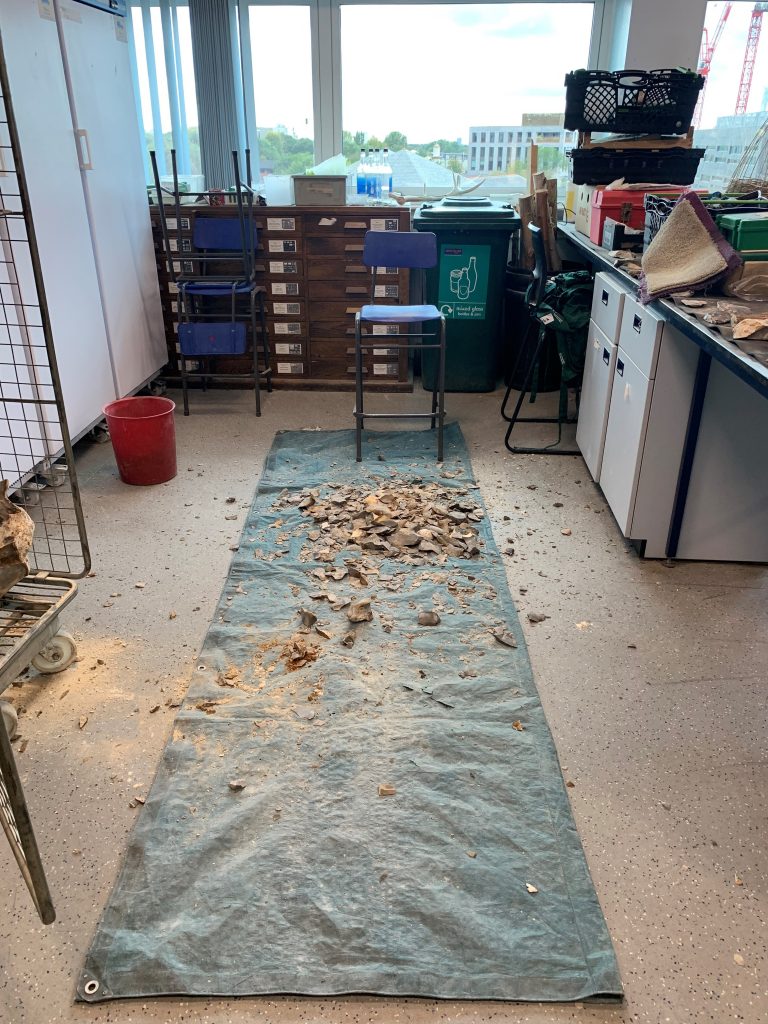
A second outcome was a spare flake left over and I turned it into this nicely shaped handaxe on Friday. Anyway, it has some interesting features. Mainly cortex on the dorsal surface, and some areas of original flake ventral on the other surface.
I was a little disappointed that I didn’t clear all the original ventral from the surface, however, from a teaching and learning perspective it illustrates dorsal and ventral really well. My relationship to this handaxe has changed since making it. I have shifted from aesthetically disappointed to pedagogically excited. It just took me a while to become fully acquainted!
This is a strange time of year for me. Relatively quiet diary wise and along the corridor, but work wise I have a lot to do within the couple of weeks before term starts.
This flexibility inevitably means I end up in the lab and doing what I am obsessed with at the moment, making handaxes. However, over the past two days things have not gone so well.
I have been trying to work the big chunks I have had lying round for a long time, but seem to be just destroying stuff, rather than being able to make anything. I think it is because I have so much going on in my head it is difficult for me to slow down and focus.
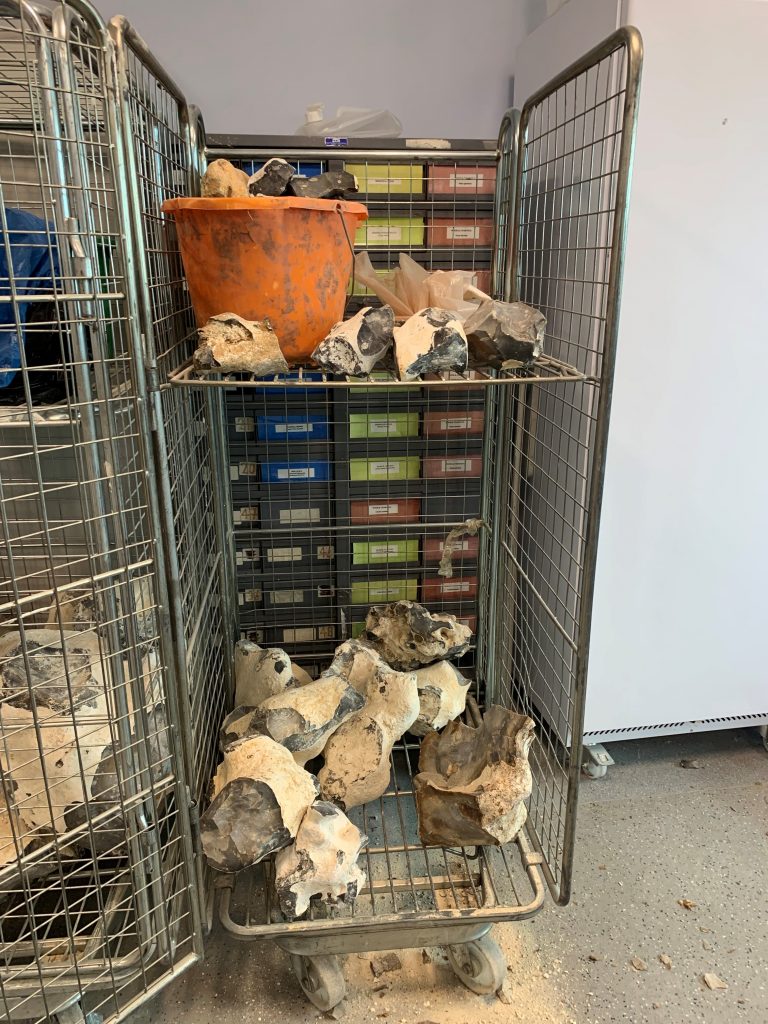
Anyway, I was pretty pleased with this handaxe preform. It was a large clean flake removal from the bottom right nodule in the cage. So far so good. The hard hammer shaping went well and I moved onto the soft hammer. The thing to note on the above photo is the dark brown inclusion at the bottom near my little finger. This material was a lot harder than the flint it was sat within.
This is a better view of the hard section. Soft hammer wise I do not have so much choice, they are all a pretty similar size, and I could have done with something heavier to take longer flakes from this particular flint, but I did not have that option, so I just had to hit it faster with the aim of increasing the kinetic energy and therefore impact. Above is an example of what I would class as a good platform, both low and isolated, or sticking out a bit. All the ingredients to produce a good clean removal.
However, I hit the platform of hard material, again and again with no result, until this happened. Increasing the impact at one end has split the handaxe preform in the middle. I know this as endshock, although I do not fully understand the phenomena, I just avoid hard hits at one end of a handaxe. With this example I was working with it on my leg, held down at the distal end and hitting hard the proximal. I wonder if my leg acted as a fulcrum and it gave way in the middle? Is this the same as endshock? I don’t know, but I am keeping this as a really interesting example of something or other.
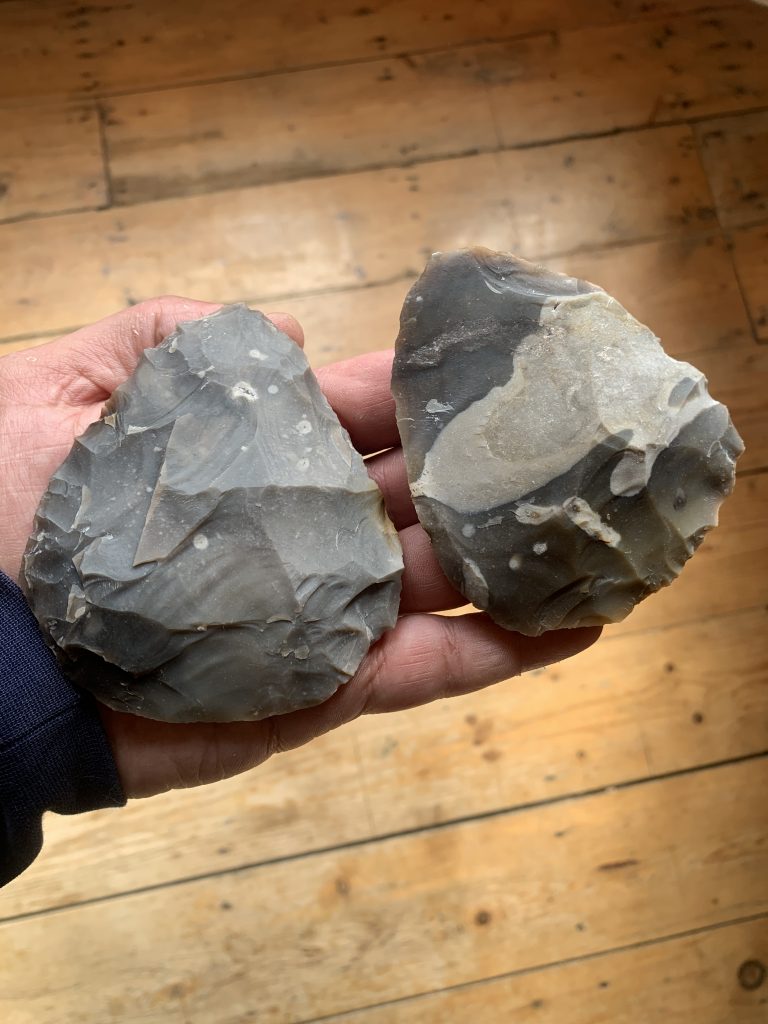
I have been making quite a few handaxes recently, but only just detected that I have a style. It occured to me when I saw these two next to each other and recognised how similar they are. Shape and size was an obvious similarity, and so these two can be recognised as the same ‘type’, and that would be cordate, or heart shaped.
However, it is the process, or ‘technology’ that is the real connector and this relates to how I get my initial flakes. We have very large and chalky nodules, as discussed here and these nodules need breaking down into flakes in order to make a handaxe. Flakes have a thick, bulbar ‘proximal’ end, and a thin and sharp ‘distal’ edge at the other. Intuitively, I seem to make my handaxes with a heavily thinned bulbar section on one side, and a minimally thinned distal edge on the other. This method has developed unconsciously, and I have only became aware of it with these two, and then looking at earlier examples.
In the above video you can first of all see the minimally worked ‘distal’ edge, then the more intensively worked bulbar section, and finally the ripples of percussion indicating this was originally the ventral face of the flake. I’m not sure why my body chooses to work the flakes in this way. I will have to make some more handaxes to find out!
I have become a bit obsessed with twisted cordate handaxes, and in particular, understanding the bodily process of making them. This is my third one, the other two were not ‘quite right’ and ended up being destroyed in the process of getting them ‘right’. This one is not exactly right but has survived. Perhaps it is because it is five o’clock on Friday afternoon I has given it a reprieve.
I need to have the archaeological example next to me whilst making to keep checking I have the twist right. I have read about the making method which was useful, but it is not a conceptual understanding I am after. My aim is for my body to get it, without need of a reference. Watch this space…
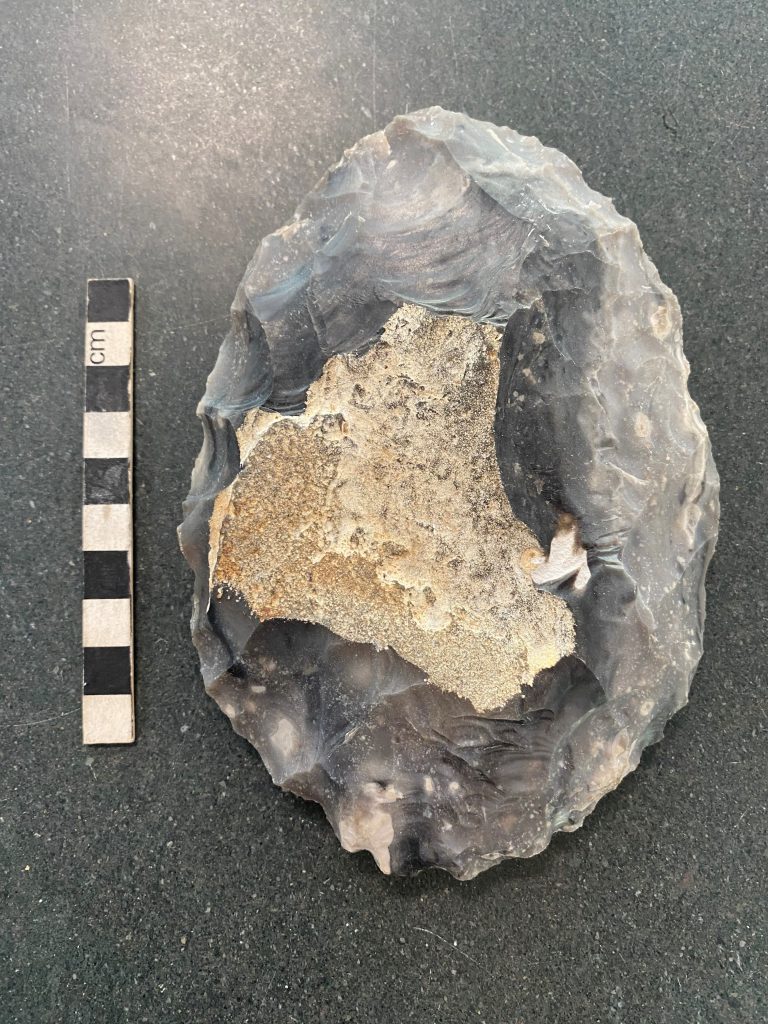
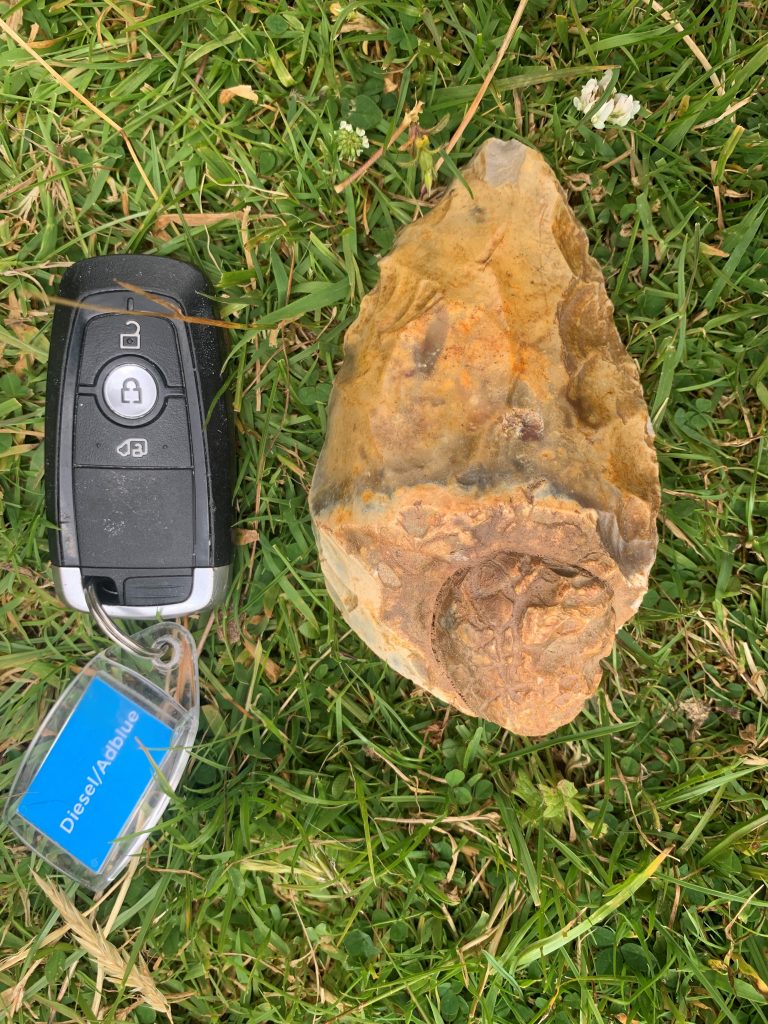
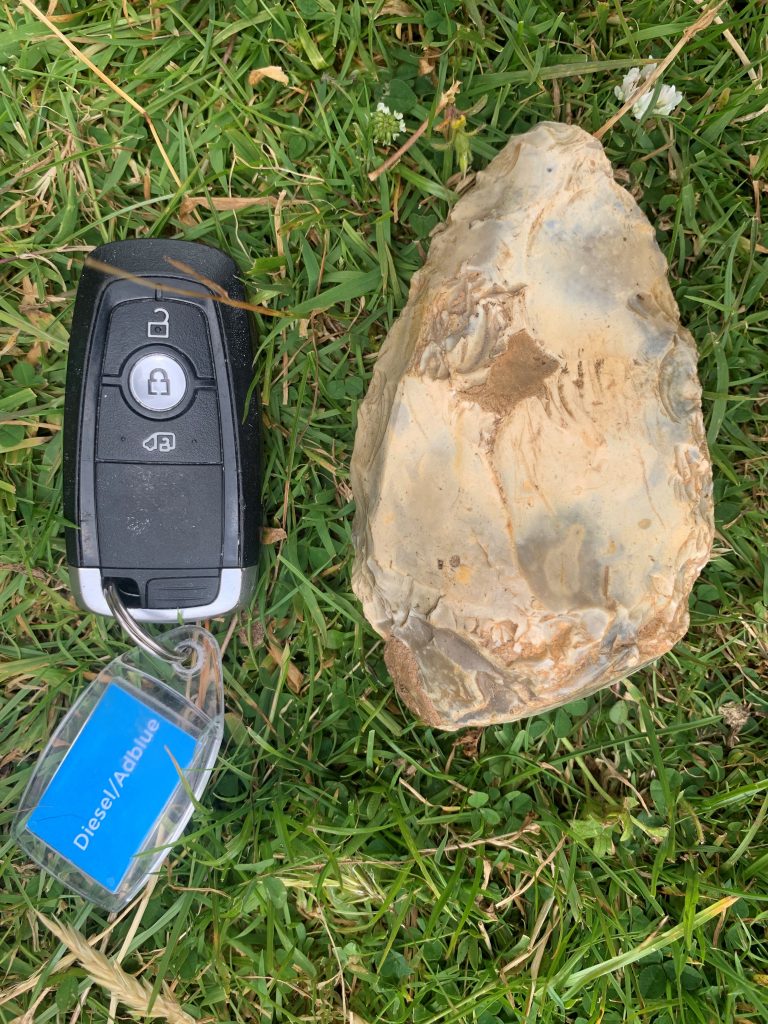
As discussed in the previous post Ian brought not one, but two of Mrs Anning’s handaxes to site for me to have a look at. This second handaxe is another amazing example, for both similar and different reasons to the first.
Dealing with ‘similar’ first, you can see from comparing these two photographs that the patina on each surface is different. It looks like the more orange face sat uppermost, whilst the more cream coloured face was face down and protected, for many millennia (my hypothesis).
Moving onto different reasons, the echinoderm in the room is the amazing fossil sitting at the top of the photograph below. I sent a picture of it to my Geology friend, Stephen Poole, and he got back to me with the term: echinoderm. A number of well known handaxes have fossil inclusions and this has led to debates about evidence for Palaeolithic aesthetics. The most recent paper I read (Flanders & Kay 2023) argues that with the famous West Tofts example, it was simply left in because it would have been difficult to remove. I have discussed similar in a previous post.
There is a potentially long and interesting discussion on Palaeolithic aesthetics, however I think we first need to speak to Mrs Anning!
Reference: Emily Flanders, Alastair Key, The West Tofts handaxe: A remarkably average, structurally flawed, utilitarian biface, Journal of Archaeological Science, Volume 160, 2023, 105888, ISSN 0305-4403, https://doi.org/10.1016/j.jas.2023.105888.